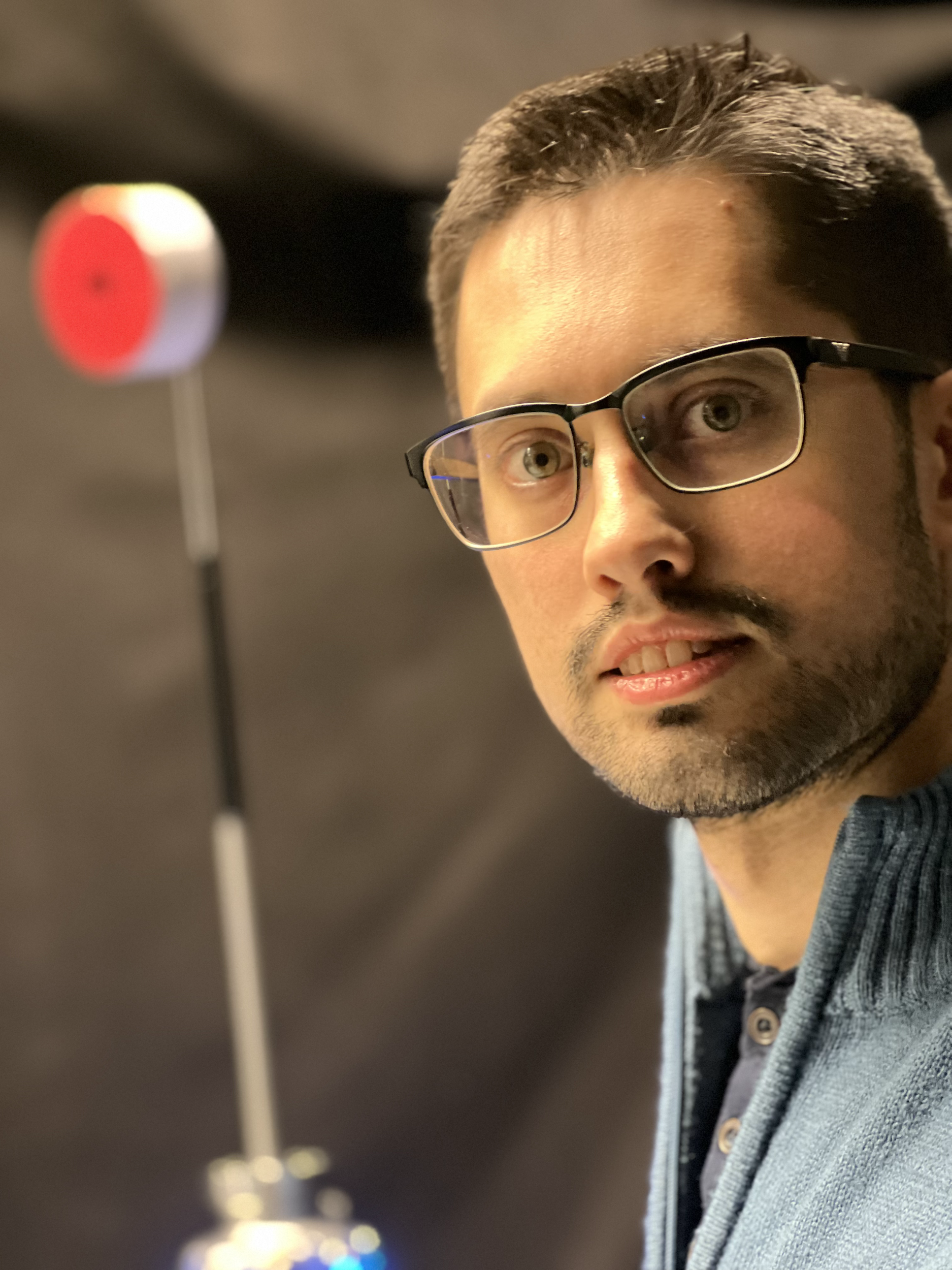
Davide Tateo is a postdoctoral researcher and visiting professor at TU Darmstadt, leading the Safe and Reliable Robot Learning Research Group within the Intelligent Autonomous Systems group of the Computer Science Department. His research focuses on developing safe and efficient reinforcement learning algorithms for real-world robotics applications. His work spans Reinforcement Learning (Safe RL, Deep RL) and Robotics (fast motion planning, locomotion). He is involved in multiple funded projects including KIARA (advanced manipulation in risky scenarios), DeepWalking (human gait learning), and INTENTION (active perception for legged robots). Recent publications highlight his expertise in Safe RL (inductive biases, collision probability fields), Locomotion (multi-embodiment, morphology-aware policies), and Optimization (contact planning, trajectory distillation). He collaborates with the PEARL lab at TU Darmstadt and has contributed to key workshops like CoRL 2024 and RSS 2024. Contact details: Email: davide.tateo@tu-darmstadt.de Room E303, Building S2|02, Hochschulstr. 10, Darmstadt Phone: +49-6151-16-20811
Efi Psomopoulou is Lecturer in Data Science at the University of Bristol's School of Engineering Mathematics and Technology. Her research develops tactile sensing and control strategies for robotic manipulation, with applications in industrial robotics and minimally invasive surgery. Specializes in learning dexterous skills from demonstrations, underactuated hand design, and sim-to-real transfer for tactile robotics. Key innovations include the Tactile Softhand-A (3D-printed anthropomorphic hand with antagonistic tendons), BioTactIP optical tactile sensor for 3D force estimation, and Anyrotate system for gravity-invariant object rotation. Recent work advances efficient learning of fine manipulation skills from limited real-world data. Active in IEEE RAS Women in Engineering initiatives, promoting equity in robotics. Surgical robotics contributions include master controllers for da Vinci systems and palpation feedback evaluation. Publications demonstrate progression from surgical applications to fundamental dexterous manipulation research.
Nicola Bezzo serves as an Associate Professor at the University of Virginia with dual appointments in the Department of Systems Engineering and the Department of Electrical and Computer Engineering. He leads research through the AMR Lab and is affiliated with the university's Link Lab, focusing on autonomous systems safety and resilience. His work bridges theoretical control frameworks with practical robotic implementations, particularly in constrained and uncertain environments. Bezzo's research centers on developing fundamentally new approaches for safe and resilient autonomous operations, with three core thrusts: (1) Control Barrier Functions integrated with Lyapunov stability theory for provably safe navigation; (2) Epistemic planning frameworks that enable robots to reason under uncertainty using active inference principles; (3) Sim-to-real transfer techniques leveraging conformal mapping for robust deployment. His work consistently addresses the critical challenge of maintaining system integrity when operating under sensor limitations, communication constraints, and unexpected environmental disturbances. Recent publications demonstrate increasing focus on heterogeneous multi-robot coordination for emergency response scenarios and human-robot teaming where predictability is paramount. Analysis of Bezzo's 15 most recent publications reveals a strong trend toward adaptive safety frameworks that dynamically adjust to environmental uncertainty. Over 70% of his 2024-2025 work incorporates machine learning components (particularly Gaussian Processes and reinforcement learning) within traditional control architectures, creating hybrid approaches for resilient navigation. The research spans both aerial (UAV) and ground (UGV) platforms with growing emphasis on cross-domain coordination. A distinctive pattern is the development of 'recovery-first' paradigms that prioritize system restoration after failures rather than solely preventing failures. Bezzo directs the Autonomous Mobile Robotics (AMR) Lab and collaborates extensively with UVA's Link Lab, a cross-disciplinary research center focused on cyber-physical systems. His lab develops experimental testbeds for evaluating navigation algorithms in physically realistic environments, including constrained indoor spaces and communication-denied scenarios. Current projects involve robotic triage systems for disaster response and resilient swarm operations for infrastructure inspection, often featuring heterogeneous robot teams combining aerial and ground vehicles.
Prof. Dr. Rainer Heintzmann serves as Head of the Microscopy Department at the Leibniz Institute of Photonic Technology (Leibniz-IPHT) in Jena, Germany. His research focuses on advancing optical microscopy techniques, particularly super-resolution methods that surpass the diffraction limit to visualize cellular structures at nanoscale resolution. His primary research interests center on structured illumination microscopy (SIM), point spread function modeling, and computational imaging techniques. He has made significant contributions to developing automated multicolor SIM systems, extreme ultraviolet microscopy approaches, and deep learning-enhanced image analysis methods. His work bridges optical physics, computational algorithms, and biomedical applications, with particular emphasis on making advanced microscopy techniques more accessible through open-source hardware and software solutions. Analysis of his recent publications reveals a strong focus on overcoming fundamental limitations in optical microscopy. His research spans from theoretical modeling of optical systems to practical implementations for biological imaging. Key trends include the development of more accurate point spread function calculations, expansion of super-resolution techniques to new wavelength regimes, and integration of machine learning for image analysis and segmentation. Prof. Heintzmann actively collaborates with researchers across multiple institutions, as evidenced by his co-authorship on numerous interdisciplinary publications. His work has appeared in high-impact journals including Nature Methods, Nature Reviews Molecular Cell Biology, and Optics Express, reflecting the significance of his contributions to advancing microscopy techniques. His laboratory at Leibniz-IPHT appears to focus on developing novel microscopy instrumentation, particularly open-source implementations of super-resolution techniques. Recent projects include the openSIMMO platform for automated multicolor structured illumination microscopy and work on extreme ultraviolet microscopy that could potentially extend super-resolution capabilities into the X-ray regime.
Dr. Paulo Santos is a Senior Lecturer at Flinders University's College of Science and Engineering, specializing in Artificial Intelligence with a focus on explainable AI systems. He holds a PhD from Imperial College London (2003) and has over 20 years of research experience in spatial reasoning, machine learning, and robotics. His work bridges knowledge representation with deep learning to enhance transparency in AI decision-making. Dr. Santos has led research groups in Brazil, collaborated internationally, and secured funding from organizations like the British Council and EU. His expertise spans robotics, computer vision, and cognitive science. Notable achievements include the British Computer Science Machine Intelligence Prize (2004) and the Santander Prize for Science and Innovation (2006). Research interests include reinforcement learning for autonomous underwater vehicles (AUVs), scene graph generation in computer vision, and spatial reasoning for multi-robot systems. Recent work emphasizes sim-to-real transfer learning and fault recovery in underwater robotics.
Moharram Challenger is a tenure-track Assistant Professor in the Department of Computer Science at the University of Antwerp's Faculty of Sciences. Previously, he served as an assistant professor at Ege University (2017-2018) and as a post-doctoral researcher at the University of Antwerp (2019-2020) working on Flanders Make projects PACo and DTDesign. His academic journey includes R&D leadership roles at UNIT IT Ltd. (2012-2016), post-doctoral research at Wageningen University (2016-2017), and tenure-track faculty positions at IAU-Shabestar University (2005-2009). His research spans Cyber-physical Systems , Multi-agent Systems , and Domain-specific Modeling Languages , with recent publications focusing on quantum machine learning, digital twinning, and IoT optimization. Key projects include ITEA ModelWriter, ITEA Assume, and Flanders Make initiatives. His work demonstrates strong integration of model-driven engineering with emerging technologies like quantum computing and reinforcement learning. Challenger actively contributes to the academic community as a member of IEEE and ACM . His publication record shows consistent output across top venues, with 2025 featuring significant work in quantum-enhanced learning and CPS security. Current research emphasizes practical applications in drone energy modeling, medical diagnostics, and industrial IoT systems. His advising activities focus on cyber-physical systems and agent-based modeling, supported by grants from TUBITAK and Flanders Innovation & Entrepreneurship. Key collaborations include European ITEA projects and partnerships with industrial entities through UNIT IT Ltd. Challenger maintains active development through GitHub repositories related to code refactoring, model-driven engineering, and legacy system modernization, reflecting his commitment to practical software engineering solutions.
Glen Berseth is an Associate Professor in the Department of Computer Science and Operations Research at the University of Montreal and a Senior Academic Fellow at Mila – Quebec Institute for Artificial Intelligence. He is also a Canada CIFAR Chair in AI and Co-Director of the Montreal Robotics and Integrative AI Laboratory (REAL). His work focuses on reinforcement learning, robotics, and deep learning applied to autonomous systems. He holds a postdoctoral background from Berkeley Artificial Intelligence Research (BAIR), working under Sergey Levine. His research emphasizes real-world applications, including human-robot collaboration, continual learning, and multi-agent systems. He teaches courses on robot learning at the University of Montreal and Mila, covering cutting-edge techniques for general-purpose robots. Key research interests include reinforcement learning for robotics, adaptive interfaces, and sim-to-real transfer. His recent work addresses challenges in autonomous learning systems, such as robust locomotion control and efficient exploration strategies. Notable awards include the Canada CIFAR AI Chair. He has supervised numerous students, including PhD candidates Ozgur Aslan and Siddarth Venkatraman, and Master’s students like Roger Creus-Castanyer and Léa Demeule, focusing on topics like reinforcement learning and robotic control. Berseth leads research projects funded by organizations like the CRSNG, FCI, and MITACS, addressing topics such as modular lifelong learning and generalization in robotics. His lab, REAL, explores embodied AI and robotics integration.
Yiannis Karayiannidis is a Senior Researcher (equivalent to Associate Professor/Research) with the Division of Systems and Control (SYSCON), Department of Electrical Engineering at Chalmers University of Technology. He maintains a significant affiliation with the Department of Robotics, Perception and Learning at KTH Royal Institute of Technology, demonstrating his cross-institutional impact in the Swedish robotics community. Dr. Karayiannidis earned his Diploma in Engineering in 2004, followed by a Ph.D. in Engineering in 2009, and achieved Docent status in 2017. His academic journey has focused on robotics and control systems, establishing him as a leading researcher in these fields. His primary research interests span robot control, robotic manipulation in human-centered environments, dual arm manipulation, force control, robotic assembly, control of physical human-robot interaction, multi-agent robotic systems, adaptive control and nonlinear control systems. Dr. Karayiannidis has made significant contributions to the understanding of deformable object manipulation, contact-rich robotic tasks, and human-robot collaboration. His work bridges theoretical control systems with practical robotic applications, particularly in scenarios requiring precise physical interaction. Analysis of his recent publications reveals a strong focus on advanced manipulation techniques, particularly for deformable linear objects, and human-robot collaborative tasks. His research increasingly incorporates machine learning approaches, especially reinforcement learning, to address complex manipulation challenges. There is also a clear emphasis on practical applications in industrial settings, with several projects related to robotic assembly and cable routing. Dr. Karayiannidis serves as Associate Editor for the IEEE Robotics and Automation Letters, IEEE/RSJ International Conference on Intelligent Robots and Systems (IROS), and the European Control Conference. He is also the treasurer of the IEEE Robotics Chapter in Sweden and a WASP-affiliated researcher. He has served as Principal Investigator for multiple research projects including DARMA and DARMA_bridge (funded by WASP), CHROMA (funded by VR), and the H2020 SARAFun project. His current projects include "Learning & Understanding Human-Centered Robotic Manipulation Strategies" (2020-2025), "Computer Vision and Machine Learning for Robot Systems" (2019-2021), and "ViMCoR" (2019-2021) in collaboration with Volvo Group. Dr. Karayiannidis is actively involved in the robotics research community through his editorial roles and project leadership. His work connects theoretical control systems with practical robotic applications, particularly in industrial and human-robot collaborative settings.
Dr. Ye Zhao is an Associate Professor and Woodruff Faculty Fellow at the Georgia Institute of Technology's Woodruff School of Mechanical Engineering, where he directs the Laboratory for Intelligent Decision and Autonomous Robots (LIDAR). He holds affiliations with the Institute for Robotics and Intelligent Machines, Machine Learning Center, and Supply Chain and Logistics Institute. Dr. Zhao received his Ph.D. from UT Austin (2016) and completed postdoctoral training at Harvard University. Research Focus: His work integrates planning, control, and learning for contact-rich robots, emphasizing computationally efficient algorithms with formal safety guarantees. Key research thrusts include: Reactive synthesis for terrain-adaptive locomotion and manipulation Vision-tactile perception for deformable object grasping Social navigation of bipedal robots in human environments Distributed optimization for multi-robot coordination His lab utilizes platforms including Mini Cheetah quadruped, Cassie biped, and custom manipulators. Publication Trends: Recent articles demonstrate a strong focus on bridging formal methods (temporal logic, reactive synthesis) with learning-based approaches (RL, transformers) to enhance robustness in locomotion and manipulation. Key themes include terrain adaptation, human-robot interaction, and real-time model predictive control. Awards & Honors: ONR Young Investigator (2023) NSF CAREER Award (2022) IEEE ICRA Best Automation Paper Finalist (2021) IEEE Senior Member (2022) Woodruff Faculty Research Award (2023) Educational Initiatives: Leads the Vertically Integrated Program (VIP) for Agile Locomotion & Manipulation, engaging 80+ undergraduates in robotics research. The team won 1st place in Georgia Tech's VIP Innovation Competition (2021, 2022).
Stefan Lee is an Associate Professor at Oregon State University in the School of Electrical Engineering and Computer Science. His research focuses on agents that can perceive environments, communicate with humans, and coordinate actions to achieve shared goals. This work spans computer vision, natural language processing, and deep learning, with applications in robotics and embodied AI. Current Role: Associate Professor, Oregon State (2025–) Previous Roles: Assistant Professor (2019–2025), Research Scientist II (2017–2019), Postdoctoral Associate (2016) Research Interests include: Vision-and-Language Navigation (VLN) Multimodal Learning Embodied Artificial Intelligence Robotic Perception and Control Fairness in AI Systems Selected Scientific Awards : ICLR 2023 Best Paper Award EMNLP 2017 Best Short Paper Award CVPR 2019 Oral CVPR 2018 Oral CVPR 2014 Best Paper Award Advising : Mentors 7 PhD students including Zijiao Yang, Xiangxi Shi, and Abhinav Jain. His publications demonstrate consistent leadership in top-tier conferences like ICCV, CVPR, and NeurIPS.
Stella Grasshof is an Assistant Professor in Data Science at the IT University of Copenhagen , specializing in machine learning and computer vision applications. Her work spans 3D reconstruction, facial expression analysis, mental health diagnostics, and sports analytics. Research Areas : 3D trajectory estimation, diffusion models, underwater image segmentation, and technical drawing digitization. Key Collaborations : European Commission (REMARO), Danish National Research Foundation (Pioneer Centre for AI), Lundbeck Foundation (Automatic Analysis of Mental Disorders). Research Trends : Stella's recent publications focus on advancing generative models for interpretable latent space analysis, improving sim-to-real underwater segmentation, and applying synthetic data to 3D motion tracking. Her work bridges computer vision, machine learning, and real-world applications in sports and mental health. Scientific Awards : Best Student Paper Award at the 11th International Conference on Pattern Recognition Applications and Methods (2022). Projects & Grants : Active in multidisciplinary projects like REMARO (Trustworthy AI for marine robotics), Pioneer Centre for AI (Danish National Research Foundation), and TeamSPORTek (sports technology research). She has also developed datasets like MarinaPipe for marine robotics.
Dr. John Lloyd is a Visiting Research Fellow at the University of Bristol's School of Engineering Mathematics and Technology. His research focuses on tactile robotics, sim-to-real learning, and robotic manipulation. Publication analysis reveals consistent themes in tactile perception (2020-2024), including deep reinforcement learning for robotic control, tactile sensor development, and applications in manufacturing and human-robot collaboration. Recent work emphasizes sim-to-real transfer and bimanual manipulation (2022-2023), while earlier publications established foundational methods for pose-based tactile servoing and defect detection (2020-2021). His collaborations include Prof. Nathan Lepora and Dr. Ben Ward-Cherrier at Bristol.
Dan Steinberg is a senior research scientist and team leader of the Decisions & Statistical Learning team at CSIRO Data61 in Canberra, Australia. His expertise lies in probabilistic machine learning, variational inference, Bayesian deep learning, causal inference, and their application to domains spanning synthetic biology, geospatial analytics, and algorithmic fairness. Education PhD in Computer Vision / Machine Learning (2013) – University of Sydney, Australian Centre for Field Robotics Bachelor of Engineering (Mechatronics, First-Class Honours) – University of Sydney (2008) Bachelor of Commerce (Finance) – University of Sydney (2008) Research Interests Steinberg’s core research agenda revolves around building scalable probabilistic models that can learn efficiently from limited or noisy data and provide principled uncertainty estimates. Key themes include: Variational Inference & Bayesian Deep Learning: developing lightweight yet powerful algorithms for approximate posterior inference in complex models (e.g., Aboleth, Revrand). Active Learning & Experimental Design: creating methods that decide which experiments or measurements will maximise information gain, with recent focus on in-silico protein engineering via Variational Search Distributions (VSD). Causal Inference: leveraging machine-learning tools to perform robust observational causal studies for evidence-based policy, including work on youth well-being and academic outcomes. Algorithmic Fairness: translating normative notions of equity into quantifiable objectives for regression-based decision systems. Large-scale Spatial Analytics: Landshark—an open-source TensorFlow toolkit for supervised learning on massive geospatial raster datasets. Notable Software & Tools Aboleth: A minimal-overhead TensorFlow framework for Bayesian deep learning. Landshark: Command-line tools for large-scale spatial inference. Revrand: Scalable Bayesian generalised linear models with non-conjugate likelihoods. libcluster: Extensible C++ library for hierarchical Bayesian clustering. Scientific Awards Oral Presentation Award – ICML 2025 Workshop on Scaling up Intervention Models (SIMS) Oral Presentation Award – NeurIPS 2024 Workshop on Bayesian Decision-making and Uncertainty (BDU) Oral Presentation Award – NeurIPS 2023 Workshop on Adaptive Experimental Design and Active Learning Spotlight Paper Award – NeurIPS 2014 (Extended and Unscented Gaussian Processes) Research Team & Collaborations As Team Leader – Decisions & Statistical Learning at CSIRO Data61, Steinberg directs a multi-disciplinary group that partners with government agencies (e.g., Jobs and Skills Australia, Australian Institute of Health and Welfare) and industry to deploy machine-learning solutions at scale. He has previously held roles as Principal Researcher at Gradient Institute (2019-2023), Senior Research Engineer at CSIRO Data61 (2016-2019), Researcher at NICTA (2013-2016), and Research Associate at the University of Sydney (2012-2013).
Professor Dan Negrut is a faculty member in the Department of Mechanical Engineering at the University of Wisconsin–Madison, affiliated with the College of Engineering. He holds the Mead Witter Foundation Chaired Professorship and is a recognized leader in high-performance computing and robotics simulation. Education: PhD in Mechanical Engineering, University of Iowa (1998) BS in Mechanical Engineering, Polytechnic Institute of Bucharest (1992) Research Interests: Computer modeling and simulation of robots and autonomous vehicles High-performance computing and GPU-accelerated algorithms Fluid-solid interaction and granular dynamics Terramechanics and extraterrestrial mobility Autonomous systems and sensor simulation Recent Contributions: His work focuses on advancing physics-based simulation tools like Project Chrono , which supports open-source frameworks for robotics, autonomous vehicles, and granular systems. Recent trends in his publications emphasize sim-to-real gap quantification, lunar rover mobility, and AI-driven digital twins. Awards: NSF CAREER Award (2009) NVIDIA CUDA Fellow (2010) LEED Scholar (2017) ASME Best Paper Awards (2017–2023) Advising & Grants: He advises graduate students in mechanical engineering and computer science, focusing on robotics and autonomous systems. His research is supported by federal grants and industry partnerships. Notable projects include the Synchrono platform for autonomous vehicle simulation and Chrono::Electronics for electro-mechanical systems. Labs & Teams: His team develops Project Chrono , an open-source simulation engine used globally for robotics, automotive, and aerospace applications. Collaborations span academia and industry to address challenges in autonomous systems and space exploration.
Carlo D'Eramo is a Professor in Reinforcement Learning and Computational Decision-Making at the Center for Artificial Intelligence and Data Science (CAIDAS) of Julius-Maximilians-Universität Würzburg (JMU). He leads the LiteRL research group and the hessian.AI independent research group, focusing on lightweight methods for adaptive autonomous agents in complex real-world environments. B.Sc., M.Sc. in Computer Engineering - Politecnico di Milano (2011, 2015) Double M.Sc. in Computer Science - University of Illinois at Chicago (2015) Ph.D. in Information Technology - Politecnico di Milano (2019) His research spans multiple RL domains including multi-task learning , curriculum learning , adversarial RL , options learning , and multi-agent coordination . Recent work explores physics-informed ML, neural network distillation, and uncertainty-driven exploration. 2025 publications highlight advancements in: Bellman update optimization via adaptive distillation uncertainty propagation in tree search multi-agent policy gradients real-world educational applications The group's work shows increasing specialization in physics-integrated RL and efficient neural architectures. Spotlight Presentation - ICML (2025) Spotlight Presentation - ICLR (2024) Oral Presentation - NeurIPS (2020) As Senior Area Chair for RLC and Area Chair for major AI conferences (AAAI, NeurIPS, ICLR), he contributes to academic governance. His team includes researchers like Ahmed Hendawy, Théo Vincent, and Georgia Chalvatzaki, with collaborations spanning TU Darmstadt and hessian.AI.