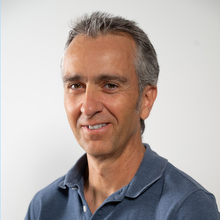
Laurent Sauvage is a Lecturer at Télécom Paris and a member of the Secure and Safe Hardware (SSH) research team within the Information Processing and Communication Laboratory (LTCI) and Communications and Electronics (Comelec) department. His work focuses on hardware security, fault injection attacks, and side-channel analysis in cryptographic systems. Research Interests: Hardware security, fault injection attacks, side-channel analysis, and embedded systems. Laboratory: LTCI (Information Processing and Communication Laboratory), Télécom Paris. Publications: Recent works include advancements in masked implementations, EM fault injection models, and countermeasures against cryptographic vulnerabilities.
Andrej Bogdanov is a Professor in the Department of Computer Science at the Weizmann Institute of Science's Faculty of Mathematics and Computer Science. With a prolific publication record spanning over two decades from 2002 to 2025, he has established himself as a leading researcher in theoretical computer science and cryptography. His research interests span multiple areas of theoretical computer science, with a particular focus on cryptography, computational complexity, pseudorandomness, and secret sharing. His work often bridges theoretical foundations with practical cryptographic applications, exploring the mathematical underpinnings of secure computation and cryptographic primitives. His research has evolved to address contemporary challenges in quantum computing security and machine learning evaluation. Bogdanov's publication record shows consistent contributions to top-tier conferences including FOCS, STOC, CRYPTO, TCC, and ITCS. His work demonstrates deep theoretical insights while maintaining relevance to practical cryptographic applications. Recent publications indicate expanding interests into quantum computing security and machine learning evaluation frameworks. Bogdanov has collaborated extensively with leading researchers in theoretical computer science, most notably with Alon Rosen (31 joint publications), as well as Siyao Guo, Yuval Ishai, and Chin Ho Lee. His collaborative work spans multiple institutions and reflects the interdisciplinary nature of modern theoretical computer science research. His academic contributions include foundational work on pseudorandom generators, secret sharing schemes, hardness amplification, and more recently, contributions to post-quantum cryptography and quantum security. His research has been supported by multiple grants that have enabled his team to explore the theoretical boundaries of cryptographic security.
Ágnes Kiss is a Researcher at the Department of Computer Science, Technical University of Darmstadt, Germany. She earned her PhD in 2021 with a thesis titled Efficient Private Function Evaluation . Her research focuses on cryptographic protocols, privacy-preserving technologies, and secure computation, with applications in distributed systems and real-world security challenges. Her work spans topics such as private function evaluation (PFE), universal circuit design, and privacy-preserving location proximity schemes. She has contributed to advancing secure computation efficiency and resistance against side-channel attacks. Her publications appear in top venues like Journal of Cryptology , EUROCRYPT , and USENIX Security Symposium . Key areas of interest include cryptography, algorithmic countermeasures, and the practical implementation of secure protocols. Her recent work addresses security risks in scripting languages and explores trustworthy AI inference systems, reflecting her commitment to both theoretical and applied cryptography.
Atul Mantri is an Assistant Professor in the Department of Computer Science at Virginia Tech's College of Engineering. His research focuses on secure delegated quantum computing, quantum internet protocols, and cryptographic systems resilient to quantum attacks. He holds a Ph.D. from the National University of Singapore (NUS) and Singapore University of Technology and Design (SUTD), and a B.S./M.S. in Physics from the Indian Institute of Science Education and Research (IISER) Mohali. His work spans theoretical and applied quantum computing, including quantum security analysis, lattice-based quantum advantage, and protocols for verifiable blind quantum computing using trapped ions and photons. He has contributed to foundational research on the quantum internet's architecture and its societal implications, alongside developing resource-efficient verification frameworks leveraging statistical bounds like Serfling’s theorem. Recent publications highlight advances in quantum internet design, delegated computation security, and lattice-based algorithms. His research bridges quantum theory with real-world applications, emphasizing practical implementation challenges and scalable solutions. No scientific awards or grants are explicitly mentioned in the provided materials. Advising roles and student collaborations are not detailed here. His work primarily centers on theoretical and experimental advancements in quantum information science.
Riad Wahby is an Assistant Professor in the Electrical and Computer Engineering department at Carnegie Mellon University's College of Engineering, with affiliations in the Computer Science Department. His research focuses on theoretical computer science with applications in cryptography and security systems. Primary research areas include: Zero-knowledge proof systems and SNARKs Secure multiparty computation Cryptographic protocol design Formal verification methods His publications demonstrate consistent innovation in cryptographic compilers, constraint systems for SNARKs, and practical applications of zero-knowledge proofs. Recent work highlights include advancements in finite-field verification, decentralized auction systems, and side-channel attack analysis. Current advising includes graduate students Quang Dao and Kunming Jiang. Teaching includes courses in computer systems and cryptography (15-330).
Shih-Chun You is a Researcher at the Department of Computer Science and Technology, University of Cambridge. Their research focuses on cryptographic hardware security, particularly side-channel attacks and vulnerability analysis in cryptographic implementations. They specialize in template attacks targeting permutation-based ciphers like ASCON, Keccak, and SHA-3, with a focus on embedded systems and 32/8-bit devices. Research interests include hardware security, cryptographic algorithm implementations, and improving resistance against physical attacks. Their work bridges theoretical cryptography and practical embedded device security. Publications emphasize novel attack methodologies and their implications on cryptographic system design. No awards are explicitly mentioned in the provided texts.
Prof. Jan Pelzl is a Professor of Computer Security at Hamm-Lippstadt University of Applied Sciences. His research focuses on cryptography, cyber security, and embedded security, with a strong emphasis on post-quantum cryptography and industrial security solutions. He leads projects addressing long-term data protection under regulations like the NIS2 Directive and explores practical implementations for critical infrastructure. Key research areas include cryptographic algorithms (ECC, RSA, hash functions), key management systems, and security engineering for embedded systems. Collaborations with industry partners such as Robert Bosch GmbH and TÜV Rheinland Akademie highlight his work on industrial security and safety standards. His publications span over two decades, with recent focus on post-quantum cryptography applications, cryptographic protocols, and embedded security architectures. Pelzl’s contributions address both theoretical advancements and real-world implementations, particularly in automotive and IoT security contexts.
Dr. Ilias S. Kotsireas is a Professor in the Department of Computer Science and Physics at Wilfrid Laurier University (WLU), Canada. He serves as Director of the CARGO (Computer Algebra Research Group) lab and Editor-in-Chief of the Journal of Algebraic Combinatorics . His research focuses on computational mathematics, combinatorics, optimization algorithms, and symbolic computation. Kotsireas is a Fellow of the Institute of Combinatorics and its Applications (ICA, 2004) and has held leadership roles in organizations like ACM SIGSAM and the ACA Working Group. He maintains adjunct appointments at the Athena Research Center (Greece) and the University of Waterloo, and is a Principal Scientist at ORCCA (Ontario Research Centre for Computer Algebra). His work integrates computer algebra systems with SAT solvers to address complex combinatorial problems, such as Hadamard matrices and Golay pairs. Recent research explores neurosymbolic frameworks, blockchain economics, and machine learning applications in algebraic geometry. Education: Advanced degrees in Mathematics/Computer Science (not explicitly listed, inferred from roles). Research Interests: Computer algebra systems, combinatorial search, algorithm portfolios, cryptographic protocols, and computational neuroscience applications. His contributions span theoretical advancements (e.g., Legendre pair algorithms) and practical tools (e.g., Maple-based software). Kotsireas collaborates internationally, organizing conferences like ACA and publishing in venues such as Journal of Symbolic Computation and SpringerPlus . His lab, CARGO, emphasizes supercomputing and interdisciplinary projects. Awards: Fellow of the Institute of Combinatorics and its Applications (ICA), 2004 Labs & Teams: Leads the CARGO lab and affiliated with ORCCA, focusing on computational algebra and high-performance computing.
Dr. Jia Jia is a Lecturer in International Business and Strategy at Plymouth Business School (Faculty of Arts, Humanities and Business), University of Plymouth. Her research focuses on cybersecurity, cryptography, blockchain technology, and federated learning. She has held previous academic roles at UCL School of Management and Royal Holloway University of London. Her work bridges business strategy with technological advancements, particularly in secure digital systems and AI-driven cybersecurity solutions. Teaching Responsibilities include courses such as International Business Strategy, Asia-Pacific Business Management, and Capstone/Honours Project supervision. She actively contributes to research in e-voting security, identity-based identification systems, and distributed PKI frameworks. Recent publications address challenges in Byzantine-robust federated learning, blockchain-based e-auctions, and post-quantum cryptographic systems. Research interests span interdisciplinary areas including: Cybersecurity in pervasive computing environments Blockchain and smart contract applications Secure data transfer protocols in cloud computing Adaptive adversary resistance in distributed systems Her articles highlight contributions to e-voting security, federated learning resilience, and AI-driven hazard simulation for driver education. Current doctoral supervision includes Tonari Arikekpar’s work on Nigerian international students’ experiences. No academic awards are listed.
Olivier Markowitch is a Professor at the Computer Sciences Department of the Faculty of Sciences at Université Libre de Bruxelles (Free University of Brussels). He currently serves as Dean of the Faculty of Sciences and is the university's information security advisor. Previously, he was Head of the Computer Sciences Department and co-president of the university's ethics committee. He co-founded the inter-university Master in Cybersecurity program and co-organized the Cybersecurity Research Center at ULB. His research focuses on: Design and analysis of cryptographic protocols Communication protocol security Side-channel attack methodologies Blockchain applications Hardware security (Network-on-Chip) Secure computation outsourcing Analysis of his 100+ publications reveals consistent focus on applied cryptography, with recent work emphasizing blockchain-based auction systems, hardware security for multi-core architectures, lightweight encryption for IoT devices, and theoretical advances in cryptographic protocols. His publications frequently address both theoretical foundations and practical implementations. Markowitch has supervised doctoral candidates in areas including lattice-based cryptography and secure Network-on-Chip protocols. He leads institutional cybersecurity initiatives and teaches courses in algorithms, cryptography, and computer security.
Florian Tramèr is an Assistant Professor of Computer Science at ETH Zurich, leading the SPY Lab. His research focuses on computer security, privacy, and adversarial machine learning, particularly studying vulnerabilities in deep learning systems. He holds a PhD from Stanford University and previously worked at Google Brain. Education: Bachelor's and Master's from EPFL (Switzerland), PhD from Stanford University. Research Interests: Adversarial machine learning, privacy-preserving technologies, cryptography, and evaluating AI safety through frameworks like AgentDojo. His work addresses societal impacts of rapidly deployed machine learning systems. Awards: Two Best Paper Awards at ICML 2024, CAIS SafeBench competition win, Google/Amazon Research Awards. His research has been featured in Nature , Science , and The Economist . Labs/Teams: SPY Lab (ETH Zurich), part of the Information Security Institute and ZISC. Associated with ETHZ AI Center. Advises PhD students on AI safety and security topics.
Pierre-Alain Fouque is Professor of Computer Science at University of Rennes 1 and Institut Universitaire de France, specializing in cryptographic security and cryptanalysis. His research spans post-quantum algorithms, symmetric cryptosystem vulnerabilities, and practical side-channel attacks. Key research areas: Lattice reduction algorithms Blockchain-based supply chain security White-box cryptography implementations Automated cryptanalysis tools Current projects include ANR SafeTLS improving TLS protocol security and Brutus project analyzing authenticated ciphers. Supervises doctoral candidates working on lattice-based signature schemes, side-channel resistant implementations, and cryptographic reverse-engineering. Extensive program committee service includes CRYPTO, Eurocrypt, CCS, and CHES conferences. Research contributions include Falcon lattice-based signatures and key recovery attacks on multivariate schemes.
Aleksei Udovenko is a post-doctoral researcher at the Laboratory of Algorithmics, Cryptology and Security (LACS) within the Security and Trust (SnT) interdisciplinary center and the Department of Computer Science (CSC) at the University of Luxembourg. His research focuses on symmetric cryptography, cryptanalysis techniques, and white-box cryptography, with notable contributions to projects like Equihash (a memory-hard proof-of-work scheme used in cryptocurrencies) and the SPARX family of lightweight block ciphers. Education: PhD in Cryptology under Prof. Alex Biryukov (2019), MSc from ITMO University (2013). Research Interests: Symmetric-key algorithms, cryptanalysis methodologies, white-box cryptography, blockchain technologies, and lightweight cryptographic primitives. He actively participates in information security competitions (CTFs) and collaborates on projects related to cryptocurrency protocols and hardware-software security. Recent Work: Authored/co-authored papers on cryptanalysis of ARX-based ciphers, LPN attacks in white-box settings, and secure obfuscation techniques. Notable publications include work on Equihash (NDSS 2016), SPARX (ASIACRYPT 2016), and advancements in meet-in-the-filter cryptanalysis techniques (SAC 2022, CHES 2023). Professional Affiliations: Member of the CryptoLUX research group, contributing to interdisciplinary projects at the University of Luxembourg. Involved in conferences such as CRYPTO, CHES, and FSE.
Ileana Buhan is an Assistant Professor at Radboud University Nijmegen's Digital Security Group and a member of the CESCA Lab. Her research focuses on hardware security, particularly advancing tools for secure hardware design and mitigating side-channel vulnerabilities. She previously held roles at Riscure (2011–2020) as a security evaluation manager and product manager, and at Philips Research (2008–2010) as a senior scientist. She earned her Ph.D. in Cryptography with Noisy Data from the University of Twente in 2008, recognized with the 2008 EBF European Biometrics Research Industry Award. Her work emphasizes practical security evaluation methods, automated leakage modeling (e.g., ABBY tool), and hardware-software co-design for resistance against side-channel attacks. She actively contributes to conferences like CHES, FDTC, and CARDIS, often in program committee roles. Recent invited talks include topics such as AI-driven vulnerability prediction, architecture-level simulators for root cause analysis, and automated tools for cryptographic implementation security. Her research spans RISC-V processors, microarchitecture analysis, and the intersection of machine learning with hardware security. Notable contributions include frameworks for leakage detection, fault simulation, and explainable side-channel analysis. She balances academic rigor with industry relevance, aiming to bridge gaps between theoretical security and real-world implementation challenges.
Riccardo Focardi is a Full Professor at Ca' Foscari University of Venice in the Department of Environmental Sciences, Computer Science and Statistics. He has held this position since September 2017, following roles as Associate Professor (2013–2017) and Researcher (1996–2002). He is also co-founder and Chief Scientist of Cryptosense and 10Sec, startups focused on cybersecurity and IoT security solutions. Education: PhD in Computer Science from the University of Bologna (1999), Laurea cum laude in Computer Science (1993). Research focuses on cybersecurity, cryptography, formal methods for security protocol analysis, and secure hardware/software systems. Notable projects include the Cryptosense Analyzer tool for cryptographic device analysis and contributions to IoT security via 10Sec's fingerprinting technologies. His work on PKCS#11 vulnerabilities and padding oracle attacks has significantly impacted practical cryptographic security. Publications emphasize applied cryptography, API security, and IoT systems. Recent work explores GAN-based authentication (EUAS-GAN) and zero-shot malware detection (Z-MDZS). Over 110 publications span top venues like CRYPTO, CCS, and IEEE S&P. Leadership roles include coordinating national cybersecurity projects (e.g., POR FESR 2017–2020), chairing conferences (ITASEC 2017, CSF 2007), and directing Ca' Foscari's Computer Science PhD program (2012–2019). Active in public engagement, including media appearances on cybersecurity trends. Labs/Teams: Cryptosense (founded 2013), 10Sec (2020), and the DAIS department's security research group. Supervised over 10 PhD students, contributing to academic-industry collaborations in secure systems.