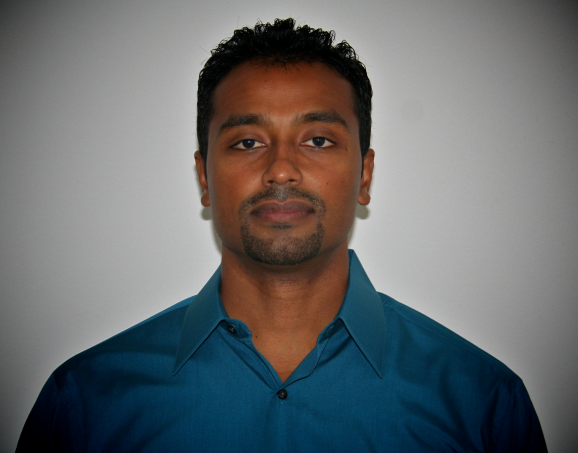
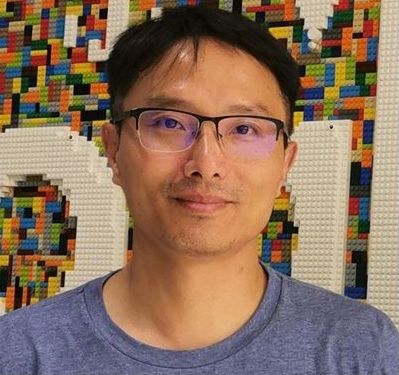
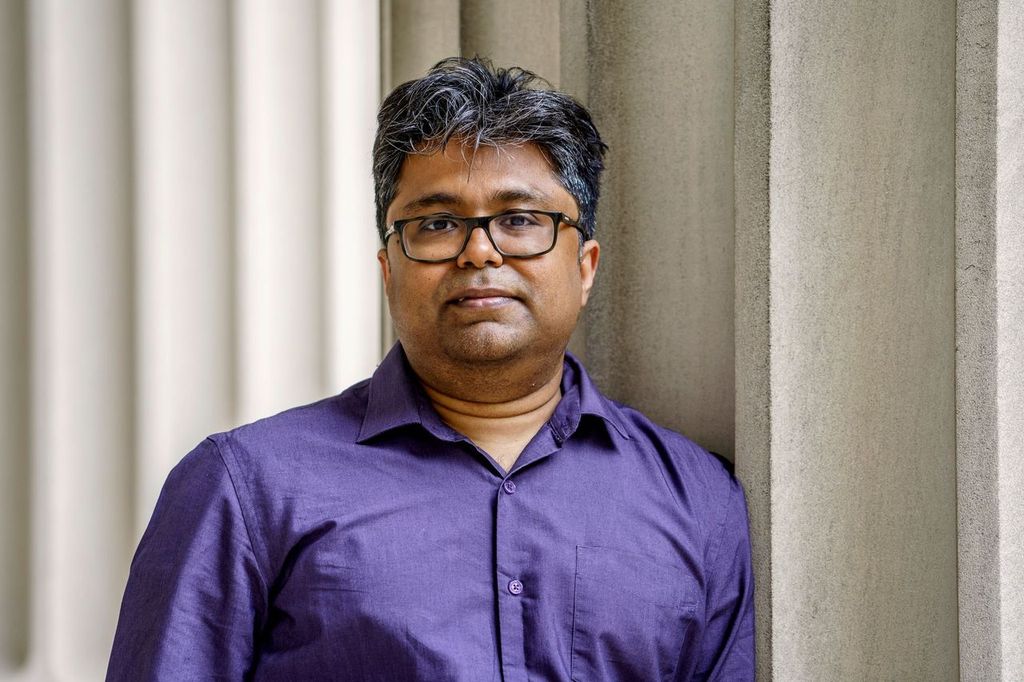
Dr. Christian Rohrbeck is a Senior Lecturer in the Department of Mathematical Sciences at the University of Bath. He holds a PhD in Statistics and Operational Research from Lancaster University and leads projects in statistical climatology through the EPSRC Centre for Doctoral Training in Statistical Applied Mathematics and Centre for Climate Adaptation & Environment Research. His research combines extreme value theory, spatial statistics, and Bayesian methods to analyze environmental and financial data. Current projects focus on flood risk modeling, climate extremes standardization, and monotonic regression techniques. Dr. Rohrbeck accepts doctoral students in extreme value analysis, flood risk, and climate adaptation statistics.
Bodhisattva Sen is a Professor of Statistics at Columbia University, New York. His research focuses on nonparametric statistics, large sample theory, optimal transportation, and statistical applications in astronomy. He completed his Ph.D. in Statistics at the University of Michigan (2008) and holds degrees from the Indian Statistical Institute, Kolkata (B.Stat., M.Stat.). His work spans shape-constrained estimation, bootstrap inference, and interdisciplinary projects in astronomy. Sen’s research emphasizes distribution-free testing, high-dimensional models, and computational methods. Education: Ph.D. in Statistics, University of Michigan, Ann Arbor (2008) M.Stat., Indian Statistical Institute, Kolkata B.Stat., Indian Statistical Institute, Kolkata Research Interests: Nonparametric function estimation Optimal transport applications in statistics Empirical Bayes and multiple testing High-dimensional statistical inference Statistical methods in astronomy Key Contributions: Developed multivariate distribution-free tests using optimal transport Advanced convex regression methods in multidimensions Contributed to nonparametric maximum likelihood estimation in mixture models Explored statistical applications in stellar abundance clustering His work bridges theoretical statistics with practical applications, emphasizing robust and computationally efficient methods. Sen has also contributed to methodological advancements in astronomy through statistical modeling of stellar data.
Edoardo Mainini is an Associate Professor at the University of Genova, specializing in mathematical analysis and applied mathematics. His research focuses on calculus of variations, partial differential equations, elasticity theory, optimal transport, and nonlinear dynamics. He has contributed to studies on fractional equations, material science, and stochastic processes. His work often bridges pure and applied mathematics, addressing problems in mechanics, probability, and geometric analysis. Mainini has collaborated extensively with researchers such as M. Kružík, D. Percivale, and U. Stefanelli, producing influential papers in journals like Calc. Var. Partial Differential Equations and Arch. Ration. Mech. Anal. . His recent articles (2020–2025) address topics ranging from fractional linear equations to Bayesian nonparametric models. Education includes a PhD in Mathematical Analysis from the University of Genova (2010) and a thesis on Infinite-dimensional porous media equations and optimal transportation . He has organized international conferences and seminars on variational methods and geometric structures. His research emphasizes rigorous mathematical frameworks for physical phenomena, including the linearization of elasticity models and the study of ground states in diffusion-dominated systems. Mainini’s contributions to carbon nanotube geometries and optimal transport theory have been recognized through invited talks at major events, such as the International School of Mathematics “Guido Stampacchia” . His work often explores the interplay between discrete and continuous models, with applications to materials science and geometric optimization.
Peter Adrian is an Associate Professor in the Department of Mathematics and Systems Engineering at Florida Institute of Technology's College of Engineering and Science. He also serves as Affiliate Faculty in the Department of Electrical Engineering and Computer Science. His research focuses on machine learning applications in signal processing, computer vision, and statistical analysis. He leads projects in environmental sound classification, seismic event discrimination, and structural health monitoring, often leveraging edge computing and deep learning frameworks. Adrian's work bridges theoretical advancements with practical systems engineering, such as developing acoustic situational awareness tools (e.g., ACE plugin) and rail infrastructure monitoring systems. Key contributions include physically-augmented deep learning models for seismic analysis and multimodal datasets for firearm acoustics research. His publications span over 5 decades, addressing challenges in sensor networks, geospatial modeling, and shape analysis using information geometry principles. While no formal awards are listed, his prolific output demonstrates sustained academic engagement. Adrian’s research website provides further details on ongoing projects, though currently inaccessible. His interdisciplinary approach integrates mathematics, computer science, and engineering to solve real-world problems in transportation safety, environmental monitoring, and astrophysics.
Prof. Dr. Melanie Birke is a faculty member at the University of Bayreuth , holding the Professorship for Mathematical Statistics within the Faculty of Mathematics, Physics and Computer Science . Her research spans multiple areas of statistics, including nonparametric methods, functional data analysis, inverse problems, goodness-of-fit tests, and random matrices. Women's Representative of the Mathematical Institute DAV Correspondent for actuarial training exemptions Research Interests are focused on nonparametric statistics, functional data, and inverse problems. She develops asymptotic theory for estimation and testing procedures, particularly in high-dimensional or infinite-dimensional spaces, with applications to real-world issues like image distortion and data collection errors. Her work also includes constructing goodness-of-fit tests for regression models and functional data, ensuring robust statistical analysis. Publications highlight her contributions to quantile regression, symmetry testing in inverse problems, and shape-constrained density estimation. A recurring theme involves improving statistical consistency by addressing model misspecification through advanced nonparametric techniques. Statistical Consulting is offered to both internal and external stakeholders, emphasizing methodological guidance during experimental design to prevent data inconsistencies. She also supervises Bachelor's and Master's theses in nonparametric statistics and financial mathematics.
Charles R Doss is an Associate Professor in the Department of Statistics at the University of Minnesota, Twin Cities, within the College of Science and Engineering. His research is centered on nonparametric inference, shape-constrained estimation, and continuous treatment effects, with applications in public health and precision medicine. He has led multiple funded research projects from the National Science Foundation and the Department of Health. Research Interests: Dr. Doss specializes in nonparametric methods, particularly under shape constraints such as convexity and monotonicity. His work includes developing theory and methodology for optimal treatment regimes, continuous treatment effects, and robust inference. Applications span public health, including wastewater surveillance for pathogens like SARS-CoV-2, and statistical learning in high-dimensional settings. The recent publications show a strong trend in causal inference, robust statistical methods, and interdisciplinary applications, particularly in public health and machine learning. His work often involves theoretical development with practical implementation, as seen in projects on wastewater surveillance and multivariate regression models. Scientific Awards: No specific awards listed in the provided text. Advising and Grants: Dr. Doss has been the Principal Investigator on three National Science Foundation grants and a Co-Investigator on a Department of Health project related to wastewater surveillance. His funding history from 2017 to 2026 reflects sustained support for methodological and applied statistical research. While no students are listed, his role as PI suggests active mentorship and research leadership. Labs and Teams: He collaborates with interdisciplinary teams, including public health officials and researchers in virology and environmental science, particularly through the wastewater surveillance project. His network includes researchers from various institutions and disciplines, indicating a collaborative research environment.
Florian Gunsilius is an Associate Professor in the Department of Economics at Emory University. His research focuses on nonparametric econometric methods, optimal transport theory, and causal inference. He earned a PhD in Economics from Brown University (2019), an MA in Economics (2014), and a BSc/MPE in Economics from the Frankfurt School of Finance and Management (2012). His work bridges theoretical econometrics and applied policy analysis, particularly in areas requiring innovative statistical techniques. Dr. Gunsilius's research interests include statistical identification, estimation of causal effects, and applications of optimal transport to economics. He has developed methods for analyzing treatment effects, demand systems, and policy impacts using advanced mathematical frameworks like free discontinuity regression and Wasserstein projections. His recent publications (2021–2025) emphasize causal inference in observational data, synthetic control methods, and nonlinear econometric modeling. Notable contributions include distributional synthetic controls for policy evaluation and free discontinuity regression for structural estimation. He maintains an active research agenda in nonparametric approaches to economic modeling.
Dr. Tengyao Wang is affiliated with the Statistical Laboratory at the University of Cambridge, part of the Faculty of Mathematics. His research focuses on statistical methodology, particularly in high-dimensional data analysis, nonparametric regression, and machine learning. He contributes to the Statistics Clinic, offering expertise in statistical problem-solving. His work includes advancements in sparse principal component analysis and isotonic regression in general dimensions. While no awards are explicitly mentioned, his publications reflect significant contributions to statistical theory and applications. As a member of the Statistical Laboratory team, he collaborates on research projects and may be involved in academic advising, though specific student names are not listed here.
Marco Grzegorczyk is an Associate Professor of Computational Statistics at the University of Groningen, affiliated with the Department of Statistics and Probability within the Bernoulli Institute. His research focuses on Bayesian networks, computational statistics, and their applications in systems biology and gene regulatory network analysis. He holds editorial roles at journals like Computational Statistics and Statistica Neerlandica . Education: PhD in Statistics (2006, TU Dortmund University), Habilitation (2012, TU Dortmund), and Diplom in Statistics (2003, Dortmund University). Research Interests : Bayesian network development for systems biology, statistical inference of gene regulatory networks, and machine learning approaches for biological data analysis. His work bridges statistical methodology with applications in genetics, proteomics, and clinical studies. Key contributions include advancements in non-homogeneous dynamic Bayesian networks and methodologies for handling incomplete data. His supervision of 10+ PhD students has led to impactful studies in clonal tracking and gene therapy safety analyses. Awards : Basis Kwalificatie Onderwijs (2017), FIT Fellowship (2017), and recognition for teaching innovation at Groningen University. He co-leads the Data Science & System Complexity group and actively participates in grants, including former DFG-funded research on Bayesian networks in systems biology.
Zoltan Szabo is a Professor of Data Science at the Department of Statistics, London School of Economics and Political Science. His research focuses on statistical machine learning, particularly kernel methods, information theoretical estimators, and scalable computation, with applications spanning safety-critical learning, style transfer, hypothesis testing, distribution regression, econometrics, and gene analysis. Affiliation : Department of Statistics, LSE Academic Rank : Professor Key Expertise : Kernel Methods, Information Theoretical Estimators, Scalable Computation His work integrates theoretical rigor with practical applications, addressing challenges in safety-critical systems and developing robust nonparametric methods. Szabo has published extensively on topics like Nyström approximation, Stein discrepancy, and random Fourier features, contributing to advancements in hypothesis testing, distribution regression, and GPU-accelerated kernel techniques. He has served as an Area Chair for top conferences (ICML, NeurIPS, AISTATS), moderated arXiv's stat.ML, and contributed to editorial roles at JMLR and ACM Transactions on Probabilistic Machine Learning. His recent articles emphasize scalable kernel methods for high-dimensional data, with applications in climate science, finance, and neuroimaging. Scientific Awards : Best Paper Award, NeurIPS 2017 HDR (Habilitation à Diriger des Recherches) with distinction, 2019 Programme Director of MSc Data Science, LSE As an advisor, Szabo mentors PhD students and interns in machine learning and statistics. His work often involves interdisciplinary collaboration, including grants with institutions like the Turing Institute and European Research Council.
Zhuowen Tu is a Professor in the Department of Cognitive Science at the University of California, San Diego (UCSD), with an affiliate appointment in the Department of Computer Science and Engineering. He leads the Machine Learning, Perception, and Cognition Lab (mlPC), where his research lies at the intersection of computer vision, machine learning, deep learning, natural language processing, and neural computation, focusing on statistical models for structured, large-scale, and multi-modal data. He received his Ph.D. from The Ohio State University and held faculty positions at UCLA before joining UCSD in 2013. He also served as a Lead Researcher at Microsoft Research Asia (2011–2013) and was an Amazon Scholar (2021–2022). His academic trajectory includes progression from Assistant to Associate and then Full Professor at UCSD. His research interests span computer vision , deep learning , generative modeling , vision-language models , diffusion models , and structured prediction . He has made seminal contributions to image parsing, auto-context models, introspective neural networks, and holistically-nested edge detection. His recent work emphasizes Bayesian diffusion models, panoptic 3D parsing, and multimodal learning. The analysis of his recent publications shows a strong trend toward diffusion-based generative modeling , particularly in 3D vision, image restoration, and vision-language tasks. He also continues to advance work in multimodal understanding, continual learning, and efficient transformers. His lab actively publishes in top venues such as CVPR, ICCV, NeurIPS, and TPAMI. Selected Scientific Awards and Honors: IEEE Fellow David Marr Prize (2003) David Marr Prize Honorable Mention (2015) NSF CAREER Award (2009) Test-of-Time Award, AISTATS 2025 (for Deeply-Supervised Nets) First Prize, MICCAI Grand Challenge on Caudate Segmentation (2007) Talbert Abrams Award Honorable Mention (2003) Advising and Grants: He has advised numerous PhD students who are now faculty at NYU, CMU, and Stanford, or research scientists at Apple, Microsoft, Intel, and Facebook. His lab has been supported by significant grants from the National Science Foundation (NSF) , Office of Naval Research (ONR) , Intel , Qualcomm , Samsung , and Northrop Grumman . Current and recent grants include NSF IIS-2433768 on Bayesian Diffusion Models and NSF IIS-2127544 on Panoptic 3D Parsing. Laboratories and Teams: He leads the Machine Learning, Perception, and Cognition Lab (mlPC) at UCSD, which brings together students and researchers working on fundamental and applied problems in AI, vision, and cognition. The lab has strong collaborations with industry and other academic institutions.
Stefan Horst Sommer is a Professor at the Department of Computer Science (DIKU), University of Copenhagen . He leads the Pioneer AI (P1AI) section, serves as Head of Studies for Machine Learning and Data Science, and co-founded the Center for Computational Evolutionary Morphometry (CCEM) with Rasmus Nielsen. His work bridges stochastic processes , geometric statistics , and machine learning with applications in computational anatomy and diffusion modeling . Key Roles : Head of Pioneer AI, Head of MLDS Studies, CCEM PI Labs : Applied Geometry Lab, CCEM Research focuses on Riemannian geometry , anisotropic diffusion , and stochastic shape analysis . Current projects include geometric machine learning for aerodynamic modeling and probabilistic image registration with applications in medical imaging and evolutionary biology . His 96+ publications emphasize manifold-valued processes and geometric deep learning . Collaborations span computational anatomy , stochastic mechanics , and AI-driven scientific computing . He co-organizes international workshops on geometric statistics and maintains active GitHub repositories for open-source research tools.
Jeffrey S. Racine is a Professor in the Department of Economics and a Professor in the Graduate Program in Statistics in the Department of Mathematics and Statistics at McMaster University. He occupies the Senator William McMaster Chair in Econometrics and is a Fellow of the Journal of Econometrics. He serves as an Associate Editor for Econometric Reviews and as the Deputy Editor-in-Chief for Econometrics. His previous academic appointments include Syracuse University, the University of South Florida, the University of California San Diego (two-year visiting appointment), and York University. Dr. Racine earned his Ph.D. from the University of Western Ontario in 1989 under the supervision of Aman Ullah. His educational background also includes a Master's degree from McMaster University and a Bachelor of Arts (Summa Cum Laude) from McMaster University. Professor Racine's research focuses on nonparametric estimation and inference, shape constrained estimation, cross-validatory model selection, frequentist model averaging, nonparametric instrumental methods, and entropy-based measures of dependence. His work bridges theoretical econometrics with practical computational implementations, with a strong emphasis on reproducible research. He has pioneered approaches for nonparametric estimation with mixed data types (both categorical and continuous predictors) and has made significant contributions to parallel distributed computing paradigms applied to computationally intensive nonparametric estimators. His recent publications demonstrate continued innovation in model averaging techniques, kernel density estimation, and quantile regression methods. Dr. Racine has received numerous professional recognitions including the Senator William McMaster Chair in Econometrics, being named a Fellow of the Journal of Econometrics, and receiving the Econometrics Best Paper Award in 2018. His scholarly output includes multiple books, monographs, and over 100 peer-reviewed publications in leading economics and statistics journals. As an educator and researcher, Professor Racine has made substantial contributions through his co-authored graduate textbook Nonparametric Econometrics: Theory and Practice (with Qi Li, Princeton University Press, 2007) and his monograph Nonparametric Econometrics: A Primer (Foundations and Trends in Econometrics, 2008). He has also authored influential books including An Introduction to the Advanced Theory and Practice of Nonparametric Econometrics (Cambridge University Press, 2019) and Reproducible Econometrics Using R (Oxford University Press, 2019). His work on software implementation is equally impactful, having co-authored the widely used R packages np and crs available on CRAN, which have become standard tools for nonparametric econometric analysis. Professor Racine maintains an active research program with collaborators worldwide and continues to advance the field of nonparametric econometrics through both theoretical developments and practical implementations. His work has applications across economics, statistics, and various social sciences where flexible modeling approaches are required.
Irene Polykarpou serves as Department Chair and Associate Professor in the Department of Health Sciences at the School of Sciences, European University of Cyprus. She concurrently holds leadership roles in professional organizations including Vice President of the Cyprus Society of Medical Physicists (SFIK) and Cyprus Association of Medical Physics and Biomedical Engineering (CAMPBE), and represents Cyprus in the European Federation of Organisations for Medical Physics (EFOMP). Her academic credentials include: PhD in Medical Imaging (2010-2014), King's College London Master's Degree in Medical Engineering and Physics (2008-2009), King's College London Physics Degree (2004-2008), University of Cyprus Dr. Polykarpou's research centers on medical physics with emphasis on nuclear imaging modalities. She pioneers motion correction techniques for PET and SPECT to enhance tumor detection accuracy and myocardial perfusion quantification. Her work integrates computational modeling, phantom studies, and clinical validation to address respiratory artifacts and scatter effects, directly improving diagnostic reliability in oncology and cardiology applications. Analysis of her publication record reveals consistent innovation in respiratory motion compensation across PET/SPECT systems, with growing focus on multimodal integration (PET/MR) and low-count statistics optimization. Her methodologies bridge engineering principles with clinical nuclear medicine practice, particularly in dynamic imaging scenarios requiring temporal resolution. She actively contributes to major research initiatives including: Optimizing myocardial perfusion imaging under liver activity influence (2018-2022, Biomedical Research Foundation of Cyprus) PET-MR motion correction (Sublima FP7 EU project, 2013-2014) SPECT respiratory motion correction for cardiac imaging (2013-2014, Biomedical Research Foundation of Cyprus) MRI biomarkers for chronic kidney disease (COST Action, 2017) Through EFOMP representation and CAMPBE leadership, she shapes European medical physics standards while organizing educational seminars. Her research infrastructure leverages hospital collaborations including German Oncology Center and St Thomas' Hospital for clinical validation of imaging protocols.
Rahul Mazumder is the NTU Associate Professor and Robert G. James Career Development Associate Professor of Operations Research and Statistics at MIT Sloan School of Management, affiliated with LIDS, the MIT Institute for Data, Systems, and Society, and the MIT Center for Statistics. Prior roles include Assistant Professor at Columbia University and Postdoctoral Associate at MIT. His research bridges statistics and optimization, focusing on computational statistics, machine learning, and large-scale algorithms with applications in finance, healthcare, and AI. Education: BStat and MStat from Indian Statistical Institute (2007), PhD in Statistics from Stanford University (2012). Awards include the 2024 Leo Breiman Junior Award, IISA Early Career Award, and ONR Young Investigator Award. Research Interests: Statistical machine learning and mathematical optimization High-dimensional statistics and sparsity Applications in recommender systems, computational finance, and computational biology Neural network pruning and efficient AI systems Key Article Trends: Focus on optimization frameworks for LLMs, sparse learning, and scalable algorithms for high-dimensional problems. Recent work addresses privacy-preserving fine-tuning, efficient neural network deployment, and statistical methodologies in genomics. Awards: Extensive recognition for contributions to optimization, machine learning, and statistics, including student paper awards as advisor. Funded by NSF, ONR, IBM, and Google Research. Advising & Grants: Supervised over 40 graduate and undergraduate students. Research supported by grants from NSF, ONR, and industry partners. Active in editorial roles for top journals like Annals of Statistics and Operations Research. Labs/Teams: Mazumder Lab develops software like L0Learn and COMET, emphasizing open-source tools for sparse learning and optimization.