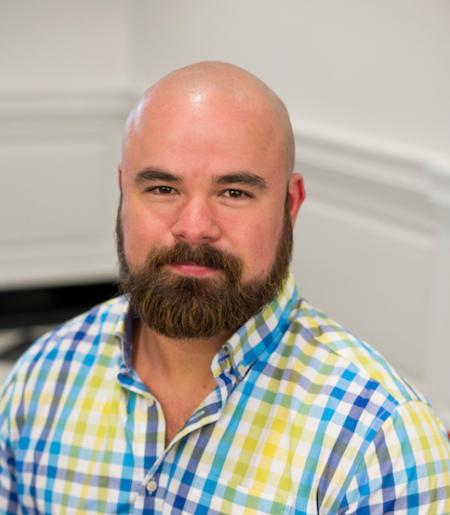
Andrew L. StewartView profile
Associate Professor
Andrew L. Stewart is an Associate Professor of Psychology at Clark University's Hiatt School of Psychology. His research focuses on intergroup relations across various dimensions including gender, race, ethnicity, nationality, sexual orientation, and class. He directs the Ideology and Intergroup Violence Laboratory and has been at Clark University since 2014. Stewart received his Ph.D. and M.A. in Social Psychology from the University of Connecticut (2014 and 2011) and B.S. degrees in Psychology and Mathematics from Colorado State University (2009). His academic journey reflects a strong foundation in both psychological theory and quantitative methods. Professor Stewart's research examines how widespread beliefs about social groups contribute to intergroup violence and discrimination, and how to change those beliefs to reduce such negative outcomes. His work particularly investigates how sexist and hegemonic masculinity norms contribute to violence against women, why people engage in collective action to reduce inequality, and how to implement effective sexual assault prevention programs. His methodological expertise includes advanced statistical techniques such as multilevel modeling, structural equation modeling, and analyses of dyadic and group data. His recent publications demonstrate a consistent focus on social dominance theory, intergroup relations, and collective action, with applications to gender inequality, racial justice, and political protest. Stewart's work bridges theoretical social psychology with practical applications for reducing discrimination and violence. Among his notable contributions are the development and evaluation of "The Men's Project," a sexual assault prevention program targeting college men, and research on international support for social movements like the Arab Spring uprisings. He has consulted with universities and non-profit organizations on men's programming and violence prevention training. As an educator, Stewart teaches courses including Advanced Social Psychology, Masculinities and Violence, Psychology of Prejudice, and Structural Equation Modeling. He also serves as an SPN Mentor, providing career guidance to underrepresented college students.