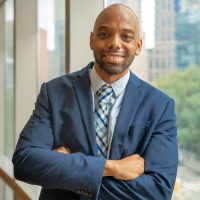
Jared M. Trujillo is an Associate Professor of Law at the CUNY School of Law. He teaches Constitutional Law, legal writing, and courses focused on the criminal and juvenile legal systems. Previously, he served as Senior Policy Counsel at the New York Civil Liberties Union, President of the Association of Legal Aid Attorneys, and as a criminal defense attorney at the Legal Aid Society NYC. He also taught as an adjunct professor at Hofstra University School of Law from 2016 through 2021. CUNY School of Law - Associate Professor New York Civil Liberties Union - Senior Policy Counsel Legal Aid Society NYC - Juvenile Defense Attorney Hofstra University School of Law - Adjunct Professor His research and advocacy focus on sentencing reform , bail policy , solitary confinement , policing of LGBTQ+ communities , Communications Decency Act Section 230 , foster care , and decriminalization of sex work . His publications analyze legislative impacts, systemic inequalities, and policy advocacy within criminal and juvenile legal systems. Jared's recent law review article on sentencing reform (2023) explores multigenerational poverty reduction through legal system changes. His 2022-2023 essays address solitary confinement ethics, policing reform, and bail system critiques, reflecting ongoing engagement with media and policy debates.
Sakari Melander is a Professor at the Faculty of Law , University of Helsinki, specializing in Criminal Law , with a focus on constitutionalization, Europeanization, and sentencing policies. His work bridges theoretical criminal law with practical legislative and policy challenges. Key research areas include EU criminal law, constitutional constraints on criminal legislation, and general doctrines of criminal law. He has extensive experience in parliamentary legal consultation, providing expert opinions to Finland’s Legislative Committees (e.g., on immigration control, anti-corruption directives, and digital evidence handling). Recent publications address topics like EU corporate sanction policies, constitutionalization of criminal law, and reforms in Finnish sentencing systems. His 2025 article in the New Journal of European Criminal Law explores balancing administrative and criminal sanctions in the EU. Scientific awards include: Hilkka ja Otto Brusiin Foundation Thesis Prize (2001) Magister Bonus – Good Teacher Award (2014) Primustohtori Award (2010) Year’s Teacher (2010) Year’s Opponent (2008) He leads research projects such as Criminal Law Under Pressure: Differentiation and Harmonization (2012-2015) and Assessment of Human Trafficking Sanction Practices (2021-2022), and supervises doctoral theses on criminal law topics.
Stephen Billings is an Associate Professor of Finance at the Leeds School of Business, University of Colorado Boulder, where he holds the Global Real Estate Capital Markets Chair position. He serves as the faculty director of the MS in Real Estate program and research director for the CU Real Estate Center. His work spans multiple research centers including the Center for Research on Consumer Financial Decision Making and the Michael A. Klump Center for Real Estate. Billings received his PhD in Economics from the University of Colorado, a MS in urban planning from the University of North Carolina, and a BS in economics from Georgetown University. Prior to joining CU Boulder in 2016, he was faculty at the University of North Carolina Charlotte with appointments in both economics and public policy, where he also served as faculty director for the real estate center. His research focuses on the intersection of housing, schools, neighborhoods and crime, addressing critical policy issues including the impact of public investment in light-rail transit on neighborhoods, school segregation's influence on academic achievement and crime, neighborhood gentrification causes, lead-based paint in low-income housing, and the effects of sea level rise and natural disasters on neighborhood sorting and household finances. Billings employs sophisticated analysis of large micro-datasets with studies based on data and policies in Charlotte, NC and Denver, CO. His work connects urban economics with public policy, demonstrating how neighborhood environments shape individual outcomes across multiple dimensions. Billings' recent publication record demonstrates a consistent focus on neighborhood effects, school choice impacts, crime economics, and housing market dynamics. His work frequently examines the intersection of race, housing, and economic outcomes, with particular attention to policy implications. He has developed innovative methodological approaches to studying residential amenities and neighborhood spillovers, with increasing attention to climate change impacts on housing markets. His research appears in top journals including The Quarterly Journal of Economics, American Economic Review: Insights, and Journal of Urban Economics. As an educator, Billings teaches undergraduate and masters classes in real estate finance and economics, as well as doctoral and masters level courses on cost-benefit analysis and statistical methods. He has extensive consulting experience conducting economic impact studies, including assessments of North Carolina's public higher education system, affordable housing needs in Colorado communities, and the economic effects of marijuana legalization on property markets. His practical policy work complements his academic research, creating a bridge between theoretical insights and real-world applications. Billings leads significant research initiatives through the CU Real Estate Center, where he directs studies examining the impact of business improvement districts and other urban development policies. His work bridges academic research with practical policy applications, making substantial contributions to our understanding of how housing, education, and neighborhood environments shape individual outcomes and community development. His December 2023 memo on the HUD Officer Next Door Program exemplifies his engagement with current housing policy issues.
Patrick Metze is Professor of Law at Texas Tech University School of Law, where he has served since 2008. He initially joined as an adjunct professor teaching the criminal defense clinic in 2007 and became a full-time Associate Professor of Law and Director of the Criminal Defense Clinics in May 2008. He was promoted to Professor of Law with tenure in September 2012. Professor Metze has established several groundbreaking clinical programs including the Capital Punishment Clinic (2010), the Caprock Regional Public Defender Office and Clinic (2010) - the first full-time public defender office operated from within a law school, and the Texas Tech School of Law Innocence Clinic (2016). Professor Metze earned his B.A. from Texas Tech University in 1970 and his J.D. from the University of Houston in 1973. Before joining academia, he maintained a private law practice in Levelland and Lubbock, Texas for over 30 years, initially handling general practice including banking, collections, corporate law, and oil and gas matters, but shifting focus to criminal and family law following the 1986 oil industry collapse in West Texas. He was one of only 14 attorneys qualified for appointment as first chair in Capital Murder cases in the 9th Administrative Judicial Region. Professor Metze's research focuses on criminal law and procedure, with particular emphasis on capital punishment, innocence projects, and the school-to-prison pipeline. His publications reveal a consistent concern with constitutional protections, ethical obligations of courts and practitioners, and systemic reforms in criminal justice. His work spans both theoretical analysis of legal principles and practical guidance for criminal defense attorneys. Among his professional recognitions, Professor Metze is a Life Fellow of The Texas Bar Foundation and maintains membership in The Pro Bono College of the State of Texas. His presentations at numerous professional seminars demonstrate his active engagement with the criminal defense bar and commitment to advancing legal practice. Professor Metze has served on various committees including the Criminal Justice Council of the State Bar of Texas, the Advisory Committee to the Lubbock Special Needs Defenders Office, and as a former board member of the Lubbock Criminal Defense Lawyers Association (where he served as President) and the Texas Criminal Defense Lawyers Association.
Elliott Ash is an Associate Professor of Law, Economics, and Data Science at ETH Zurich's Center for Law & Economics. He holds a Ph.D. in Economics and J.D. from Columbia University, a B.A. in Economics, Government, and Philosophy from the University of Texas at Austin, and an LL.M. in International Criminal Law from the University of Amsterdam. His research focuses on empirical legal studies using econometrics, NLP, and ML, examining topics like judicial behavior, legislative impact, and AI-driven governance. He has been funded by the ERC, Swiss NSF, and others. Research Interests: Elliott explores automation of legal decisions, text-as-data analysis in law, and the intersection of AI with legal systems. He develops tools like BallotBot and LePaRD to enhance legal transparency and public understanding. His work bridges law, economics, and computer science, with publications in top journals like the American Economic Journal and Review of Economics and Statistics . Teaching: Courses include Building a Robot Judge , Natural Language Processing for Law , and Big Data for Public Policy . He co-organizes the Zurich Workshop in AI+Economics and Monash-Warwick-Zurich Text-as-Data Workshops. Awards: European Research Council Starting Grant, Swiss National Science Foundation Grant, and multiple grants from U.S. and Swiss institutions. His work has been featured in NPR , VoxEU , and Georgetown Law Journal . Labs/Teams: Leads the Swiss AI Initiative's Human-AI Alignment team, collaborates with the CEPR on Political Economy research, and serves as an Economic Journal Associate Editor.
Julian Jara-Ettinger is an Associate Professor of Psychology and Computer Science at Yale University. He holds a Ph.D. from MIT (2016). His research focuses on understanding the cognitive and computational mechanisms underlying human social behavior, including fairness, linguistic communication, gesture, moral reasoning, and pedagogy. He employs interdisciplinary methods such as computational modeling, eye-tracking, cross-cultural studies, and developmental research to bridge psychology and artificial intelligence. Key research areas include the development of social cognition in children, the integration of theory of mind with communication, and the application of cognitive science principles to build socially intelligent machines. His work emphasizes how humans infer others' knowledge, intentions, and desires, with implications for AI safety and ethical systems design. Publications span topics like epistemic inference, moral judgments, and the computational foundations of social interaction. His lab's research often intersects with evolutionary simulations, neural modeling, and cultural psychology. No scientific awards are explicitly mentioned in the provided text. Collaborations involve cross-disciplinary teams addressing challenges in developmental science, AI ethics, and cognitive robotics. His work has practical applications in educational strategies, social policy, and human-AI collaboration frameworks.
Professor David Nelken is a distinguished academic in the field of law and legal studies, currently serving as Professor of Comparative and Transnational Law at the Dickson Poon School of Law, King's College London. He previously held positions at prestigious institutions including the University of Cambridge, University College London, and the University of Macerata (Italy) as a Distinguished Professor. His academic career includes roles as Distinguished Research Professor at Cardiff University (1995–2013) and Visiting Professor of Criminology at the University of Oxford (2010–2014). Professor Nelken's research focuses on comparative sociology of law, criminology, and legal/social theory. He has made significant contributions to understanding global social indicators, juvenile justice, white-collar crime, and international criminal justice. His work emphasizes interdisciplinary approaches, combining theoretical inquiry with empirical research. His notable awards include the American Sociological Association Distinguished Scholar Award (1985), Sellin-Glueck International Award (2009), and Fellowships from the British Academy (2023) and the Academy of Social Sciences (2009). He has served on editorial boards of leading journals and contributed to global legal governance initiatives, including the SCOPUS Database evaluation committee. Professor Nelken has advised on criminal justice systems globally, including roles in Scotland’s Children’s Hearings and Italian Regional Crime Committees. He is actively involved in PhD supervision, having been awarded supervisory excellence in multiple years. His teaching spans Jurisprudence, Law & Social Theory, and Sociology of Law at both undergraduate and postgraduate levels.
Nicole Myers is an Associate Professor and Graduate Coordinator in the Department of Sociology at Queen's University, Canada. She holds a PhD and MA from the University of Toronto and a BA from the University of Guelph. Her research focuses on criminology, particularly pre-trial detention, bail processes, and systemic discrimination within the criminal justice system. She critiques current practices such as excessive bail conditions, institutional risk aversion, and the erosion of the presumption of innocence. Her work examines bail court dynamics, including adjournment cultures, systemic overreach in conditions (e.g., banning ordinary locations), and the impact on marginalized groups. Recent studies highlight crises in Canada’s bail system, including deepening detention rates and Manitoba’s discriminatory practices. Myers emphasizes reform needs through policy analysis and empirical studies. Publications span 2009–2024, analyzing bail’s role as punishment, surety supervision roles, and youth justice. Her research bridges legal sociology and criminology, aiming to improve judicial practices and reduce pre-trial detention inequities.
Nessa Lynch holds the Matheson Lectureship in Law, Innovation, and Technology at University College Cork, Ireland. Previously, she served as an Associate Professor (2019–2022) and Senior Lecturer (2013–2019) at Victoria University of Wellington, New Zealand. She also held roles as a Research Fellow and adjunct faculty there. Her research focuses on emerging technologies in law enforcement, youth justice, and children’s rights. Lynch advises governmental bodies, including New Zealand Police and the Data Ethics Advisory Group, on issues like facial recognition technology and biometric ethics. She has authored multiple books, including Youth Justice in New Zealand (3rd ed., 2019) and edited volumes on global youth justice trends. Her honors include the Engagement Excellent Award (2017) and Early Career Research Excellence Award (2014). Lynch is actively involved in policy reforms, including submissions on digital justice, pandemic law, and sentencing practices for youth offenders. Education: BCL (Law), University College Cork, 2003 LLM (Law), University College Cork, 2004 PhD (Law), University of Otago, 2009 Research Interests: Technology and law enforcement ethics Youth justice policy reforms Children’s rights in criminal proceedings Biometric surveillance regulation Recent Grants: Technology-Enabled Surveillance (2024–2026) Young Adults in the Criminal Justice System (2021–2022) Facial Recognition Technology Framework (2019–2020) Key Contributions: Policy Briefs on digital justice and facial recognition Expert testimony on policing ethics and sentencing Leadership roles in New Zealand’s Data Ethics Advisory Group and Policing Authorities Awards: Engagement Excellent Award, Victoria University of Wellington (2017) Early Career Research Excellence Award, Victoria University of Wellington (2014) Labs/Teams: Leading UCC’s interdisciplinary research on law-technology intersections Collaborations with global institutions like Terre des Hommes and the EU on child rights
Cesla Amarelle serves as Full Professor and Chairholder of Public Law and Migration Law at the University of Neuchâtel's Faculty of Law. Her academic leadership extends to co-directing the Swiss Center for Migration Law (CDM) and contributing to national research initiatives including the National Center of Competence in Research (NCCR) 'On the Move'. She concurrently holds significant public appointments as Chair of the Institute of European Law at the University of Fribourg and Federal Commissioner for Women's Issues, with recent expert designation to the Federal Round Table on signature collection integrity for 2024. Her academic foundation includes a law degree from the University of Lausanne (1996), LL.M. in European and International Economic Law from the University of Fribourg, and doctoral thesis from the University of Lausanne (2004). Her career progression at the University of Neuchâtel spans assistant professor (2009-2014), extraordinary professor (2015-2016), and full professor positions since 2016, complemented by earlier research roles at Swiss National Science Foundation and University of Fribourg. Professor Amarelle's research centers on migration law frameworks, human rights protections in asylum systems, and constitutional dimensions of European integration. Her work critically examines the intersection of migration governance with digital technologies, climate change impacts, and gender equality. Current projects analyze temporary protection regimes, non-refoulement principles in technological contexts, and the evolving relationship between Swiss migration law and European legal frameworks. Her scholarship consistently bridges theoretical legal analysis with practical policy implementation challenges. Her extensive publication record demonstrates evolving focus from foundational migration law codification toward contemporary challenges including digital discrimination, child rights in emergency contexts, and sustainable finance frameworks. Recent scholarship reflects increasing engagement with technological impacts on migration governance and the humanitarian dimensions of temporary protection systems, while maintaining rigorous analysis of constitutional and European law interfaces. Professor Amarelle actively contributes to academic and public discourse through leadership in the Swiss Center for Migration Law and participation in the NCCR 'On the Move' consortium. Her public service includes significant political roles as Vaud State Councilor for Education (2017-2022) and National Councilor (2011-2017), where she chaired key committees on political institutions and finance while representing Swiss higher education interests nationally. She maintains active engagement with professional associations including the Swiss Conference of Higher Education Institutions and Conference of Directors of Public Education.
Douglas C. Ligor is a Professor of Policy Analysis at the RAND School of Public Policy and Director of the Management, Technology, and Capabilities Program at RAND's Homeland Security Research Division. He holds dual roles as a Senior Behavioral Scientist and academic researcher, specializing in homeland/national security law, immigration policy, space governance, and international legal frameworks. Education: J.D. from University of Connecticut School of Law (2000s) and B.S. in Economics from U.S. Military Academy at West Point (1990s). Prior to RAND, he served in federal legal roles including Deputy Chief Counsel at USCIS and Assistant District Counsel at DOJ/ICE. Research focuses on border security, asylum processing, outer space regulation, and federal-state-local coordination. His work frequently addresses intersections between statutory compliance and operational realities in domains like immigration enforcement and space traffic management. Notable contributions include policy analyses on Title 42 immigration restrictions, ISIS prisoner management in Syria, and frameworks for international space traffic governance. He regularly engages in public commentary through podcasts and op-eds on topics like U.S. border policy and emerging space law challenges.
Andreas Stephan is a Professor of Competition Law and Head of the School of Law at the University of East Anglia. His expertise spans Competition Law, Subsidy Control, and White Collar Crime . He advises the UK’s Competition and Markets Authority (CMA) and contributed to global legislative reforms through research on public attitudes to cartels and criminalization frameworks. He has held visiting roles at Hong Kong University and Melbourne University, and serves on UNCTAD’s Research Partnership Platform. His research focuses on cartel enforcement dynamics, private enforcement mechanisms, and post-Brexit regulatory shifts . Recent work includes analyzing the UK’s subsidy control regime and leading a landmark opt-out collective action against Amazon, successfully securing carriage rights in January 2025. Key activities include panel memberships at ICN, participation in high-profile conferences, and media commentary in major outlets like Financial Times and BBC . His projects include a Korean Government Fellowship (2016–2018) and co-leadership of the Centre for Competition Policy’s Phase 2 (2009–2014). Research trends emphasize legal-economic intersections in competition policy, with recent work addressing corporate compliance failures, post-pandemic market coordination risks, and the evolving role of private enforcement in deterring anti-competitive practices. Grants & Projects: Lead researcher on Korean Government Long-Term Fellowship (2016–2018) Principal investigator for CCP Phase 2 (2009–2014) funded by the ESRC Consultant for national competition authorities and UK Department of Business Labs/Teams: Member of UEA’s Centre for Competition Policy and Competition, Markets and Regulation research group.
Jean Galbraith is a Professor at the University of Pennsylvania Carey Law School . Her scholarship focuses on the intersection of international law , foreign relations law , constitutional law , and human rights . Key areas include treaty design, separation of powers, administrative law, and domestic implementation of international obligations.
Dr. Marianne Mason is an Associate Professor of Translation/Interpreting Studies and Forensic Linguistics at James Madison University (JMU), where she also coordinates the SETI minor and contributes to Linguistics and Legal Studies programs. Holding a Ph.D. in Linguistics from the University of Georgia, along with a BBA in Statistics and an MA in Translation, her expertise spans interdisciplinary research areas including language and law, discourse analysis, and translation studies. She is a 2018–2019 ACLS Fellow for her project on linguistic analysis in the American justice system. Her research focuses on police-layperson interactions, Miranda rights invocation, and interpreter-mediated legal discourse. Notable works include Police Interrogation, Language, and the Law (Cambridge UP, 2024) and co-editing The Discourse of Police Interviews (U Chicago Press, 2020). She has provided expert testimony in criminal cases and serves on editorial boards for journals like Translation and Interpreting Studies . Educations: Ph.D. Linguistics, University of Georgia MA Translation, [institution not specified] BBA Production Management/Statistics, [institution not specified] Research Projects: ACLS-funded study on language in the American justice system Custodial interrogation reform analysis Affiliations: International Association for Forensic and Legal Linguistics National Association of Judiciary Interpreters & Translators (NAJIT)
Colin King is a Professor at Sydney Law School, University of Sydney. He holds a LLB and PhD from the University of Limerick, Ireland, and a PGCert in Higher Education from the University of Sussex. His research focuses on financial crime, including money laundering, proceeds of crime, deferred prosecution agreements, criminal evidence, and miscarriages of justice. He has authored numerous books and articles on these topics, such as Civil Recovery of Criminal Property (OUP, 2023) and Negotiated Justice: The Legitimacy of Civil Recovery and Deferred Prosecution Agreements (Palgrave, 2018). King also serves as Editor-in-Chief of Current Issues in Criminal Justice . His teaching includes courses on Advanced Evidence, Money Laundering and Proceeds of Crime, and Foundations of Law. Recent research highlights include examining cryptocurrency-related financial crimes, EU asset recovery developments, and challenges in implementing anti-money laundering regulations. King’s work bridges legal theory and practice, addressing transnational crime, regulatory compliance, and the ethical dimensions of legal frameworks. His contributions span criminal law reform, evidence-based policy analysis, and the intersection of technology with financial crime prevention.