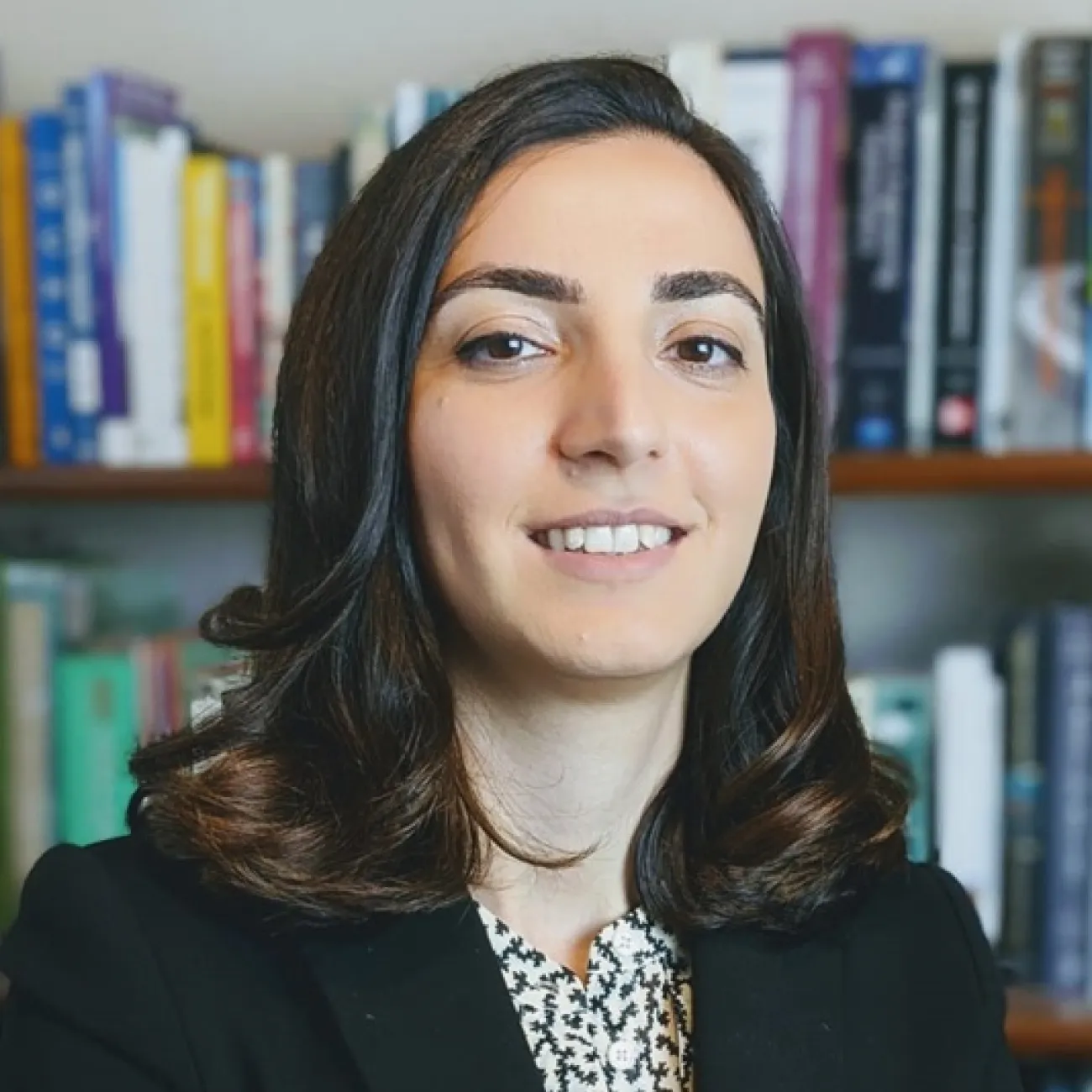
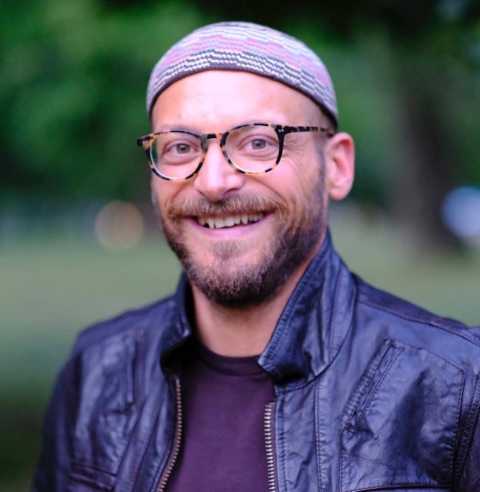
Dr Bahareh Zaghari (MSc, PhD, CEng, FHEA) is a Lecturer in the Electrical Power Engineering group at the University of Southampton's School of Electronics and Computer Science. Her research focuses on electrified aircraft systems, sensors with machine learning applications, electrical power systems, and nonlinear dynamics modeling. Current projects include acoustic sensing for temperature/flow measurement Co-design of electrical machines for aircraft electrification Research activities span hybrid-electric aircraft design (FutPrint50 Horizon project), fully electric aircraft development (EnabEl Innovate UK), and smart sensing systems for aerospace components. Industrial collaborations include KISTLER, iNetic, PALL Aerospace, Safran, ARUP, Embraer, and BAE Systems. Conference coordinator for IEEE Transportation Electrification Council's Electrified Aircraft committee Chair of IEEE/AIAA Electrified Aircraft Technology Symposium (2023) Panel moderator at AIAA Propulsion and Energy (2021) Her work demonstrates innovative applications of acoustic transducers in harsh environments, with contributions to temperature mapping, fault analysis, and energy harvesting systems. She currently supervises PhD student Shikhar Singh.
Professor Steve G Burrow is a faculty member at the School of Civil, Aerospace and Design Engineering at the University of Bristol. His research focuses on energy harvesting, vibration control, and environmental sensing, particularly in aerospace and glaciological contexts. Professor of Aircraft Systems Member of the Cabot Institute for the Environment Active in Dynamics and Control research themes His work in energy harvesting emphasizes electromagnetic transducers and nonlinear resonant structures, while environmental sensing involves deploying sensors under ice sheets to study glacial hydrology. Recent articles highlight inerter-based suspension systems, vibration absorber optimization, and broadband energy harvesting techniques. Collaborations span nonlinear mathematics, glaciology, and structural dynamics. No scientific awards were explicitly mentioned, but his research outputs demonstrate extensive contributions to power electronics and sustainable technologies.
Dr. Ludo Ausiello is a Senior Lecturer in Electronics at the University of Portsmouth, affiliated with the School of Electrical and Mechanical Engineering and the Faculty of Technology. His roles include membership in the Portsmouth AI and Data Science Centre and the Portsmouth Centre for Advanced Materials and Manufacturing. He holds a Fellowship of the Higher Education Academy and is a member of the Institute of Acoustics. Education: Integrated Master’s in Electronic Engineering (University of Bologna), European PhD in Audio Engineering, and PGCert in Higher Education (2019). Professional training includes Fonoprint Studios (Bologna) and industry experience at Maserati, Magneti Marelli, and Harman. Research interests focus on audio engineering, signal processing, electro-acoustics, and innovative manufacturing. Recent work includes developing affordable measurement ecosystems for musical acoustics, optimizing soundboard designs via least-squares analysis, and applying AI to room acoustics prediction. His studies span topics like wood elasticity, loudspeaker design, and vocal fatigue in educational spaces. Awards: Fellowship of the Higher Education Academy (2019). Teaching and advising: Taught analog and digital oscillator design at the University of Bologna and contributed to curriculum development at Solent University. Active in mentoring students through collaborative industry projects. Labs/Teams: Engaged with interdisciplinary teams at Portsmouth, focusing on advanced materials and AI-driven acoustic solutions.
Majid Taghavi is a Research Fellow at the Department of Bioengineering, Faculty of Engineering, Imperial College London. He leads the Soft Robotic Transducer Lab, focusing on developing advanced soft actuators for healthcare and robotics applications. Previously, he held a postdoctoral position at the University of Bristol’s SoftLab, where he pioneered artificial muscle technologies. He earned his PhD in BioRobotics from Scuola Superiore Sant'Anna with highest honors and an Italian Institute of Technology (IIT) scholarship. His research interests include soft robotics, materials engineering, and actuator design. Key projects involve creating monolithic soft robots with self-sensing, variable stiffness, and high contraction actuators. Recent work explores applications in wearable, implantable, and surgical robotics. Notable achievements include developing electric actuators with 98% contraction and human-muscle-equivalent power density. His articles highlight advancements in electrostatic actuators, dielectric elastomers, and biomimetic designs. Awards include the IIT scholarship and academic honors for doctoral work. He advises on open positions in his lab and collaborates across disciplines. His labs (Soft Robotic Transducers Lab and Robotics Forum) drive innovations in soft robotics systems and transducers.
James Roscow is a Senior Lecturer in the Department of Mechanical Engineering at the University of Bath, affiliated with the Centre for Integrated Materials, Processes & Structures (IMPS), IAAPS, and the Institute of Sustainability and Climate Change. His research focuses on developing ferroelectric composites for energy harvesting, sensing, and energy storage, with expertise in material fabrication, property tuning, and numerical modeling. He holds a PhD in Mechanical Engineering from the University of Bath and a BSc in Materials Science from the University of Manchester. Research interests include porous ferroelectric ceramics, piezoelectric and pyroelectric materials, and their applications in renewable energy and sensors. He has led or contributed to 12 projects funded by organizations like EPSRC and Innovate UK, exploring topics such as low-cost transducers, nanofluid cooling for solar panels, and phase transformations in ceramics. Key publications (2021–2025) address piezoelectric energy harvesting, porous material design, and advanced manufacturing techniques. His work aligns with UN SDGs, particularly sustainable energy and innovation. Roscow supervises PhD students in functional ceramics, energy storage, and sensor technologies. Notable collaborations include projects on hydraulic energy harvesters, SONAR transducers, and self-healing materials. He has contributed datasets on piezoelectric composites and energy storage systems, emphasizing reproducibility and applied research.
Professor Anthony Gachagan is a leading academic at the University of Strathclyde, serving as Head of Department and Research Director in the Department of Electronic and Electrical Engineering (EEE) within the Faculty of Engineering. He has been Director of the Centre for Ultrasonic Engineering (CUE) since 2010, leading a multidisciplinary team of around 55 researchers with over £5M in active funding. He also holds leadership roles in RCNDE as Academic Chair and Management Board member, and participates in BINDT committees. His research spans ultrasonic transducer design, non-destructive evaluation (NDE), robotics, high-power ultrasound, and industrial process control. His work is highly collaborative, involving national and international partnerships with industry and academia, and contributes to sectors such as energy, aerospace, nuclear, and healthcare. He is actively involved in major research initiatives aimed at net zero, structural integrity, and advanced manufacturing. Recent publications highlight his focus on robotic ultrasonic inspection, adaptive signal processing, phased array techniques, and in-process monitoring of additive manufacturing. These works demonstrate a strong trend toward automation, real-time defect detection, and integration of ultrasonic systems in industrial and safety-critical applications. Scientific Awards: The BINDT Annual Conference Award (2019) Prof Gachagan has secured significant grants from EPSRC, Innovate UK, and industry partners, including projects on future ultrasonic engineering, lightning impulse testing, and robotic inspection for offshore wind. He supervises numerous research students and leads large collaborative teams. He also contributes to research commercialization through IAA projects. He leads the Centre for Ultrasonic Engineering (CUE), a vibrant research unit integrating electronic, mechanical, and biomedical engineers, physicists, and material scientists. The centre focuses on next-generation ultrasonic technologies, robotics integration, and industrial deployment.
Dr. Ehsan Mohseni is a Senior Lecturer in the Department of Electronics and Electrical Engineering at the University of Strathclyde, Faculty of Engineering. He is a key member of the Centre of Ultrasound Engineering (CUE) research group and supports the Royal Academy of Engineering and Spirit AeroSystems research chair led by Professor Gareth Pierce. His work focuses on advancing robotic and intelligent Non-Destructive Evaluation (NDE) systems for industrial applications. B.Sc. in Materials Science and Metallurgical Engineering, University of Tehran, 2006 M.Sc. in Metal Forming Processes, University of Tehran Ph.D. in Automated Defect Detection using Electromagnetic NDE, École de Technologie Supérieure (ETS), Montreal, Canada Dr. Mohseni’s research is centered on NDE 4.0, integrating advanced sensing, multi-physics modeling, and machine learning. His expertise spans ultrasonic and eddy current testing, multi-sensor data fusion, and probability of detection studies. He focuses on applications in additive manufacturing, welding, composites, and metal processing, aiming to overcome current technological barriers in industrial inspection. The recent publications highlight a strong trend toward intelligent, automated, and robotic NDE systems. Key themes include self-supervised learning for ultrasonic segmentation, human-machine collaboration in data analysis, and advanced signal processing for weld and composite inspection. The integration of AI, flexible sensor arrays, and embedded navigation systems reflects a shift toward smart, adaptive inspection platforms aligned with Industry 4.0. Scientific Awards: The BINDT Annual Conference Award (2019) Dr. Mohseni is actively involved in research funding and knowledge transfer. He serves as Principal Investigator on KTP projects with ETHER NDE LIMITED and NATIONAL OILWELL VARCO UK LIMITED, focusing on in-process inspection for additive manufacturing and field calibration for ultrasonic testing. He contributes to large-scale collaborative projects funded by Innovate UK and industry partners, emphasizing practical deployment of NDE solutions. He also supervises research staff and collaborates with global aerospace firms including Pratt & Whitney Canada, Safran, and Bell Helicopter. He is a core member of the Centre of Ultrasound Engineering (CUE), a dynamic research group developing next-generation ultrasound technologies. The team works on advanced robotic sensing hubs, flexible transducer arrays, and AI-driven data interpretation tools, often in collaboration with the Royal Academy of Engineering research chair and industrial partners.
William Hurley is a Senior Lecturer at Nottingham School of Art & Design, Nottingham Trent University, specializing in Fashion, Knitwear and Textile Design. With over 18 years of experience in education and research, he focuses on industrial knit technology and its creative applications in novel textile development. His primary research interest lies at the intersection of technology innovation and creative design processes, particularly in fashion weft knitting. He explores novel applications through seamless knitting, 3D knitted structures, and electro-active textiles for medical and communication purposes. His work bridges traditional fashion design with cutting-edge technological advancements, emphasizing how technological innovation drives creative exploration in textile development. Recent publications (2025-2013) reveal consistent focus on textile-based sensors, antenna materials, and moisture management in knitted textiles. Key themes include optical and electrical sensing for health monitoring, space antenna applications, compression garments, and environmental effects on textile performance. This output demonstrates deep expertise in smart textiles and industrial knitting, with strong emphasis on practical applications in healthcare, aerospace, and wearable technology. No major scientific awards are documented in the available records. He has secured significant funding from Innovate UK, Horizon 2020, and the European Space Agency for projects including patient-customized compression sleeves for lymphoedema treatment, active simulator cockpit enhancement, and space antenna surface materials. While specific PhD students aren't listed, his role as Senior Lecturer involves supervising undergraduate students in knitwear design and research projects within the BA (Hons) Fashion Knitwear Design program. He is an active member of the Advanced Textiles Research Group (ATRG), which develops innovative textile applications across medical, communication, and aerospace domains. His work includes commercialized outcomes like Nike's Flyknit technology and SmartLife Technology Ltd's knitted transducers.
Anne Bernassau is an Assistant Professor at the School of Engineering & Physical Sciences , Heriot-Watt University , affiliated with the Institute of Sensors, Signals & Systems . Her research spans ultrasonic transducers, acoustofluidics, and biomedical applications. PhD projects: Dynamic acoustic fields for particle sorting Collaborations: Industry partners, international teams Her work focuses on acoustic particle manipulation for scalable, harmless cell sorting and tissue engineering. She integrates sensors with microfluidic systems and explores piezoelectric materials. Recent publications highlight advancements in RFID-based medical devices , symmetry breaking in oil droplet trapping , and machine learning for phenotyping . These reflect interdisciplinary applications in healthcare and environmental safety. Scientific award: Lord Kelvin Adam Smith fellowship SDG contributions: Health, Industry Innovation, Sustainable Cities, Life Below Water Bernassau collaborates across physics, engineering, and life sciences, mentoring self-funded PhD candidates and engaging in invited talks (IEEE, 2014–2015). Her research aligns with UN Sustainable Development Goals.
Dr Soroush Faramehr is an Associate Professor (Research) at Coventry University's Institute for Future Transport and Cities. He holds a PhD in Electrical Engineering from Swansea University (2015), specializing in wide bandgap semiconductor technologies. His research focuses on developing high-efficiency compound semiconductor devices for decarbonization in automotive, aerospace, renewable energy, and industrial sectors. He has over 10 years of R&D experience, with a strong publication record in peer-reviewed journals, successful grant acquisitions, and supervision of postgraduate researchers. Education: PhD in Electrical Engineering (Swansea University, 2015). Postdoctoral research at Swansea University before joining Coventry in 2019. Research Interests: Power semiconductor devices (GaN, SiC), magnetic sensors, thermal management, and E-mobility applications. His work aligns with UN Sustainable Development Goals related to climate action and sustainable infrastructure. Key Projects: Includes leadership in initiatives such as 'Gallium Nitride Smart Power Integrated Circuit Technology' (2021–2025) and 'GaN Hall Sensors' (2020). He has secured funding for projects like 'High-Voltage fast-charging efficient Electric vehicle Powertrains' (2025–2029). Advising: Supervises students researching topics like GaN HEMT switching behavior, thermal management in e-scooters, and second-life EV battery utilization. His advisees include Xuyang Lu, Arun Mambazhasseri Divakaran, and current students Louiza Mavrovounioti and Vartika Pandey. Publications: Over 30 articles in journals such as IEEE Access and IEEE Transactions on Power Electronics. Research spans CFD modeling, magnetic sensor development, and GaN device optimization.
Dr. John Tudor is a Principal Research Fellow in the Department of Electronics and Computer Science at the University of Southampton, affiliated with the Faculty of Engineering and Physical Sciences. His research focuses on smart fabrics/e-textiles, MEMS technology, sensors, and energy harvesting, with a primary emphasis on printed smart fabric innovations since 2008. He has led or co-investigated over 50 major funded projects and holds 12 patents. His work bridges materials science, biomedical engineering, and wearable technology, addressing healthcare applications such as stroke rehabilitation and pain management. Research interests include advanced manufacturing techniques (inkjet, screen printing) for smart fabrics and their integration into medical devices. Collaborations involve interdisciplinary teams in flexible electronics and e-textiles, exemplified by his contributions to the Centre for Flexible Electronics and E-Textiles (C-FLEET). Notable research outputs span 255 publications (13,042 citations, h-index 48) in areas like wearable electrotherapy systems and muscle stimulation for neurological recovery. His work emphasizes translational applications, such as improving lymphatic function and post-stroke rehabilitation through wearable technologies. John has extensive industry partnerships and academic collaborations, leveraging his expertise in sensor systems and microfabrication to advance healthcare technologies. His contributions to smart materials and flexible electronics underscore a commitment to solving real-world challenges through innovative materials and device design.
Frederic Bezombes is a Reader (associate professor) in Robotics at the School of Engineering, Liverpool John Moores University. Previously, he held roles as Lecturer in Mechatronics and Research Assistant at the university's General Engineering Research Institute (GERI). His work spans robotics, UAV applications, sensor technology, 3D reconstruction, and optical communication systems. PhD in Fiber Bragg Grating Temperature Sensors (GERI, 2004) B.Eng. Mechanical Engineering (University of Central Lancashire, 1999) D.U.T. Mechanical and Robotic Engineering (Institut Universitaire de Montpellier II, 1996) His research integrates drones with multispectral sensors for environmental monitoring, develops optical communication for underwater robotics, and explores precision measurement techniques. Recent publications highlight UAV applications in coastal morphology, virtual reality for sports analysis, and interferometer-based distance measurement. Frederic has contributed to projects like DigiArt (European Commission grant) and multiple short-term contracts with the Metropolitan Police (2023-2024), focusing on UAV deployment for security and forensic applications.
David Lines is a Knowledge Exchange Fellow in the Electronic and Electrical Engineering department within the Faculty of Engineering at the University of Strathclyde. His work focuses on advancing non-destructive evaluation technologies for industrial applications, particularly in ultrasonics and phased array systems. His research interests center on developing innovative ultrasonic inspection techniques for complex industrial components, eco-friendly transducer materials, and real-time monitoring systems for manufacturing processes. Key areas include resin infusion process monitoring in composite manufacturing, cladding integrity inspection, and intravascular ultrasound applications. His work bridges academic research with industrial implementation through multiple knowledge transfer partnerships. Lines has received significant recognition including the Roy Sharpe Prize (2022), National Instruments Global Engineering Impact Award (2019), and multiple BINDT awards. His research output demonstrates consistent contributions to NDE methodology development. As an active contributor to industrial projects, Lines serves as Principal Investigator or Research Co-investigator on multiple funded initiatives including KTP projects with National Oilwell Varco and Glasgow City Region innovation partnerships. His professional activities include frequent conference presentations and workshop participation in ultrasonics and NDE communities.
Dr. Alan Dunbar is a Senior Lecturer in Energy at the University of Sheffield, affiliated with the School of Chemical, Materials and Biological Engineering. His career spans roles like Interim Director of Education, Academic Director of CDT-PV, and Departmental REF Lead. Education: MPhys in Physics with Electronics from UMIST, PhD on Silicon-Germanium Quantum Dots Leadership: Director of Student Support, Assistant Faculty Director of Learning and Teaching Research focuses on nanomaterials for optoelectronics, particularly perovskite/organic solar cells and chemical sensors. Key themes include: Solution-Processed Thin Films X-ray/Neutron Scattering for Material Analysis Photovoltaic Efficiency and Stability Fluorescent Fibre-Optic Sensing Perovskite Stoichiometry and Degradation His 15 most recent articles highlight trends in perovskite solar cells, organic photovoltaics, battery materials, and optical/environmental sensing. Collaborations span institutions like ISIS Facility, Diamond Light Source, and Warwick University. Teaching includes Module Lead for Low Carbon Energy, Science and Technology . Professional memberships: IOP, IChemE. Peer Review Panel Member at Diamond Light Source.
Zihe Li is a Research Associate at the Department of Mechanical Engineering, University of Bath, and a Postgraduate Research Student within the same department. His work focuses on advanced materials for energy harvesting applications, particularly in the realm of piezoelectric and porous ceramics. He is affiliated with the Centre for Integrated Materials, Processes & Structures (IMPS) and contributes to UN Sustainable Development Goals related to sustainable energy and environmental protection. Research Interests Li's research specializes in piezoelectric materials, energy harvesting systems, and porous ceramic fabrication. His work explores how microstructures enhance electromechanical coupling and durability in lead-free ceramics, while also addressing applications in water monitoring and self-powered devices. He investigates digital light processing and freeze-casting techniques to optimize material properties for energy technologies. Recent Publications Li's publications highlight advancements in porous ceramics for energy harvesting, including composites for water flow monitoring, bioinspired piezoceramics, and high-strength mullite-bonded SiC ceramics. His work spans materials processing, functional properties, and sustainable design principles. Labs & Collaborations Li collaborates extensively within the IMPS center at the University of Bath. His work involves partnerships with researchers in energy engineering, materials science, and robotics, focusing on interdisciplinary applications of piezoelectric materials in sustainable technologies.