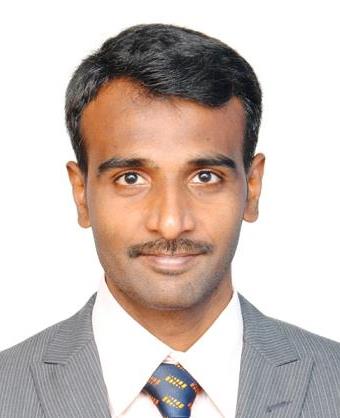
Gokulnath SabapathiView profile
Associate Professor
Dr. Gokulnath Sabapathi is an Associate Professor in the School of Chemistry at the Indian Institute of Science Education and Research (IISER) Thiruvananthapuram, where he has been serving since August 2015. He was promoted to Associate Professor in January 2023 after joining as Assistant Professor. Prior to this position, he held research positions at National University of Singapore (2012-2013) and Kyushu University, Japan (2009-2012), and served as a DST-Inspire Faculty at CSIR-IICT, Hyderabad (2013-2015). His educational background includes: B.Sc. in Chemistry from Sacred Heart College (Autonomous), University of Madras (2000) M.Sc. in Inorganic Chemistry from University of Madras (2002) Ph.D. from Indian Institute of Technology Kanpur (2009), focusing on "Interplay between Aromaticity and non-Aromaticity in Core Modified meso-Aryl Expanded Porphyrins" under Prof. T.K. Chandrashekar Dr. Sabapathi's research focuses on the synthesis and characterization of novel π-conjugated macrocyclic systems with applications in near-IR technologies, molecular sensing, and solar energy conversion. His work particularly emphasizes porphyrinoids and related expanded macrocycles that exhibit unique electronic properties due to their aromatic or antiaromatic character. These systems serve as platforms for developing molecular probes for toxic elements, new dye-sensitized solar cells (DSSCs), and heteroditopic receptors with specific binding capabilities. His group investigates how structural modifications affect conformational behavior, photophysical properties, and electronic structure in these complex macrocyclic systems. Analysis of his recent publications reveals a sophisticated progression in macrocyclic design, with increasing complexity in molecular architecture and more precise control over electronic properties. His work demonstrates particular expertise in carbazole-embedded porphyrinoids, m-phenylene linked expanded systems, and BODIPY derivatives with tailored photophysical characteristics. The research shows a clear trajectory toward developing functional materials with applications in photodynamic therapy, environmental sensing, and optoelectronic devices, with several publications featuring on journal covers and receiving editor's choice recognition. His scientific achievements include: SERB Young Scientist Grant (2016) DST Inspire Faculty Fellowship (2013) NUS Research Fellowship (2012) Global COE Post-Doctoral Fellow (2009) CSIR Senior Research Fellowship (2005) CSIR Junior Research Fellowship (2003) Dr. Sabapathi has successfully mentored numerous graduate students, with multiple PhD candidates having completed their degrees under his supervision. His research group currently includes several PhD students working on diverse projects related to macrocyclic chemistry. His research has been supported by multiple competitive grants including DST-Inspire Faculty Grant (2013-2018), DST-SERB Fast Track (2016-2019), and SERB-Core Research Grant (2020-2022). These funding sources have enabled the development of a well-equipped research program with sophisticated instrumentation. The Sabapathi Research Group maintains comprehensive facilities including multiple Schlenk lines, organic synthesizers, specialized refrigeration systems, spectroelectrochemistry setups, and various analytical instruments essential for synthetic macrocyclic chemistry research. The group's work bridges fundamental understanding of electronic structure in porphyrinoids with practical applications in sensing and energy conversion technologies, contributing significantly to the field of functional macrocyclic chemistry.