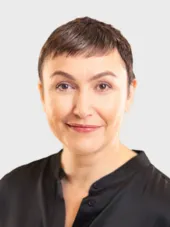
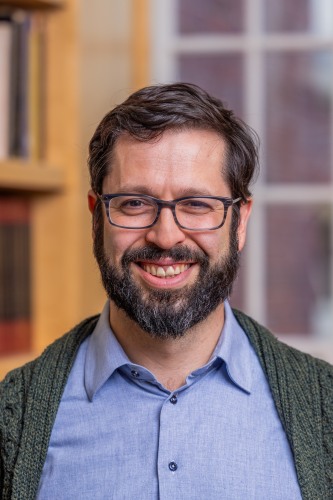
Martin Haspelmath is a Senior Research Scientist at the Department of Linguistic and Cultural Evolution at the Max Planck Institute for Evolutionary Anthropology (MPI-EVA), Leipzig, and an honorary (adjunct) professor at Leipzig University. His research focuses on comparative linguistics, language universals, and typology, particularly in syntactic and morphological systems. He co-edited the World Atlas of Language Structures (2005/2013) and co-founded Language Science Press . Education: PhD in Linguistics, Freie Universität Berlin (1990–1993) MA in Linguistics, University of Cologne and University at Buffalo (1985–1989) Undergraduate studies in Linguistics, University of Vienna (1983–1985) Research Interests: Haspelmath investigates global grammatical diversity, form-function correspondences, and universals in syntax, morphology, and lexical systems. His work emphasizes comparative concepts for cross-linguistic analysis and critiques traditional grammatical categories. Grants & Projects: ERC project leader at Leipzig University (2015–2020) Co-creator of Grambank , an open-access database of grammatical structures Leading initiatives for open-access publication and linguistic data sharing Labs/Teams: Active in the MPI's Department of Linguistic and Cultural Evolution, collaborating on projects like APICS (Atlas of Pidgin and Creole Language Structures) and ValPal (Valency Patterns Leipzig).
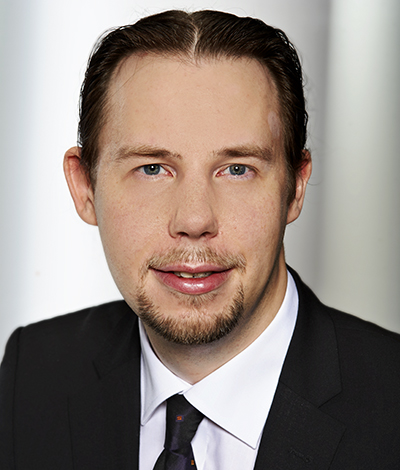
Gerd Bruder is an Associate Professor at the University of Central Florida , affiliated with the Department of Computer Science . He previously held positions as a Research Associate Professor at UCF's Institute for Simulation and Training (2016-2022), Post-Doc at University of Hamburg (2014-2016), and Post-Doc at University of Würzburg (2011-2014). Habilitation : Computer Science, University of Hamburg (2017) Ph.D. : Computer Science, University of Münster (2011) M.Sc. : Computer Science (minor in Mathematics), University of Münster (2009) Research Interests : Gerd Bruder's work focuses on Extended Reality (XR) systems, spanning Virtual Reality (VR) , Augmented Reality (AR) , and Mixed Reality (MR) . Key areas include human factors , digital twins , 3D user interfaces , and perceptual modeling , with applications in healthcare, military operations, architecture, and smart environments. Recent Publications highlight innovations in XR locomotion , trust calibration with autonomous agents, spatial cognition , and haptic-visual integration . His 2025 articles address task-switching efficiency in XR and collaborative mixed reality design. Scientific Awards : Best Paper at ACM VRST 2023 2021 TechConnect Innovation Award Best Demo at ACM SUI 2021 Multiple Best Paper Awards (2016-2023) Best Poster & Demo Awards (2015-2020) Patents include systems for medical simulation , smart environment interruption management , and adaptive AR interfaces . His work bridges academic research and practical applications across VR, AR, and MR domains.
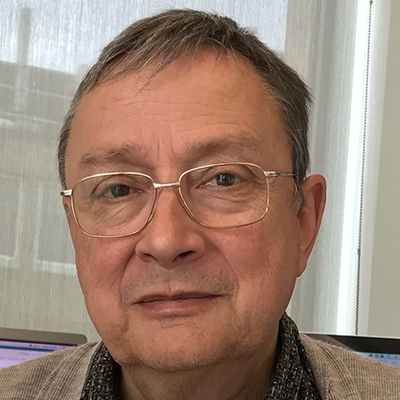
Mark Baker is a Professor of Linguistics and Cognitive Science at Rutgers University. His work focuses on comparative syntax, linguistic universals, semantic roles, and the study of Amerindian and African languages. He holds the title of Distinguished Professor and maintains an office in Scott Hall. As of 2021, his office hours were by appointment due to sabbatical leave. His research interests include syntactic diversity, its limits, and patterns across languages. Notable themes in his work involve logophoric pronouns, switch-reference mechanisms, and the relationship between case systems and agreement structures. He has contributed to discussions on language typology, formal syntax, and the cognitive foundations of linguistic structures. Baker teaches advanced syntax courses and has published extensively on topics ranging from Panoan languages to theoretical models in generative grammar. His recent articles explore syntactic variation, morphosyntactic alignment, and interdisciplinary connections between linguistics and cognitive science. He serves on editorial boards and has reviewed for journals such as Journal of East Asian Linguistics and Yearbook of Corpus Linguistics and Pragmatics . His work bridges formal linguistic theory with empirical cross-linguistic analysis, emphasizing the interplay between universal grammatical principles and lineage-specific traits.
Paola Cascante-Bonilla is an Assistant Professor in the Department of Computer Science at Stony Brook University, with expertise in computer vision, natural language processing, and embodied AI. Her research focuses on developing systems for compositional reasoning, common-sense inference, and trustworthy AI using vision-language models, while addressing cultural bias and explainability challenges.
Prof. Dr. Pia Knoeferle is a leading academic at Humboldt-Universität zu Berlin , where she serves as a Professor in the Department of German Language and Linguistics . She is a principal investigator in the Collaborative Research Center (CRC 1412) focused on register phenomena and leads the Reaction Time, Eye-tracking, and EEG Laboratories . Her research spans psycholinguistics , cognitive neuroscience , and computational modeling of language , with a central interest in how real-time language comprehension interacts with social context , formality-register congruence , and morphosyntactic processing . Appointments: Professor at Humboldt-Universität (2024), CRC 1412 member Methodologies: Eye-tracking, EEG, Visual World Paradigm, ERP Her work investigates lifespan language processing (children, adults, older adults) through contextual cue integration , including emotional , spatial , and social context such as gender cues , eye gaze , and facial expressions . Key questions include: How do pragmatic and contextual factors modulate lexical and grammatical processing ? What representations underlie register sensitivity in spoken and written comprehension ? Recent articles (2022-2024) focus on register congruence effects in German sentence processing, age-related differences in formality-register anticipation , and interactions between register and morphosyntactic knowledge . Using eye-tracking and visual world paradigms , her team examines incremental integration of socially-situated context with verb-argument relations and grammatical constraints . Findings suggest subtle late-stage register effects and interference between pragmatic and syntactic processing . Her lab collaborates with researchers like Katja Maquate , Valentina Nicole Pescuma , and Camilo Ronderos , contributing to the Frame text of the Second Phase Proposal for CRC 1412 (2020) and subsequent reviews in Frontiers in Psychology (2023). The work emphasizes complementary methods to model register variability across languages , modalities , and cultural contexts .
Michael Goldsmith is a Senior Research Fellow at the Department of Computer Science and Worcester College, University of Oxford. He holds multiple leadership positions including Director of the Oxford Martin Programme on AI Threat Detection, Associate Director of the Cyber Security Centre, and Co-Director of the Centre for Doctoral Training in Cybersecurity. His research bridges formal methods, concurrency theory, and practical cybersecurity applications. Goldsmith's research focuses on cybersecurity analytics including threat detection, risk management, and trust frameworks. He pioneered automated cryptoprotocol analysis and investigates multidisciplinary projects spanning mathematical models to socio-technical systems. His core interests include formal verification, AI threat landscapes, privacy architectures, and security protocol design. Analysis of his recent publications reveals strong emphasis on practical cybersecurity challenges: 63% focus on threat detection (especially insider threats), 22% on trust/risk frameworks, and 15% on formal methods applications. His work consistently integrates technical security mechanisms with human factors and organizational contexts. He currently advises Ahmed Salman and has supervised 10+ students including Mary Bispham, Rodrigo Carvalho, and Elizabeth Phillips. His research teams collaborate on projects funded by Technology Strategy Board, government agencies, and industry partners. Goldsmith leads the Oxford Martin Programme on AI Threat Detection and co-directs the Centre for Doctoral Training in Cybersecurity. His research group develops tools for security visualization (CyberVis), trust metrics, and identity management frameworks.
Julian Jara-Ettinger is an Associate Professor of Psychology and Computer Science at Yale University. He holds a Ph.D. from MIT (2016). His research focuses on understanding the cognitive and computational mechanisms underlying human social behavior, including fairness, linguistic communication, gesture, moral reasoning, and pedagogy. He employs interdisciplinary methods such as computational modeling, eye-tracking, cross-cultural studies, and developmental research to bridge psychology and artificial intelligence. Key research areas include the development of social cognition in children, the integration of theory of mind with communication, and the application of cognitive science principles to build socially intelligent machines. His work emphasizes how humans infer others' knowledge, intentions, and desires, with implications for AI safety and ethical systems design. Publications span topics like epistemic inference, moral judgments, and the computational foundations of social interaction. His lab's research often intersects with evolutionary simulations, neural modeling, and cultural psychology. No scientific awards are explicitly mentioned in the provided text. Collaborations involve cross-disciplinary teams addressing challenges in developmental science, AI ethics, and cognitive robotics. His work has practical applications in educational strategies, social policy, and human-AI collaboration frameworks.
Mark Steedman is Professor of Cognitive Science at the University of Edinburgh's School of Informatics, with adjunct appointment at University of Pennsylvania. His research spans computational linguistics, AI, and cognitive science, focusing on Combinatory Categorial Grammar (CCG) and its applications. His research examines: Combinatory Categorial Grammar parsing and semantics Language model capabilities and limitations Cross-linguistic semantic inference Brain modeling of language processing Recent publications analyze hallucination sources in large language models, cross-linguistic entailment graphs, and brain-computer parallels in structure-building. He develops computational models integrating symbolic and distributional approaches to semantics. Honors include ACL Lifetime Achievement Award (2018) and George E. Davis Medal (2001). He serves on editorial boards of major linguistics journals and has authored influential books including 'The Syntactic Process' and 'Taking Scope'.
Elena Simperl is a Professor of Computer Science and Deputy Head of Department for Enterprise and Engagement at King's College London's Department of Informatics. She co-directs the King's Institute for Artificial Intelligence and serves as Director of Research for the Open Data Institute. As a Hans Fischer Senior Fellow at the Technical University of Munich's Institute for Advanced Study, she leads the Trustworthy Knowledge Graphs focus group and contributes to advancing human-centric AI research across European institutions. Professor Simperl obtained her doctoral degree in Computer Science from the Free University of Berlin and her diploma from the Technical University of Munich. Prior to joining King's, she held academic positions in Germany, Austria, and at the University of Southampton, and was a Turing Fellow. Her career trajectory demonstrates consistent leadership in bridging academic research with practical applications in data ecosystems. Her research sits at the critical intersection of AI and social computing, focusing on human-centric approaches to building sociotechnical systems that integrate data, algorithms, and human capabilities. She investigates how to make knowledge engineering more accessible, how to leverage collective intelligence for data quality improvement, and how to design participatory AI systems that address societal challenges like misinformation. Her work spans knowledge graphs, semantic technologies, crowdsourcing, and open data, with particular emphasis on the social dimensions of data-intensive systems and the governance frameworks needed for trustworthy AI deployment. Analysis of her recent publications reveals a strong evolution toward integrating large language models with traditional knowledge engineering practices while maintaining human oversight. There's a clear trajectory from foundational work on knowledge representation toward increasingly applied research addressing real-world challenges in media ecosystems, citizen science, and data governance, with growing attention to policy implications of AI technologies. Fellow of the British Computer Society Fellow of the Royal Society of Arts Hans Fischer Senior Fellow at TUM-IAS (2023) Ranked among top 100 most influential scholars in knowledge engineering of the last decade Included in Women in AI 2000 ranking Professor Simperl has led 14 major European and national research projects totaling millions in funding, including MediaFutures (a Horizon 2020 program tackling online misinformation), QROWD, ODINE, Data Pitch, and ACTION. She currently co-chairs the Croissant working group in ML Commons developing data standards for AI, and serves as president of the Semantic Web Science Association. Her research has directly influenced the development of data ecosystems supporting startups and citizen science initiatives across Europe, demonstrating exceptional ability to translate theoretical advances into practical impact. As Director of Research at the Open Data Institute, she oversees initiatives connecting data entrepreneurs with artists and civic organizations. Her leadership in the MediaFutures project established a data-driven innovation hub that supported 51 startups/SMEs and 43 artists through three open calls, creating a sustainable model for arts-technology collaborations addressing media challenges. Her work with the ODINE project helped create a European ecosystem for data-driven startups, demonstrating her commitment to building practical applications of open data principles.
Mohammad T. Alhawary is Professor of Arabic Linguistics and Second Language Acquisition at the University of Michigan's Middle East Studies department within the College of Literature, Science, and the Arts. He serves as Director of both the MA Program in Arabic for Professional Purposes (APP) and the MA Program in Teaching Arabic as a Foreign Language (TAFL). His educational background includes a Ph.D. from Georgetown University (1999). Prior to joining the University of Michigan, he contributed to developing Arabic and Middle Eastern Studies programs at various US institutions. Professor Alhawary's research spans both theoretical and applied Arabic linguistics, with particular focus on second language acquisition processes. His work examines how factors like age, input quality, output practice, and first language transfer affect Arabic language learning. He has made significant contributions to understanding Arabic language pedagogy, curriculum design, proficiency testing, and the application of technology in language learning. His research also extends to bilingualism, multilingualism, language impairment, and Arabic medieval grammatical traditions. His publications reflect a strong trajectory in Arabic linguistics research, with recent works focusing on practical language teaching applications, reading comprehension mechanisms, code-switching patterns in digital communication, and multilingual acquisition processes. The 2023 publication 'Teaching Arabic as a Foreign Language' represents his latest contribution to language pedagogy methodology. 2019 AATA Book Award for 'Arabic Second Language Learning and Effects of Input, Transfer, and Typology' As an academic leader, Professor Alhawary serves as Executive Director of the American Association of Teachers of Arabic and edits both the Journal of Arabic Linguistics Tradition and Al-'Arabiyya journal. He continues to develop empirical research on Arabic second language acquisition to inform teaching practices both in America and globally.
Professor Aditi Lahiri is a Research Professor of Linguistics at the University of Oxford's Faculty of Linguistics, Philology and Phonetics. She holds positions in the Centre for Linguistics and Philology and directs the Language and Brain Laboratory. Her research focuses on phonology, phonetics, historical linguistics, psycholinguistics, and neurolinguistics, with special expertise in metrical theory, feature theory, and morphological complexity. Education : BA (Mathematics, Economics) from University of Calcutta (1971); MA (Comparative Philology) from University of Calcutta (1973); DPhil (Comparative Philology and Linguistics) from University of Calcutta (1979); PhD (Linguistics) from Brown University (1982). Research Interests : Her work spans experimental and theoretical linguistics, including prosodic phrasing, lexical representation, language change, and neural correlates of phonological processing. Key areas include: Metrical phonology and historical sound change Cognitive representation of speech sounds Morphological complexity in the mental lexicon Speech perception and production mechanisms Recent Research Trends : Over the past decade, her publications emphasize cross-disciplinary approaches, integrating experimental psycholinguistics with computational modeling (e.g., ERC-funded projects on morphophonological alternations). Recent work explores language processing in multilingual speakers and the neural basis of phonological features. Awards : Recipient of prestigious awards including the Leibniz Prize (2000), Max Planck Research Prize (1994), and Fellow of the British Academy (2010). She serves as Vice President of the British Academy and President of the Philological Society. Grants & Leadership : Secured over €8 million in research funding, including ERC Advanced Grants (e.g., MORPHON, WORDS). Directed the DFG-funded Sonderforschungsbereich 471 (2006-2008). Established key partnerships in India through endowed scholarships and academic outreach initiatives. Labs & Collaborations : Leads the Language & Brain Laboratory, collaborating internationally on projects combining neurolinguistic methods with historical and experimental linguistics. Supervised numerous PhD students who have become leading academics globally.
Masood Masoodian is an Associate Professor in the Department of Art and Media at Aalto University, Finland. He leads the Visual Communication Design research group, focusing on interactive visualization for health, energy, and sustainability contexts. Previously, he held roles at the University of Waikato (2000-2016), University of Southern Denmark, and Massey University. Education: Doctoral degree in Other disciplines from the University of Waikato (1999) Research interests include design thinking, visualization of complex data, and creative aging interventions. Notable projects include the EU-funded INT-ACT initiative (2024-2026) addressing intangible cultural heritage. He has received an award for collaborative work on video game ludonarrative analysis (2019). Recent activities include organizing workshops on map-based interfaces, co-creating cultural heritage methods, and delivering public talks on digital design. Supervised two theses and contributed to 131 peer-reviewed outputs, emphasizing human-centered design and sustainability. Grants: Principal investigator for multiple EU projects totaling over 3 years of active funding. Awards: Prize for 'Comedy in the Ludonarrative of Video Games' (2019). Labs/Teams: Visual Communication Design group, collaborating internationally on projects like INT-ACT's cultural heritage mapping.
Michael Smith is the McCosh Professor of Philosophy at Princeton University. He holds a DPhil from Oxford University (1989) and has been a faculty member since 2004, previously at the Australian National University. His research focuses on ethics, moral psychology, philosophy of mind, political philosophy, and philosophy of law. Smith’s work integrates constitutivist theories of practical reason with analyses of moral agency. He has contributed to debates on moral rationalism, the nature of reasons for action, and the relationship between rationality and normativity. Education: MA, Monash University (1980); BPhil (1983), DPhil (1989), University of Oxford Smith’s scholarship emphasizes the interplay between ethical theory and psychological explanations of agency. Recent publications explore topics like carbon capture technologies, cultural clashes in moral reasoning, and probabilistic forecasting in oceanography. His philosophical contributions address foundational questions in meta-ethics, including the ‘moral problem’ and the implications of constitutivism for normative frameworks. He advises on interdisciplinary projects at the intersection of philosophy and emerging technologies. Notable research trends include applying philosophical analysis to environmental ethics and developing frameworks for resolving moral dilemmas through rational agency models. His work often bridges analytic philosophy with empirical inquiries in psychology and social science.
Roman Feiman is the Thomas J. and Alice M. Tisch Assistant Professor of Cognitive, Linguistic, and Psychological Sciences and an Assistant Professor of Linguistics at Brown University. He directs the Brown Language and Thought Lab, focusing on how humans combine words into meaningful sentences and develop logical reasoning abilities. His research integrates methods from cognitive developmental psychology, psycholinguistics, and formal semantics. Feiman holds a PhD in Psychology from Harvard University (2015), followed by postdoctoral training at Harvard and UC San Diego. His work explores the cognitive systems underlying language and thought, including negation comprehension, quantifier scope, and the development of exact equality concepts. He teaches courses such as Language Processing in Humans and Machines and Logic in Language and Thought . His research interests span cognitive development, linguistic pragmatics, and the language of thought hypothesis. Notable findings include studies on children’s understanding of negation and how logical principles shape early language acquisition. Feiman has been recognized with the 2023 Henry Merritt Wriston Fellowship. His lab investigates topics like word referencing, semantic development, and the interplay between language and nonverbal reasoning. Recent work examines how neural networks might model human cognitive processes, bridging AI and psychological theory.
Suzanne Stevenson is a Professor in the Department of Computer Science at the University of Toronto, affiliated with the Cognitive Science Research Community (CoRC). She holds a BS in Computer Science and Linguistics from William & Mary and MS/PhD in Computer Science from the University of Maryland. Before joining UofT in 2000, she was faculty at Rutgers University with joint appointments in Computer Science and Cognitive Science. Her research focuses on computational cognitive models of language acquisition and processing, integrating insights from linguistics, psycholinguistics, and machine learning. Key areas include semantic/syntactic learning from text, probabilistic computational models of word learning, and cross-situational learning. Notable awards include the NSERC University Faculty Award (2000) and NSF CAREER Award (1997). Her work bridges computational linguistics and cognitive science, emphasizing multidisciplinary approaches. Recent publications (2014–2018) explore topics like probabilistic perspective models in language production, bilingual word associations, and semantic search algorithms. She advises on computational linguistics and cognitive modeling, with grants supporting investigations into language acquisition dynamics and semantic networks. Active in teaching, she previously offered courses on computational linguistics and the computational lexicon. Her lab’s research themes include child language acquisition, ambiguity resolution, and computational modeling of linguistic phenomena.