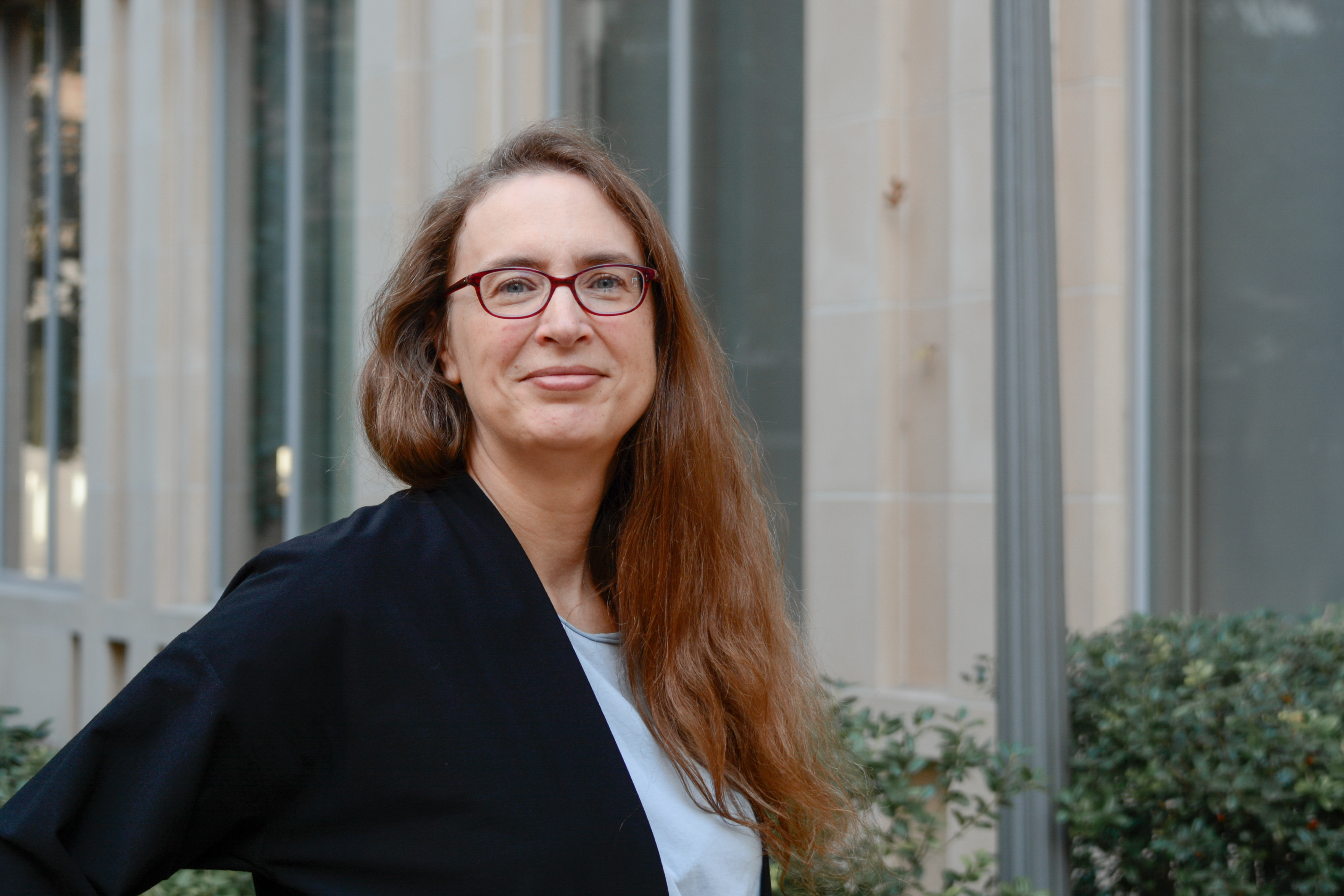
Maelys Blandenet is a Lecturer in Latin language and literature at ENS de Lyon, with a focus on ancient agronomy and digital humanities. She serves as the scientific coordinator of the AgroCCol project (ANR "Young Researcher", 2018-2024) and is affiliated with the HiSoMA laboratory. Her research spans Latin literature, ecocriticism, cultural anthropology, and digital humanities applications in classical studies. PhD in Latin Literature (Paris-Sorbonne University) Her research explores technical literature, rhetorical constructions of rural identity in Roman texts, and interdisciplinary digital editions of agronomic treatises. She specializes in Latin didactic poetry, historiography, and comic theatre from the Republic to the High Empire. Recent publications emphasize intertextual analysis of Columella’s De re rustica, digital corpus creation for Greco-Roman agronomy, and collaborative projects like the Dictionary of Images of Poetics in Antiquity. She leads initiatives combining philology with archaeobotany and digital indexing. Scientific activities include organizing international conferences, participating in science festivals, and directing virtual exhibitions such as "Le ménage des champs" (2021), showcasing Roman agricultural knowledge and its Renaissance transmission.
Corinne WECKSTEEN-QUINIO is a Lecturer in English at the University of Artois within the Faculty of Languages. She serves as Co-director of the 'Linguistics, translation studies and didactics' collection at Artois Presses Universitaire (APU) and is an active member of the Texts and Cultures Research Center. Education: Doctorate in English and North American Studies: Translation Studies (2005, University of Artois) External English aggregation (1993) Specializing in Translation Studies, WECKSTEEN-QUINIO's research reconciles the methodological rigor of linguistics with the analytical finesse of literary studies. Her three main research themes are 'Translation and Hermeneutics,' 'Translation and Didactics,' and 'Translation and Writing.' Her work particularly focuses on English-French translation challenges including cultural connotations, translation didactics, and the complexities of translating specific linguistic elements like the N-word, accents, dialects, and toponyms. She has extensively studied literary works such as Mark Twain's 'Huckleberry Finn' and John Grisham's 'A Time To Kill,' examining how cultural references are preserved or adapted in translation. Her recent publications demonstrate evolving trends in translation studies, with increasing focus on marginalized voices, racial terminology, and the cultural implications of linguistic choices. The articles reveal a trajectory from theoretical foundations toward more socially conscious translation practices, particularly examining how translation handles sensitive cultural concepts and identity markers. WECKSTEEN-QUINIO actively contributes to academic mentoring, serving as an external jury member for doctoral theses and as a follow-up committee member for PhD candidates. Her teaching responsibilities span undergraduate to master's level courses in translation and translation studies. She has prepared students for teaching competitions including CAPES and Internal aggregation, while also holding significant academic leadership roles such as Educational manager for the internal English aggregation (2012-2017). She has organized numerous international conferences and study days through the Texts and Cultures Research Center, including events on 'Translation and Transculturalities' and 'Translating Diversity.' Her upcoming project includes organizing the international conference 'Yves Bonnefoy: from poetry to a poetics of translation' (November 2023), continuing her commitment to advancing translation studies through collaborative academic engagement.
Martina Uličná is an Assistant Professor at the Faculty of Applied Languages, University of Economics in Bratislava, specializing in Slovak language instruction for foreigners. With academic affiliations at Comenius University (2006-2011, 2014-2017), Moscow State University, and the University of Prešov (1997-1999), her career spans three decades of language education and research. Her research focuses on: Color terminology in Slavic and Romance languages Language materials development Online language assessment Intercultural communication Floral lexical analysis Word order in Slovak acquisition Recent publications emphasize digital tools in language teaching, including monographs and textbooks for A1-A2 proficiency levels. Research projects include: VEGA 1/0107/18 Chromatism and its connotations KEGA 018EU-4/2020 ICT in online language education She has presented at international conferences in Kyiv and Pula, focusing on professional language assessment and online teaching methodologies.
Ján Keresty serves as an instructor at the Department of Romance and Slavic Languages within the Faculty of Applied Languages at the University of Economics in Bratislava, a position he has held since September 1, 2023. Previously, he served as a lecturer in the same department from September 23, 2013, to August 31, 2023. His research concentrates on Contrastive Linguistics between Slavic and Romance languages (particularly Russian and Slovak), Translation Studies focusing on untranslatable expressions and cultural adaptation, and Error Analysis in foreign language acquisition. He investigates lexical-grammatical structures, pleonasms, and translation strategies across linguistic boundaries. His publications from 2015-2017 reveal consistent thematic focus on cross-linguistic comparison, translation challenges in audiovisual contexts, and systematic error patterns in language learning, demonstrating significant contributions to applied linguistics and translation theory. No scientific awards are documented in the available information. Keresty has supervised 5 Bachelor's theses and 4 Master's theses. His research involvement includes participation in major VEGA projects: VEGA 1/0107/18: Chromatism and its connotations in the context of Slavic and Romance languages VEGA 1/0066/18: Model of marketing communication for health-oriented consumer behavior
Anita Ivanova Todoranova-Dushkova serves as a Lecturer in the Department of Modern Bulgarian Language within the Faculty of Modern Languages at St. Cyril and St. Methodius University of Veliko Turnovo. Her academic work focuses on contemporary Bulgarian linguistics with particular attention to how digital communication and technological advancement influence language structure and usage. She actively participates in academic discourse through conference presentations and scholarly publications addressing current linguistic challenges in the digital age. Dr. Todoranova-Dushkova's research interests center on Bulgarian phraseology, computer terminology, spelling norms, and digital communication linguistics. Her work examines how modern technology affects traditional language structures, particularly in the areas of orthography and phraseological units. She conducts comparative analyses between Bulgarian and Romanian languages, exploring shared linguistic features and cultural connections through lexical items related to concepts like money, water, and bread. Her research increasingly addresses the intersection of artificial intelligence and language processing, investigating how computational approaches interact with human linguistic intuition. Her recent publications reveal a clear trend toward examining digital language evolution, with numerous studies on how the digital generation approaches writing conventions, spelling norms, and technical terminology. She analyzes contemporary linguistic phenomena such as internet lexemes with computer-related roots (bug, crash) and investigates how crisis situations affect language use and humor. Her work bridges traditional linguistic scholarship with emerging digital communication patterns, making significant contributions to understanding modern Bulgarian language evolution. Dr. Todoranova-Dushkova regularly contributes to national and international academic conferences focused on digital transformation of education, language standardization, and phraseological studies. Her scholarly output appears in reputable Bulgarian academic journals and conference proceedings, demonstrating consistent research productivity through 2025. While specific information about her teaching responsibilities isn't detailed in the available materials, her position as Lecturer suggests active involvement in undergraduate language instruction. Her research focus on digital communication and modern language usage likely informs contemporary approaches to language teaching at the university level.
Katrin Erk is a Professor at the University of Texas at Austin , holding joint appointments in the Department of Linguistics and Department of Computer Science . She is actively involved in UT Austin NLP and computational linguistics groups and serves as a faculty advisor in the Natural Language Learning reading group . Education: PhD in Linguistics from Saarland University (2002), dissertation on tree description languages and ellipsis Research Focus: Computational semantics, graded word meaning representations, and integration of distributional models with logic-based sentence semantics Her work takes a distributional approach to lexical semantics, using word embeddings and contextualized representations to study how word meanings are modulated by context without relying on predefined sense inventories. At the sentence level, she develops probabilistic frameworks that combine logical representations with distributed models for weighted inference. Recent research explores narrative schemas and their role in understanding word connotations through typical story patterns. Key article trends show interdisciplinary work at the intersection of machine learning and linguistic theory , focusing on semantic representation challenges. Her publications demonstrate expertise in implicit argument prediction , world knowledge integration , and semantic plausibility modeling through computational methods. Scientific Awards: 2017: CSLI Fellow, Stanford 2013: College Research Fellowship, UT Austin 2009: Big XII Faculty Fellowship, UT Austin 2008: Dean’s Fellowship, UT Austin 2007: Summer Research Assignment, UT Austin 1998-2001: Doctoral Dissertation Scholarship from German Research Foundation (DFG) 1995-1998: Scholarship from Studienstiftung des deutschen Volkes 1994-1995: Scholarship from German Academic Exchange Service (DAAD) She maintains active office hours (Tuesdays 9:45-10:45, Wednesdays 10-11 and 3-4 in Fall 2024) and can be reached at katrin.erk@mail.utexas.edu .
Natasha Ajdžanović is Associate Professor at the Department of Russian Language and Literature , Faculty of Philosophy, University of Novi Sad. Since 2010, she has held teaching and administrative roles including lecturer, commission member for language testing, and coordinator for the Department of Slavic Studies at the Center for Languages. She works part-time (1/3 capacity) at multiple institutions. Education: BA in Russian Language/Literature (University of Novi Sad, 2000), MA (2010), PhD (2016) Key Commissions: B2 Russian testing (2015+), Russian Olympiad test writer (2013+), Court Interpreter certification (2011+), Total Dictation initiative (2014+) Her research focuses on Russian language pedagogy in bilingual environments, with publications analyzing: Contrastive Serbian-Russian grammar/lexicon Augmentative morphology in literary translation Indefinite adjective equivalents in Ivo Andrić's works Individualized teaching methods via workbooks Methodological practice for Russian as a foreign language Age-specific curriculum design She serves as Vice-President of the Slavic Society of Serbia (2019+) and Deputy Head of Slavic Studies Department (2019+), while maintaining editorial board membership for Methodical Perspectives journal.
Juan Ramón Martín San Román is a Professor at the Faculty of Communication, Universidad Pontificia de Salamanca, specializing in Audiovisual Communication and Advertising. He serves as Chair Manager within the faculty and is actively affiliated with research groups ICS (Innovation in Social Sciences) and Innovation in communication and marketing. He earned his PhD from Universidad Pontificia de Salamanca in 2005 with the thesis 'The connotative meaning of the plastic sign in visual communication: the redesign of newspapers in the strategic planning of public image,' supervised by Dr. Javier Nó Sánchez. His academic credentials establish him as a specialist in visual communication theory and practice. Dr. Martín San Román's research spans visual communication, graphic design, and user experience with particular emphasis on contemporary design movements. His work explores the New Ugly aesthetic, adaptive branding strategies, and the impact of digital technologies on visual communication. He has made significant contributions to understanding typography in digital contexts, feminist visual communication on social media, and user-centered design approaches for digital publications. His research consistently examines how visual elements convey meaning and influence user perception across various media platforms. His publication record from 2005-2022 reveals a consistent scholarly trajectory with increasing focus on digital media interfaces, particularly examining tablet publications, mobile journalism, and contemporary design trends. His work demonstrates a methodological approach that often combines semantic differential analysis with empirical user testing to evaluate visual communication effectiveness. As an educator, he has developed innovative teaching methodologies, including smartphone-based learning approaches for communication students, demonstrating his commitment to integrating emerging technologies into pedagogical practices. His research activities are conducted through his affiliation with the ICS research group and the Innovation in communication and marketing group, where he contributes to advancing knowledge in visual communication theory and practice within contemporary digital contexts.
Dr Kirk N. Olsen serves as Research Centre Manager at the Centre for Healthcare Resilience and Implementation Science within the Australian Institute of Health Innovation at Macquarie University, Sydney, Australia. Previously, he held positions as Research Fellow in the Macquarie University School of Psychological Sciences and Centre Manager of the Macquarie University Centre for Elite Performance, Expertise, and Training. He also manages the Macquarie University hub of the Music, Sound and Performance Research Group. Dr Olsen earned his Doctor of Philosophy in Psychology from Western Sydney University in 2011 and his Bachelor of Psychology (Honors) from the same institution in 2007. His academic journey includes postdoctoral positions at Macquarie University and Western Sydney University, where he contributed to research in auditory psychophysics and music cognition. Dr Olsen's research combines psychological science with music and sound to investigate the mechanisms underlying human auditory perception, cognition, and emotion, with recent emphasis on the benefits of music for health and well-being across cultures and within subcultures. His work spans several key areas including music and emotional health, psychosocial implications of violent music, social cohesion through intercultural music engagement, music passion and well-being, and the health benefits of physical musicality. His research often explores how music with violent themes can have positive emotional, cognitive, and social consequences for fans, challenging common assumptions about the effects of such music. His recent publications demonstrate a strong focus on cross-cultural music perception, the cognitive benefits of music in therapeutic contexts, and the social-emotional dimensions of musical experience. His work frequently employs meta-analytic approaches, qualitative analysis, and experimental methodologies to investigate the complex relationship between music, emotion, and well-being. Executive Dean's Early Career Researcher Award, Faculty of Human Sciences, Macquarie University (2018) 10th International Conference on Music Perception and Cognition 'Outstanding Young Researcher Award' (Honourable Mention) (2008) Dr Olsen has served in various leadership roles including as Web Developer and Social Media Manager for the School of Psychological Sciences, Early Career Researcher Representative on the School of Psychological Sciences Research Committee, and member of the Western Sydney University Low and Negligible Risk Human Research Ethics Review Committee. He is also Co-Editor of the book 'The science and psychology of music: From Beethoven at the office to Beyoncé at the gym' (Greenwood Press/ABC-CLIO). His research group focuses on understanding how music influences psychological processes and how these insights can be applied to improve health outcomes and social cohesion.
Stefan Keym is Professor of Musicology (W3) and Director of the Institute of Musicology at Leipzig University. He serves as Project Director for 'Robert Schumann's Poetic World' in Leipzig and chairs the Leipzig Mendelssohn Edition Commission. Keym is also Research Area Coordinator for the LeibnizScienceCampus 'Eastern Europe Global Area' and Spokesperson for the GfM Music Theory Group. Keym's research focuses on Modern European music history (17th-21st centuries) with regional emphases on France, Germany, and Eastern Europe. His work spans three interconnected areas: music within cultural transfers and national identity constructions; repertoires and institutions including concerts, publishers and press; and detailed work analysis and interpretation. His scholarship demonstrates particular expertise in German-Polish musical relations, symphonic tradition, and the analysis of modern musical theater. His recent publications show a consistent focus on cultural transfer phenomena in music history, with increasing attention to digital humanities approaches as evidenced by his DFG-funded project on symphonic repertoire internationalization featuring a comprehensive database. His work bridges historical musicology with theoretical frameworks examining how musical elements carry cultural meaning across national boundaries. Full Member of the Saxon Academy of Sciences (2024) Keym serves on numerous scientific advisory boards including for the Society for Music Research, Revue de musicologie, and MGG Online. He acts as a reviewer for major funding organizations across Europe including DFG, ANR (France), PCN (Poland), SNF (Switzerland), and FWF (Austria), as well as for Oxford University Press and various national academic foundations. His international collaborations include an ongoing partnership with Université Toulouse Jean Jaurès since 2019. As Director of the Institute of Musicology at Leipzig University, Keym leads research initiatives focused on cultural transfer in music, particularly examining how musical ideas, practices, and institutions move across national and cultural boundaries in European history.
Carlo Adolfo Porro is a Professor at the Department of Biomedical, Metabolic and Neuroscience Sciences at the University of Modena and Reggio Emilia. His research focuses on neural mechanisms of pain , empathy processing , and palliative care integration in oncology and hematology. He employs fMRI and neuroimaging to investigate pain perception, emotional recognition, and placebo analgesia . Key Research Areas Neurobiology of pain and empathy Clinical applications in palliative care Temporal perception and motor cognition Placebo mechanisms in neurorehabilitation Methodological Expertise Functional MRI analysis Psycholinguistic pain models Placebo-controlled clinical meta-analyses Motor ideation-execution paradigms Collaborative Networks Italian Consensus Conference on Pain in Neurorehabilitation International palliative care research groups Neuroimaging consortia His recent work examines deceptive pain expressions , metaphorical language in palliative care , and neural substrates of semantic pain . Publications span from 2016 to 2025 , with emphasis on clinical neuroscience and patient-centered care models . Porro's team explores neural network interactions , emotional recognition circuits , and contextual factors in pain processing .
Roman Fisun is a Researcher at the University of Regensburg, specializing in Slavic linguistics with a focus on semantic mapping, grammaticalization, and morphological analysis of pronouns. He earned his MA in Slavic Studies from the University of Regensburg (2016) and a BA in Russian Studies from Lomonosov Moscow University (2013). Current research projects include collaboration on the DFG-funded "Compound Indefinite Pronouns in Slavic Languages" (2016-2021). His academic work examines semantic features, grammaticalization sources, and contextual distribution of compound pronouns across Russian, Ukrainian, and Polish. Past roles include research assistant positions at both the University of Regensburg (2016-2019) and Ludwig Maximilian University of Munich (2018-2019). Roman actively contributes to linguistic conferences, including presentations at the 14th German Slavic Studies Congress (2022), online colloquiums on Slavic Linguistics (2020-2021), and international Russian language conferences (2014-2019).
Professor Björn Hansen is Chair of Slavic Linguistics at the Institute of Slavic Studies, University of Regensburg, where he has held a professorship since 2002. Previously, he served as Lecturer in Slavonic Linguistics at the University of Cambridge (2000-2002) and as a research assistant at the University of Hamburg. He is also Partnerschaftsbeauftragter for university cooperation with the University of Novi Sad (Serbia) and University of Łódź (Poland), and chairs the doctoral committee for the Faculty of Philosophy IV at Regensburg. Born: 1964 in Flensburg 1984-1991: Studies in East Slavic Studies and German Language and Literature at University of Hamburg 1995: PhD in Slavic Linguistics (University of Hamburg) 2001: Habilitation in Slavic Philology - Linguistics (University of Hamburg) Hansen's research spans multiple areas of Slavic linguistics, with particular focus on the structures of Polish, Russian, Serbian and Croatian languages. His work investigates language contact phenomena, areal typology, language change in Slavia, heritage linguistics, and corpus linguistics. He specializes in syntax and semantics, particularly examining modality, grammaticalization processes, contact-induced change, clitics (including clitic climbing), indefiniteness, subject encoding, frame semantics of public discourse, and the language of religion. His methodological approach often combines corpus-based analysis with theoretical linguistic frameworks. Analysis of Hansen's recent publications reveals consistent focus on microvariation in South Slavic languages, particularly Bosnian, Croatian, and Serbian. His work demonstrates expertise in clitic phenomena, modal constructions, and subject case marking. He frequently employs corpus-based methodologies to investigate rare linguistic phenomena, especially in underresourced languages. His research increasingly connects historical linguistics with contemporary language use, examining how grammaticalization processes evolve over time and across language contact situations. Member of DFG-Fachkollegium 104-02 (2009-2024) Official expert for Alexander von Humboldt Foundation (since 2011) Reviewer for multiple national research foundations including DFG, Swiss National Science Foundation, and Austrian Science Fund Member of editorial boards for several international linguistics journals Hansen has supervised numerous doctoral and master's students, with research spanning heritage language syntax, Slavic modality, language contact phenomena, and corpus-based linguistic analysis. He leads multiple externally funded research projects including 'seeFfield' (VolkswagenStiftung, 2022-2029), 'LangGener' (DFG-NCN, 2018-2022), and several DFG projects examining microvariation in Bosnian/Croatian/Serbian, Polish-German bilingualism, and historical semantics of corruption. As Principal Investigator of the Graduate School for East and Southeast European Studies (2012-2019), he has significantly contributed to interdisciplinary research in the region. Hansen directs the Binational Study Program 'German-Polish Studies' (funded by DAAD) and has organized numerous international conferences and workshops on Slavic linguistics, including the 'Clitic Climbing' workshop (2017) and 'Perspectives of German-Slavic Multilingualism' conference (2016).
Dorota Głuszak is an Assistant Professor at the Department of Slavic Linguistics, Institute of Linguistics and Literary Studies, Faculty of Languages, Literatures and Cultures at Maria Curie-Skłodowska University. Her academic career spans since 2014, starting as an assistant at the Russian Language Department before becoming an adiunkt in 2019. PhD in Humanities (2018) Specializes in historical linguistics, phraseology, and loanword adaptation Her research focuses on lexical borrowing processes in 17th-century Russian texts, particularly the Vesti-Kuranty periodicals. She examines how foreign terms were integrated into Russian language systems, covering phonetic adaptation, morphological changes, and semantic evolution. Publications include a monograph on borrowed nouns in Vesti-Kuranty and numerous articles analyzing polonisms, gallicisms, and germanisms in early modern Russian. Her work reveals patterns in how Russian press of the era handled foreign concepts related to technology, finance, and culture. She has participated in international research stays at: Russian State Pedagogical University (St. Petersburg, 2020) Belarusian State University (2012) Moscow’s Pushkin Institute (2007)
Prof. Roman Lewicki is a distinguished faculty member at Maria Curie-Skłodowska University (UMCS) , where he has held leadership roles including Head of the Russian Language Department (1994–2019) and Head of the Department of Slavic Linguistics (2019–2023). He earned his PhD in Humanities (1984) and habilitation (1994) from UMCS, focusing on translation theory and lexicography. Academic Leadership : Directed the Institute of Slavic Philology (1997–2003) and organized the Translation–Language–Culture conference series (2002–2018). Research Focus : Specializes in translation strategies, proper name equivalence, cultural connotations, and Slavic linguistic interactions. His work bridges Polish and Russian lexicography, with notable publications on religious terminology and cross-cultural phraseology. Scientific Awards : Złoty Krzyż Zasługi (1999) Złoty Medal za Długoletnią Służbę (2013) Nagroda Rektora UMCS Homo Didacticus (2022) Teaching & Mentorship : Supervised over 250 MA graduates at UMCS and Biała Podlaska institutions, teaching courses in translation theory, descriptive grammar, and general linguistics.