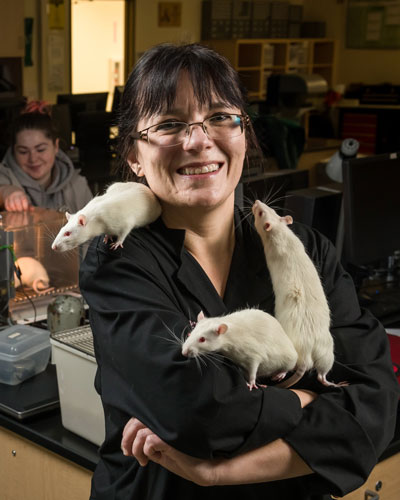
Gwen Lupfer is an Associate Professor in the Department of Psychology at the University of Alaska Anchorage, affiliated with the College of Arts and Sciences. Her career spans research, teaching, and administrative service. Education: Ph.D., M.S., and B.A. in Psychology from Kansas State University (2004, 2001, 1998). Teaching: Courses in Evolutionary Psychology, Behavioral Neuroscience, and Psychology of Learning. Service: Chair of multiple faculty search committees, member of institutional and departmental committees including the Institutional Animal Care and Use Committee (since 2005). Research Interests: Focus on impulsive behavior, social learning across species (rats, dwarf hamsters, domestic dogs), binge-eating mechanisms, and energy regulation disruptions. Her work integrates behavioral neuroscience with evolutionary perspectives. Grants: Secured $2500 (2014) for sucralose impact studies and $1500 (2005) for social learning research in dogs. Publications highlight cross-species behavioral analysis and translational implications for human health.
Andrea Carnaghi is a Full Professor in Social Psychology at the University of Trieste, with a focus on intergroup relations and social cognition. He holds key roles in doctoral programs (Coordinator for Neural and Cognitive Sciences, Cycles XXXVIII-XXXIX) and serves on multiple Boards of Studies. Education: Ph.D. in Psychological Science (Catholic University of Louvain, 2004); Clinical Psychology degree (University of Padova, 2000) Research Interests His work spans: Language's role in social perception (noun vs adjective effects) Homophobic epithets and their impact on prejudice Objectification of women and neural correlates Bullying/cyberbullying prevention programs Stereotype revision and acculturation barriers for immigrants Scientific Recognitions IAS Fellowship (University of Surrey, 2018) Gordon Allport Prize (2008) for intergroup research He supervises a research group analyzing social exclusion, dehumanization, and hormone-behavior interactions, with funding from Regione Friuli Venezia Giulia and national grants.
Jean Lamont is an Associate Professor of Psychology in the Department of Psychology at Bellarmine University's College of Arts and Sciences. Her research bridges social and health psychology, focusing on how body stigma impacts physical health through psychological and physiological pathways. Education: Bachelor of Arts in Psychology and English Literature from Denison University Master of Arts in Clinical Psychology from Connecticut College Doctor of Philosophy in Social Psychology from Pennsylvania State University Research Focus: Dr. Lamont investigates body shame, weight bias, and their consequences for health behaviors and outcomes. Her work examines mechanisms like body responsiveness and self-compassion, with particular attention to menstrual health, healthcare avoidance, and intergenerational body image transmission. Research is conducted through the Emotions, Health, & the Body (EHB) Lab , which provides undergraduate research opportunities. Publication Trends: Recent work (2022-2024) shows increasing focus on mechanistic pathways (body responsiveness, rumination), menstrual health connections, and intergenerational dynamics. Over 70% of publications involve undergraduate co-authors, demonstrating strong student mentorship. Key journals include International Journal of Behavioral Medicine , Current Psychology , and Women's Reproductive Health . Scientific Awards: No awards were mentioned in the source material. Advising and Grants: Dr. Lamont actively supervises undergraduate research assistants in the EHB Lab, with consistent student co-authorship across publications. While specific grants aren't documented, her longitudinal research program (2012-2024) indicates sustained funding support for lab operations and student stipends. Laboratory: The Emotions, Health, & the Body (EHB) Lab serves as the primary research hub, facilitating studies on body image, health behaviors, and stigma through experimental and survey methodologies. The lab emphasizes undergraduate involvement in all research phases from design to publication.
Jenny Cole is a Lecturer in Psychology at Keele University's School of Psychology. Her qualitative research examines body image, weight stigma, and gendered health experiences, with recent work on endometriosis impacts and digital avatar influences. Publications investigate selfie paradoxes in young women, male body image across life stages, and video game character representation. Teaching includes qualitative methods and social psychology courses. Her career spans Staffordshire University, Manchester Metropolitan University (as Digital Education Lead during COVID-19), and Keele University since 2022.
Jane Turner is a Senior Lecturer at London Metropolitan University and an acclaimed choreographer, researcher, and director of the dance company TURNING WORLDS. With a career spanning dance, theatre, film, and interdisciplinary collaborations, she merges art, science, and technology to pioneer innovative performance practices. Education: PhD in Complexity as Choreographic Model (University of Chichester, 2012) Professional Affiliations: External Examiner at University of Bedfordshire and ESART Barcelona; collaborator with Cambridge University Computer Laboratory, British Embassy Warsaw, and Imperial College London Her research focuses on self-organizing systems, complexity, and emergence in choreography, showcased through projects like Gog Magog (2020) and Marconi’s Leap (2021). Recent articles and performances highlight her work in digital performance, environmental art, and intercultural praxis. Jane’s work has earned recognition, including the Pavilion Dance South West’s Joie de Vivre Bronze Award (2016). She is a Senior Fellow of the Higher Education Academy and facilitates collaborations with organizations like Duckie, National Portrait Gallery, and CAST. Teaching Expertise: Specializes in dance, choreography, and creative practice with diverse communities, including prisoners, over-60s, and young people. Labs/Teams: Collaborates with international artists, scientists, and technologists; leads seminars at institutions like University of Cambridge and University of Essex.
Robert G. Lord is a Professor affiliated with Durham Business School at Durham University. Previously, he served as Distinguished Professor of Psychology at the University of Akron for 38 years. He holds a Ph.D. from Carnegie-Mellon University (1975) and has authored over 125 journal articles and books. His research focuses on leadership perceptions, motivation, complexity theory, ethical leadership, and cognitive processes in organizational behavior. Lord is a Fellow of the American Psychological Association and Association for Psychological Sciences, and has received prestigious awards for his contributions to leadership research. Education: Ph.D. in Psychology, Carnegie-Mellon University, 1975 Research Interests: Lord’s work explores leadership dynamics through cognitive and social frameworks. Key themes include leadership categorization theory, follower self-identity, complexity leadership theory, and the interplay of emotion and memory in leadership processes. He emphasizes dynamic systems approaches to understanding leader-follower interactions and has pioneered studies on leadership emergence and identity dynamics. Recent Trends in Publications: Recent work focuses on leader identity fluidity, cognitive architectures in leadership perception, and the impact of vulnerability and narcissism on leadership behaviors. His research bridges psychological theory with organizational practices, emphasizing practical applications for leadership development. Awards and Honors: 2009 Leadership Quarterly Distinguished Scholar Award 2012 SIOP Distinguished Scientific Contribution Award Fellow of APA and APS Advising and Grants: He supervises doctoral students like Carolina Bysh and has contributed to grants exploring leadership skill development, gender/race impacts on leadership, and ethical leadership frameworks. Labs/Teams: While no specific lab is named, his collaborations involve interdisciplinary teams studying leadership processes, including work with Durham Business School colleagues and international researchers in leadership and organizational behavior.
Kimberley L. Gammage is a Professor in the Department of Kinesiology at Brock University, serving as Director of the Master of Professional Kinesiology Program and the SeniorFit exercise program at the Brock-Niagara Centre for Health & Well-Being. Her research focuses on body image, particularly positive body image, and its relationship with physical activity across diverse populations including university students, older adults, and individuals with chronic conditions such as multiple sclerosis and cardiovascular disease. She employs both qualitative and quantitative methodologies to explore how exercise environments, yoga, and educational interventions can improve psychological and physiological outcomes. Recent work includes studying the impact of online fitness programming during the pandemic and cortisol responses to body image threats. Professional Affiliations: NASPSPA, SCAPPS, Digest Editor for the Journal of Sport and Exercise Psychology Certifications: Certified fitness, spin, and yoga instructor Her teaching portfolio includes courses such as Exercise Psychology, Body Image, and Programming for Older Adults. She leads initiatives like the BIAS (Body Image Awareness Seminars) program, co-created with community members to promote positive body image. Research grants include SSHRC Insight Grant ($192k) for studying positive body image across the lifespan and NSERC funding ($40k) examining psychobiological responses to social-evaluative threats.
Alan McKee is a Professor and Head of the School of Art, Communication and English at The University of Sydney. He holds a PhD in Communication and Media Studies from the University of Glasgow. His research focuses on pornography's effects, healthy sexual development, and the role of entertainment in society. McKee has authored influential books such as What Do We Know About the Effects of Pornography After Fifty Years of Academic Research? (2022) and Objectification: On the Difference Between Sex and Sexism (2021). McKee's work bridges media studies, sexuality studies, and cultural analysis. He advocates for evidence-based policies on digital sexual literacy and has been recognized as Australia’s leading sex and sexuality researcher (2025). His recent grants include a 2024 Australian Research Council project on improving digital sexual literacy. He frequently engages with media, discussing topics like ethical pornography criteria (2023) and age verification systems (2024). His research appears in journals like New Media & Society and Culture, Health & Sexuality , emphasizing interdisciplinary collaboration between humanities and social sciences. Awards: Leading sex and sexuality researcher (Australian newspaper, 2025) Grants: 2024 ARC Discovery Project on digital sexual literacy Labs/Teams: Leads the School of Art, Communication and English at Sydney University, fostering interdisciplinary research in media and cultural studies.
Sophia Choukas-Bradley is an Associate Professor in the Gender, Sexuality, & Women's Studies Program at the University of Pittsburgh, affiliated with the Kenneth P. Dietrich School of Arts and Sciences. Her research focuses on sociocultural and interpersonal influences on adolescent mental health, particularly examining how social media impacts body image, identity development, and well-being in LGBTQ+ youth. She holds a Ph.D. from the University of North Carolina at Chapel Hill and supervises graduate advisees in clinical, developmental, and social psychology. Choukas-Bradley’s work emphasizes intersectional approaches to understanding how gender, race/ethnicity, and sexual identities intersect with body image and mental health. Her lab (TAYA Lab) explores topics like minority stress among gender minorities, digital media’s role in self-objectification, and pandemic-related mental health trends. Key areas include LGBTQ+ youth resilience, social media consciousness, and feminist identity formations. Her recent publications highlight frameworks linking social media use to adolescent girls’ mental health ('The perfect storm'), longitudinal studies on appearance-related consciousness, and qualitative insights from transgender adolescents. She has contributed to theoretical reviews on digital well-being during the pandemic and co-designed interventions to reduce social isolation among rural LGBTQ+ youth. Key Research Themes: Social media psychology, body image, LGBTQ+ health, intersectionality Labs/Teams: TAYA Lab (Twitter: @TAYA_Lab) Grants: NSF CAREER grant for 'Social Media and Body Image Among Adolescent Girls' (2024) Choukas-Bradley currently does not accept new graduate students but collaborates on interdisciplinary projects across psychology, public health, and digital media studies.
Dr. Eduardo Vasquez is a Senior Lecturer in Forensic Psychology and Senior Academic Adviser at the School of Psychology, University of Kent. His work bridges forensic and social psychology, focusing on aggression, inter-group violence, and alcohol-related behavior. Research Interests Aggression and displaced aggression Inter-group relations (personalization, self-disclosure, inter-gang violence) Alcohol and social behavior (aggression, inter-group anxiety) Sexual objectification and domestic violence Supervision & Grants He supervises postgraduate students, including Alvaro Rodriguez and Anita Ruddle, whose work explores domestic violence proclivity and aggression predictors. Grants include funding from Kent Police (2015, £24,000) and Stockholm Police (2012, €2,500) for research on neighborhood panels and crime displacement.
Randi L. Garcia is an Associate Professor of Psychology and of Statistical & Data Sciences at Smith College, where she has taught since 2016. Her interdisciplinary work bridges social psychology and statistical methodology, with a focus on understanding how status and power dynamics in daily interactions reproduce social inequalities. She teaches courses in both the Psychology Department and the Program in Statistical and Data Sciences, including research methods, psychology of women and gender, and statistical methods for undergraduate research. Education: PhD in Social Psychology, University of Connecticut MS in Statistics, University of Connecticut BA in Psychology and Women's Studies (Double Major), University of California, Los Angeles Randi Garcia's research explores interpersonal interactions and relationships among people with different social group identities across various contexts. Her work examines sexual objectification among newly acquainted individuals, racial bias in dyadic and group interactions, and inequality in household labor. Using quantitative methods and dyadic data analysis, she investigates how daily interactions contribute to larger social inequalities. Her methodological expertise includes the Actor-Partner Interdependence Model and other advanced statistical techniques for analyzing relational data. Analysis of Garcia's recent publications reveals a consistent focus on intersectional approaches to understanding social dynamics. Her work spans social psychology, family studies, and statistical methodology, with particular emphasis on LGBTQ+ families, racial dynamics in interpersonal interactions, and gender inequality. A recurring theme is the application of sophisticated dyadic and group-level statistical models to understand how individual experiences are shaped by relational contexts. Scientific Awards: Sherrerd Prize for Distinguished Teaching, Smith College, 2019 President's Innovation Challenge, Smith College, 2018-2019 Kahn Institute short-term project, Smith College, 2018 SGA Smith College Teaching Award (untenured Faculty), 2018 Curriculum Enhancement Grant (SDS/MTH 290), Smith Botanic Garden, 2018 APA Division 49, Small Groups, Dissertation Award Finalist, 2013 Garcia serves as a Methods and Statistics Associate Editor for the Journal of Personality and Social Psychology and on the editorial board of Personality and Social Psychology Bulletin. She has advised numerous undergraduate researchers, many of whom have co-authored publications with her. Her work has been supported by various grants including the Curriculum Enhancement Grant from the Smith Botanic Garden. Garcia has developed the dyadr R package for dyadic data analysis, demonstrating her commitment to advancing methodological approaches in social psychology research. Randi Garcia leads research on sexual objectification, dyadic data analysis, and inequality in the home. She collaborates with colleagues across disciplines, particularly in the areas of LGBTQ+ family studies and racial dynamics. Her work with the dyadr R package has created valuable resources for researchers studying interpersonal relationships. She frequently conducts workshops on dyadic data analysis, including the annual Data Analysis Techniques for Interpersonal Contexts (DATIC) workshop.
Kathleen Rodgers is an Associate Professor in the Department of Human Development at Washington State University (WSU), part of the College of Agricultural, Human, and Natural Resource Sciences. Her research focuses on adolescent development, risk-taking behaviors, and the intersection of media influence with gender socialization and sexuality. She holds a Ph.D. in Child and Family Studies from the University of Wisconsin-Madison (1995) and has held academic and extension roles at WSU since 2003. Her work examines how community contexts, poverty, and media content shape adolescents' health decisions. Notable projects include studying music and alcohol media's impact on sexual attitudes and the role of parental communication in Tanzania. Collaborations with Dr. Stacey Hust led to innovations in media literacy and gender studies, earning them the 2014 National Council on Family Relations Innovation Grant and the Mary Ann Yodelis Smith Award for Feminist Research. Key themes in her research include sexual objectification in media, rape myth acceptance, and interventions targeting alcohol-facilitated sexual assault. She has advised numerous graduate students and contributed to community-based initiatives like Youth Asset Mapping and the Teen Assessment Project. Education: Ph.D. Child and Family Studies, UW-Madison, 1995 M.S. Child and Family Studies, UW-Madison, 1989 B.S. Child and Family Studies, Cal Poly, 1983 Grants & Awards: 2014 National Council on Family Relations Innovation Grant 2014 AEJMC Feminist Research Award Her publications span Journal of Marriage and Family , Journal of Interpersonal Violence , and Psychology of Popular Media Culture . She leads interdisciplinary teams exploring media effects on youth behavior and advocates for culturally responsive sexual health education.
Tiffany Brown is an Associate Professor in the Department of Psychological Sciences at Auburn University and Co-Director of the Auburn Eating Disorders Clinic (AEDC). She previously served as an Assistant Project Scientist and licensed clinical psychologist at the UCSD Eating Disorders Program. Her research focuses on developing interventions for appearance-based and eating disorders in marginalized populations, particularly LGBTQ+ individuals, males, and gender-diverse groups. She also examines interoception, anxiety sensitivity, and treatment outcomes across genders and sexual identities. Education: PhD, Florida State University Post-doctoral work at UCSD Eating Disorders Program Research Interests: Her work emphasizes prevention programs targeting LGBTQ+ and male populations, muscle dysmorphia risk reduction, and adapting dialectical behavior therapy (DBT) for eating disorders. She investigates sociocultural factors influencing body image, including media impact and minority stress. Lab Affiliations: She leads the Appearance Concerns, Eating, Prevention and Treatment (ACCEPT) Lab at Auburn, which collaborates with international teams (e.g., Brazil, Denmark) to address eating disorders in underserved communities. The lab also explores systemic barriers to care and culturally adapted interventions. Advising & Training: Guides a diverse team of graduate students and postdocs focusing on eating disorders, body image, and mental health equity. Current advisees include Kristin Denmark (LGBTQ+ body talk), Marley Billman Miller (intersectionality in treatment), and Jennifer Finkelstein (biological and sociocultural factors in LGBTQ+ eating disorders).
Dr. Jerald Morgan is an Assistant Professor of Psychology at the University of Wisconsin-Madison, leading the Intersectionality and Marginalization (I.AM) Lab. Her work focuses on sociocultural influences on Black women’s gender beliefs, sexual well-being, and experiences of sexualization. She employs interdisciplinary methods from social psychology, Black feminism, and communication studies to examine media’s role in shaping stereotypes about Black youth and their impact on mental and sexual health. Research Interests: Dr. Morgan’s research centers on two key areas: 1) media’s role as a socialization agent for Black adolescents regarding gender and sexuality, and 2) consequences of stereotype awareness on Black women’s well-being. Her recent work explores how awareness of the Jezebel stereotype impacts sexual attitudes and experiences of sexualization. Recent Publications: Her most recent work (2023) addresses community-building strategies for scholars of color in academia. Earlier studies (2022–2017) examine media representation of Black women, stereotype effects on mental health, and media’s influence on Black students’ gender ideologies. Team & Collaborations: Lab Manager Milena is pursuing a PhD at University of Illinois-Chicago, while RA Maddy Cometa advances to University College Dublin. RAs Jordyn Chesir and Odilon Aranda have received awards for their contributions to the lab’s research. Lab Mission: The I.AM Lab adopts a strengths-based approach to study how oppression shapes Black women’s identities and behaviors, emphasizing self-definition despite systemic marginalization.
Meredith Martin serves as an Associate Teaching Professor in the Department of Psychology within Syracuse University's College of Arts and Sciences, where she teaches foundational and advanced undergraduate courses including Foundations of Human Behavior and Psychology of the Adolescent. Her academic credentials include: Ph.D. in Developmental Psychology from the University of Rochester (2014) M.A. in Developmental Psychology from the University of Rochester (2011) B.A. in Psychology and Social Anthropology from SUNY Binghamton (2006) Dr. Martin's research investigates developmental mechanisms of insecurity in youth, examining how threats to safety in family and peer contexts impact psychological development. Her work integrates biological, emotional, and cognitive perspectives to understand pathways from insecurity to psychopathology, with particular focus on interparental conflict, parent-child relationships, peer victimization, and resilience-promoting factors like secure friendships. She emphasizes how developmental stage influences coping strategies and security restoration. Her recent publications reveal consistent thematic focus on family systems and youth adjustment, with empirical studies in top journals like Child Development and Family Process exploring intergenerational transmission of conflict, emotion regulation processes, and contextual influences on developmental trajectories. Teaching excellence has been formally recognized through: Laura J. and L. Douglas Meredith Teaching Recognition Award for Early Career Performance (2023) Writing Across the Curriculum Faculty Fellowship (2022) Dr. Martin actively mentors undergraduate students through Psychology Club advisement and honors capstone supervision, while contributing to faculty development through workshops on active learning pedagogy, diversity integration in curricula, and graduate school preparation for psychology students.




.jpg)