Klaus Freiherr von Gleissenthal is an Assistant Professor at the Faculty of Science and the Network Institute at Vrije Universiteit Amsterdam. His research focuses on computer security, hardware security, and programming languages. He teaches courses on compiler construction and verification for security. His work addresses challenges in embedded systems, microcontroller-based devices, and open-source processor verification. Collaborations span international research networks, emphasizing practical applications in cybersecurity and hardware-software co-design. Research Interests: Hardware-Triggered Security Mechanisms Type Systems and Static Analysis Side-channel Attack Mitigation Compiler Optimization Impacts on Security His recent publications explore topics such as data integrity in microcontrollers, refinement type systems, and leakage contracts for open-source processors. He actively contributes to conferences like CCS and PLAS, fostering interdisciplinary approaches to security challenges.
Prof. A.D. Pimentel holds a full professorship at the Informatics Institute of the University of Amsterdam, leading the Parallel Computing Systems (PCS) group within the Systems and Networking Lab. His research focuses on multi-core and multi-processor systems, emphasizing performance, energy efficiency, dependability, and productivity in system design and runtime management. He earned his PhD and MSc in Computer Science from the University of Amsterdam in 1998 and 1993, respectively. Current roles: Chair of PCS group, Board member of Advanced School for Computing and Imaging (ASCI), and ICT Research Platform Nederland (IPN) Teaching: Courses on Multi-core Processor Systems, Embedded Software, and Architecture Research interests span edge AI, sustainable computing, and system-level modeling. Recent work includes innovations in energy-efficient scheduling, thermal management in 3D-stacked systems, and adaptive CNN inference at the edge. Over 25 years of contributions to embedded systems design space exploration and hardware/software co-design have been recognized through awards like the IEEE CEDA Outstanding Service Award (2025). Awards: IEEE DATE Fellow (2025), NWO Knowledge & Innovation Covenant grant lead Active in conference organization, serving as General Chair for Embedded Systems Week (2026) and Design Automation and Test in Europe (DATE 2024). Engages in cross-disciplinary projects like improved secure semiconductor evaluation (ISSE) and energy labeling for digital services.
Erik van der Kouwe is an Assistant Professor at the Faculty of Science, Vrije Universiteit Amsterdam, holding dual appointments in the Computer Systems department and the Network Institute. His research focuses on system security, fault injection, fuzzing, and embedded systems security. He contributes to both theoretical advancements and practical implementations of security mechanisms. Key research areas include mitigating vulnerabilities through hardware-software co-design, exposing compiler optimization flaws that evade sanitizers, and developing efficient fuzzing frameworks for malware analysis. His work often bridges academic research with real-world applications in embedded systems and operating systems. Recent publications highlight innovations like InvisiGuard for microcontroller security, hwdbg for hardware debugging frameworks, and Enviral for environment-aware malware analysis. His research has been published in top-tier venues such as IEEE Transactions, ACM conferences, and workshops like EuroSEC. Teaching responsibilities include Advanced Operating Systems, Secure Programming, and Software Security courses. Collaborations span international teams working on topics like compiler hardening, embedded system resilience, and vulnerability benchmarking.
Lejla Batina is a full professor of security of embedded devices in the Digital Security (DiS) group at Radboud University's Computing Science Department within the Faculty of Science. She also holds an adjunct professorship at the Selmer Center of the University of Bergen, Norway. Her research focuses on applied cryptography, embedded systems security, and leveraging machine learning for side-channel analysis. Batina has contributed significantly to cryptographic implementations, including ECC and post-quantum cryptography. She has organized major conferences such as CHES 2014, EUROCRYPT 2020/2021, and ACNS 2024, and currently serves on editorial boards like ACM TECS. Notable achievements include a VIDI grant (2014) and IEEE Senior Membership (since 2018). Her work spans over 240 publications, covering topics like SCA-resistant ECC, neural network security, and hardware countermeasures. Batina has mentored over 20 PhD students and postdocs, many of whom now hold academic or industry leadership roles. Her lab, CESCA, emphasizes collaborative research in cryptographic hardware and embedded systems security. Education: Professional Doctorate in Engineering (PDEng) in Mathematics for Industry, TU Eindhoven (2001) PhD in Mathematics, KU Leuven (2005) M.Sc. in Mathematics, University of Zagreb (1995) Research Interests: Her work bridges theoretical cryptography and practical implementations, with emphasis on Side-channel and fault attacks on embedded devices Machine learning applications in security Low-cost countermeasures for constrained hardware Post-quantum cryptography implementations Security of neural networks and AI models Grants & Awards: VIDI grant from Dutch Research Council (2014) Senior Member, IEEE (2018–present) Editorial Board Member, ACM Transactions on Embedded Computing Systems (since 2018) Advising & Mentorship: Supervised 15+ PhD students and numerous postdocs, including prominent alumni like Dr. Stjepan Picek (Associate Professor at Radboud) and Dr. Lukasz Chmielewski (Assistant Professor at Masaryk University). Labs & Teams: Leads the Cryptographic Embedded Systems and Security Applications (CESCA) lab, collaborating internationally on hardware-software co-design for secure implementations.
Pepijn Pinkse is a Full Professor at the MESA+ Institute of the University of Twente. His research focuses on quantum optics and nanophotonics, with applications in quantum information processing and secure communication. Education Habilitation, Technische Universitat Munchen (2008) PhD in Physics, University of Amsterdam (1997) Master in Physics, Leiden University (1993) Research Interests Pepijn Pinkse's work spans quantum technologies, including quantum computing, communication, and simulation using nanofabricated photonic structures. His studies often involve complex media and reconfigurable quantum-optical circuits, contributing to the advancement of secure quantum systems and integrated photonic processors. Scientific Awards Fellow of the Optical Society (2017, 2018) Posterprijs (2012) Poster prize at AMO meeting (2015) The Physics Prize of the Academy of Sciences in Göttingen (2004) Advising and Collaborations While no specific advisees are listed, Pinkse collaborates on datasets and research projects, including the 2023 dataset on quantum simulation thermodynamics and numerous invited talks and presentations in 2024 regarding quantum authentication and photonic structures.
Georgi Gaydadjiev is a Professor in Innovative Computer Architecture at the University of Groningen's Faculty of Science and Engineering. Previously, he held roles including Chair Professor at TU Delft and Chalmers University of Technology, and served as VP of Dataflow Software Engineering at Maxeler Technologies. He holds a PhD from TU Delft and has over 35 years of industry and academic experience, focusing on reconfigurable computing, high-performance systems, and energy-efficient architectures. His research spans embedded systems, fault tolerance, and scalable architectures. Education: MSc Electrical Engineering (TU Delft), PhD (TU Delft), studies at Voenmeh (Baltic State Technical University). Research interests include reconfigurable computing, advanced architectures, parallel systems, and HPC. He leads projects funded by EU, Google, and Swedish Research Councils, addressing exascale computing and customized hardware. His work has been recognized with awards like the CES Design Showcase (1999) and best paper awards at ICS'10 and WiSTP'07. He advises PhD students and oversees labs like Maxeler IoT-Labs BV, focusing on deploying dataflow technology beyond data centers.
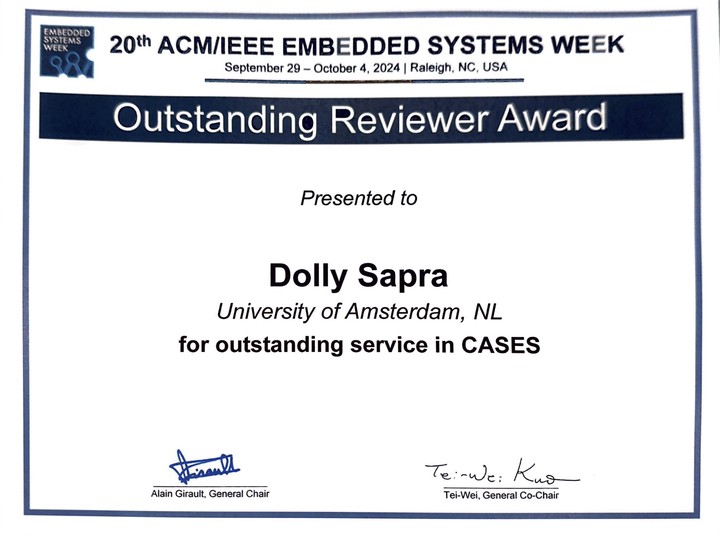
Dolly Sapra is a researcher at the University of Amsterdam , affiliated with the Department of Computer Science under the Faculty of Science . Her work focuses on adaptive deep learning, secure neural inference, energy-efficient computing, and fault-aware systems. She received the IEEE/ACM CASES '24 Outstanding Reviewer Award . Her research spans Machine Learning , Edge Computing , and Embedded Systems , with a focus on Model elasticity for CNNs Privacy-preserving edge intelligence Power-efficient inference Transformer optimization Climate-aware computing . The 15 most recent articles highlight her leadership in adaptive neural architectures , secure multi-party inference , and sustainable computing , with applications in embedded systems and real-time environments .
Peter Schwabe is a scientific director at the Max Planck Institute for Security and Privacy (MPI-SP) in Bochum, Germany, and a part-time professor for cryptographic engineering in the Digital Security Group at Radboud University in Nijmegen, The Netherlands. He has held these positions while leading significant research initiatives in post-quantum cryptography and high-assurance cryptographic implementations. His research interests center on post-quantum cryptography, cryptographic engineering, and high-assurance crypto software. Schwabe's work focuses on developing and verifying cryptographic implementations that are resistant to side-channel attacks while maintaining high performance. He has made significant contributions to lattice-based cryptography, hash-based signatures, and the standardization of post-quantum cryptographic algorithms. His research bridges theoretical cryptography with practical implementation concerns, particularly for resource-constrained environments. Analysis of Schwabe's recent publications reveals a strong focus on post-quantum cryptography standardization, formal verification of cryptographic implementations, and protection against side-channel attacks. His work spans theoretical advances in cryptographic primitives, practical implementations for real-world systems, and tools for verifying the security properties of cryptographic code. A significant portion of his recent work relates to the CRYSTALS-Kyber standard selected by NIST, including formal verification of its security properties and implementation correctness. Schwabe has served as an elected member of the IACR Board of Directors, member of the IACR CHES Steering Committee, and member of the IACR RWC Steering Committee. He is also a member of the advisory boards of Bitmark Inc., PQShield, Neutrality, and SciEngines, demonstrating his influence in both academic and industry cryptographic communities. As an advisor, Schwabe has supervised numerous Ph.D. students working on various aspects of cryptography, including post-quantum cryptography, side-channel resistance, and formal verification of cryptographic implementations. His work on the EPOQUE project (Engineering post-quantum cryptography), funded by an ERC Starting grant from October 2018 to December 2023, demonstrates his leadership in advancing post-quantum cryptographic research. Schwabe leads research efforts at the intersection of formal methods and practical cryptography, with a particular emphasis on creating high-assurance cryptographic implementations that can withstand both theoretical and practical attacks. His work often involves collaboration with international teams across academia and industry to advance the state of the art in cryptographic engineering.
Ileana Buhan is an Assistant Professor at Radboud University Nijmegen's Digital Security Group and a member of the CESCA Lab. Her research focuses on hardware security, particularly advancing tools for secure hardware design and mitigating side-channel vulnerabilities. She previously held roles at Riscure (2011–2020) as a security evaluation manager and product manager, and at Philips Research (2008–2010) as a senior scientist. She earned her Ph.D. in Cryptography with Noisy Data from the University of Twente in 2008, recognized with the 2008 EBF European Biometrics Research Industry Award. Her work emphasizes practical security evaluation methods, automated leakage modeling (e.g., ABBY tool), and hardware-software co-design for resistance against side-channel attacks. She actively contributes to conferences like CHES, FDTC, and CARDIS, often in program committee roles. Recent invited talks include topics such as AI-driven vulnerability prediction, architecture-level simulators for root cause analysis, and automated tools for cryptographic implementation security. Her research spans RISC-V processors, microarchitecture analysis, and the intersection of machine learning with hardware security. Notable contributions include frameworks for leakage detection, fault simulation, and explainable side-channel analysis. She balances academic rigor with industry relevance, aiming to bridge gaps between theoretical security and real-world implementation challenges.
Dr. Marten van Dijk is a Full Professor in the Computer Security department at Vrije Universiteit Amsterdam (VU) since 2022 and a Group Leader for Computer Security at CWI since 2020. He also holds a Gratis Full Research Professor position at the University of Connecticut's ECE Department since 2020. Previously, he served as Associate and Full Professor at the University of Connecticut and held research roles at MIT CSAIL, RSA Laboratories, and Philips Research. PhD in Mathematics (1997, Eindhoven University of Technology) M.S. in Mathematics (Cum Laude, 1993) M.S. in Computer Science (Cum Laude, 1991) His research focuses on foundational computer security problems using cryptographic principles, including secure processor design, oblivious computation, and privacy-preserving machine learning. Notable contributions span Physical Unclonable Functions (PUFs), Aegis secure processor architecture, and oblivious RAM protocols. 15+ publications in 2023-2025 address topics like PUF cryptanalysis, differential privacy in federated learning, and Byzantine fault tolerance Key journals: IEEE Transactions on Computers, Journal of Cryptology, ACM CCS Conference Award highlights include: IEEE Fellow (2022) for secure processor design and encrypted computation IEEE Technical Achievement Award (2023) Intel Test of Time Award (2022) ACM CCS Best Paper (2013) A. Richard Newton Technical Impact Award (2015) His technical leadership spans hardware security (blu-ray error correction codes), cryptographic protocol design, and machine learning privacy frameworks. Current projects focus on secure processors with hardware-enforced isolation and differential privacy optimization.
Marc Geilen is an Associate Professor at the Electronic Systems group of Eindhoven University of Technology (TU/e) . He leads the Model-Based Design Lab within the CompSOC Lab and High Tech Systems Center .