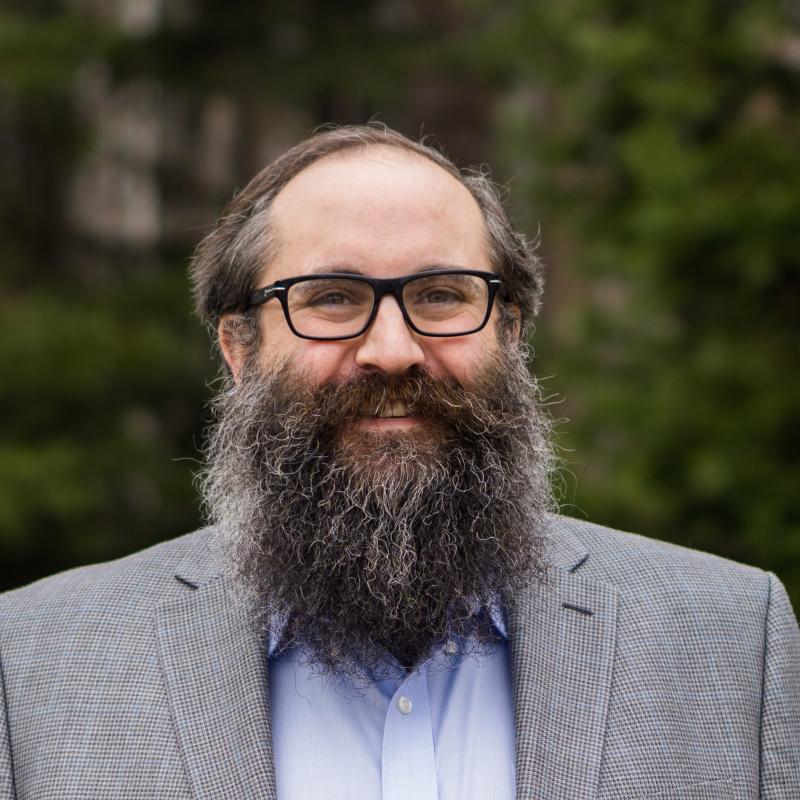
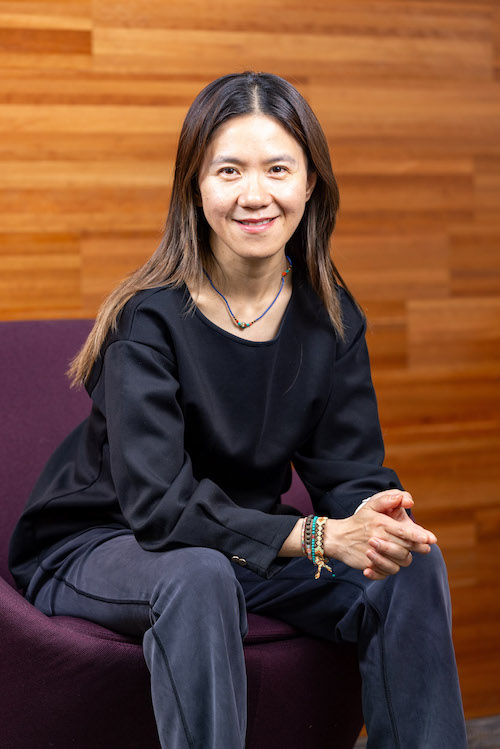
Mark Gondree is an Associate Professor in the Computer Science Department at Sonoma State University, with research expertise in security pedagogy, applied cryptography, and secure computation. He holds a PhD from UC Davis and has received multiple teaching awards including the CSU Student Success Analytics Certificate and POGIL Activity Clearinghouse recognition. His research explores cybersecurity education methods, cloud data geolocation, and industrial control system vulnerabilities. Recent publications focus on curriculum development for computer security concepts and efficient cryptographic protocols. Awards: CSU Student Success Analytics Certificate (2024) POGIL Activity Clearinghouse Publications (2022) QuARRY Repository Award (2020) He actively advises graduate and undergraduate researchers on projects ranging from fuzz testing to pseudorandom number generator analysis. Current grants include NSF funding for CS teacher preparation programs and cloud security research. As department chair, he oversees curriculum development and leads the Computer Science Colloquium series.
Dr. Daniel Gardham is a Lecturer at the University of Surrey, affiliated with the Surrey Centre for Cyber Security and the School of Computer Science and Electronic Engineering. He teaches modules such as Privacy Enhancing Technologies (COM3030) and Data Structures & Algorithms (COM1029). His research focuses on applied cryptography, including privacy-preserving techniques, authentication protocols, and post-quantum cryptography using lattice-based methods. Previously, he was a postdoctoral researcher at Royal Holloway, University of London, and earned his PhD from the University of Surrey in 2021 under Mark Manulis, exploring attribute-based signatures in classical and post-quantum contexts. Education: PhD in Computer Science (University of Surrey, 2021), MMath in Mathematics (University of Bath, 2017). Research interests include developing cryptographic protocols for secure communication, post-quantum security solutions, and enhancing user privacy through authentication mechanisms. His recent work addresses phishing awareness for older adults and oblivious PRFs leveraging homomorphic encryption. Publications span topics like asynchronous key generation, hierarchical attribute-based signatures, and biometric authentication systems. He contributes to cybersecurity through interdisciplinary research, bridging theoretical cryptography with practical applications. Labs/Teams: Active in the Surrey Centre for Cyber Security and the Computer Science Research Centre, advancing cryptographic innovation and cybersecurity education.
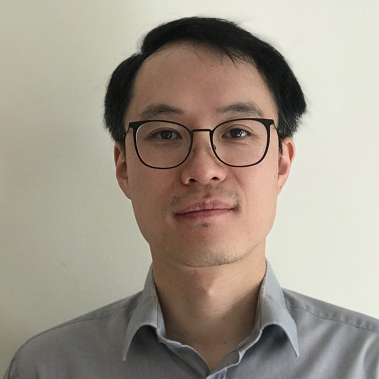
Dr. Raymond Hu is a Lecturer in Computer Science at Queen Mary University of London's School of Electronic Engineering and Computer Science (EECS). He holds a BA from the University of Cambridge and an MSc/PhD from Imperial College London. His research focuses on programming languages, distributed systems, type systems, and session types, with applications in concurrent and fault-tolerant systems. He collaborates with industry partners like Google, Red Hat, and the Ocean Observatories Initiative. Dr. Hu is a member of the Theory Group and the Centre for Fundamental Computer Science within EECS, and actively contributes to academic conferences and workshops. Education: BA, University of Cambridge MSc, Imperial College London PhD, Imperial College London Research Interests: Dr. Hu's work spans programming language design, distributed systems, and formal methods. Key areas include session types for safe communication protocols, type systems for concurrency, and fault tolerance in distributed environments. His recent projects involve rate-based session types for IoT devices and generics in the Go programming language. Grants & Collaborations: He collaborates with industry leaders such as Google (on Go generics) and Cognizant, and has secured grants supporting projects like session-based protocols for embedded systems. He also organizes academic events like TIME 2025 and co-chairs workshops such as PLACES '24. Labs & Teams: Member of the Theory Group and Centre for Fundamental Computer Science, actively involved in protocol design and verification initiatives.
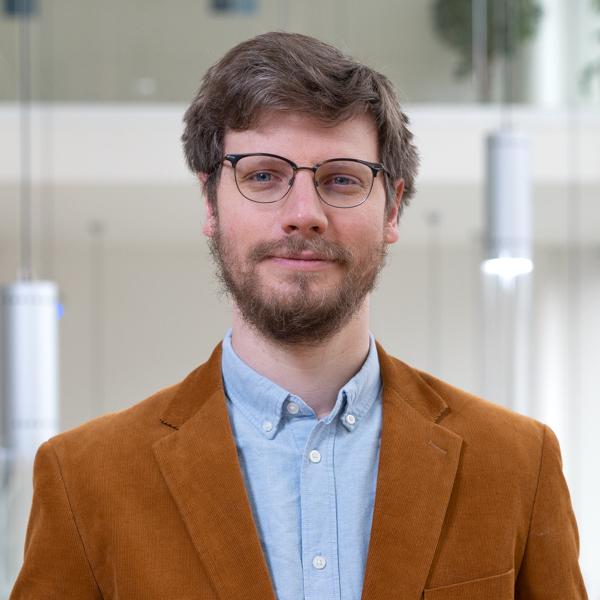
Joseph Liu is a Full Professor at Monash University's Faculty of Information Technology, leading the Monash Cybersecurity Discipline Group and founding director of the Monash Blockchain Technology Centre. He holds a PhD from the Chinese University of Hong Kong (2004) and has pioneered research in blockchain security, linkable ring signatures (underpinning Monero cryptocurrency), and applied cryptography. His work spans cloud security, healthcare privacy, and lightweight cryptographic algorithms. He has received over 10,000 citations and 200+ publications in top venues like CRYPTO and ACM CCS. Awards include the 2018 ICT Researcher of the Year (ACS) and 2021 IEEE Technical Achievement Award. Education: PhD Information Engineering, Chinese University of Hong Kong (2004) MPhil Information Engineering, Chinese University of Hong Kong (2001) BEng Information Engineering, Chinese University of Hong Kong (1999) Research focuses on bridging cryptographic theory with real-world applications, emphasizing privacy-preserving technologies and post-quantum security. Recent projects include the Algorand Centre of Excellence for Sustainability Informatics and ethical frameworks for blockchain-based digital credentials. He has led 22+ research projects and contributed to ISO/IEC blockchain standards. Awards: ACS ICT Researcher of the Year 2018 IEEE Technical Achievement Award 2021 Best Paper Awards (2021–2022) Teaching includes courses like FIT2034 and FIT5043. He co-chairs the IEEE Blockchain Australia Chapter and has organized major conferences (e.g., ProvSec, Pairing). Current initiatives include privacy-preserving AI in materials discovery and scalable blockchain systems.
Alain Tapp is a tenured Professor at the Université de Montréal's Faculty of Arts and Science, Department of Computer Science and Operations Research. He is affiliated with the RALI (Linguistics), LITQ (Theoretical and Quantum Informatics), and talents (AI Cybersecurity) laboratories. His research focuses on Artificial Intelligence, Theoretical Computer Science, and Natural Language Processing, with contributions to quantum computing and machine learning applications. He actively collaborates on projects like DEEL (Dependable & Explainable Learning) and NSERC CREATE in Machine Learning for Finance. Tapp has advised over 25 graduate students, guiding them in topics ranging from quantum protocols to reinforcement learning in robotics. He has secured grants from NSERC, CRIAQ, and others, emphasizing AI, cybersecurity, and quantum computing. His work bridges theoretical foundations with practical applications, including privacy-preserving AI models and sim-to-real robotics. Education: Multiple programs in Fundamental and Applied Sciences, specializing in Information and Communication Technologies. Research interests span quantum communication complexity, secure multiparty computation, and machine learning fairness. His recent work explores lossless text encoding and adversarial training for bias mitigation. Tapp is also involved in initiatives like the crypto-democracy model, advocating for privacy through distributed trust frameworks. His contributions to quantum information theory and AI ethics underscore his interdisciplinary impact.
Tal Rabin is the Rachleff Family Professor in Computer and Information Science at the University of Pennsylvania. Her cryptography research focuses on secure multiparty computation, threshold cryptography, and blockchain security, developing frameworks like YOSO (You Only Speak Once) for secure distributed computation. Recent work includes privacy-preserving deep learning systems (Falcon) and threshold cryptography service models. She has contributed to cryptographic foundations through improved RSA key generation protocols and analysis of leakage-resilient systems. Dr. Rabin serves on program committees for major security and cryptography conferences worldwide.
Cédric Fournet serves as Senior Principal Research Manager at Microsoft Research in Cambridge, UK, where he leads the Constructive Security research team. He also directs the Secure Distributed Computations project at the MSR-INRIA Joint Center in collaboration with INRIA Paris's Prosecco team. With over two decades of experience since joining Microsoft Research in 1998, Fournet maintains active collaborations across academic and industrial research communities. His educational background includes graduation from École Polytechnique in 1992, followed by a year working on deductive databases at BULL. He obtained a second engineering degree from École Nationale des Ponts et Chaussées in 1995 and completed his PhD in computer science at INRIA Rocquencourt, where he applied concurrency theory to distributed programming through a variant of the pi calculus. Fournet's research spans multiple interconnected domains in computer security and programming languages. His primary focus involves building, verifying, and deploying secure components for critical infrastructure, most notably through the Everest project which aims to create verified replacements for HTTPS components like miTLS. His work integrates formal methods with practical security concerns, addressing challenges in cryptographically-verifiable computing, TLS security, secure cloud outsourcing using trusted hardware (SGX, TPM), side-channel resistance, and information-flow security. A unifying thread throughout his career is the application of dependent types, particularly through the F* programming language, to create provably secure systems. Analysis of his recent publications reveals a consistent trajectory toward verified security implementations across diverse platforms and protocols. His work has evolved from theoretical foundations in cryptographic protocol verification to practical, production-ready systems like EverCrypt and EverParse. The research demonstrates increasing sophistication in handling real-world constraints while maintaining formal guarantees, with recent work addressing microarchitectural security, confidential computing in AI accelerators, and media provenance for combating synthetic media. CCS Distinguished Paper Award (2024) for Principled Microarchitectural Isolation on Cloud CPUs Best Paper Award Nominee (2023) for Confidential Consortium Framework Distinguished Paper Award (2015) for A Messy State of the Union: Taming the Composite State Machines of TLS As leader of the Constructive Security team at Microsoft Research, Fournet oversees multiple significant research initiatives with substantial funding from both internal Microsoft resources and external collaborations. His team's work on Everest has received sustained support for developing verified cryptographic implementations, while the MSR-INRIA Joint Center provides a framework for international collaboration on secure distributed systems. The team maintains strong industry partnerships that facilitate the transition of research prototypes into deployed systems. The Constructive Security research team operates at the intersection of theory and practice, maintaining close connections with both the INRIA Prosecco team in Paris and various Microsoft product groups. Their work environment emphasizes formal verification techniques applied to real-world security challenges, with particular focus on creating tools and frameworks (like F*) that enable building systems with strong security guarantees. The team's approach combines deep theoretical insights with practical engineering considerations to produce solutions that are both formally verified and deployable in production environments.
Chris Brzuska is an Associate Professor at Aalto University's Department of Mathematics and Systems Analysis, part of the School of Science. His research focuses on cryptography, security protocols, and formal verification of cryptographic systems. He has contributed to key areas including post-quantum cryptography, white-box security, obfuscation, and game-based security models. His work often involves rigorous analysis of cryptographic primitives and protocols, emphasizing practical security and formal proofs. Brzuska's recent research includes studies on LWE assumptions, garbling schemes, TLS security, and resistance against side-channel attacks. He has authored or co-authored over 30 publications in top-tier conferences and journals, such as CRYPTO, EUROCRYPT, and ASIACRYPT. His work bridges theoretical foundations and applied cryptography, addressing real-world security challenges in protocols like TLS and messaging frameworks.
Jared Saia is a Professor in the Department of Computer Science at the University of New Mexico, within the College of Engineering. His research spans theoretical computer science, with a focus on distributed algorithms, security, game theory, and spectral methods. He has taught numerous advanced courses in algorithms, data structures, blockchains, and game theory. University: University of New Mexico School: College of Engineering Department: Department of Computer Science Academic Rank: Professor Email: saia@cs.unm.edu Education: PhD in Computer Science, University of Washington, 2002 BS in Computer Science, Stanford University, 1993 His research interests lie at the intersection of theory and practical systems, particularly in enabling large-scale groups to function effectively without centralized control. He has made significant contributions to distributed consensus, blockchain technologies, and algorithmic game theory. The recent publications and course topics reflect a strong trend toward interdisciplinary work combining algorithms with economics, security, and machine learning. His work often employs probabilistic and geometric methods to solve complex distributed computing problems. Scientific Awards: NSF CAREER Award School of Engineering Junior Faculty Research Excellence Award School of Engineering Senior Faculty Research Excellence Award Several best paper awards Prof. Saia has been actively involved in mentoring through graduate courses and research supervision. He has led projects on secure distributed systems, blockchain applications, and algorithmic resilience. His teaching includes core graduate courses such as CS 561 (Algorithms and Data Structures), CS 506 (Advanced Geometric and Probabilistic Methods), and specialized seminars on Bitcoin and game theory. Labs and Research Groups: While not explicitly named, his course websites and research themes suggest leadership in a theoretical computer science and distributed systems research group at UNM, focusing on algorithm design for secure and decentralized environments.
Xukai Zou is an active researcher in Cybersecurity , Federated Learning , and Privacy-Preserving Authentication . His work spans multiple institutions and focuses on secure e-voting systems, biometric authentication, and robust machine learning frameworks. Key Research Areas : Federated Learning, Network Security, Biometric Authentication, Privacy-Preserving Techniques Collaborations : Frequently works with Feng Li, Agnideven Sundar, and Qin Hu Recent Trends include applying Deep Learning to Network Intrusion Detection , developing Decentralized Federated Learning for Non-IID Data , and creating Interactive Cybersecurity Curricula inspired by E-Voting technology. Notable Contributions in Group Communication security and Key Management date back to the early 2000s, showing sustained expertise in cryptographic protocols and distributed security solutions.
Haris Smajlović is a Postdoctoral Associate in the Department of Biomedical Informatics & Data Science at Yale School of Medicine, working in the Hoon Cho Lab. His research bridges privacy-enhancing technologies, compiler design, and biomedical data security, with a focus on enabling secure collaborative analysis of sensitive health information. Dr. Smajlović earned his PhD in Computer Science from the University of Victoria (2024), where he worked at the 0xTCG lab under Prof. Ibrahim Numanagić. Previously, he completed his MSc in Theoretical Computer Science (2017) and BSc in Mathematics (2015) at the University of Sarajevo, where he also served as a lecturer in the Department of Mathematics before pursuing his doctorate. His educational background spans mathematics, theoretical computer science, and practical software engineering experience from his role as lead software engineer at Symphony.is. His research interests center on privacy-preserving computational frameworks for biomedical applications, with particular expertise in secure multiparty computation, homomorphic encryption, and high-performance compiler design. Dr. Smajlović specializes in creating practical tools that bridge the gap between theoretical cryptographic techniques and real-world biomedical data analysis needs. Analysis of his publication record reveals a consistent trajectory from computational geometry and optimization algorithms toward increasingly sophisticated privacy-preserving frameworks for biomedical data. His most recent work focuses on compiler-based approaches to secure distributed computation, with applications in genomic analysis and healthcare data sharing. The progression shows a shift from theoretical algorithms to practical frameworks that integrate cryptographic techniques with domain-specific biomedical applications. Golden Badge of University of Sarajevo (2017) Graduate Award of University of Victoria (awarded annually 2020-2024) Ph.D. Fellowship at University of Victoria (2020-2021) Dr. Smajlović actively contributes to the academic community as a reviewer for prestigious venues including Genome Biology, ACM SIGPLAN International Conference on Compiler Construction, ISMB, and RECOMB. His invited talk at Applied Machine Learning Days (EPFL) in 2025 highlights his growing recognition in the field of secure federated AI. His work on the Sequre and Shechi frameworks has been supported by research funding at Yale, particularly within the context of the NSF grant for confidential genome analytics mentioned in the lab news. As a core member of the Hoon Cho Lab at Yale's Biomedical Informatics & Data Science department, Dr. Smajlović contributes to the lab's mission of creating algorithmic solutions for computational challenges in genomic and health-related data. The lab's research themes align closely with his expertise, particularly in privacy-enhancing technologies for biomedical applications. His work on the Shechi framework directly supports the lab's focus on secure computation for sensitive biomedical data, while his compiler expertise contributes to their scalable AI/ML in genomics initiatives.
Nico Döttling is a faculty member at the CISPA Helmholtz Center for Information Security, where he leads research in cryptographic foundations. His work focuses on advancing theoretical and practical aspects of modern cryptography, with particular emphasis on homomorphic encryption, post-quantum cryptography, and secure multi-party computation. Dr. Döttling received his PhD in Computer Science from the Karlsruhe Institute of Technology in 2014 under the supervision of Jörn Müller-Quade. Prior to joining CISPA in 2018, he held positions as an Assistant Professor at Friedrich-Alexander University Erlangen-Nuremberg (2017-2018), a postdoctoral researcher at UC Berkeley (2016-2017) supported by a DAAD fellowship, and a postdoctoral researcher at Aarhus University's Cryptography Group (2014-2016) working with Ivan Damgård and Jesper Buus Nielsen. Dr. Döttling's research centers on the theoretical foundations of cryptography with practical applications. His work spans public-key encryption, communication-efficient secure multi-party computation, homomorphic encryption, and post-quantum cryptographic systems. He has made significant contributions to laconic cryptography, time-lock puzzles, and verifiable delay functions, with his ERC Starting Grant project 'Next Generation Laconic Cryptography (LACONIC)' driving innovation in communication-efficient cryptographic protocols. His research bridges theoretical computer science with practical security applications, addressing fundamental questions while developing usable cryptographic primitives. Analysis of Dr. Döttling's recent publications reveals a strong focus on efficient cryptographic primitives with particular attention to communication complexity, security proofs, and practical implementations. His work spans theoretical foundations of cryptography, post-quantum security, and novel applications of cryptographic techniques to real-world problems. A notable trend is his exploration of laconic cryptography - developing protocols with minimal communication overhead - which has applications in resource-constrained environments and large-scale distributed systems. Dr. Döttling's scientific achievements have been recognized with several prestigious awards: ERC Starting Grant for the project 'Next Generation Laconic Cryptography (LACONIC)' (2021) Best Paper Award at Crypto for 'Identity-Based Encryption from the Diffie-Hellman Assumption' (2017) Postdoctoral Fellowship at UC Berkeley sponsored by DAAD (2016) Best Paper Award at ProvSec 2015 for 'From Stateful Hardware to Resettable Hardware Using Symmetric Assumptions' (2015) Biennial dissertation award for best dissertation in computer science at Karlsruhe Institute of Technology (2014) As a faculty member at CISPA, Dr. Döttling leads an active research group focused on cryptographic foundations. His ERC Starting Grant provides significant research funding to advance laconic cryptography. While specific information about his advisees is not provided in the source material, his extensive publication record with multiple co-authors suggests active collaboration with students and researchers. His work bridges theoretical cryptography with practical security applications, making contributions that advance both academic understanding and real-world cryptographic implementations. Dr. Döttling leads the Algorithmic Foundations and Cryptography research group at CISPA, focusing on developing theoretically sound yet practically efficient cryptographic protocols. His team explores innovative approaches to longstanding cryptographic challenges, particularly in making cryptographic protocols more communication-efficient without sacrificing security. Current research directions include post-quantum cryptographic systems, verifiable delay functions, and novel applications of homomorphic encryption to privacy-preserving computation.
L.A.M. (Berry) Schoenmakers is an Associate Professor at the Coding Theory and Cryptology department of Eindhoven University of Technology. His research spans cryptography, secure computation, and algorithm design, with a focus on threshold systems and numerical methods in cryptographic contexts. Active in Secure Multiparty Computation , Secret Sharing , and Elliptic Curve Cryptography Published extensively in Cryptography , Fixed-Point Arithmetic , and Algorithm Design Recent work includes secure implementations of Newton-Raphson iteration and Extended GCD algorithms . He teaches courses in Cryptographic Protocols , Linear Algebra , and Programming , with active supervision of research outputs.
Huijia (Rachel) Lin is a Professor in the Paul G. Allen School of Computer Science & Engineering at the University of Washington. Her research bridges theoretical cryptography with broader domains in computer science, including complexity theory, algorithm design, learning, and security. Dr. Lin leads the Simons Collaboration on the Theory of Algorithmic Fairness (2020–2027) and collaborates with UW’s cryptography and theory groups, which include Professors Andrea Coladangelo, Stefano Tessaro, and Nirvan Tyagi. She has also served on numerous prestigious program committees and steering committees, including as a co-chair for TCC 2025 and FORC 2026. Research Interests: Theoretical aspects of cryptography Program obfuscation and functional encryption Lattice-based cryptography Secure multiparty computation Non-malleability and concurrent security Connections to quantum computation Scientific Awards: NSF CAREER Award Hellman Fellowship Cisco Research Award JPMorgan Faculty Award Microsoft Research PhD Fellowship Best Paper Award at STOC 2021 Best Paper Award at Eurocrypt 2018 Best Paper Honorable Mention at Eurocrypt 2016 Advising and Grants: Dr. Lin has mentored numerous PhD students and postdocs, including Kameron Shahabi, Ji Luo, and Min Jae Song. Her research is supported by the Simons Collaboration on the Theory of Algorithmic Fairness.
Zvika Brakerski is a Professor at the Department of Computer Science and Applied Mathematics of the Weizmann Institute of Science. He is an active researcher in theoretical computer science with a focus on cryptography and quantum computing. His work bridges foundational aspects of computer science with practical cryptographic applications. His educational background includes: Ph.D. from Weizmann Institute of Science (2011), advised by Shafi Goldwasser M.Sc. from Faculty of Engineering of Tel-Aviv University (2002), advised by Boaz Patt-Shamir B.Sc. joint degree from Faculty of Engineering and School of Computer Science of Tel-Aviv University (2001) Brakerski's research primarily focuses on the foundations of computer science, with particular emphasis on cryptography and quantum computing. His work explores the intersection of these fields, developing new cryptographic primitives that are secure against quantum adversaries while also leveraging quantum phenomena for cryptographic purposes. He has made significant contributions to lattice-based cryptography, fully homomorphic encryption, and quantum cryptography, establishing new connections between computational complexity and cryptographic security. His recent publications demonstrate a consistent focus on advancing the theoretical foundations of post-quantum cryptography while exploring novel applications of quantum computing to cryptographic problems. There's a clear trend toward establishing connections between seemingly disparate areas such as quantum information theory, computational complexity, and traditional cryptographic constructions. His work often introduces new frameworks that unify previously separate concepts, creating bridges between theoretical computer science and practical cryptographic applications. Brakerski has mentored students and collaborated with numerous researchers in the field, contributing to the advancement of cryptographic theory and quantum computing. His work has been supported by various research grants, though specific details are not provided in the source material.