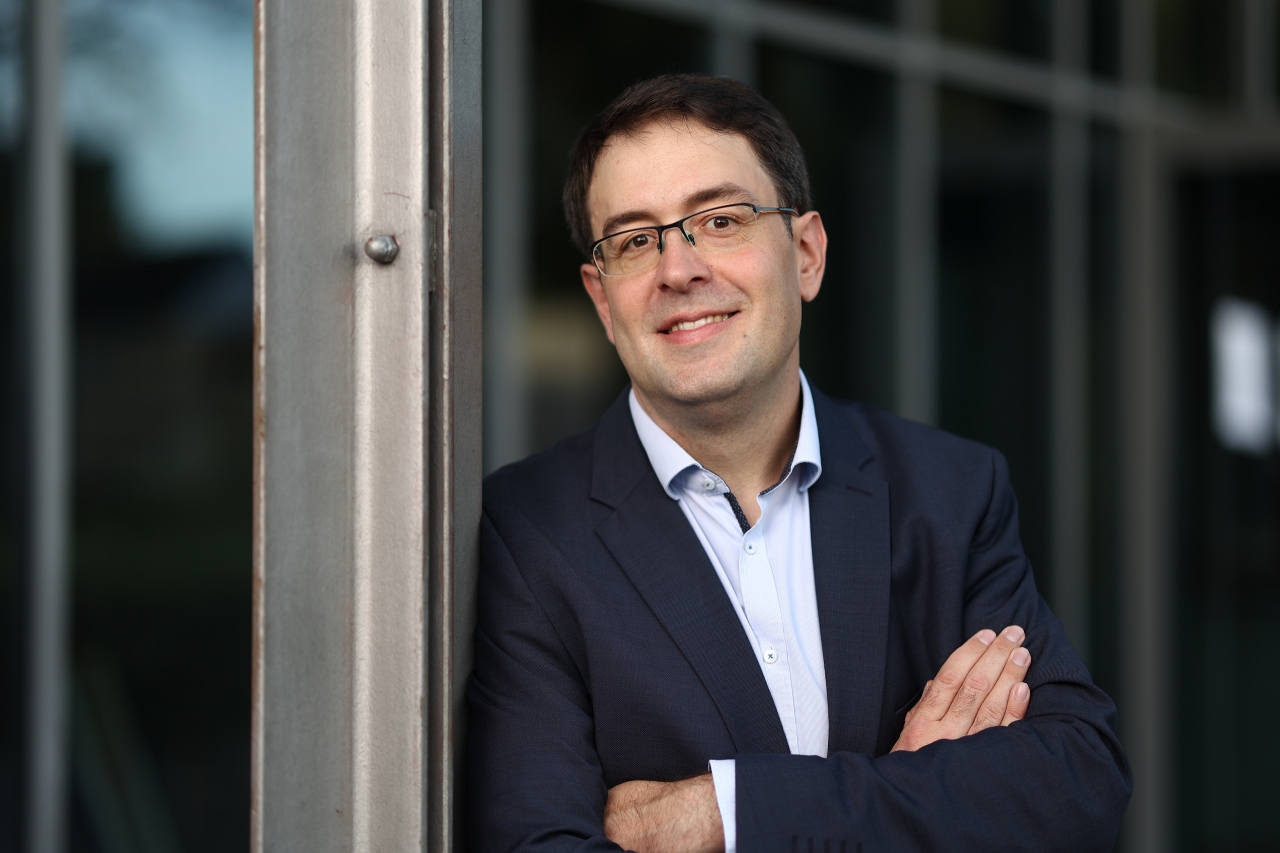
Jürgen Brehm is an Adjunct Professor at the Faculty of Electrical Engineering and Computer Science of Leibniz University Hannover . He holds a venia legendi in Computer Engineering after completing his habilitation in 2000. Education: Diploma in Computer Science (1986), Doctorate in Engineering (1991), Habilitation (2000) Research interests span computer architecture , parallel processing , performance analysis , and e-learning . His work explores ubiquitous computing , communication architectures , and optimization algorithms . Recent publications highlight trends in parallel computing , optimization , and interactive systems , including works on swarm intelligence , particle swarm optimization , and open content integration. Scientific award : Feodor Lynen Fellowship (1994) Teaching includes core courses like Basics of Computer Architecture , Operating Systems , and Parallel Processing . He also designed two multimedia-equipped computer science lecture halls and managed large-scale DFG projects for e-learning and HPC computing.
Mark Harman is a part-time Professor of Software Engineering at University College London's Department of Computer Science within the Faculty of Engineering Sciences, while working full-time as a Research Scientist at Meta Platforms in the Instagram Product Performance team. He previously served as head of Software Engineering at UCL and director of its CREST centre from 2006 to 2017 before joining Meta when his startup Majicke was acquired in 2017. Harman's research spans multiple domains of software engineering, with particular emphasis on Search Based Software Engineering (SBSE), which he co-founded in 2001. His work has evolved to include LLM-based software engineering, software testing, program analysis, and bias mitigation in machine learning systems. He has made significant contributions to automated testing through systems like Sapienz and WW that have been deployed at scale at Meta. His publication record shows a clear evolution from traditional software testing and analysis toward increasingly sophisticated integration of machine learning techniques. Recent work demonstrates strong focus on addressing fairness challenges in ML systems, improving test reliability in continuous integration environments, and exploring the applications of large language models in software engineering tasks. This reflects both his ability to identify emerging challenges and his commitment to practical, industry-relevant research. IEEE Harlan Mills Award (2019) ACM Outstanding Research Award (2019) Fellowship of the Royal Academy of Engineering (2020) Harman maintains a unique bridge between academia and industry, having co-founded the Simulation-Based Testing team at Meta and previously directing UCL's CREST research centre. His work on Sapienz grew from his startup Majicke and has had significant industrial impact while maintaining strong academic foundations. He frequently participates in academic conferences as both contributor and committee member, demonstrating ongoing commitment to the research community despite his industry position. At Meta, Harman works within the Instagram Product Performance team, building on his earlier work with the Simulation-Based Testing team where he co-developed platforms for client- and server-side testing. His research on cyber-cyber digital twins represents an innovative application of simulation techniques to virtual software systems rather than physical ones.
Xavier Devroey is an Assistant Professor of Software Engineering at the University of Namur in Belgium. He co-leads the SNAIL Team with Benoît Vanderose, focusing on innovative approaches to software testing and automation. His work bridges academic research with practical applications in the software engineering community. His educational background includes a Ph.D. and Master's in Computer Science from the University of Namur, plus a Bachelor's in Analyst Programming from Haute Ecole de Bruxelles, Belgium. This comprehensive academic training informs his research and teaching approach. Devroey's research interests center on Software Testing , with particular emphasis on Search-Based Software Engineering and Software Variability . His specific focus areas include: Search-Based Testing and Fuzzing Model-Based Testing Mutation Testing Variability Modeling Software Product Line Testing Test suite augmentation DevOps integration These interests reflect his commitment to advancing automated approaches for test case design, generation, selection, and prioritization. His recent publication portfolio (2019-2025) demonstrates consistent contributions to software testing research, with particular focus on crash reproduction, API testing, and innovative approaches to test automation. The articles reveal a strong emphasis on practical applications of search-based techniques across various testing domains. Devroey maintains active engagement with the academic community through conference participation, having served on program committees for major software engineering conferences including ASE, ICSE, ISSTA, and ICST across multiple years (2019-2025). He also contributes to educational aspects of software engineering, with publications examining testing education approaches and tools for programming exercise assessment. His personal website (xdevroey.be) and GitHub profile demonstrate his commitment to open academic practices and community engagement.
Sen Chen is a Professor at Nankai University, holding positions in both the College of Cryptology and Cyber Science and the College of Computer Science. He leads the Nankai Software Security Laboratory (NKSSecLab) and is a member of Professor Zheli Liu's research group. Previously, he served as a tenured associate professor and research professor at Tianjin University (2021-2024), and as a research assistant professor at Nanyang Technological University (NTU), Singapore. Dr. Chen's research focuses on software security and software supply chain security, with particular emphasis on vulnerability analysis and malware detection. His work spans multiple domains including mobile security, AI security, open-source security, and intelligent software development and testing. His research has led to significant contributions in automated security vulnerability detection, software composition analysis, and security tool development for various platforms including Android, Java, and blockchain systems. Analysis of Dr. Chen's recent publications (2023-2025) reveals a strong focus on software supply chain security, with particular attention to vulnerability detection and remediation in open-source ecosystems. His work demonstrates expertise in applying advanced machine learning techniques to security problems, especially in the context of Android applications and containerized environments. There's a clear trajectory toward addressing emerging challenges in AI security and large language model supply chains, reflecting his ability to adapt research directions to evolving technological landscapes. ACM SIGSOFT Distinguished Paper Award (FSE 2024) ACM SIGSOFT Distinguished Paper Award (ASE 2023) First Place of the 13th Challenge Cup China College Students' Entrepreneurship Competition ACM SIGSOFT Distinguished Paper Award (ICSE 2023) Prototype Research Tool Award 2nd Place (Freestyle) in CCF ChinaSoft 2022 First Place of The 8th China International College Students' 'Internet+' Innovation and Entrepreneurship Competition ACM SIGSOFT Distinguished Paper Award (ASE 2022) ACM China Rising Star Award (ACM Tianjin Council) ACM SIGSOFT Distinguished Paper Award (ICSE 2021) First Class of Progress of Science and Technology Prize of Tianjin, 2020 Dr. Chen has successfully secured funding from multiple prestigious sources including key R&D programs, general and pre-research projects of the National Natural Science Foundation of China, and the Populus euphratica Forest Fund. His theoretical research has been applied by major companies such as State Grid, China Automotive Industry Corporation, and Huawei. He has mentored students to win national gold medals in both the 'Internet Plus' and Challenge Cup programs, demonstrating his commitment to student development and practical application of research. Dr. Chen leads NKSSecLab (Nankai Software Security Laboratory), which focuses on cutting-edge research in software security and supply chain security. The lab has developed several notable tools including SCTruster (a digital trust chain platform for software supply chain security) and LiDetector. The lab maintains strong international collaborations with institutions like Nanyang Technological University in Singapore and has established itself as a leading research group in software security within China.
Jia Li is an Assistant Professor at the College of AI, Tsinghua University, where they lead the Tsinghua University Programming Language Processing Group (THU-PLP). They completed their PhD at Peking University in 2025 under the supervision of Prof. Zhi Jin and Prof. Ge Li. Dr. Li's research focuses on Programming Language Processing (PLP), which aims to develop artificial intelligence techniques for understanding and generating source code. Their work spans two main areas: foundation models for PLP and applications of PLP in software development and beyond. They develop new model architectures, training strategies, inference approaches, and evaluation metrics to improve code understanding and generation capabilities. Their application research explores how PLP can enhance software development efficiency through code generation, test generation, and code optimization, as well as its applications in embodied AI and neuroscience. Dr. Li's recent publications demonstrate a strong focus on advancing code generation and understanding through large language models. Their work addresses key challenges in repository-level code completion, class-level code translation, vulnerability detection, and benchmarking evolving code generation capabilities. They've made significant contributions to developing efficient models like aiXcoder-7B and creating comprehensive benchmarks like EvoCodeBench and ClassEval-T. NeurIPS 2025 Spotlight Paper (3.2% acceptance rate) for "SATURN: SAT-based Reinforcement Learning to Unleash Language Model Reasoning" Dr. Li actively mentors students and researchers, seeking highly-motivated interns to join the THU-PLP research group. They have established collaborations with researchers at Peking University, as evidenced by their joint publications with supervisors Prof. Zhi Jin and Prof. Ge Li. Dr. Li leads the Tsinghua University Programming Language Processing Group (THU-PLP), which focuses on cutting-edge research at the intersection of programming languages and artificial intelligence. The group maintains active GitHub repositories for their research projects, including EvoCodeBench, SkCoder, and CodeEditor, demonstrating their commitment to open science and reproducible research.
Dr. Aitor Arrieta is a permanent full-time Lecturer and Researcher at Mondragon University in Spain. His research focuses on software engineering and testing methodologies for complex systems including Cyber-Physical Systems, AI-based systems, and Generative AI models. He maintains strong industry collaborations with companies like Orona and Developair to address real-world engineering challenges. Research interests span: AI system validation and safety testing Metamorphic testing techniques Autonomous vehicle verification Large Language Model bias/fairness analysis Search-based software engineering His recent publications demonstrate a focus on developing automated testing tools for AI systems, particularly in safety-critical domains. Awarded Best Paper at the 15th International Symposium on Search-Based Software Engineering. Active in European research projects: InnoGuard: Generative AI for autonomous cyber-physical systems TRUST4AI: Trustable AI-driven internet search
Kai Petersen serves as Professor of Software Engineering at Flensburg University of Applied Sciences within the Faculty of Business, Department of Business Management / Business Informatics. He teaches in the Business Informatics program, provides academic advising, and maintains office C 206 with contact number 0461/805-1470. Petersen leads multiple research initiatives including FLAIR (Flensburg Artificial Intelligence Research), the Software Factory, and TechStartUp@HS-Flensburg (TeStUp). His research program centers on empirical approaches to software engineering with specialization in Agile Methods, Software Metrics, Software Security, and increasingly the integration of Artificial Intelligence. Petersen has pioneered work in Value-based Software Engineering and systematic mapping studies, bridging theoretical frameworks with practical industry applications through extensive corporate collaborations. Analysis of Petersen's recent publications reveals an evolving research trajectory from traditional software engineering methodologies toward AI-integrated approaches. His 2025 work on LLM-based systematic mapping studies represents cutting-edge exploration of AI in academic research processes, while his 2023 publications maintain strong connections to practical applications in public sector BI systems, regression testing decision support, and value-focused development frameworks. Petersen's scientific contributions have received significant international recognition: Listed among top 2% most influential scientists worldwide (1960-2019 study) Ranked among top 10 software engineering scientists globally and #1 in Germany (2010-2017) Recognized as top 100 Swedish scientist in technology/mathematics by Fokus magazine Three highly impactful Journal of Systems and Software publications Most cited work has accumulated 375 citations with significant industry adoption Petersen attributes his research success to strategic collaborations with industry partners that enable real-world testing of methodologies. His TechStartUp@HS-Flensburg initiative demonstrates commitment to translating academic research into practical applications, while his leadership in FLAIR positions him at the forefront of AI integration in software engineering. Student projects under his guidance frequently contribute directly to his research outputs, creating a productive academic-industry-student ecosystem. As contact person for FLAIR and leader of the Software Factory, Petersen actively shapes the university's research direction in AI applications, data science, and modern software development practices, ensuring his work maintains strong relevance to both academic discourse and industry needs.
Prof. Dr. Heike Trautmann is a leading researcher in statistics and optimization at the University of Twente (2021-2026) and former Professor at WWU Münster (2013-2016). Her work bridges computational statistics, evolutionary optimization, and social media analytics. She has held visiting positions at TU Dortmund, Leiden University, and RWTH Aachen. Current affiliation: University of Twente (Data Science: Statistics and Optimization) Previous roles: WWU Münster (Professor for Information Systems and Statistics), TU Dortmund (Postdoctoral researcher) Research Focus: Multi-criteria optimization, automated algorithm selection, data stream mining, and disinformation detection in social media. Her methodological innovations in exploratory landscape analysis and evolutionary computation have transformed algorithm configuration practices. Developed COSEAL consortium for algorithm selection Co-founder of Benchmarking Network (2019) Principal investigator in projects like PropStop and MODERAT! Academic Contributions: Over 150 publications in top venues like GECCO, PPSN, and Evolutionary Computation journal. Pioneered feature-based landscape analysis tools (flacco, pflacco) and stream clustering frameworks.
David Marson is a Researcher at the Chair of Software & Systems Engineering (Prof. Pretschner) at the Technical University of Munich since September 2022. He holds a Master's in Aerospace Engineering and has industry experience as a systems engineer. His research focuses on cyber-physical systems (CPS), modeling and simulation (M&S), scenario-based testing, and drone swarm controllers, particularly in generating test cases for cooperating UAVs. Teaching: He contributes to courses such as Systems Engineering (IN8015) and Scenario-Based Testing of Cyber-Physical Systems . He oversees thesis projects in UAV swarm robustness, search-based testing, and autonomous systems quality attributes. Key Projects: INVOLVED IN RESEARCH INITIATIVES LIKE SUPPRA (Algorand Center of Excellence), TAPFER, AND SCENARIO-BASED TESTING METHODS. Advising: Supervised theses include Inaccuracies in UAV Awareness (Bachelor's), Development of Robust UAV Route Planners (Master's), and Testing Collaborative UAV Safety (Bachelor's). Ongoing projects focus on swarm controller robustness and component failure scenarios. Labs/Teams: Active in CPS testing and UAV swarm research within the Chair's collaborative environment.
Grace Li Zhang is an Assistant Professor (Tenure Track) in Hardware for Artificial Intelligence at TU Darmstadt since 2022. Previously, she served as Group Leader on Heterogeneous Computing at TU Munich (2018–2022) and earned her Dr.-Ing. in Electrical and Computer Engineering (summa cum laude) from TU Munich (2014–2018). Her research focuses on AI hardware-software co-design, including hardware accelerators for AI algorithms, neuromorphic computing, and emerging memory technologies like RRAM and FeFET. She explores circuit design methodologies, explainability of AI systems, and energy-efficient architectures. Recent work emphasizes leveraging large language models (LLMs) for automated hardware design, verification, and code generation. Her projects address challenges in optical neural networks, in-memory computing, and robustness against hardware non-idealities. Zhang’s contributions span 60+ peer-reviewed articles, with a strong focus on practical implementations for real-world applications. She leads the TU Darmstadt Hardware for AI group, collaborating with industry partners on next-generation computing systems. Her work bridges theoretical innovations with tangible hardware solutions, targeting efficiency, scalability, and security in AI infrastructure.
Daniel Höller is a researcher in the Foundations of Artificial Intelligence (FAI) Group at the Department of Computer Science, Saarland University, Germany. He joined the group in January 2020, having previously worked at the Institute of Artificial Intelligence at Ulm University from November 2013 to December 2019. He holds an M.Sc. in Computer Science from Bonn-Rhein-Sieg University, where he studied from 2007 to 2013. Ph.D., Computer Science, Ulm University M.Sc., Computer Science, Bonn-Rhein-Sieg University (2013) Daniel Höller's research lies at the intersection of theoretical and practical aspects of AI planning. His primary focus is on Hierarchical Task Network (HTN) planning, where he has made significant contributions to expressivity analysis, solver development, and the use of classical planning heuristics to guide HTN search. He also works on lifted planning, plan repair, plan recognition, and the integration of planning with deep reinforcement learning. His work often involves formal analysis, heuristic development, and the creation of practical planning systems. He is particularly interested in how planning can be made more efficient, reliable, and applicable to real-world problems, including human-aware applications. His recent publications demonstrate a consistent trend in advancing HTN planning through novel formalisms (e.g., HDDL), sophisticated solving techniques (e.g., progression search, SAT-based approaches), and the development of robust software frameworks (e.g., PANDA, TOAD, LiSAT). His work increasingly bridges planning with learning, exploring how learned models can inform planning and how planning can provide structure for learning. The subfields span formal methods, search algorithms, knowledge representation, and system building. ICAPS 2024 Best Dissertation Award for his thesis on hierarchical planning SoCS 2024 Best Student Paper Award (co-authored) Winner in 4 out of 6 tracks in the 2023 IPC HTN competition ICAPS 2018 Best Student Paper Award ICTAI 2018 Best Paper Award TCTS 2018 Best Paper Award Shortlisted for Best Paper at KI 2020 Daniel Höller has been actively involved in teaching and mentoring, having taught courses on Artificial Intelligence and AI Planning at Saarland University, and previously served as a teaching assistant for a wide range of AI and computer science courses at Ulm and Bonn-Rhein-Sieg Universities. He has received funding through his involvement in the Transregional Collaborative Research Center SFB/Transregio 62 at Ulm University. He has organized and contributed to numerous workshops and conferences, demonstrating strong service to the academic community. Daniel Höller is a core developer of the PANDA planning framework, the TOAD HTN solver, and the LiSAT system for lifted planning. These systems are state-of-the-art tools that implement his research on heuristic search, model transformation, and SAT-based compilation. His work is conducted within the FAI group at Saarland University, a leading research group in automated planning.
Felix Gessert is a Researcher at the University of Hamburg's Department of Computer Science, affiliated with the Visual and Semantic Information Systems (VSIS) group. He is the CEO and co-founder of Baqend, a company developing web acceleration technology based on his PhD research on caching for cloud computing. His work focuses on cloud systems, NoSQL databases, and scalable data architectures. Research Interests: Cloud Computing, Polyglot Persistence, Scalable Database Systems, Distributed Systems, Web Protocols, Microservices, Probabilistic Data Structures, Stream Processing. Key Projects: Baqend (co-founder), InvaliDB (push-based real-time queries), Orestes (low-latency caching middleware), and Speed Kit (GDPR-compliant caching solution). Publications: Author of 31+ papers on web performance, cloud data management, and NoSQL systems. Notable works include cross-entity delta encoding in web compression, polyglot persistence architectures, and real-time query frameworks. Honors: Junior Fellow of the German Informatics Society (GI); winner of Heureka 2018 (10,000 Euro) and Startups@Reeperbahn 2017 (100,000 Euro). Academic Service: Organizer of workshops and symposia on scalable cloud data management; member of program committees for IEEE Big Data, VLDB, and BTW conferences.
Yuetian Mao is a Doctoral Candidate and Research Associate at the Technical University of Munich (TUM), affiliated with the TUM School of Computation, Information and Technology (CIT). He holds a Master's degree in Software Engineering from Shanghai Jiao Tong University (2020-2023) and a Bachelor's degree in the same field from the same institution (2016-2020). His research focuses on Intelligent Software Engineering and Query Refinement , particularly in the application of large language models (LLMs) to code search and optimization tasks. His work addresses challenges in Code Vulnerability Detection , GUI Testing Simulation , and LLM-based Tool Use for software development. Recent publications analyzed include topics in Code Search , Query Reformulation , HiveQL Anti-patterns , and LLM-enhanced Software Engineering . His research also intersects with Human-Centric AI , Accessibility Testing , and Automated GUI Repair . Scientific Awards : Hypergryph Scholarship (2021.11) The First Prize Graduate Study Scholarship (2020.9, 2021.9, 2022.9) Yuetian is part of the Chair of Software Engineering & AI at TUM's Heilbronn campus, contributing to projects in Model Context Protocols , Generative Engine Optimization , and EU AI Act Compliance research.
Jieshan Chen is a Researcher at CSIRO's Data61 , Australia, and a Dieter Schwarz Fellow at the Institute for Advanced Study (TUM-IAS) under the mentorship of Prof. Chunyang Chen. His research bridges software engineering and human-AI interaction , focusing on dark pattern detection , UI design automation , and mobile accessibility enhancement . Education: PhD in Computer Science from Australian National University. His work leverages LLM-based agents to address challenges in responsible software development by design , with publications in top-tier venues like ICSE , ASE , and UIST . Notable awards include the CSIRO SCS Early Career in Science Award (2024) and Women in Science Career Award (2023) . His research trends highlight advancements in AI-assisted mobile app development and ethical user interface design , contributing to fields like software security and human-centered AI . Scientific Awards: CSIRO SCS Biannual Awards - Early Career in Science Award 2024 CSIRO SCS Biannual Awards - Women in Science Career Award 2023 ACM SIGSOFT Distinguished Paper Award (ICSE2020)
Gordon Fraser is a Professor at the University of Passau, where he leads the Chair of Software Engineering II. His research focuses on software testing, automated test generation, and software engineering education, with particular emphasis on gamification techniques to improve testing practices and educational approaches for novice programmers. His research interests span multiple areas of software engineering, with a strong focus on practical testing solutions. He has made significant contributions to automated test generation, particularly for Android applications and block-based programming environments like Scratch. His work on gamification in software testing has led to innovative educational tools that engage students and professional developers alike. Fraser's research also addresses challenges in continuous integration, mutation testing, and flaky test detection, contributing to more reliable software development processes. Fraser has received recognition through his extensive publication record in top software engineering venues including ASE, ICSE, ISSTA, and ESEC/FSE. His work on tools like Pynguin (for Python test generation), Gamekins (for gamifying testing in Jenkins), and Code Critters (for teaching testing through games) demonstrates his commitment to bridging research and practical applications. Extensive research on automated test generation techniques Pioneering work in gamification of software testing education Significant contributions to testing block-based programming environments Active development of practical testing tools used by researchers and practitioners As an educator, Fraser has developed innovative approaches to teaching software testing concepts, particularly to young learners and novice programmers. His work integrates game design principles with software engineering education to create engaging learning experiences that improve comprehension and retention of testing concepts.