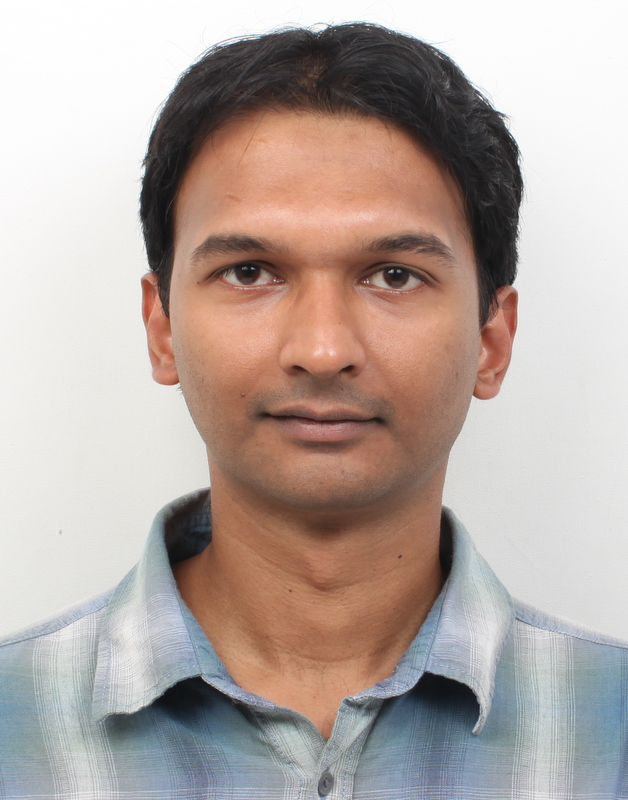
Shivaram Kalyanakrishnan is an Associate Professor at the Department of Computer Science and Engineering , Indian Institute of Technology Bombay , specialising in Artificial Intelligence and Machine Learning . His research spans sequential decision making , multiagent learning , multi-armed bandits , and humanoid robotics , with applications in robot soccer , computer games , and online advertising . He teaches advanced courses like CS 747: Foundations of Intelligent and Learning Agents and CS 748: Advances in Intelligent and Learning Agents , focusing on end-to-end system design and theoretical analysis. His scientific awards include the Best Student Paper Award at RoboCup International Symposium 2006 and nomination for Best Student Paper Award at AAMAS 2007 . His work on reinforcement learning and policy iteration has been published in leading venues such as IJCAI , ICML , and COLT , with recent contributions to railway scheduling and bandit algorithms. While no explicit list of advisees is provided, his research projects and publications suggest mentorship of students in collaborative efforts. Contact : shivaram@cse.iitb.ac.in .
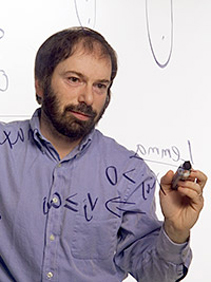
David B. Shmoys is the Laibe/Acheson Professor of Business Management & Leadership Studies at Cornell University's School of Operations Research and Information Engineering (ORIE) and holds a joint appointment in the Department of Computer Science. He is a leading researcher in approximation algorithms, stochastic optimization, and computational sustainability. His work emphasizes data-driven decision-making in enterprise and society, with applications ranging from healthcare logistics to environmental conservation. Shmoys has advised 27 Ph.D. students and served as an editorial board member for top journals like Operations Research and Mathematics of Operations Research. Education: Ph.D. in Computer Science, University of California, Berkeley (1984). Postdoctoral positions at MSRI and Harvard University, followed by faculty roles at MIT before joining Cornell. Research Interests: Design and analysis of approximation algorithms for NP-hard problems, stochastic optimization, scheduling, facility location, and inventory management. Applications include computational sustainability, epidemiological modeling, and political districting optimization. Articles Trends: Focus on optimization under uncertainty, computational sustainability, and real-world applications like air ambulance routing, bike-sharing systems, and gerrymandering analysis. Notable works include the 2018 Wagner Prize-winning paper on bike-sharing analytics and the 2013 Lanchester Prize-winning textbook on approximation algorithms. Awards: Lanchester Prize (2013), Daniel H. Wagner Prize (2018), Fellowships from ACM, INFORMS, and SIAM, NSF Presidential Young Investigator (1987). Advising & Grants: Over 27 advised Ph.D. students, with former students at MIT, Waterloo, Brown, and D-Wave. Active in grants related to data science and sustainability. Labs/Teams: Involved in the Institute of Computational Sustainability at Cornell, focusing on applying algorithms to environmental challenges. Collaborates with organizations like Motivate (bike-sharing) and Ornge (air ambulance services).
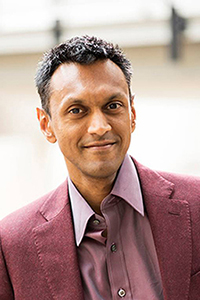
Sham Kakade is the Rampell Family Professor of Computer Science and Professor of Statistics at Harvard University, co-director of the Kempner Institute. His research focuses on advancing artificial general intelligence through foundational work in reinforcement learning, large-scale learning systems, and autonomous agent architectures. He earned his PhD in 2003 from the Gatsby Computational Neuroscience Unit at University College London. His work emphasizes scalable optimization algorithms, distributed systems for foundation models, and understanding emergent capabilities in neural architectures. Research interests include full-stack training pipelines for foundation models, mathematical principles of large-scale learning systems, and bridging language models with embodied intelligence. He advises prospective students with backgrounds in applied deep learning or theoretical computer science, offering access to the Kempner Institute's computational resources. He serves on committees for the ACM Prize in Computing and Sloan Research Fellowships, co-organizes the Simons Symposium on Theoretical Machine Learning, and chaired COLT 2011. His lab works at the intersection of theory and practice, addressing challenges in AI's societal impact and technical scalability. Labs/Teams: Co-directs the Kempner Institute, fostering collaborations between AI researchers and social scientists. Active in Harvard's SEAS community.
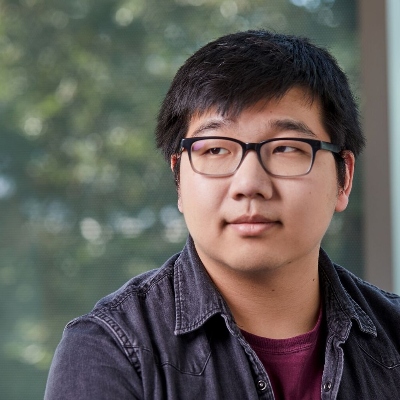
Rachit Agarwal is an Associate Professor in the Department of Computer Science at Cornell University, with research focusing on systems, networking, and theoretical problems arising in practical systems. He leads a research group working on resource disaggregation, host architecture, secure cloud storage, and datacenter design. PhD in Computer Science, Cornell University Undergraduate, IIT Kanpur His research spans three major directions: Resource Disaggregation (with $3M NSF and Google awards), Host Architecture (exploring terabit interconnects), and PANCAKE (secure oblivious cloud storage with $1M NSF award). He also contributed to foundational work in Near-optimal Datacenter Design and Data Plane Monitoring . Awards include the Sloan Fellowship, NSF CAREER, IRTF Applied Networking Prize, and multiple best paper awards. His recent publications focus on host network architecture, congestion control, oblivious data access mechanisms, and secure cloud storage systems. He has advised multiple Ph.D. and postdoctoral researchers who now hold faculty positions at leading institutions. Sloan Research Fellowship NSF CAREER award Kavli Fellowship IRTF Applied Networking Research Prize SIGCOMM Best Student Paper Award Usenix Security Distinguished Paper Award Tau Beta Pi Professor of the Year 2025 Rachit has advised numerous students including current Cornell advisees like Midhul Vuppalapati, Shreyas Kharbanda, and Omar Eqbal. Former advisees include Saksham Agarwal (UIUC), Qizhe Cai (UVA), and Mina Tahmasbi Arashloo (University of Waterloo). His research is supported by large NSF grants and industry awards, with deployments in real-world systems and open-source contributions.
Dr. Amin Keramati is an Assistant Professor of Supply Chain Management at Widener University’s School of Business Administration. He holds a PhD in Transportation & Logistics from North Dakota State University and previously served as a graduate research assistant at the Upper Great Plains Transportation Institute. His work includes federally funded projects like the Mountain-Plains Consortium’s MPC-550 project, focusing on highway-rail grade crossing safety. Dr. Keramati teaches courses in enterprise resource planning, decision analytics, database management, transportation/logistics, project management, and data analytics. Education: PhD in Transportation & Logistics, North Dakota State University Graduate Research Assistant at Upper Great Plains Transportation Institute Research Focus: Dr. Keramati develops mathematical, statistical, and machine learning approaches to solve complex problems in transportation, supply chain, and logistics. Key areas include data mining, big data decision support, transportation network analytics, project scheduling, smart manufacturing, and accident analysis. His interdisciplinary work bridges supply chain optimization with emerging technologies like blockchain for healthcare and clinical trials. Awards & Recognition: Student Paper Award, American Association of State Highway and Transportation Officials (2017) Grants & Projects: Lead researcher on the Mountain-Plains Consortium’s MPC-550 project, which expanded his dissertation work on safety systems for highway-rail crossings. Collaborates on federally funded transportation safety initiatives and supply chain optimization for bioethanol and pharmaceutical industries. Labs/Teams: Active in Widener’s School of Business research groups focusing on supply chain innovation and interdisciplinary projects combining logistics with emerging technologies.
Jiatao Gu is an Assistant Professor in the Department of Computer and Information Science (CIS) at the University of Pennsylvania, with a part-time role as Staff Research Scientist at Apple (MLR). He holds a Ph.D. in Electrical and Electronic Engineering from the University of Hong Kong (2018) and a B.Eng. in Electronic Engineering from Tsinghua University (2014). His research focuses on generative machine learning and AI agent interaction with the physical world, emphasizing multi-modal systems spanning language, images, videos, and 3D. Key themes include efficient modeling , flexible architecture design , and scalable decision-making frameworks . 2025: ICLR paper on DART framework 2024: TMLR work on GFlowNet alignment 2023: NeurIPS research on diffusion stability 2022: ACL papers on speech translation Recent publications explore diffusion models for text-to-image synthesis, 3D reconstruction, and efficient sampling techniques. His work addresses fundamental challenges in attention mechanisms, entropy collapse, and multi-stage distillation while advancing non-autoregressive translation and vision-language reasoning . Prospective students can apply through his recruitment process at UPenn. Prior affiliations include Meta AI (FAIR Labs) and academic collaborations with institutions like New York University's CILVR Lab.
Benjamin Carrison-Schafer is an Associate Professor and Assistant Dean for Graduate Student Success at the Department of Electrical and Computer Engineering, Erik Jonsson School of Engineering and Computer Science, University of Texas at Dallas. He leads the Design Automation and Reconfigurable Computing Laboratory (DARClab), focusing on systems, high-level design, and programming methodologies for VLSI computing systems and FPGAs. Education: MBA from McGill University, Canada (2012) PhD in Electrical and Electronic Engineering from University of Birmingham, UK (2003) Research Interests: His work spans modeling, analysis, synthesis, optimization, and implementation of VLSI systems. Current projects include: Approximate Computing, High-Level Synthesis Design Space Exploration, Hardware Security, Behavioral MPSoC Optimization, and Automatic Fault-Tolerant System Generation. His research blends theory and practice, using analytical and experimental techniques to solve real-world problems. Publication Trends: Recent publications demonstrate strong focus on hardware security, FPGA optimization, and automated design methodologies. Key themes include High-Level Synthesis innovations, hardware acceleration techniques, and cross-disciplinary applications of reconfigurable computing. His work frequently addresses challenges in hardware trustworthiness, energy efficiency, and design automation scalability. Professional Activities: Associate Editor: IEEE Transactions on Sustainable Computing (2022-present) Conference Chair: ICCD 2024, DCAS 2024 Program Committee: ASP-DAC, DATE, FCCM, GLSVLSI Advising & Labs: Supervises multiple PhD and Master's students at DARClab. Current research includes domain-specific architecture design, hardware security, sustainable computing, and ML for VLSI design. The lab collaborates with industry partners like Renesas Electronics and develops commercial tools through spin-off company highX Technologies.
Bahar Asgari is an Assistant Professor in the Department of Computer Science at the University of Maryland, College Park. She holds appointments in CS, UMIACS, and ECE, and directs the Computer Architecture and Systems Lab (CASL). Her research focuses on domain-specific architecture design, near memory processing, and reconfigurable computing. Before joining UMD, she worked at Google, contributing to system optimization and memory utilization strategies. Education: Ph.D., Georgia Institute of Technology, 2021. Research Interests: Developing energy-efficient architectures for sparse problems, scientific computing acceleration, FPGA optimizations, and reconfigurable hardware systems. Her work addresses challenges in memory efficiency, parallelization, and hardware-software co-design across domains like machine learning and IoT. Key Awards: 2024 UMD Excellence in Teaching Award 2023 DOE Early Career Award Advising & Grants: Supervises 9 graduate students and leads projects sponsored by NSF, DOE, and industry partnerships. Her lab explores systolic arrays, near-data processing, and fault-tolerant computing. Labs/Teams: Directs CASL, which builds next-generation computing systems through hardware innovation and algorithm-architecture co-design.
Shane G. Henderson is the Charles W. Lake, Jr. Professor in Productivity at Cornell University's School of Operations Research and Information Engineering (ORIE). His research focuses on the intersection of optimization and simulation, with applications to complex systems such as bike-sharing networks, medical scheduling, and ambulance deployment. He emphasizes practical societal relevance, addressing challenges in healthcare, transportation, and parallel computing environments. Education: B.Sc. (Mathematics), University of Auckland (1992) M.S. (Statistics), Stanford University (1995) Ph.D. (Operations Research), Stanford University (1997) Research Interests: Structured simulation optimization, parallel computing applications, applied probability, and case-driven problem-solving. Recent work includes MRI scheduling, radiation treatment planning, and land/air ambulance systems. He advocates for methodologies that leverage convexity or quasi-convexity to enhance algorithmic efficiency and robustness. Awards and Recognition: 2016 Tau Beta Pi Professor of the Year 2014 Sonny Yau '72 Excellence in Teaching Award 2011 Hess Research & Education Award NSF CAREER Award (1999) Teaching & Service: Courses in probability, simulation, and mathematical modeling using case-based learning. Served on award committees for INFORMS Nicholson Prize, Pierskalla Prize, and Impact Prize. Organized major conferences including the 2009 INFORMS Applied Probability Society conference and multiple Winter Simulation Conferences. Currently co-edits simulation-optimization testbeds for experimental comparisons. Labs & Collaborations: Active in Cornell's collaborative research environment, focusing on interdisciplinary projects with industry partners like Motivate (bike-sharing systems). Engaged in advancing methodologies for complex systems through data-driven approaches.
Steven I-Jy Chien serves as Professor and Director of the Transportation Program within the Department of Civil and Environmental Engineering at the New Jersey Institute of Technology (NJIT). His career spans academia, government, and industry with significant contributions to transportation engineering research and practice. His educational credentials include: Ph.D. in Civil and Environmental Engineering from University of Maryland-College Park (1995) M.S. in Civil and Environmental Engineering from University of Maryland-College Park (1991) B.S. in Civil Engineering from Tamkang University (1983) Professor Chien's research focuses on transportation system resilience, sustainable transit operations, and advanced traffic modeling. His work addresses critical challenges in urban rail networks, demand-responsive transit services, and energy-efficient transportation systems. He employs sophisticated computational methods including genetic algorithms, machine learning, and Bayesian approaches to solve complex transportation problems involving network vulnerability, passenger behavior, and infrastructure optimization under uncertainty. Analysis of his recent publications reveals strong emphasis on transportation resilience against cascading failures, sustainable operations for electric transit systems, and pandemic-responsive aviation scheduling. His research spans diverse geographic contexts including major Chinese metropolitan areas and U.S. transportation networks, demonstrating global applicability of his methodologies. His professional recognition includes: 2024 Keynote Speaker at Union-Tech Lecture, National Taiwan Ocean University 2022 Keynote Speaker at International Conference of Chinese Institute of Transportation 2022 Best Poster Award from New Jersey Department of Transportation Professor Chien has secured research funding from federal agencies including the Federal Highway Administration (FHWA) where he contributed to CORSIM traffic simulation software development. His industry experience with China Engineering Consultants Inc. and Information Dynamic Inc. informs his practical approach to transportation challenges. As Transportation Program Director, he oversees curriculum development and industry partnerships that prepare students for transportation sector careers. He maintains active collaboration with transportation agencies globally, particularly through his leadership in the Transportation Program at NJIT which serves as a hub for innovation in urban mobility solutions.
Nate Foster is a Professor of Computer Science at Cornell University and currently serves as the Associate Dean for Research in the Ann S. Bowers College of Computing and Information Science. He is also a Visiting Researcher at Jane Street and served as a Visiting Professor at École Polytechnique Fédérale de Lausanne during the 2023-24 academic year. His research uses ideas from programming languages to solve problems in networking, databases, and security. BA in Computer Science, Williams College (2001) MPhil in History and Philosophy of Science, University of Cambridge (2008, all work completed in 2003) PhD in Computer and Information Science, University of Pennsylvania (2009) Foster's research focuses on developing languages and tools that make it easy for programmers to build secure and reliable systems. His current work centers on the design and implementation of languages and tools for programmable networks, particularly using the P4 language. His past work includes bidirectional languages (also known as 'lenses'), database query languages, data provenance, type systems, mechanized proof, and formal semantics. His research group at Cornell has made significant contributions to network verification, software-defined networking, and formal foundations for programmable data planes. Analysis of Foster's recent publications reveals a strong focus on network verification and programming language foundations for networking. His work consistently applies formal methods to practical networking problems, with a particular emphasis on the NetKAT and P4 languages. Over the past five years, his research has evolved toward more complex network verification techniques, including infinite state verification, active learning of network models, and dependently-typed approaches to network programming. His work bridges theoretical computer science with practical networking systems, making formal methods accessible to network engineers. ACM Fellow (2025) ACM SIGPLAN Robin Milner Award (2023) ACM SIGCOMM Rising Star Award (2018) NSF CAREER Award (2013) Alfred P. Sloan Fellowship (2012) Multiple distinguished paper awards across top conferences including POPL, PLDI, and SIGCOMM Foster has advised numerous PhD and Master's students who have gone on to prominent positions in both industry and academia, with many continuing work in programming languages and networking. He has led multiple significant research grants including an NSF CAREER Award and has been involved in the P4 Language Consortium, serving as Chair of the P4 Language Governing Board. His work has been supported by various organizations including NSF, DARPA, and industry partners like Intel and Jane Street. Foster is also active in the programming languages research community, serving on numerous program committees and as Vice Chair of DARPA's Information Science and Technology (ISAT) study group. Foster leads a vibrant research group at Cornell focused on programming languages for networks, with collaborators from academia and industry. His group has developed several influential tools and frameworks including NetKAT, Petr4, and KATch. They maintain strong connections with the P4 community and work closely with industry partners to ensure their research has practical impact on real-world networking systems.
Alexandre Jacquillat is the Maurice F. Strong Career Development Associate Professor and Associate Professor of Operations Research and Statistics at MIT Sloan School of Management. His research focuses on data-driven decision-making with applications in air traffic management, urban mobility, and decarbonization. He holds a PhD in Engineering and MS degrees from MIT and École Polytechnique. Education PhD in Engineering, MIT MS in Technology and Policy, MIT MS in Applied Mathematics, École Polytechnique Research Interests His work develops scalable optimization models for efficient, equitable, and sustainable operations. Key areas include stochastic optimization, large-scale systems design, and machine learning applications in transportation and public policy. Recent projects explore vertiport planning for urban aerial mobility and prescriptive analytics for pandemic response. Awards Harold W. Kuhn Award (2024) INFORMS Harvey Greenberg Research Award (2023) MIT Jamieson Prize for Excellence in Teaching (2023) Multiple INFORMS Best Paper Awards (2015-2023) Named Leading Academic Data Leader by Chief Data Officer Magazine (2021-2022) Teaching & Grants Teaches courses in optimization (15.093, 15.083) and analytics (15.072). His grants support work in robotic warehousing, air traffic scheduling, and disaster response logistics. Advises on transportation analytics for industry and government. Labs/Teams Leads MIT Sloan's operations research group, collaborating with industry partners like McKinsey & Co. and Booz Allen Hamilton on transportation analytics and optimization projects.
Khuzaima Daudjee is a Professor and David R. Cheriton Faculty Fellow in the Cheriton School of Computer Science at the University of Waterloo. His research focuses on systems-oriented problems at the intersection of systems and data management, particularly building large-scale systems, storage infrastructure in the cloud, and modern hardware applications. He leads projects in distributed database systems, elastic scaling, and resource optimization. His recent work includes Caerus (geo-replicated transactions), Tiresias (predictive storage), and MorphoSys (automatic physical design metamorphosis). Daudjee has chaired major conferences including ICDE 2026 and serves on editorial boards for VLDB, SIGMOD, and IEEE TKDE journals. His awards include ACM Distinguished Scientist and multiple best paper awards. Educational initiatives include developing distributed systems teaching materials and supervising graduate students across database and distributed systems domains. His industry collaborations involve cloud infrastructure optimization and scalable data processing frameworks.
Prof. Raffaello D'Andrea is a Full Professor at ETH Zürich's Department of Mechanical and Process Engineering, affiliated with the Institute for Dynamic Systems and Control. His research focuses on bridging digital and physical worlds through robotics, control systems, and autonomous systems. He has pioneered work in aerial robotics, swarm systems, tactile sensing, and soft robotics. His philosophy emphasizes solving 'easy' problems with scalable, robust solutions, prioritizing simplicity and replicability. Key research areas include UAV navigation, distributed control, tactile sensor design, and fault-tolerant systems. He has founded multiple organizations and led roles as CTO/CEO, emphasizing cross-disciplinary innovation. His work has commercial applications in logistics, healthcare, and automation, driven by a belief in technology's role in improving human life. Notable projects include the Cubli robotic cube, aerial vehicle swarms, and optical tactile sensors for robotics. His lab emphasizes collaboration and team leadership, aiming to translate theoretical insights into practical, scalable technologies. Scientific awards: None explicitly listed in the provided texts. Advising and grants: No students listed in the provided texts; grants information not detailed. Labs/Teams: Leads research at ETH Zurich's Institute for Dynamic Systems and Control, collaborating with industry and academic partners globally.
Quanquan C. Liu is an Assistant Professor in the Department of Computer Science at Yale University, part of the School of Engineering & Applied Science. His research focuses on algorithms for large data, dynamic/distributed/parallel graph algorithms, and differential privacy. He holds a PhD from MIT's Theory Group, advised by Erik Demaine and Julian Shun, with postdoctoral experience at Northwestern University and MIT. Liu has authored over 50 publications in top venues like FOCS, SPAA, and STACS, and received a Best Paper Award at SPAA 2022. He advises a team of 12+ students, including PhD and undergraduate researchers. His service roles include PC membership for PPoPP, ESA, and SPAA, and coaching for the USA Computing Olympiad (USACO) and ICPC teams. Notable research contributions include advancements in parallel algorithms for graph problems and privacy-preserving techniques.