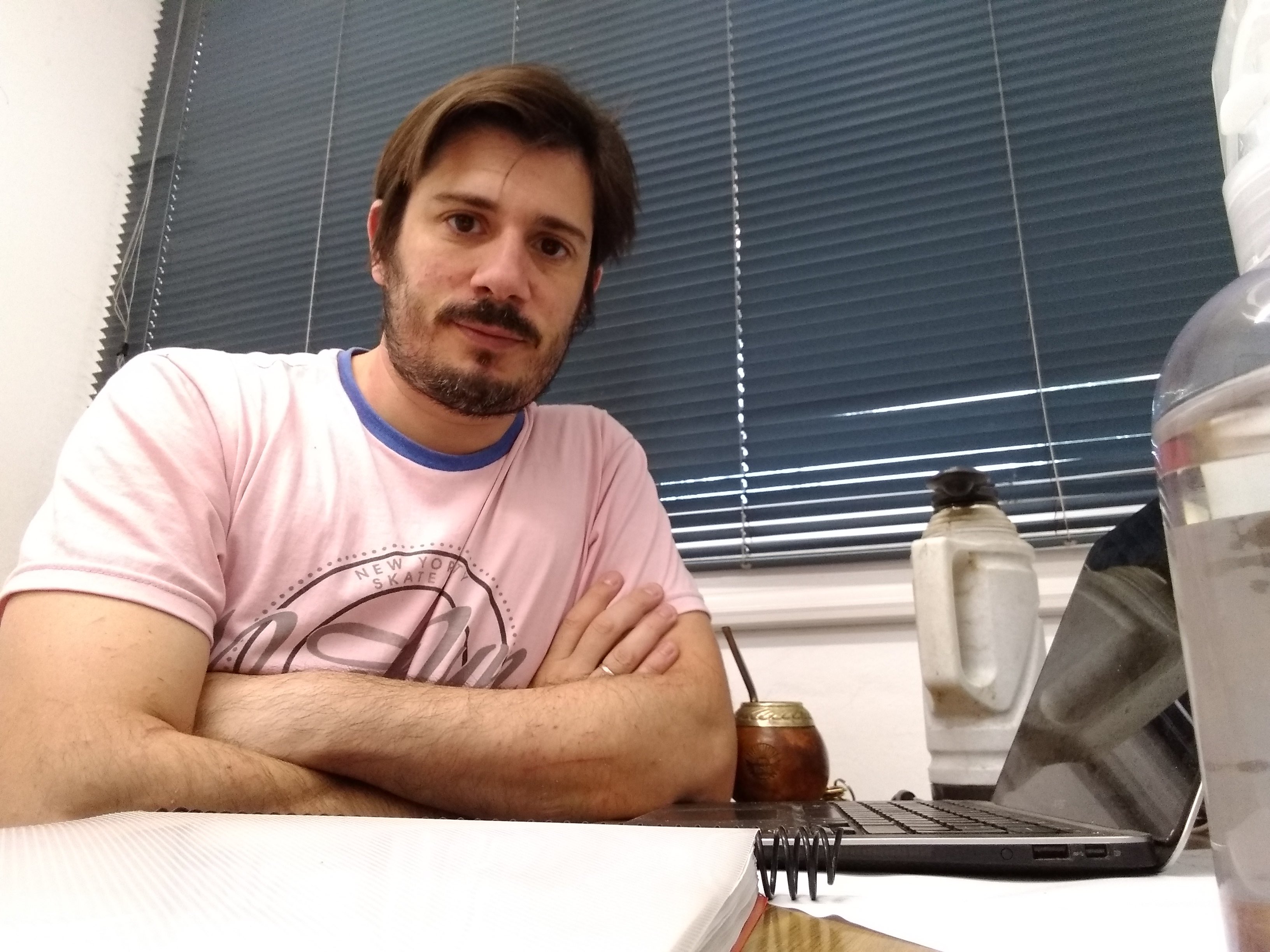
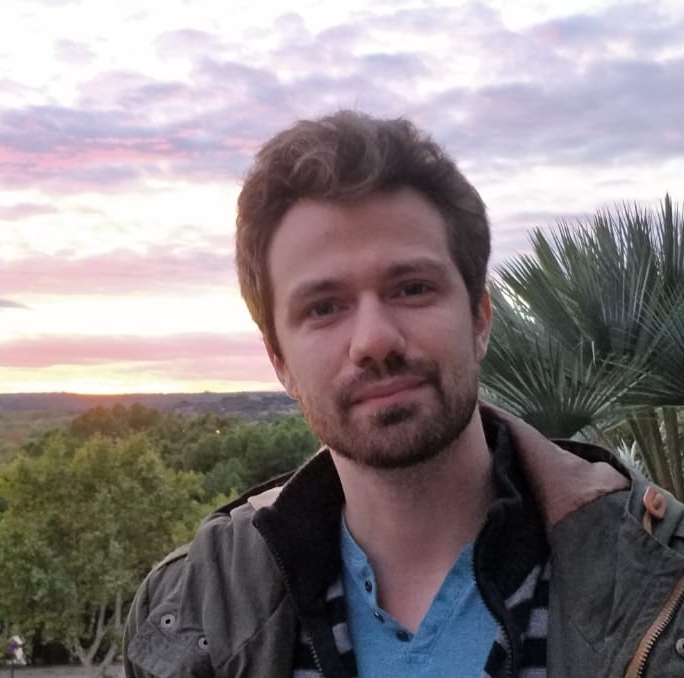
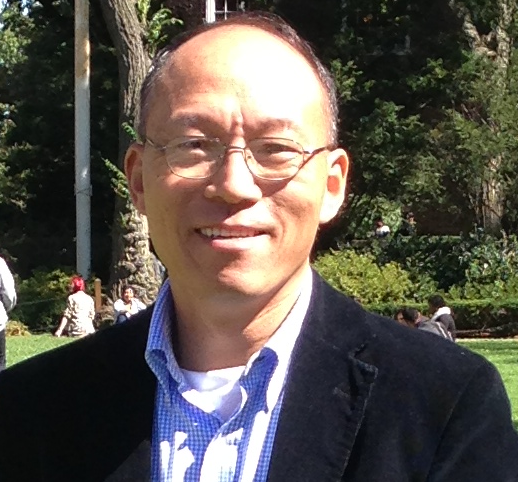
Gábor Tardos is a Hungarian mathematician and computer scientist with a career spanning esteemed institutions such as the Alfréd Rényi Institute of Mathematics (since 1991) and Simon Fraser University (2005–2013). He currently holds a professorship at Central European University and leads the Lendület cryptography research group at Rényi Institute. His work bridges discrete mathematics, computer science, and complexity theory. Key fields of interest: Discrete and computational geometry Cryptography Extremal combinatorics Complexity theory Major scientific contributions include probabilistic fingerprinting codes, advancements in the Lovász local lemma, and combinatorial geometry breakthroughs. His awards include the 2020 Gödel Prize and Lendület Grant. He serves as an editor for journals such as Order and Combinatorica .
Mattias Guns is an Associate Professor in the Department of Computer Science at the Faculty of Engineering Science, KU Leuven. He is a core member of the Declarative Languages and Artificial Intelligence (DTAI) research unit and holds affiliations with Leuven.AI and the KU Leuven Institute for Mobility (LIM). He serves on the Council of the Faculty of Engineering Science and the Programme Committees for Artificial Intelligence and Mobility and Supply Chain. His research centers on bridging Artificial Intelligence with constraint-based optimization, focusing on Explainable AI, Predict-and-Optimize frameworks, and machine learning integration for constraint solving. Key interests include human-centric explainability in decision systems, perceptual reasoning, and energy-efficient optimization models. His work addresses fundamental challenges in program synthesis, scheduling, and trustworthiness of AI planning systems. Recent publications reveal strong trends in fusing machine learning with declarative problem-solving paradigms. Notable themes include LLM-driven constraint modeling, mutational testing for solvers, step-wise explanation generation, and preference learning for unsatisfiable constraints. His research consistently targets real-world applications in supply chain optimization, inventory management, and perceptual reasoning systems. As principal investigator, he leads multiple major projects: TED-AI: Trustworthy Explanations for Decision Making in AI (2025) Towards Human-Centric Explainable Constraint Solving (2025-2028) SAELING: Energy Optimization via Learning (2024-2027) From Natural Language to Constrained Optimization (2023-2027) He has supervised PhD student Mulamba Ke Tchomba on machine learning-enhanced constraint solvers for perceptual reasoning. Within the DTAI research group, he contributes to KU Leuven's leadership in declarative AI through collaborative work on constraint programming foundations and applications. His team actively develops open-source tools like CMPpy for prediction-optimization integration and participates in European AI initiatives through Leuven.AI.
Yong Gao is a Professor of Computer Science, Data Science, and Mathematics at the University of British Columbia (UBC) Okanagan, affiliated with the Irving K. Barber Faculty of Science. He holds a PhD from the University of Alberta and leads research in algorithmic and computational problems in artificial intelligence, network science, and computational biology. His work emphasizes graph theory, probabilistic methods, and applications in social media and biological systems. Educational Background : PhD in Computer Science, University of Alberta Research Interests : Algorithmic foundations of AI and network science Graph-based methods for computational biology and social media analysis Probabilistic modeling of complex systems Awards & Grants : Recipient of multiple NSERC Discovery Grants (2006–2019) UBC Okanagan Startup Grant (2005–2008) Senior Member, Association for the Advancement of AI (AAAI) Professional Roles : Member, Centre for Optimization, Convex Analysis and Nonsmooth Analysis Graduate student supervisor Teaching : Courses in algorithm design, artificial intelligence, discrete mathematics, and network science.
Friedrich Slivovsky is a researcher at the Institute of Logic and Computation within the Faculty of Informatics at Technische Universität Wien (Vienna University of Technology). His work focuses on theoretical and practical aspects of computational logic, with particular expertise in Quantified Boolean Formulas (QBFs), Propositional Model Counting (#SAT), and Knowledge Compilation. His research interests span the theoretical foundations and practical applications of computational logic. Slivovsky investigates the complexity of logical reasoning problems, develops efficient algorithms for solving them, and creates practical tools that implement these theoretical advances. His work bridges the gap between theoretical computer science and practical applications in areas like hardware verification, artificial intelligence, and electronic design automation. Analysis of his publication trends reveals a consistent focus on QBF solving techniques, with increasing emphasis on circuit minimization, proof complexity, and practical solver engineering. His recent work (2023-2024) shows a strong focus on circuit minimization techniques, combining QBF and SAT approaches to solve complex optimization problems in hardware design. Earlier work (2019-2021) emphasized dependency schemes, certification methods, and theoretical foundations of QBF solving. Slivovsky leads several significant software projects that have become important tools in the computational logic community: Qute : A dependency learning QBF solver with GitHub repository showing active development (latest commit December 2024) Unique : A preprocessor for (D)QBF that computes unique Skolem and Herbrand functions Pedant : A certifying DQBF solver These projects demonstrate his commitment to translating theoretical advances into practical tools that benefit the broader research community.
Thomas Eiter is a Professor at TU Wien's Institute of Logic and Computation. His research focuses on declarative programming paradigms, knowledge representation, and artificial intelligence. He leads projects in neurosymbolic systems, answer set programming (ASP), and stream reasoning, with applications in visual question answering, scheduling optimization, and semantic scene generation. Eiter has contributed to foundational work in ASP semantics, computational complexity, and hybrid reasoning frameworks. His work bridges logical formalisms with practical AI challenges, emphasizing explainability and scalability. Projects like ALASPO and neurosymbolic integration showcase his focus on advancing both theoretical and applied aspects of AI. Projects: HumanE AI Network, WASP, REWERSE Research Themes: Neurosymbolic AI, Answer Set Programming, Stream Reasoning Notable achievements include pioneering work on semiring-based reasoning frameworks and developing efficient ASP solvers like Alpha. His contributions span over 471 publications, emphasizing interdisciplinary applications in computer vision, robotics, and automated planning.
Anil Nirmal Hirani serves as a Professor in the Department of Mathematics at the University of Illinois at Urbana-Champaign, specializing in the intersection of geometric theory and computational methods. Education: PhD, Caltech, 2003 Hirani's research centers on applied geometry and topology, with significant contributions to Discrete Exterior Calculus (DEC) as a framework for numerical analysis. His work bridges abstract mathematical concepts like cohomology and Hodge theory with practical computational physics applications, particularly in fluid dynamics and dynamical systems. The fingerprint analysis of his publications reveals dominant themes including Calculus (100%), Discrete Exterior Calculus (78%), and Finite Element Methods (27%), indicating a consistent focus on structure-preserving discretizations of physical systems. Recent publications demonstrate an evolving trajectory toward multi-physics problems, combining DEC with phase-field methods for fluid interfaces and developing conservative integrators for non-smooth systems. This reflects a strategic expansion from theoretical foundations to complex real-world simulations while maintaining mathematical rigor. Scientific Awards: NSF CAREER Award (2007) for "Algebraic Topology and Exterior Calculus in Numerical Analysis" (2007–2012) Hirani maintains active research collaborations evidenced by multi-institutional publications and global network connections. His advising activities, though not explicitly detailed in the source, are inferred through co-authored works with junior researchers. Current investigations appear focused on extending DEC frameworks to multi-material systems and non-smooth dynamics, supported by continued NSF engagement beyond the initial CAREER grant period.
Miki Hermann is a CNRS Researcher at the Laboratory of Computer Science (LIX) at École Polytechnique, France. He is affiliated with the Algorithms and Complexity research group and maintains an active research program in theoretical computer science and computational logic. His research interests span computational complexity, constraint satisfaction problems, satisfiability, and logic in computer science. Hermann's work focuses on the theoretical foundations of computational problems, particularly examining complexity classifications, counting problems, and algorithmic solutions for logical and combinatorial structures. His research bridges theoretical computer science with practical applications in artificial intelligence and data analysis. The analysis of his recent publications reveals a consistent focus on computational complexity across various logical frameworks. His work demonstrates expertise in classifying the complexity of constraint satisfaction problems, propositional logic systems, and graph-theoretic problems. Notable research directions include minimal inference problems, counting complexity, and applications of satisfiability to big data transformation through his MCP project. Hermann is part of the Algorithms and Complexity research group at LIX (CNRS, UMR 7161), where he contributes to theoretical computer science research. He has developed significant software projects including MCP (Multi-Classification Project) for transforming datasets into propositional formulas and GYT (Generalized Young Tableaux) for solving variadic polynomial equations over non-negative integers.
Pablo Francisco Castro is a Professor and current Chair of the Department of Computer Science at Argentina's National University of Rio Cuarto (UNRC), while simultaneously serving as a Researcher at the Argentinean National Research Council (CONICET). His dual-role positions demonstrate significant academic leadership in both institutional administration and national research infrastructure. His educational foundation includes: Licenciatura in Computer Science from UNRC PhD in Computer Science from McMaster University, Canada Castro's research program centers on the theoretical and practical applications of logic to computing systems, with deep specialization in fault-tolerance mechanisms, computational complexity theory, and functional programming paradigms using Haskell and Python. His work bridges abstract logical frameworks with concrete implementation challenges, particularly in concurrent systems verification and probabilistic reasoning models. His 2023 JELIA conference publication on satisfiability bounds for adaptive knowing-how logic exemplifies his research trajectory toward formalizing complex cognitive processes within computational models, revealing consistent focus on the intersection of epistemic logic, AI reasoning, and computational tractability. While no specific awards are documented in the provided materials, his extensive service as program committee member for premier conferences (FM, CONCUR, CLEI) and reviewer for top-tier journals (Artificial Intelligence, IEEE Transactions) indicates substantial peer recognition within the formal methods community. No information regarding student advisement or research grants appears in the source texts. Similarly, no dedicated laboratory structures or formal research teams are explicitly described, though his GitHub repositories suggest independent tool development aligned with his publication topics.
Dr. Ian Pratt-Hartmann is a Senior Lecturer at the School of Computer Science, specializing in Formal Methods. He received his PhD in Philosophy from Princeton University (1987) and previously studied Mathematics and Philosophy at Brasenose College, Oxford. His research spans logic, artificial intelligence, and cognitive science, focusing on intersections between logic and complexity theory, logic and geometry, and logic and natural language. He has supervised 11 PhD students, including Dominik Schoop, Nick Player, and Yegor Guskov, with topics ranging from mereotopology to temporal logics.
Alessio Mansutti is an Assistant Professor at IMDEA Software Institute, Madrid, where he conducts research in logic and formal methods in computer science. Prior to this, he was a Research Associate in the Automated Verification Group at the University of Oxford. His research focuses on decision procedures for arithmetic theories, separation logic, modal logics, and proof theory. Key areas include Presburger arithmetic with non-linear operations (exponentiation, GCD), quantifier elimination, complexity analysis, and logical expressiveness. He has made significant contributions to the decidability and complexity of extended arithmetic and spatial logics. The recent publications show a strong trend in developing quantifier elimination techniques for linear-exponential and counting extensions of arithmetic, analyzing reachability in separation logic, and designing internal calculi for modal and spatial logics. His work bridges theoretical logic with practical verification and optimization problems. Scientific Awards : None mentioned in the text. Advising and Grants : Alessio Mansutti is currently leading independent research funded by the Madrid Regional Government under the César Nombela grant 2023-T1/COM-29001. There is no mention of formal students or advisees, suggesting he may be early in his independent career. He was previously involved in the ERC project ARiAT (2020–2024) led by Christoph Haase, focusing on advanced reasoning in arithmetic theories. Labs and Teams : He is affiliated with the IMDEA Software Institute and was part of the Automated Verification Group at the University of Oxford. His research is deeply collaborative within the formal methods and logic communities, particularly in decision procedures and logical foundations for program verification.
Neng-Fa Zhou is a Professor of Computer and Information Science at Brooklyn College and the Graduate Center of the City University of New York (CUNY). He holds a BS from Nanjing University (1984), and MS and PhD from Kyushu University (1988, 1991). Before joining CUNY, he served as an Associate Professor at Kyushu Institute of Technology (1991-1999) and held visiting positions at Yale, Alberta, Tokyo Tech, and Melbourne. Specializes in programming languages, constraint logic programming, and compiler design Developed Picat and B-Prolog languages with constraint-based graphics libraries Contributed to SAT encodings, multi-agent pathfinding, and declarative programming Scientific Awards: Most Practical Paper Award at PADL 2017 Award in ASP Solver Competition for BPSolver (2011)
Seth Freeman is an Adjunct Associate Professor of Management and Organizations at the Leonard N. Stern School of Business, New York University, where he has taught since the early 2000s and formally joined in 2007. He also teaches at Columbia University’s School of International & Public Affairs and leads programs at Stern Executive Education. His expertise spans negotiation, conflict resolution, and organizational decision-making, with global outreach including Sun Yat-Sen University’s EMBA program in Guangzhou, China. His research focuses on overcoming the wariness problem —designing mechanisms that help wary individuals collaborate safely—and enabling mutually satisfying conversations on hot-button issues despite deep disagreement. These themes are central to his teaching, training, and public scholarship. His work has reached broad audiences through his book 15 Tools to Turn the Tide (HarperCollins) and his The Great Courses™: The Art of Negotiating the Best Deal . His insights have been featured in major media including The New York Times , Time , Washington Post , Fortune , and Bloomberg TV . Scientific Awards: Top 5 Teaching Award, Columbia University School of International & Public Affairs As a trainer, Professor Freeman has conducted negotiation workshops for leaders at the United Nations, Fortune 500 companies, major law firms, churches, and nonprofits. He is also a trained mediator who served at the Queens Mediation Center. He received his J.D. from the University of Pennsylvania and a B.A. in Economics from Cornell University. He maintains a student-focused website at www.professorfreemanforstudents.com. He is actively involved in executive education and public engagement, with no indication of retirement or former staff status.
Matthias Troyer is a Professor at ETH Zurich, affiliated with the Computational Physics group. His research focuses on quantum computing, algorithm design, and computational physics, with a particular emphasis on quantum annealing and optimization techniques. Key Contributions: Co-authored a 2017 publication in SciPost Phys on quantum annealing applications to satisfiability filters. Professional Information: ORCID ID: 0000-0002-1469-9444 Personal web page: http://www.comp.phys.ethz.ch/people/troyer.html
Nutan Limaye is a Professor at the Department of Theoretical Computer Science , IT University of Copenhagen , specializing in Algorithms , Computational Complexity , and Algebraic Circuits . She actively contributes to research on polynomial complexity, quantum computation, and lower bound techniques. Key Research Areas : Algebraic Circuit Complexity, Polynomial Computation, Graph Isomorphism, Boolean Satisfiability Current Projects : FLows : Formula complexity and lower bounds (2024-2026) DIREC: OnlineAlgo : Digital research initiatives (2022-2025) BARC2 : Basic Algorithms Research Copenhagen (2024-2029) Scientific Recognition includes the FOCS Best Paper Award (2022) . Her work frequently appears in top conferences like CCC , FSTTCS , and SIGACT News , with recent collaborations in Denmark and international institutions. She contributes to public understanding through media appearances on topics like basic computer science research and BARC's initiatives .
Marcello Dalpasso is an Associate Professor of Computer Science at the School of Engineering, University of Padova, Italy, and a member of the Department of Information Engineering. He has held this position since 2004 after serving as a researcher and teaching assistant at the same university from 1998. Born in Ferrara, Italy (1965) Graduated with highest honors in Electronic Engineering (1990), University of Bologna PhD in Electronic Engineering and Computer Science (1994), Rome His research focuses on integrated circuit testing , fault simulation , and algorithm design . He has developed techniques for IDDQ testing , bridging fault modeling , and Boolean satisfiability applications in digital systems. Other contributions include optimization algorithms for Traveling Salesman Problem (TSP) and efficient data structures. Recent publications highlight his work on Answer Set Programming for timing analysis, Python programming education , and TSP neighborhood exploration . His research spans both theoretical and applied domains, from hardware testing to software development and computational biology. He has co-authored textbooks on Computer Networks , Software Design , and Programming in Java/Python/C++ , serving as a key contributor to educational materials in computer science.