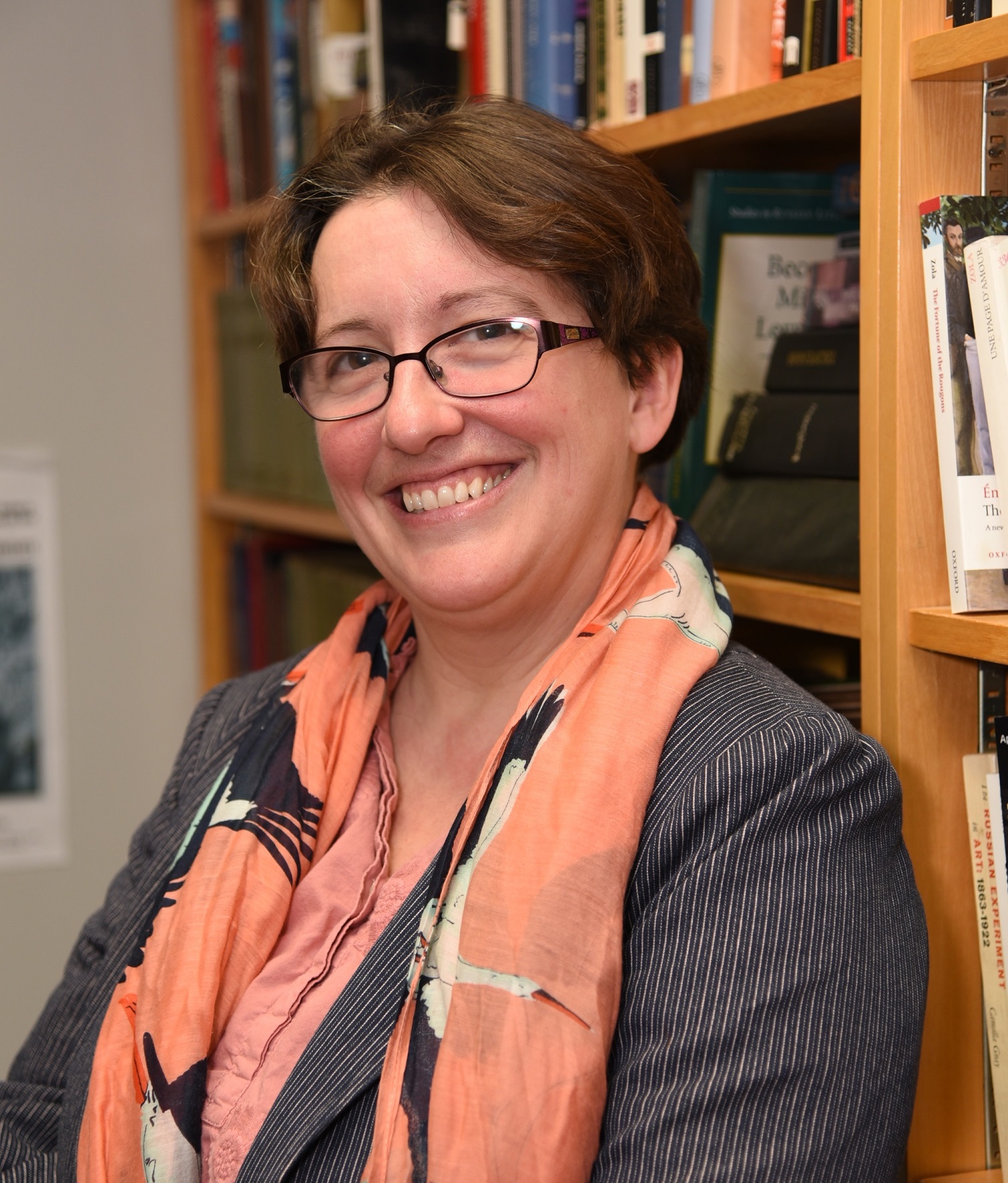
Kate Holland is an Associate Professor and Acting Associate Chair (Graduate) at the University of Toronto, specializing in 19th-century Russian literature and its cultural contexts. Her work focuses on the history of the novel, Russian literary theory, and the interplay between Russian and European literary traditions. She teaches courses such as 'The Golden Age of Russian Literature' and 'Dostoevsky in Literary Criticism and Theory.' Dr. Holland earned her PhD from Yale University (2004) and a BA/MA from the University of Cambridge (1998). Her research explores themes like genre evolution in Dostoevsky’s works, the publication culture of 19th-century Russian periodicals, and the theoretical frameworks of Historical Poetics. Her recent publications include A Dostoevskii Companion: Texts and Contexts (2018) and The Novel in the Age of Disintegration (2013), analyzing Dostoevsky’s engagement with genre and modernity. Her scholarship frequently examines narrative form, cultural history, and the intersection of literature with philosophical and religious thought.
Denis Kozlov is an Associate Professor in the Department of History at Dalhousie University, specializing in modern Russian and Soviet history. His academic journey includes a BA from Herzen Russian State Pedagogical University, an MA from the University of Massachusetts Amherst, and a PhD from the University of Toronto. He holds appointments within Dalhousie's Faculty of Arts and Social Sciences and maintains an active research profile focused on cultural and intellectual transformations in the Soviet Union. His educational background reflects deep engagement with Russian studies: BA: Herzen Russian State Pedagogical University MA: University of Massachusetts Amherst PhD: University of Toronto Kozlov's research centers on Soviet cultural and intellectual history during the post-Stalin era (1953-1991), with particular emphasis on memory practices, reading audiences, and migration. His work examines how Soviet citizens processed historical trauma through literature and media, especially during the Thaw period, and explores transnational migrations from the USSR in the 1970s-1980s. He investigates intersections between literature, society, and historical consciousness, revealing how cultural production shaped Soviet identity and social change. Analysis of his 15 most recent publications shows consistent focus on Soviet cultural history, with dominant themes including reading practices during de-Stalinization, migration as political expression, and memory politics. His methodology combines archival research with cultural analysis, increasingly incorporating transnational perspectives in recent works on Soviet Jewish migration and Eastern European identity. His scholarly recognition includes significant awards: SSHRC Insight Grant (2019-2024) Andrew W. Mellon Fellowship at Institute for Advanced Study, Princeton (2010-2011) Harvard University Postdoctoral Fellowships (2008-09) Faculty of Arts and Social Sciences Teaching Award (2014-2015) Kozlov actively supervises graduate research in Soviet history while securing major grants including SSHRC and NEH funding. His teaching spans introductory surveys to advanced seminars on Soviet Russia and comparative cultural history, with recent courses including HIST 2021F (Soviet Russia) and HIST 3088F (History & Memory Russia and West) for 2024-2025. While no dedicated research labs are mentioned, his collaborative projects like the NEH-funded conference "The Thaw: Soviet Society and Culture during the 1950s and 1960s" demonstrate his role in building scholarly networks. Current work focuses on Soviet migration patterns and their ideological implications.
J. Paul Goode is an Associate Professor and McMillan Chair in Russian Studies at the Institute of European, Russian and Eurasian Studies (EURUS) within Carleton University’s Faculty of Public and Global Affairs. His research focuses on nationalism, authoritarianism, and political identity in Russia and post-Soviet states. He holds degrees from the University of Oxford (PhD, MPhil), University of Wisconsin-Madison (MA), and University of Texas-Austin (BA). Professor Goode serves as Editor-in-Chief of Communist and Post-Communist Studies and Associate Editor of Nationalities Papers . He contributes to editorial roles at Russian Politics and Social Science Quarterly , and advises Nations and Nationalism . His professional memberships include the Program Committee and advisory board of the Association for the Study of Nationalities, and the Department Development Partnership Program of European University at St. Petersburg. Previous roles include founding Director of the Center for the Study of Nationalism and Coordinator for Russian and East European Studies at the University of Oklahoma, and Convenor of the Research Group on Nationalism, Populism, and Radicalism at the University of Bath. His research explores nationalism in authoritarian contexts, the interplay between state strategies and everyday patriotic practices, and political legitimation mechanisms. Recent projects investigate pandemic politics, AI’s impact on identity, and the evolution of Putin’s governance. He consistently analyses how regimes engineer nationalist narratives to sustain power, with a focus on Russia’s territorial and ideological boundaries. Goode’s work bridges theory and practice through interdisciplinary frameworks, emphasizing constructivist approaches to mass-level nationalism. His editorial leadership aims to democratize scholarly discourse on post-communist and authoritarian systems. He has pioneered studies on hybrid regimes and the challenges of conducting fieldwork in restricted environments. His contributions highlight the need for adaptive research strategies in politically volatile regions.
Nicole Jackson is an Associate Professor in the School for International Studies at Simon Fraser University (SFU), Vancouver. Her research focuses on foreign and security policy, particularly Russian foreign policy, post-Soviet Central Asia, securitization, and hybrid challenges. She holds a Ph.D. from the London School of Economics (LSE) in Government, an MSc in Comparative Government from LSE, and a BA (Hons) in Political Science from the University of Toronto's Trinity College. Her career includes prior roles as Assistant Professor at the University of Warwick (UK) and current research on NATO's approaches to nuclear and information warfare risks. She is the 2025 NATO Defence College Fellow, focusing on strengthening responses to disinformation and hybrid threats through multilateral cooperation. Her work spans empirical studies on Russian policy, Canadian foreign policy responses, and theoretical debates on securitization. Education: Ph.D., Government, London School of Economics MSc, Comparative Government, London School of Economics BA (Hons), Political Science, University of Toronto Research themes include Russian military actions in post-Soviet conflicts, securitization frameworks, and Canada/NATO strategies against hybrid warfare. She has published extensively on these topics, including her 2003 book Russian Foreign Policy and the CIS and recent articles on disinformation and deterrence. Her 2024 MINDS/NDC Fellowship in Rome aims to address NATO’s responses to manipulated information threats. Teaching includes courses on Russian foreign policy, global security governance, and special topics in governance and conflict. She supervises graduate students on Eurasian security and Canadian foreign policy, with alumni in government agencies like Global Affairs Canada and CSIS.
Jeff Sahadeo is a Professor of Russian and Eurasian History at Carleton University, affiliated with the Department of History within the Faculty of Public and Global Affairs. He specializes in contemporary Central Asia and the Caucasus, with a strong focus on empire, migration, and nationalism. BA, Simon Fraser University MA, Carleton University PhD, University of Illinois at Urbana-Champaign His research explores the intersections of empire and identity in Russia and Central Asia, with particular attention to diaspora, migration, and comparative colonialisms. He investigates how historical memory shapes ethnic relations, especially in post-Soviet contexts like Kyrgyzstan and the Ferghana Valley. His work often employs oral history and interdisciplinary methods to understand the lived experiences of marginalized groups in Soviet and imperial Russia. Jeff Sahadeo's recent scholarly output reflects a deep engagement with themes of race, urban life, and empire. His publications analyze the racialization of southern migrants in Soviet cities, the imperial administration of Tashkent, and the geopolitical dynamics of contemporary Central Asia. The articles span disciplines including history, sociology, political science, and memory studies, with recurring subfields such as postcolonial theory, urban marginality, and historical trauma. His current research projects—funded by SSHRC—include studies on rivers and societies in Soviet Georgia and the multinational character of Soviet cities like Moscow and Leningrad. Committee Member, Reginald Zelnik Prize for Best Book in History, ASEEES (2018–2019) He has advised various research initiatives and leads the Migration Research Laboratory at South Ural State University, Russia. His public engagement includes media appearances on CBC, CTV, ABC News, and CFRA, particularly during the Ukraine crisis and on issues related to Russian foreign policy. He has also contributed to policy discussions through the Global Centre for Pluralism and the Kyrgyz Presidential Commission on Historical Science. Jeff Sahadeo teaches core courses in European, Russian, and Eurasian Studies, including graduate seminars on research methodology, imperialism, and Soviet culture. He co-teaches a course on Nazism and Stalinism, reflecting his broader interest in totalitarian regimes and comparative history.
Daniel Schwartz is an Associate Professor at McGill University , specializing in Russian and German Cinemas. His work bridges sound studies, urban studies, and documentary film, with a focus on early 20th-century cinematic experiments and their intersections with music, mass spectacle, and radio. He has published extensively in journals like Cinema Journal , Slavic Review , and Studies in Russian and Soviet Cinema . Research Focus: Sonic dimensions of silent cinema, urban modernity, Soviet/Russian film Contact: daniel.schwartz2@mcgill.ca | 680 Sherbrooke St. West, Montreal, QC His 2024 book City Symphonies: Sound and the Composition of Urban Modernity, 1913-1931 challenges assumptions about silent films through archival and interdisciplinary analysis. Recent articles explore topics like Dinara Asanova's documentaries, Sergei Loznitsa's archival practices, and the geopolitics of post-Soviet cinematic borders.
Aileen Friesen is an Associate Professor in the Department of History at the University of Winnipeg, affiliated with the Faculty of Arts. She also serves as Executive Director of the Plett Foundation, focusing on interdisciplinary historical research and community engagement. Her work bridges academic and public history through initiatives like heritage cruises and educational outreach. Education Background : While specific degrees are not detailed in the text, her academic roles and publications suggest advanced training in History, likely with a PhD in Russian or Mennonite Studies. She is associated with the Centre for Transnational Mennonite Studies and the H. Sanford Riley Centre for Canadian History. Research Interests : Mennonite History : Focuses on migration, religious dissent, and colonial experiences in Siberia and Ukraine. Russian/Soviet History : Explores Orthodoxy’s role in colonization, state-religion interactions, and ethnic group policies. Migration Studies : Analyzes displacement patterns, transnational identity formation, and diaspora communities. Her work frequently intersects with environmental history, religious studies, and colonial studies. Publications Trends : Recent scholarship emphasizes Siberian Mennonite communities, Soviet-era religious policies, and transnational ethnic mythologies. She combines archival research with oral histories, as seen in The Russian Mennonite Story (2018) and Colonizing Russia’s Promised Land (2024). Her 2020 analysis of Omsk bishops reveals how spiritual networks shaped colonial dynamics. Awards & Grants : No specific awards listed. However, her publications and roles suggest sustained institutional support for research in Mennonite and Russian studies. Labs/Teams : Active in the Newberry Consortium in American Indian Studies and the State Socialism Workshop. Collaborates with the Oral History Centre and the Centre for Rupert’s Land Studies.
Katherine Bowers is an Associate Professor and Canada Research Chair in the Department of Central, Eastern, and Northern European Studies at the University of British Columbia. She directs the Centre for European Studies and leads the Eurasia Research Cluster, specializing in Russian literature, digital humanities, and Gothic studies. Bowers holds a PhD from Northwestern University (2011) and completed postdoctoral research at the University of Cambridge. Her award-winning monograph 'Writing Fear' (2022) established Gothic fiction's influence on Russian realism. Current digital projects include 'Digital Dostoevsky' analyzing the writer's corpus through computational methods. As Acting Department Head (2024-25), Bowers promotes comparative studies of Central/Eastern European cultures. Her teaching spans Russian literature, European magic tales, and digital humanities methodologies. Honors include the International Dostoevsky Society Service Award (2023) and Killam Research Fellowship (2023). Bowers co-founded the feminist DH collective 'Data-Sitters Club,' developing accessible text analysis guides. Her forthcoming 'Oxford Handbook of Global Realisms' (2025) reexamines literary realism through transnational perspectives.
Vladimir Popov is a Visiting Professor at Carleton University and a Professor at the New Economic School in Moscow. His work focuses on transition economies, comparative economic systems, and development theories, with specific expertise in China, Russia, and Eastern Europe. Key Research: Economics of transition, post-Soviet transformation, income inequality, mortality crises, and institutional capacity in developing countries. Teaching: Macroeconomics, Comparative Economic Systems, and Economics of Transition. Research Trends: Recent publications examine China's economic model, Russian mortality patterns, BRICS financial strategies, and post-pandemic economic policies. His work spans topics like resource curse, industrial policy, and the socio-political impacts of economic reforms. Scientific Awards: Premia INOP 'Obshchestvennaya Mysl' (Public Thought) in 2011 Professional Contributions: Served on the UN ECOSOC Committee for Development Policy (2008-09), contributed to WIDER/UNU, and participated in global conferences on transition economies and development strategies.
Thomas Soehl is an Associate Professor and Canada Research Chair in International Migration at McGill University's Department of Sociology (Faculty of Arts). His research focuses on migrant families' intergenerational processes, political attachments of migrants, and cross-border connections. He employs quantitative methods such as multilevel modeling and Bayesian approaches. Education : - PhD in Sociology, University of California Los Angeles (2014) - MA in Political Science, CUNY Graduate Center - MPA in Public Administration, Harvard Kennedy School - Urban Planning degree, University of Kassel Research Interests : Explores how migration impacts political/social identities, family dynamics in transnational contexts, and the role of geopolitical trauma in nationalism. His work bridges migration studies, family sociology, and political sociology. Awards : - 2013 Reuben Hill Award for Inheriting the Homeland? Intergenerational Transmission of Cross-Border Ties in Migrant Families Teaching & Engagement : Teaches courses on migration, social stratification, and quantitative methods. Previously worked as a policy analyst in New York City Council, influencing his applied research focus. Key Contributions : - Pioneered methodologies for studying global migrant populations via social media - Advanced theories on transnational political engagement among refugees - Analyzed legacy effects of historical trauma on contemporary nationalism
Heather Coleman is a Professor and Chair of the History, Classics, & Religion Department at the University of Alberta's Faculty of Arts. Her research focuses on the intersection of religion and modernization in 19th and 20th century Russia and Ukraine, particularly examining the role of Orthodox clergy as cultural brokers in Kyiv province. She has authored influential books such as Russian Baptists and Spiritual Revolution, 1905-1929 and edited volumes including Sacred Stories: Religion and Spirituality in Modern Russia . Her current SSHRC-funded project, “Holy Kyiv: Priests, Communities, and Nationality in Imperial Russia,” explores ethno-religious diversity in Kyiv and its impact on Russian and Ukrainian identities. Dr. Coleman has held leadership roles, including Editor of Canadian Slavonic Papers (2011-2020) and Director of the Program on Religion and Culture at the Canadian Institute of Ukrainian Studies. She teaches courses on Russian history, European modernity, and religion, and actively mentors graduate students in Eastern European history. Her awards include an honorable mention for the Wallace K. Ferguson Prize. Key research themes include: religious dissent, imperial borderland dynamics, and the cultural history of Orthodoxy. She has published widely on clergy attitudes toward nationalism, Jewish communities, and the evolving role of the Orthodox Church in multiethnic regions. Her work bridges historical scholarship with contemporary debates, emphasizing the interplay between faith, identity, and political power. Recent publications analyze clerical diaries, regional identity formation, and transnational religious networks.
Lucian Turcescu is Professor and Graduate Program Director in the Department of Theological Studies at Concordia University, serving as Acting Chair from July to December 2025. His scholarship bridges historical theology and contemporary political analysis, with significant contributions to understanding religion's role in post-communist societies. His academic credentials include: PhD in Theology from University of St. Michael's College (University of Toronto), 1999 M.A. Equivalent from Faculty of Theology, University of Bucharest, 1992 Dr. Turcescu's research centers on Religion and Politics with specialized focus on Orthodox Christianity in Eastern Europe , particularly Romania's religious landscape during and after communism. His work examines Religion and Human Rights , Gender dynamics in Orthodoxy , and Patristic theology through historical and sociological lenses. Key projects analyze church-state relations, religious persecution, and theological responses to dictatorship, reflecting his dual expertise in early Christianity and modern political theology. His publication trajectory demonstrates consistent focus on post-communist religious transitions, with recent works analyzing Orthodox Church finances, historical memory, and geopolitical positioning. The scholarship reveals methodological rigor combining archival research with political theory, particularly evident in collaborative projects with Lavinia Stan examining institutional collaboration under communism. As an active thesis supervisor for Theological Studies (MA), Humanities (PhD), and Individualized Programs (PhD), Dr. Turcescu has secured substantial research funding from SSHRC Canada. His professional leadership includes twice serving as Past President of the Canadian Society of Patristic Studies (2004-2008) and editorial roles for the Journal of Ecumenical Studies and St. Vladimir’s Theological Quarterly. He also provides expert consultation for national research councils across North America and Europe, and serves as Expert Witness in religious persecution asylum cases.
Lyudmila Parts is a Professor at McGill University specializing in Russian Studies, with expertise spanning 19th-20th century literature, Chekhov scholarship, and post-Soviet cultural analysis. She earned her MA and PhD from Columbia University, establishing foundational expertise in Russian literary traditions. Her research critically examines symbolic geography and nationalist discourses , particularly through travel writing like Karamzin's Letters of a Russian Traveler , where she analyzes micro-encounters and identity construction. Current work investigates cultural narratives underpinning Russian aggression against Ukraine, connecting historical provincial myths to contemporary geopolitics. Recent publications reveal consistent thematic threads: spatial dynamics in Russian identity, center-periphery tensions, and literary responses to nationalism, with increasing focus on Ukraine-related discourses since 2022.
Stefanie von Hlatky is a Professor and Canada Research Chair in Gender, Security, and the Armed Forces in the Department of Political Studies at Queen's University's Faculty of Arts and Science. She is also a fellow with the Centre for International and Defence Policy (CIDP) and co-director of the Canadian Defence and Security Network. Her academic journey includes positions at Georgetown University, the Woodrow Wilson International Center for Scholars, Dartmouth College, ETH Zurich, and she served as a Fulbright Visiting Research Chair at the University of Southern California. Dr. von Hlatky's research focuses on how greater diversity and inclusion can improve prospects for peace, particularly examining the implementation of the Women, Peace and Security (WPS) agenda within international security organizations. Her work explores gender integration in military operations, NATO's adaptation to security challenges, and alliance politics. She has conducted extensive fieldwork and interviews across NATO missions in Iraq, Kosovo, and the Baltics. Her research output shows a strong trend toward examining gender integration in military contexts, NATO's evolving role in contemporary security challenges, and Canadian defense policy. Recent publications increasingly address Ukraine-related security dynamics, NATO's adaptation to Russian aggression, and the practical implementation of gender perspectives in military operations. Her work bridges theoretical insights with policy-relevant analysis, emphasizing the tension between operational effectiveness and genuine gender equality in military contexts. Canada Research Chair in Gender, Security, and the Armed Forces As founder of Women in International Security – Canada, Dr. von Hlatky actively mentors emerging scholars and practitioners in the field. Her research has been supported through various grants that enable extensive fieldwork with military personnel across multiple NATO operations. She frequently engages with defense policymakers to translate academic insights into practical recommendations for military organizations. Dr. von Hlatky leads research teams examining conflict-resolution techniques within top international security organizations. Her approach combines qualitative fieldwork with policy analysis to assess how gender perspectives are integrated into military operations and how these integrations affect both operational outcomes and broader peacebuilding efforts.
Yana Meerzon is a Full Professor in the Department of Theatre at the University of Ottawa, affiliated with the Faculty of Arts. Her academic roles include teaching advanced courses such as Performance and Migration , THE 5130 Dramaturgy , and THE 5934 Theatre at the Crossroads of Narratives . She holds additional adjunct roles at institutions like Carleton University’s Cultural Mediations Program and Dalhousie University’s Department of English. Her research focuses on theoretical approaches to performance and migration, including studies on displacement, multilingualism, and identity politics. She has authored four books and co-edited nine collections, with recent works exploring Russian nationalism and migration narratives. Her current SSHRC-funded project examines the intersection of migration and neo-nationalism in European theatre. Meerzon’s academic leadership includes serving as President of the Canadian Association for Theatre Research (2020–2022) and membership in global organizations like IFTR and EASTAP. Her educational background includes a Ph.D. from the University of Toronto and advanced degrees from the Russian Academy of Theatre Arts (GITIS). Her scholarly contributions span over 86 publications, including analyses of Wajdi Mouawad’s work, Michael Chekhov’s pedagogy, and digital performance in crises. She actively engages in public discourse through interviews and media links, emphasizing the ethical and cultural dimensions of migrant theatre practices in Canada and beyond.