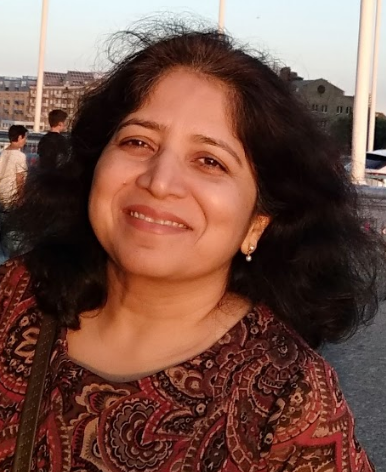
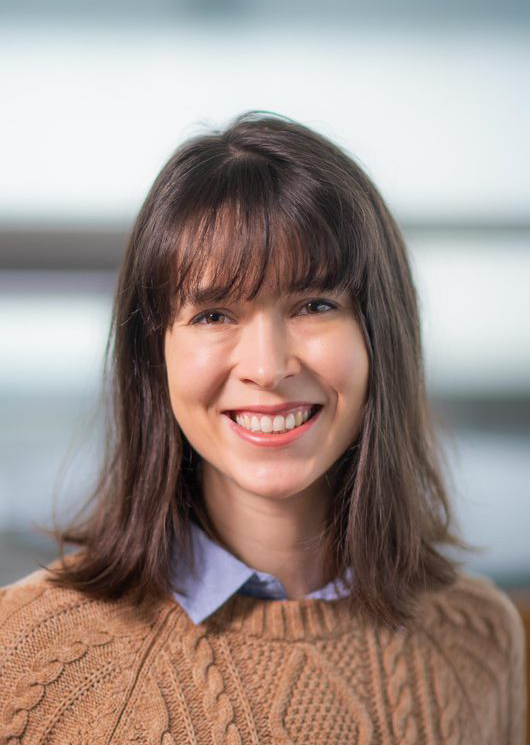
Sunita Sarawagi is a Professor at Computer Science and Engineering , IIT Bombay, and a member of AI Labs@CSE . She is also associated with the Center for Machine Intelligence and Data Science (CMInDS), which she founded in 2020. Education: PhD in Computer Science from UC Berkeley (Thesis: Query Processing in Tertiary Memory Databases), BTech in Computer Science from IIT Kharagpur Research Interests span machine learning , data analytics , graphical models , and structured learning , with applications in text segmentation, sequence modeling, domain adaptation, and human-in-the-loop systems. Her publications reveal a strong focus on integrating data mining with database systems , temporal data analysis , and information extraction using probabilistic methods. Professional Activities include serving on the IEEE John Von Neumann Medal committee (2017-), VLDB 2011 Research Track Co-chair , and multiple program committee roles at top conferences like ICML, KDD, and SIGMOD. Labs & Teams : Leads the SS Lab , a research group focused on probabilistic graphical models, sequence modeling, and data integration techniques.
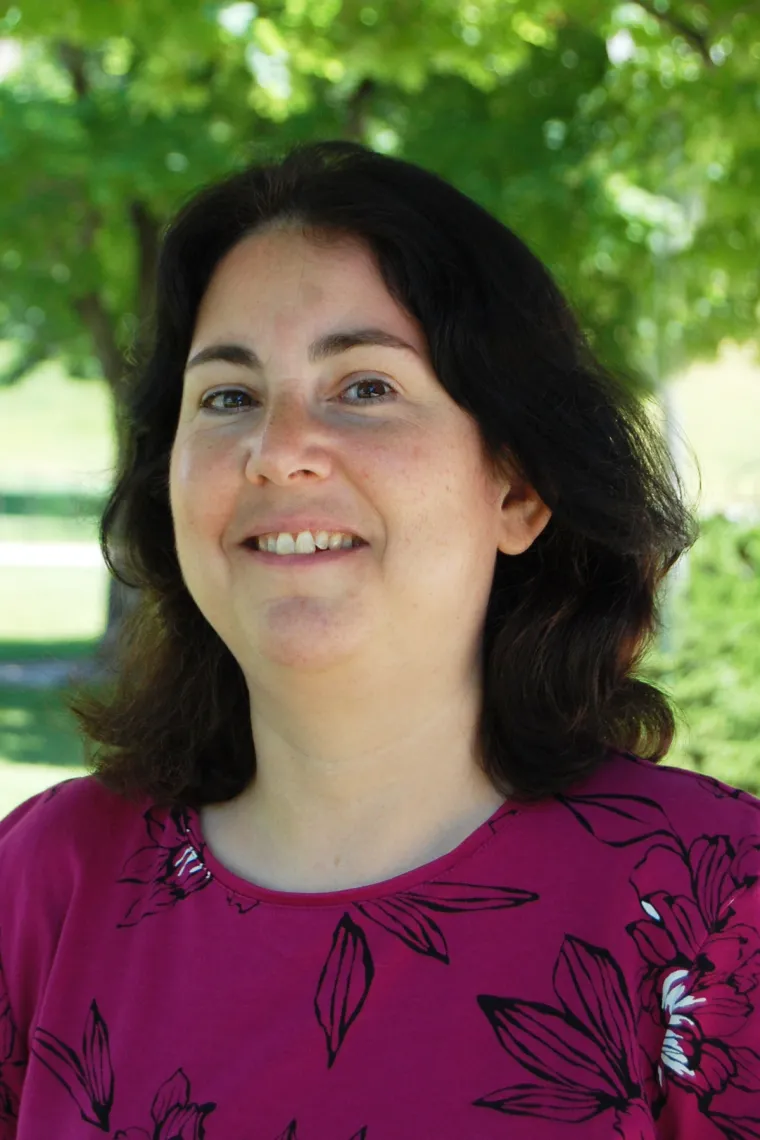
Fabian Suchanek is a full professor at Institut Polytechnique de Paris, specifically affiliated with Télécom Paris. He leads research in the Data, Intelligence, and Graphs (DIG) team within the Computer Science department. His academic career focuses on bridging artificial intelligence with structured knowledge representations. Suchanek's research interests span artificial intelligence, knowledge bases, and natural language processing, with particular emphasis on knowledge graph construction , rule mining , knowledge-based language models , and explainable AI . His work demonstrates how structured knowledge can enhance machine learning systems, particularly large language models, by providing factual grounding and interpretability. The research group he leads develops practical systems that address real-world knowledge management challenges. His recent publications showcase a strong trajectory in knowledge-intensive AI, with notable contributions to knowledge graph completion, rule mining techniques, and neural approaches to knowledge base validation. The research demonstrates increasing integration between symbolic and neural approaches to AI. Best Student Paper Award at KR 2024 for work on contextual reasoning Best Demo Award of IJCAI 2024 for rule mining in knowledge graphs French Open Research Award for the YAGO project Best Paper Award of ESWC 2021 for Neural Knowledge Base Repairs Suchanek has secured significant research funding, evidenced by his active recruitment of PhD students for knowledge-based language model research. He has held visiting positions, including at Nanyang Technological University (June-September 2023), and is recognized internationally through keynote invitations such as the Singapore ACM SIGKDD Symposium 2023. He has deliberately stepped back from administrative duties at Institut Polytechnique de Paris to focus on research. His laboratory maintains strong industry connections through open-source software projects including the YAGO knowledge base, AMIE for rule mining, STACI for explainable AI, and several other tools that have become standard in knowledge representation research.
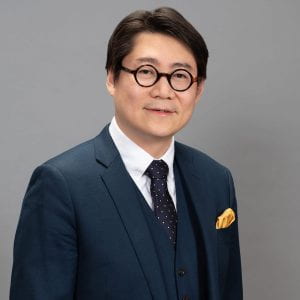
Ellen Riloff serves as Department Head and Professor in the Department of Computer Science at the University of Arizona, where she leads research at the intersection of natural language processing (NLP) and artificial intelligence. Her work bridges theoretical advancements with real-world applications in social computing, planetary science, and crisis response systems. Education: Ph.D. in Computer Science, University of Massachusetts at Amherst (1994) Research Focus: Dr. Riloff specializes in affective computing and information extraction , developing techniques to recognize emotion, social cues, and embodied expressions in text. Her methodologies frequently employ bootstrapping, stacked learning, and semantic lexicon induction. Recent projects address crisis informatics (e.g., social cue recognition in emergencies) and interdisciplinary applications like the Mars Target Encyclopedia for planetary science data extraction. Publication Trends: Analysis of her 15 most recent publications (2021–2025) reveals three dominant trajectories: (1) affective event modeling in social contexts with applications to crisis response; (2) domain-specific NLP for planetary science and food systems; and (3) advanced language model techniques including retrieval-augmented generation and multi-view prompting. Her work increasingly integrates deep learning with traditional linguistic features. Grants and Leadership: Dr. Riloff has directed multiple NSF-funded projects, including RI: Small: Recognizing Implicit Personal States in Natural Language (2016) and RI: Small: Acquiring Domain Knowledge from Text through Cooperative Bootstrapping (2010). These initiatives pioneered bootstrapping frameworks for affective event recognition and information extraction. She also co-organized the Workshop on Pattern-based Approaches to NLP (2023), highlighting her leadership in advancing hybrid NLP methodologies. Collaborative Infrastructure: She co-developed the Mars Target Encyclopedia—a large-scale information extraction system that processes planetary science literature to create structured databases of Mars surface targets. This project demonstrates her commitment to building reusable scientific infrastructure through NLP.
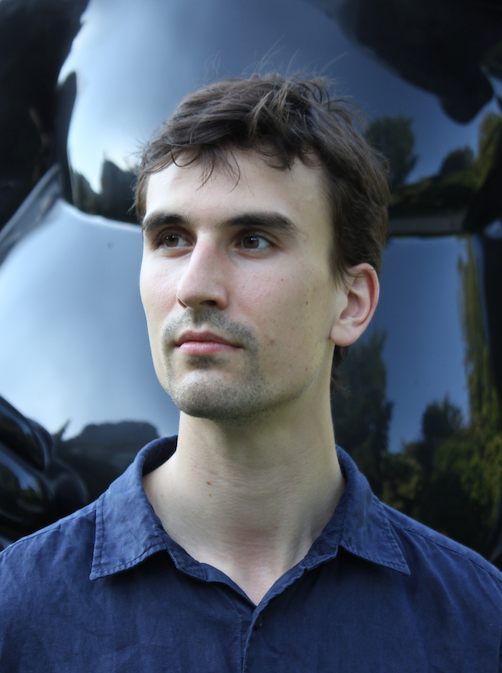
Dr. George Stamou is a Professor at the School of Electrical and Computer Engineering of the National Technical University of Athens (NTUA), serving as Director of the Artificial Intelligence and Learning Systems Laboratory (AILS). His expertise spans knowledge representation, machine learning, neural networks, and semantic technologies. He leads interdisciplinary initiatives such as the postgraduate program 'Data Science and Machine Learning' (2018–2022). Research Interests: Focuses on knowledge graphs, interpretable AI, semantic web applications, and multimodal learning. His work integrates formal logic systems (e.g., description logics) with modern deep learning techniques, addressing challenges in explainability, bias detection, and ethical AI applications. Publications: Over 150 articles in AI journals/conferences with an h-index of 34 (Google Scholar). Notable contributions include datasets like CHORDONOMICON (music analysis), GOSt-MT (gender bias in MT), and methodologies for counterfactual explanations in machine learning. Awards & Committees: Active in W3C and RuleML standardization bodies. Co-organized major AI conferences. Recognized for contributions to semantic interoperability and knowledge-based systems. Labs & Teams: Directs AILS-NTUA lab and collaborates with CISRI (Computer & Information Systems Research Institute). Engages in EU projects like CultureLabs (cultural heritage digitalization) andsmarty4covid (health data analysis).
Henrik Boström is a Professor of Computer Science specializing in Data Science Systems at the Division of Software and Computer Systems, KTH Royal Institute of Technology. His research focuses on trustworthy machine learning , with emphasis on conformal prediction (for confidence-calibrated predictions) and explainable AI . He is the developer of Python packages crepes (conformal classifiers/regressors) and xrf (explainable random forests). His primary research domains include: Developing robust methods for uncertainty quantification in predictive models Creating interpretable machine learning frameworks Optimizing ensemble techniques for high-dimensional data Applying ML to healthcare informatics and industrial diagnostics Analysis of his recent publications reveals strong emphasis on: (1) advancing conformal prediction theory for trustworthy AI, (2) enhancing interpretability of complex models like random forests and GNNs, and (3) developing efficient algorithms for uncertainty-aware learning in domains including healthcare, graph data, and high-dimensional regression. He serves as examiner for multiple degree projects and teaches courses including Programming for Data Science (ID2214) and Research Methodology and Scientific Writing (II2202) . He leads development of open-source tools for conformal prediction and model interpretation.
Teruko Mitamura is a prominent researcher at Carnegie Mellon University with over three decades of contributions to natural language processing, computational linguistics, and artificial intelligence. Her work spans from foundational research in event representation to advanced applications in multimodal systems and question answering. Her research interests focus on event detection and understanding, question answering systems, information retrieval, and multimodal processing. She has made significant contributions to event coreference resolution, timeline construction, and cross-document event analysis, developing methodologies that have become standard in the field. Her work often bridges theoretical advances with practical applications, particularly in complex information environments requiring deep semantic understanding. Natural Language Processing : Specializing in event extraction, coreference resolution, and narrative understanding with over 179 publications Question Answering Systems : Developing advanced techniques for complex question answering, particularly through NTCIR QA Lab and PoliInfo tasks Multimodal Processing : Integrating textual, visual, and temporal information for richer understanding in systems like ProMQA Evaluation Methodologies : Creating robust frameworks for assessing NLP systems through TAC KBP Event Tracks Her recent publication trends show a strong focus on leveraging large language models for event understanding, multimodal question answering, and timeline construction. She has expanded her research into specialized domains including patent analysis and novelty examination, demonstrating the breadth of her research impact across academic and practical applications. Active participant in major NLP conferences including ACL, EMNLP, NAACL, and AAAI with consistent publications Long-standing collaborator with researchers at CMU's Language Technologies Institute including Eduard H. Hovy and Eric Nyberg Contributor to shared tasks that have shaped research directions in event processing and question answering Organizer of multiple NTCIR QA Lab tasks focused on political information question answering Dr. Mitamura has mentored numerous researchers who have gone on to make their own contributions to the field, as evidenced by her extensive co-authorship network and the progression of her former students and collaborators into faculty and research positions. Her work continues to evolve with the field while maintaining her focus on deep semantic understanding of events and narratives.
Terrence Chapman is a Professor of Government at the University of Texas at Austin, affiliated with the Robert S. Strauss Center for International Security and Law, Center for European Studies, and Clements Center on History Strategy, and Statecraft. His research focuses on international organizations, conflict resolution, and political economy frameworks. Key research areas include: International institutional legitimacy Global regulatory regimes Public opinion in international affairs Conflict management mechanisms Formal modeling of diplomatic interactions Recent scholarly trends reveal expertise in climate governance negotiations, digital surveillance politics, and regulatory effectiveness. His work spans theoretical modeling and empirical analysis of international collaboration dynamics. Scientific recognition includes: 2011-2012 APSA Conflict Processes Section Book Award Teaching portfolio covers: Science Fiction and Politics International Organization and Law Research Methods in International Politics Previously served as associate/senior editor for International Studies Quarterly .
Yuhua Wang serves as the Ford Foundation Professor of Modern China Studies within Harvard University's Faculty of Arts and Sciences, Department of Government. His scholarly work establishes him as a leading authority on Chinese political development, state capacity, and historical institutional analysis across imperial and contemporary contexts. His academic foundation includes: B.A. from Peking University Ph.D. from the University of Michigan Professor Wang's research program integrates comparative politics with Chinese studies through core interests in bureaucracy , institutions , judiciary and public law , political economy & development , political geography , and state-society relations . He employs a methodological triad of historical , qualitative , and quantitative approaches to analyze China's political evolution. His work uniquely bridges macro-historical patterns with contemporary governance challenges, particularly examining how historical legacies shape modern state capacity and institutional resilience in authoritarian contexts. Analysis of his publication trajectory reveals consistent focus on state development mechanisms, with increasing sophistication in comparative historical methodology. Recent work demonstrates expanded geographic scope beyond China while maintaining analytical depth in imperial political economy. His research shows growing integration of cross-national datasets with deep historical case studies, reflecting broader trends in political science toward mixed-method designs for complex institutional analysis. His distinguished recognition includes: 2023 Lubbert Best Book Award in Comparative Politics from the American Political Science Association for The Rise and Fall of Imperial China Harvard College Professor appointment (2025) Professor Wang maintains active research leadership through extensive publication in premier journals including American Political Science Review and Comparative Political Studies , with significant contributions to theoretical frameworks like State-in-Society 2.0. His work generates substantial policy-relevant insights on corruption, judicial review, and urban governance in China. As a core faculty member in Harvard's Government Department, he contributes to the university's intellectual ecosystem through cross-disciplinary collaboration and participation in research initiatives focused on Asian political development, though specific lab affiliations are not documented in available sources.
Mauro Barelli is Professor of International Law at The City Law School, City, University of London. He holds a PhD from Cardiff University and an LLM from the University of Bristol, and has been a faculty member at City since 2009, progressing from Lecturer to Professor in 2024. He teaches Advanced Issues of International Law, International Human Rights Law, and a course on Minority and Indigenous Peoples' Rights. He has held visiting positions at the University of Cambridge (Lauterpacht Centre), Nanjing University, the University of Iceland, and the University of Trento. His research focuses on: Rights of ethno-cultural and indigenous peoples Law on the use of force Chinese perspectives on international law Soft law and normative development Minority rights and litigation His publications include four books and numerous articles in leading journals such as Journal of Conflict and Security Law , Human Rights Quarterly , and Asian Journal of International Law . His recent work analyzes China’s engagement with international law, the UK’s relationship with the ICJ, and the synchronization of biodiversity protection with indigenous rights. Key scientific recognitions include: Higher Education Academy Fellow (since 2012) He is an experienced PhD supervisor, having chaired and served on numerous doctoral committees, including as PhD Programme Director. His advisee Engin Firat is currently a research student at City. He has also served in administrative roles such as Assistant Dean (Research). His expertise has been sought by national governments, parliaments, and international NGOs. He is an active participant in international academic events, particularly through the European China Law Studies Association.
Lars Eriksson is a researcher at the Department of Chemistry, Stockholm University, affiliated with the Faculty of Science. He is part of Gunnar Svensson's group, which focuses on solid-state inorganic chemistry, including the synthesis of energy-related compounds and their crystal structure analysis. Research interests span inorganic chemistry, solid-state chemistry, crystallography, energy applications, organic synthesis, catalysis, and chemical education. His work bridges experimental and computational approaches, with recent publications exploring molecular design for energy storage, asymmetric synthesis, triplet-to-singlet energy transfer, and pedagogical strategies in chemistry education. Trends in his research highlight applications in materials science, environmental chemistry, and educational methodologies. While no formal scientific awards are mentioned in the provided texts, his contributions include collaborative studies on catalysis, molecular structure, and student learning processes. He has no listed grants or students, but his publications emphasize tutor-student interactions and practical epistemology analysis. The research group he belongs to investigates fundamental properties of synthesized compounds, often with energy-related applications, and maintains strong ties to the broader chemistry community through peer-reviewed publications and educational studies.
Matthew B. Blaschko is a Professor in the Department of Electrical Engineering at KU Leuven, Belgium. He serves as director of the KU Leuven ELLIS unit and is a fellow in the ELLIS Health program. He is a Core PI in the Flanders AI Research Program, working as a workpackage lead for Decision Support Systems and Medical Imaging. Blaschko is also a member of the KU Leuven Institute for Artificial Intelligence and one of the leaders of the working group on Machine Learning and Data Science. Professor Blaschko received his B.S. from Columbia University, M.S. from the University of Massachusetts Amherst, and Dr. rer. nat. from Technische Universität Berlin (awarded for work at Max Planck Institutes Tübingen). He was a Newton International Fellow at the University of Oxford and received his Habilitation (HDR) from École Normale Supérieure de Cachan. Prior to joining KU Leuven, he was a Permanent Research Scientist in the INRIA Saclay Research Center and a Faculty Member at Ecole Centrale Paris. His research focuses on machine learning techniques applied to visual data, with particular emphasis on calibration in deep learning, medical image analysis, and federated learning. Blaschko's work bridges theoretical foundations with practical applications, as evidenced by technology developed in his research being incorporated into MONA, software for ophthalmic image analysis. His research group has made significant contributions to the fields of model calibration, uncertainty estimation, and medical imaging analysis, with recent publications showing strong trends toward improving reliability of AI systems in medical contexts and advancing theoretical understanding of calibration metrics. Professor Blaschko has been recognized with several awards including the Université Paris-Saclay STIC Doctoral School Best Scientific Contribution Award, Best Paper Award at CVPR 2008, Main Award at DAGM 2008, and Best Student Paper Award at ECCV 2008. Professor Blaschko has supervised numerous PhD and Master's students, with current and former students including Deniz Soysal, Claire Marchal, Dongli Xu, Sebastian Gruber, Jiameng Li, Marco Mezzina, and many others working on diverse topics from Alzheimer's disease analysis to surgical phase recognition. His research has been supported by various funding sources including the Flanders AI Research Program. He has co-organized several influential workshops including the "Another Brick in the AI Wall: Building Practical Solutions from Theoretical Foundations" at CVPR 2025, Commands 4 Autonomous Vehicles workshop at ECCV 2020, and the Learning from Limited Labeled Data workshop series at NIPS 2017 and ICLR 2019. His laboratory focuses on machine learning for medical image analysis, with applications in ophthalmology, neurology, and surgical robotics. The group maintains active collaborations with medical institutions and participates in international challenges such as the KNee OsteoArthritis Prediction (KNOAP2020) challenge.
Nils Holzenberger is an Assistant Professor at Télécom Paris, France, since February 2023, affiliated with the Data Intelligence Graphs (DIG) research team within the Information Processing and Communication Laboratory (LTcI). His work bridges artificial intelligence, natural language processing, and legal domains through neuro-symbolic approaches to statutory reasoning, particularly in tax law. Education: PhD in Computer Science, Johns Hopkins University (2017-2022) Master's in Engineering, Mines ParisTech (2013-2017) Preparatory Classes, Lycée Louis-le-Grand (2011-2013) Holzenberger's research centers on legal artificial intelligence with emphasis on statutory reasoning limitations in large language models. He pioneered the SARA dataset for tax law reasoning and LegalBench benchmark, developing hybrid symbolic-neural frameworks that expose LLMs' shortcomings in precise legal interpretation. His work integrates Prolog solvers with NLP techniques to create executable tax code mappings and contract analysis tools, establishing foundational methods for verifiable legal AI systems. Analysis of his 15 most recent publications (2019-2024) reveals three dominant research thrusts: (1) Tax law reasoning benchmarks exposing LLM hallucinations, (2) Neuro-symbolic integration for statutory interpretation, and (3) Low-resource template extraction for legal documents. His work consistently demonstrates that pure neural approaches fail at precise legal reasoning, necessitating symbolic grounding for reliable legal AI applications. The DIG research team at Télécom Paris, where Holzenberger leads legal AI initiatives, is actively hiring faculty for neuro-symbolic projects. While specific grant details aren't public, his collaborations with HEC Paris, Copilex startup, and featured podcast appearances indicate substantial industry-academia engagement in legal tech development. Holzenberger directs the legal AI vertical within LTcI's DIG team, focusing on data intelligence for statutory reasoning. His group develops tools for tax minimization strategy discovery, contract analysis, and legal information extraction, maintaining close ties with legal practitioners through projects like the Prolog-based tax code interpreter. The team's infrastructure supports both academic research and startup partnerships in computational law.
Karoline Faust is an Associate Professor at KU Leuven, affiliated with the Laboratory of Molecular Bacteriology (Rega Institute) and the Faculty of Medicine . She contributes to the iSi Health and Leuven One Health institutes, and serves on senior academic councils. Her research spans microbial systems biology, focusing on community dynamics and network analysis. Education: PhD in bioinformatics (2010, KU Leuven) Affiliations: KU Leuven, ISME Journal editorial board, Belgian Society for Microbiology Her research investigates microbial community dynamics , systems biology approaches to microbiomes, and bioinformatics tool development . She specializes in modeling human gut microbiota , synthetic microbial communities , and environmental microbiomes (e.g., microplastic impacts on Daphnia microbiomes). Her work integrates metabolic modeling , network analysis , and experimental systems to understand microbial interactions. Recent publications highlight her contributions to microbial network inference , 16S rRNA sequencing protocols , microfluidics , and ecological modeling of microbiomes. She develops tools like manta , miaSim , and CoNet to analyze community structures. Teaching: Karoline co-teaches courses in microbiology, bioinformatics, and network analysis at KU Leuven, and has contributed to international workshops on microbial network inference. Scientific Engagement: She serves as Senior Editor at ISME Journal and Secretary of the Belgian Society for Microbiology .
Ricardo Soares de Oliveira is Full Professor of Political Science at CERI Sciences Po and Senior Research Fellow at the Department of Politics and International Relations, University of Oxford . He also co-directs the Oxford Martin Programme on African Governance and serves as joint editor of Oxford Studies in African Politics and International Relations by Oxford University Press. He is a fellow of the Global Public Policy Institute in Berlin. Education: While specific degrees are not listed, his academic trajectory includes affiliations with the University of Cambridge, Yale University, and the Woodrow Wilson Center, indicating a robust scholarly background. Research Interests: His work centers on the international political economy of African states , with a strong focus on extractive industries , offshore finance , kleptocracy , African-Asian relations , and post-conflict reconstruction . His fieldwork spans multiple African countries and examines how global financial systems and governance structures interact with African political systems. Publications: His scholarly output includes major monographs such as Magnificent and Beggar Land: Angola Since the Civil War (2015) and Oil and Politics in the Gulf of Guinea (2007), as well as edited volumes like China Returns to Africa (2008). His current book project, Africa Offshore , explores the global offshore economy's impact on African politics. Awards and Fellowships: British Academy Senior Research Fellowship (2023) Leverhulme Trust Fellowship (2011) Grants and Collaborations: He has received funding from leading institutions including the ESRC , Rockefeller Foundation , Volkswagen Foundation , and DFID/FCDO . He has consulted for organizations such as the World Bank , European Commission , UNCTAD , and Oxfam . Labs and Teams: He co-directs the Oxford Martin Programme on African Governance at the University of Oxford, a major interdisciplinary initiative examining governance challenges across the African continent.
Caroline Lemieux is an Assistant Professor at the Department of Computer Science, University of British Columbia (UBC), with research focused on advancing software correctness, security, and performance through innovative testing and synthesis techniques. Her work bridges Programming Languages and Software Engineering , particularly in fuzz testing, specification mining, and program synthesis. PhD from University of California, Berkeley (2021), advised by Koushik Sen Postdoctoral researcher at Microsoft Research, NYC (2021-2022) Key contributions: FuzzFactory , CodaMOSA , Arvada , and Gauss Her research integrates machine learning with traditional testing methods, exemplified by projects like RLCheck (reinforcement learning for test generation) and AutoPandas (neural synthesis for dataframes). Recent publications analyze generator-based fuzzing challenges and propose hybrid strategies combining coverage feedback with AI-driven insights. Scientific Awards : ACM/SIGSOFT Best Paper Award (ESEC/FSE 2019) ACM/SIGSOFT Tool Demonstration Award (ISSTA 2019) ACM/SIGSOFT Distinguished Artifact Award (ISSTA 2019) NSERC Postgraduate Scholarship-Doctoral (PGS D) UBC Governor General's Silver Medal (2016) Teaching roles include: 2025W2: CPSC 539L - Topics in Programming Languages 2024W2: CPSC 410 - Advanced Software Engineering 2023W2: CPSC 410 (with Alex Summers) She supervises graduate and undergraduate researchers working on projects like ExploTest (automated unit test generation) and GRIMOIRE (grammar extraction from pseudo-rules). Her research team collaborates with institutions including Microsoft Research, Google, and academic partners in systems security and AI-driven testing.