Gabriella Casalino is an Assistant Professor at the University of Bari Aldo Moro, Department of Computer Science, and a key researcher at CILAB - Computational Intelligence Lab. Her work focuses on Computational Intelligence methods for interpretable data analysis, particularly in eHealth, Data Stream Mining, and eXplainable Artificial Intelligence (XAI) within medical and educational domains. She has contributed to innovative approaches in smartphone-based health monitoring, fuzzy logic applications, and remote vital sign detection via photoplethysmography. Education : Ph.D. in Computer Science, with advanced training at institutions like Universitat de Girona and Université de Mons. Research Trends : Recent publications highlight applications of evolving granular computing, neuro-fuzzy systems, and explainable AI in hypertension prediction, bipolar disorder monitoring, and educational data analysis. Key subfields include remote health monitoring, medical data streams, and hybrid AI models. Grants : Research funded by AIRC (Italian Cancer Research Foundation), focusing on computational methods for healthcare challenges. Labs & Collaborations : Active in CILAB, collaborating on projects involving mHealth solutions, cardiovascular risk assessment, and intelligent educational systems.
Salvatore Ruggieri is a Full Professor in the Department of Computer Science at the University of Pisa, where he teaches in the Master Programme in Data Science and Business Informatics. He is affiliated with the KDD LAB, a joint research group of ISTI-CNR and the University of Pisa, and actively contributes to national and European AI initiatives such as XAI, NoBIAS, TAILOR, and SoBigData.eu. His research focuses on data mining and knowledge discovery, with a strong emphasis on ethical AI. Key areas include discrimination discovery and prevention, fairness, privacy, explainable AI (XAI), causal inference, and classification algorithms. He has led significant projects such as ENFORCE, a national FIRB project on legal and computational enforcement of non-discrimination and privacy rights in ICT systems (2010–2014), and has served as program chair for the XIII Italian Symposium on Artificial Intelligence (2014). The recent publications (2018–2023) highlight a consistent trend in interpretable and fair machine learning, including selective classification, stability of interpretable models, and causal reasoning for fairness. His work often involves collaboration with leading researchers like Dino Pedreschi and Riccardo Guidotti, and appears in top venues such as AAAI, IEEE TKDE, and WIREs. His scientific honors include the award for the best Ph.D. thesis in Theoretical Computer Science from the Italian Chapter of EATCS. Best Ph.D. Thesis in Theoretical Computer Science, Italian Chapter of EATCS He advises and collaborates with numerous researchers in the KDD LAB and has contributed to major grants and research initiatives in AI and data science. He is involved in educational programs, including the National Ph.D. in Artificial Intelligence - Society, and promotes interdisciplinary research at the intersection of computer science, law, and ethics. Ruggieri is a member of the KDD LAB, where he leads research in ethical and transparent AI. He is also part of large collaborative networks such as SoBigData.eu and HumanE-AI-Net, which aim to build socially responsible and human-centered AI systems.
Dr. Alexander Artikis is an Associate Professor of Artificial Intelligence at the University of Piraeus and a Research Associate at the National Centre for Scientific Research (NCSR) "Demokritos". He leads the Complex Event Recognition (CER) group , focusing on symbolic and probabilistic approaches to event recognition and forecasting. University of Piraeus (2025–present) NCSR Demokritos (2017–present) Complex Event Recognition Group (2017–present) His research spans Artificial Intelligence and Distributed Systems , with a focus on: Complex Event Recognition (CER) : Developing logic-based systems for detecting events in real-time data streams Event Calculus : Creating probabilistic and incremental versions for runtime reasoning Multi-Agent Systems : Modeling norm-governed interactions Maritime Informatics : Applying CER to vessel trajectory analysis and fleet management Key publications reveal trends in: Neuro-symbolic forecasting models combining deep learning and logic-based reasoning Symbolic automata with memory for pattern detection Online learning techniques for dynamic event rule generation Tensor-based formalizations for efficient temporal reasoning Handling uncertainty in real-time maritime data streams Optimizing memory usage for scalable stream processing He contributes to open-source tools like RTEC (Run-Time Event Calculus) and holds a European patent on complex event forecasting. His work addresses challenges in: Proactive decision-making systems Knowledge Graph consistency Hybrid human-machine discovery of movement patterns Big Data analytics for time-critical applications
Zachary Tatlock is an Associate Professor at the Paul G. Allen School of Computer Science & Engineering at the University of Washington, where he leads the Programming Languages & Software Engineering Group (PLSE) and the SAMPL Group. His research spans programming languages, formal verification, compilers, and computational fabrication. He is also an Amazon Scholar with AWS's Automated Reasoning Group and previously advised OctoML. Tatlock's work bridges theoretical foundations with practical systems, focusing on making it easier to write tricky code while ensuring correctness through rigorous proofs and measurements. PhD in Computer Science & Engineering, University of California, San Diego (2014) Thesis: Reducing the Costs of Proof Assistant Based Formal Verification Advisor: Sorin Lerner BS in Computer Science (Honors) and Mathematics, Purdue University (2007) Professor Tatlock's research focuses on the intersection of programming languages, formal methods, and systems. His work in compilers and formal verification aims to make it easier to write tricky code while ensuring correctness through rigorous proofs. He explores computational fabrication techniques that bridge digital design with physical manufacturing. His recent work on equality saturation (via the egg framework) has transformed program optimization and synthesis. Tatlock also investigates floating-point numerics, distributed systems verification, and hardware/software co-design, always seeking to balance theoretical rigor with practical implementation. Tatlock's recent publications demonstrate a strong focus on equality saturation techniques (egg framework), computational fabrication, and verified systems. His work increasingly integrates machine learning with program analysis and synthesis. There's a clear trajectory toward more practical applications of formal methods in real-world systems, particularly in numerical computing and fabrication. His research group has made significant contributions to e-graph technology, floating-point accuracy, and the verification of distributed systems. Distinguished Paper Award for Rewrite Rule Inference Using Equality Saturation (OOPSLA 2021) Spotlight Paper Award for Dynamic Tensor Rematerialization (ICLR 2021) Distinguished Paper Award for egg: Fast and Extensible Equality Saturation (POPL 2021) Faculty Appreciation for Career Education & Training (FACET) Award (2020) NSF CAREER Award: Verifying Distributed System Implementations (2017) Distinguished Paper Award for Automatically Improving Accuracy for Floating Point Expressions (PLDI 2015) Distinguished Teaching Award Nomination (2015) Professor Tatlock has advised numerous doctoral, master's, and undergraduate students who have gone on to prominent positions in academia and industry, including faculty positions at the University of Utah and Brown University, and leadership roles at companies like OctoML and Certora. His research is supported by significant funding from NSF, DARPA, DOE, and industry partners, totaling millions of dollars. Current grants include projects on computer-aided reasoning, formal verification, computational fabrication, and machine learning systems. He has served on numerous program committees and organized workshops including FPTalks, EGRAPHS, and PNW PLSE. As co-leader of the Programming Languages & Software Engineering (PLSE) research group and affiliate of the SAMPL Group at the University of Washington, Tatlock has developed influential tools including egg (an equality saturation toolkit), Carpentry Compiler, and Odyssey. His group actively collaborates with industry partners including Amazon Web Services, where he serves as an Amazon Scholar. The group has made significant contributions to equality saturation, floating-point accuracy, program synthesis, and computational fabrication, with applications ranging from compiler optimization to 3D printing.
Shunyuan Zhang is an Assistant Professor at Harvard Business School with research focusing on AI algorithms, economic inequality, and computer vision applications in business contexts. His work examines how algorithmic systems impact economic outcomes, particularly in sharing economy platforms like Airbnb. His research interests include AI algorithms, economic inequality, pricing algorithms, machine learning, computer vision, and the sharing economy. Zhang's work often combines technical computer vision approaches with economic analysis to understand platform dynamics. Zhang's recent publications demonstrate a strong focus on the intersection of AI, fairness, and economic outcomes. His work analyzes how algorithmic pricing affects racial disparities on platforms like Airbnb, and how visual content impacts demand in the sharing economy. His research employs sophisticated methodologies including deep learning, structural modeling, and causal inference. He has published in top journals and working paper series, with notable work including 'Can an AI Algorithm Mitigate Racial Economic Inequality? An Analysis in the Context of Airbnb' and 'What Makes a Good Image? Airbnb Demand Analytics Leveraging Interpretable Image Features.' Zhang collaborates extensively with leading researchers at Carnegie Mellon University and University of Toronto, particularly on topics related to algorithmic fairness and platform economics. His work has significant implications for both academic understanding and practical policy recommendations regarding algorithmic systems in marketplace contexts.
Per-Arne Andersen is an Associate Professor at the Department of Information and Communication Technology within the University of Agder . His research focuses on artificial intelligence , reinforcement learning , Tsetlin machines , and deep learning , with applications in real-time strategy games , industrial environments , and IoT systems . Projects: RESTORE Research Groups: CAIR - Center for Artificial Intelligence Research, CIEM - Center for Integrated Crisis Management, Intelligent Mechatronics (iTron) His work explores safe and sustainable reinforcement learning , interpretable AI , and generative environment modeling . He has developed frameworks like CaiRL and CostNet for high-performance RL environments and goal-directed learning. Recent publications include advancements in Tsetlin automaton analysis , GNSS jamming classification , and road quality detection . Articles from 2025-2016 span machine learning , computer vision , and environmental modeling . He contributes to IEEE , Springer , and LNCS publications, with a focus on interdisciplinary AI applications in crisis management , cybersecurity , and industrial optimization .
Dan Moldovan is a Professor in the Department of Computer Science at The University of Texas at Dallas, within the Erik Jonsson School of Engineering and Computer Science. He leads the InterVoice Research Center in the Human Language Technology Research Institute and has played a pivotal role in advancing question answering technologies, achieving top performance in multiple TREC evaluations (TREC-8 to TREC-13). Education: Ph.D. in Electrical Engineering and Computer Science, Columbia University (1978) M.S. in Electrical Engineering and Computer Science, Columbia University (1974) Diploma Engineer in Electrical Engineering, Polytechnic Institute of Bucharest (1969) His research centers on Natural Language Processing and Artificial Intelligence , with major contributions in Question Answering Systems , Knowledge Acquisition from Text (KAT) , Word Sense Disambiguation , and Semantic Indexing and Retrieval . He has developed systems to enrich WordNet with domain knowledge and transform it into a logical knowledge base. His work also explores distributed and parallel processing for scalable NLP algorithms. The recent publications (2005–2007) highlight his focus on semantic reasoning, multilingual QA, validation of answers using logic provers like COGEX, and the semantics of noun compounds. These works reflect a strong trend toward deep semantic understanding, contextual reasoning, and integration of logic in NLP systems. Scientific Awards: Best performance in TREC-8 (1999), TREC-9 (2000), TREC-11 (2002), TREC-12 (2003), and TREC-13 (2004) QA competitions Dan Moldovan has advised numerous research projects and led major initiatives such as Extended WordNet and the development of PowerAnswer. He has secured significant research support through appointments and leadership roles across institutions. His work in distributed NLP and parallel processing of rule-based systems reflects a long-standing interest in scalable AI architectures. He has directed several key research labs: InterVoice Research Center, UTD Parallel and Distributed Computer Systems Laboratory, University of Southern California Parallel Knowledge Processing Laboratory, University of Southern California
Charles Ling is a Professor of Computer Science at Western University, holding the title of Science Distinguished Research Professor. He also serves as Director of the Data Mining and Business Intelligence Lab and Associate Scientist at the Lawson Health Research Institute. His academic background includes a B.Eng. (CS and EE) from Shanghai Jiao Tong University and MSc/PhD from the University of Pennsylvania (UPenn). Research interests span machine learning, deep learning, AI, and healthcare informatics, with notable contributions to the GlucoGuide diabetes management system. He has authored over 220 peer-reviewed papers and a book titled Crafting Your Research Future , focusing on academic career development. Awarded Fellow of the Canadian Academy of Engineering (CAE) and recipient of the First Prize for Best Clinical Research Presentation (2011). Active in grants (NSERC, FedDev, Mitacs) and organizational roles in top conferences (KDD, ICDM). Supervises 5 PhD and 4 MSc students, with notable advisees including Harry Zhang and Victor Sheng. Leverages AI in education to enhance children's cognitive abilities through video-based programs like Power Thinking , approved by Curriculum Services Canada. His work integrates machine learning with healthcare, finance, and software engineering.
Karim Ali is an Associate Professor of Computer Science at New York University Abu Dhabi (NYUAD), where he leads research in programming languages, static analysis, security, and compilers. He is affiliated with the Department of Computer Science within the College of Arts and Science. Prior to joining NYUAD, he served as an Associate Professor at the University of Alberta. His academic training includes a BSc from The American University in Cairo, and MMath and PhD degrees from the University of Waterloo, completed in 2014. BSc: The American University in Cairo MMath: University of Waterloo PhD: University of Waterloo (2014) His research focuses on making static analysis tools more practical by enhancing their scalability, precision, and usability. He investigates program analysis techniques applicable to real-world software, with applications in security, just-in-time compilation, and mobile app development. His work spans theoretical foundations and tool development, including the SWAN framework for Swift and contributions to secure cryptographic API usage through CogniCrypt. The recent publications reflect a strong trend in developer-centric static analysis, secure coding, energy efficiency in mobile apps, and compiler optimization. His work combines empirical studies with tool-building, emphasizing usability and integration into developer workflows. Scientific Awards: Dahl-Naygaard Junior Prize (2021) ACM SIGSOFT Distinguished Paper Award ACM SIGPLAN Distinguished Paper Award Distinguished Artifact Award, ECOOP 2014 Karim Ali has mentored numerous students and collaborated extensively with researchers worldwide. His lab has contributed tools adopted by major static analysis frameworks like Soot, WALA, and DOOP. He has secured research recognition through awards and industrial impact, including helping Symantec fix a security vulnerability. He teaches core courses such as Computer Systems Organization and supervises capstone projects, guiding students in original research. His lab conducts research on programming languages and static analysis, with projects including SWAN for Swift analysis, usability studies of static analysis tools, and development of precise pointer analysis techniques. The team works on both academic research and practical tooling for developers.
Dr Zhe Wang is a Senior Lecturer at the School of Information and Communication Technology, Griffith University, focusing on artificial intelligence, knowledge graphs, and semantic technologies. He earned his PhD in Computer Science from Griffith University (2011) and previously worked as a Research Fellow at the University of Oxford (2011-2013) on ontology-based systems. Research: Specializes in knowledge graph construction, rule mining for explainable AI, and integrating machine learning with logical reasoning. Led development of the scalable RLvLR rule-mining system and contributed to the HermiT ontology reasoner. Teaching: Instructs undergraduate and postgraduate courses including Introduction to Artificial Intelligence, Secure Development Operations, and Software Engineering Fundamentals. Grants: Funded by Australia's Economic Accelerator Ignite Grant (2025) for AI-driven marine life survey systems and Office of National Intelligence projects (2021-2022). Publications: Active in top venues like AAAI, ICASSP, and ISWC, with recent work on temporal knowledge graph reasoning, auction design algorithms, and neurosymbolic AI systems.
Nishchal K. Verma is a Professor at the Department of Electrical Engineering, Indian Institute of Technology Kanpur. He holds a PhD from IIT Delhi (2007), an M.Tech from IIT Roorkee (2003), and a B.Tech from DEI Agra (1996). His postdoctoral research includes work at the University of Tennessee (2009) and Louisiana Tech University (2008). Specialization: Fuzzy Logic, Health Monitoring, Intelligent Informatics Current Research Interests: Intelligent Data Mining, Computer Vision, Smart Grids, Biomedical Applications His research focuses on Fuzzy Systems , Machine Learning , and Health Monitoring with applications to power systems, biomedical data, and wireless sensor networks. He has developed technologies like the Transducers and Instrumentation Virtual Laboratory and Brain Computer Interface Laboratory , emphasizing predictive modeling and fault diagnosis. Key sponsored projects include DST-funded Fuzzy Rule-Based Image Prediction and DRDO-supported Visual Surveillance Systems . His work spans 15+ years of interdisciplinary publications in journals and conferences. Scientific Awards : Devendra Shukla Young Faculty Research Fellowship (2013-16) He has served as Associate Editor for journals and Chairman of IEEE chapters, with leadership roles in academic administration at IIT Kanpur.
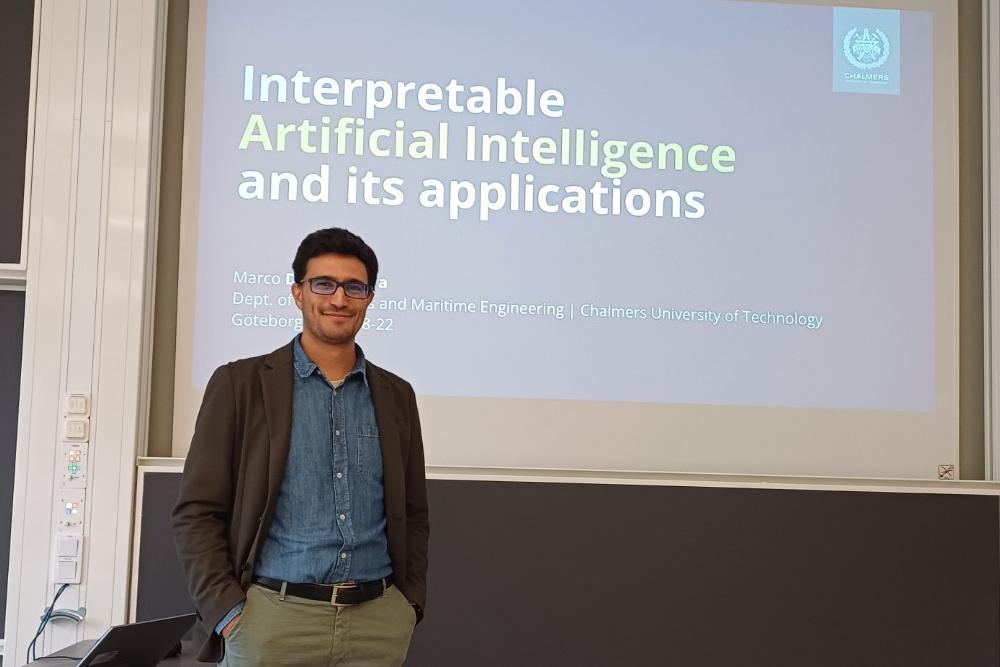
Marco L. Della Vedova is a Senior Lecturer in Applied Artificial Intelligence at Chalmers University of Technology, Sweden. He works in the Vehicle Engineering and Autonomous Systems division within the Department of Mechanics and Maritime Sciences, as part of Prof. Mattias Wahde's research group. Since 2025, he has served as Director of the Data Science and AI master's programme (MPDSC) at Chalmers, where he teaches courses including Introduction to Artificial Intelligence and Digitalization in Sports. Dr. Della Vedova earned his academic foundation at the University of Pavia, Italy, where he completed his BSc (2006), MSc (2009), and PhD (2013) in Computer Engineering. His doctoral research focused on "Real-Time Physical Systems and Electric Load Scheduling" under Prof. Tullio Facchinetti. During his PhD studies, he spent a year at U.C. Berkeley hosted by Prof. Francesco Borrelli at the Model Based Predictive and Distributed Control Lab. His research spans multiple AI domains with a strong emphasis on interpretability. Dr. Della Vedova develops interpretable methods for conversational AI, naturalness evaluation of forests using canopy height models, and geospatial applications. His work bridges theoretical AI with practical societal benefits, particularly in environmental monitoring, transportation systems, and orienteering. He has previously contributed to cloud computing, hate speech detection, and cyber-physical energy systems, demonstrating his interdisciplinary approach to AI research. Dr. Della Vedova's publication record reveals a consistent trajectory of impactful research across multiple domains of artificial intelligence. His recent work shows a strong focus on interpretability in AI systems, with significant contributions to natural language processing, geospatial analysis, and causal inference. The research demonstrates both theoretical depth and practical applications, particularly in environmental monitoring and social media analysis. His methodology often combines traditional machine learning approaches with novel interpretability techniques, creating bridges between complex AI systems and human understanding. Dr. Della Vedova has received several prestigious recognitions for his work: Best PhD thesis award from the Order of the Engineers of Bergamo (2013) Italian champion of Il Cervellone (2012) Top Italian performer in IEEEXtreme 6.0 programming competition (148th overall globally, 2012) Premio Arturo Schena award from Fondazione Credito Valtellinese (2010) With over 50 students supervised through bachelor's and master's theses, Dr. Della Vedova has established himself as a dedicated mentor in the AI community. His current PhD students include Minerva Suvanto working on interpretable NLP and Vivien Lacorre developing AI for railway infrastructure inspection. His supervision spans diverse topics from forest naturalness evaluation to hate speech detection and transportation optimization. Beyond formal supervision, he actively contributes to educational initiatives including serving as Director of Chalmers' Data Science and AI master's program and developing innovative teaching methods that connect theoretical concepts with real-world applications. Dr. Della Vedova is deeply embedded in both academic and professional communities. He leads the Applied Artificial Intelligence research group at Chalmers while maintaining strong connections with European research networks through projects like the ERASMUS+ EUrienteering initiative. His interdisciplinary approach is reflected in collaborations across computer science, environmental science, and social sciences. Notably, he applies his AI expertise to orienteering both as a researcher developing localization methods and as a licensed Event Advisor for the International Orienteering Federation, demonstrating how his professional and personal interests converge in innovative ways.
Mostafa Milani is an Assistant Professor in the Department of Computer Science at Western University. His research focuses on data management, databases, and their applications in data cleaning, privacy, provenance, and fairness. Before joining Western, he held postdoctoral positions at the University of British Columbia and McMaster University, and earned his Ph.D. from Carleton University under Dr. Leopoldo Bertossi. Education: Ph.D. in Computer Science from Carleton University (supervised by Leopoldo Bertossi), Postdoctoral Fellowships at University of British Columbia and McMaster University. Research Interests: Data Quality, Privacy, Provenance, Fairness, Entity Matching, Query Optimization, and Database Systems. His work emphasizes ethical data practices and integrates machine learning for improved database interactions. He has contributed to projects like Building Trust in Data (privacy/fairness integration) and Unified Data Exploration (provenance and query recommendations). Courses taught include Databases I/II, Applied Logic, and Web Systems. Current advisees include 7 MSc and 1 PhD student. Former students have graduated across MSc and undergraduate programs. His research is supported by grants and collaborations, and he actively participates in program committees for top conferences like SIGMOD and VLDB.
Professor Tova Milo is the Chair for Information Management at the School of Computer Science, Tel Aviv University, leading the prominent Databases Lab (DB Group). Her research spans databases, big data management, crowd-based data sourcing, and business process querying, with significant contributions to data integration and semi-structured data systems. Her research interests focus on innovative approaches to data management challenges through machine learning integration, crowd computing, and business process analysis. Key projects include Business Process Querying (BPQ) for analyzing BPEL specifications, MoDaS for crowd-based data management, and PROX for data provenance summarization. Her work bridges theoretical foundations with practical applications in fraud detection, recommendation systems, and data cleaning. Analysis of her recent publications reveals strong trends in human-in-the-loop data management systems, with growing emphasis on crowd integration for data cleaning and knowledge acquisition. Her research increasingly combines traditional database theory with machine learning techniques for scalable big data processing, while maintaining focus on business process modeling and provenance tracking. ACM PODS Alberto O. Mendelzon Test-of-Time Award (2010) ERC Advanced Investigators grant MoDaS (2011) The Weizmann Prize for Exact Sciences (2017) VLDB Women in Database Research award (2017) IEEE TCDE Impact award (2022) ISF Breakthrough Research Grant (2022) Doctorate Honoris Causa, University of Zurich (2023) ACM Fellow Member of Academia Europaea Professor Milo has advised over 30 graduate students including PhD candidates like Yael Amsterdamer and Ohad Greenshpan, and numerous MSc students working on projects including MoDaS, BPQ, and EDOS. Her research has been supported by major grants including the ERC Advanced Investigators grant and ISF Breakthrough Research Grant. She actively collaborates with industry partners including IBM and Microsoft, particularly in business process management standards. She directs Tel Aviv University's Databases Lab, which maintains the DB Group with multiple research streams including business process querying (BPQ), crowd-based data management (MoDaS), and self-adaptive data dissemination (EDOS/COLT). The lab operates from the Schreiber Building (M-20) and maintains strong international collaborations, particularly with European institutions through the ERC-funded MoDaS project.
Domingo Savio Rodríguez Baena is a Professor at Pablo de Olavide University, affiliated with the Department of Computer Languages and Systems. His research focuses on data mining, bioinformatics, and computational biology, with a particular emphasis on biclustering algorithms, gene co-expression networks, and high-performance computing applications. PhD in Engineering, Data Science, and Bioinformatics (2012) from Pablo de Olavide University His work spans interdisciplinary domains, including recommender systems , livestock behavior analysis , and biological data interpretation . Recent articles highlight his contributions to multi-GPU optimization , ensemble learning , and historical database construction . Key collaborations include the DATAi Intelligent Data Analysis and DASE Data Analytics Science & Engineering research groups. He has developed tools like the CyEnGNet–App for gene network visualization and BIGO for gene enrichment analysis. Contact: dsrodbae@upo.es