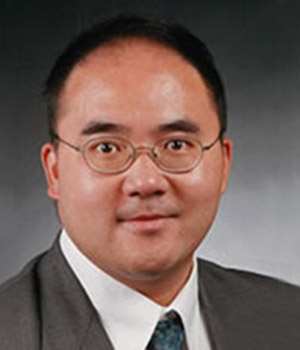
Weizhong Wang is Associate Professor in Electrical Engineering and Computer Science at University of Wisconsin-Milwaukee. Research develops magnetic content addressable memory for high-speed networking and radar applications. Innovations improve router efficiency and image search operations. Education includes PhD and MS in Electrical Engineering from University of Maryland, and BS from Southeast University (China). Research areas: Spintronic device architectures Radiation-hardened integrated circuits Magnetic field sensing technologies Anti-tampering hardware systems IEEE publications focus on MRAM optimization and sensor noise reduction. Community outreach includes science fair judging.
Eugene Belilovsky is an Assistant Professor in the Department of Computer Science and Software Engineering at Concordia University. His research focuses on machine learning, computer vision, optimization algorithms, and their applications in medical imaging and federated learning. He explores topics such as continual learning, model merging, and bias mitigation in deep learning systems. His work bridges theoretical advancements with practical applications, including healthcare diagnostics and efficient training strategies for large models. Belilovsky's recent publications emphasize innovative methods like MuLoCo for inner optimizer design, FairDropout for enhancing minority group generalization, and techniques to scale multi-task learning with sparse masks. His studies on federated learning explore incentive mechanisms for decentralized systems and robust pre-training of large language models. His contributions to 3D reconstruction and motion prediction highlight interdisciplinary applications in computer graphics and generative models. His research trends reflect a strong emphasis on improving model efficiency, fairness, and adaptability across diverse domains. While no scientific awards are explicitly listed, his prolific publication record underscores his impactful contributions to AI and machine learning.
Dr. Martin Collier is an Associate Professor in the School of Electronic Engineering at Dublin City University and director of the Entwine Centre, focusing on IoT infrastructure. His research spans data and computer communications, network security, energy-efficient networking, and SDN/NFV. He leads projects like Horizon 2020's INPUT and FP7's ECONET, collaborating with IBM on data centre network design. His work emphasizes switch fabrics, green routers, and optical technologies. Research Interests: Switching/Routing, SDN, NFV, IoT, Energy Efficiency, Data Centre Networks. Recent Projects: INPUT (SDN/NFV personal cloud services), ECONET (energy efficiency), and IBM-funded data centre design. Laboratory activities include NetFPGA-based testing and SDN implementations. Teaching: Modules include Broadband Networks (EE552), Network Programming (EE562), and Communications Theory (EE450). Supervises final-year and MEng projects. Labs/Teams: Switching & Systems Lab (NetFPGA testbed), Entwine Centre (IoT infrastructure).
Dr. Xiaojun Wang is an Associate Professor at the School of Electronic Engineering, Dublin City University (DCU). He holds a BEng and MEng from Beijing University of Posts and Telecommunications (BUPT) and a PhD from Staffordshire University (UK). His research focuses on energy-efficient networking, hardware acceleration for packet classification/deep inspection, and cryptography algorithms. He has been instrumental in establishing China-Ireland academic collaborations, including the China-Ireland International Conference on Information and Communications Technologies (CIICT), and coordinated a successful joint Telecommunications Engineering program with Wuhan University (2006–2012). He is also a member of DCU's Entwine Research Centre. Key roles include Head of China Affairs at DCU (2002–2007), contributing to institutional partnerships. His technical work spans green energy solutions for networks, quantum computing protocols, and hardware-software co-design for cryptographic systems. He has led projects on edge computing security, vehicular communication optimization, and blockchain-based trust frameworks. Educations: BEng in Computer & Communications, BUPT (1984) MEng in Computer Applications, BUPT (1987) PhD in Engineering, Staffordshire University (1992) Affiliations: Member of Entwine Research Centre Former Head of China Affairs, DCU His recent publications emphasize secure edge computing, quantum steganography, and 5G resource orchestration. He has pioneered energy-efficient router architectures and contributed to standards for vehicular networks and blockchain trust systems.
Dr. Graham Swift is the MSc Course Leader in the Department of Engineering and Mathematics at the College of Business, Technology and Engineering. He holds a BEng (Hons) and PhD in Engineering, and is a member of institutions such as MIET, CPhys, and FHEA. His research focuses on optical communications, signal processing, and the application of software tools for designing signal-based systems and devices. Education : BEng (Hons) in Engineering PhD in Engineering Research Interests : Dr. Swift specializes in optical time division multiplexing (OTDM), optical buffering, and all-optical systems. His work addresses challenges in high-speed optical networks, including signal demultiplexing, crosstalk analysis, and optical router design. He has contributed to advancements in nonlinear optical loop mirrors (NOLM), soliton-based control pulses, and semiconductor laser amplifier modeling. Advising & Grants : Supervised PhD theses by A.A. Als (2004), R. Gao (2003), and C.Y. Cheung (2001) Focus areas: optical packet networking, noise analysis in demultiplexers, and all-optical buffering Publications Trends : His articles span optical demultiplexing, terahertz systems, and educational pedagogy. Recent work emphasizes ultra-fast optical routers and student engineering education practices.
Daniel Holcomb is an Associate Professor in the Department of Electrical and Computer Engineering at the University of Massachusetts Amherst, part of the College of Engineering. He specializes in secure and reliable embedded systems, with research interests spanning embedded systems security, hardware security, formal verification, VLSI design, and cryptography. Education : B.S. Electrical & Computer Engineering, University of Massachusetts (2005) M.S. Electrical & Computer Engineering, University of Massachusetts (2007) Ph.D. Electrical Engineering and Computer Sciences, University of California, Berkeley (2013) His research focuses on mitigating hardware vulnerabilities in FPGAs and chiplet-based systems, including countermeasures against side-channel attacks, voltage attacks, and IP theft via reverse engineering. He has contributed to the development of secure design methodologies, PUF-based authentication, and fault-resistant cryptographic implementations. His publications highlight advancements in FPGA security, such as defeating memory protection units (MPUs), preventing trojan insertion during fabrication, and mitigating power distribution attacks in multi-tenant environments. Holcomb is an active member of IEEE and Tau Beta Pi Honor Society. Labs & Teams : His work aligns with the College of Engineering’s research strengths in hardware security, including collaborations with labs focused on embedded systems and VLSI design.
Dr. Abbas A. Fairouz is an Assistant Professor in the Computer Engineering Department at Kuwait University. He holds a PhD from Texas A&M University (2019) and BS/MS degrees from Kuwait University (2006/2011). He previously served as a system engineer at Kuwait's Ministry of Electricity & Water (2006–2014) and as a part-time faculty member at PAAET's Higher Institute of Telecommunication and Navigation (2008–2010). Affiliations: Academic Visitor at University of Oxford (OSCAR Research Group) Research Focus: VLSI design, AI/ML processor architecture, secure computer systems, microarchitecture optimization, and FPGA-based acceleration. His current projects include hardware-based sorting networks, privacy-preserving instant messaging systems, and chiplet-based secure architectures. He has received the President of Kuwait Award (2012) and was a best paper nominee at GLSVLSI'17. His work spans hardware-software co-design for cryptographic accelerators, special function units (SFUs), and low-power NoC routers. Collaborations include the Oxford Secure Computer Architecture Research (OSCAR) group.
Christos Papadopoulos is a Professor in the Department of Computer Science at Colorado State University. His research spans computer networks, network security, multimedia communication, and distributed systems. He leads projects funded by DHS, NSF, and ONR, including LANDER-CSU, MURI, and MADCAT. Current Research Focus Network security (DDoS, malware detection) Computer networks (traffic analysis, multicast protocols) Distributed systems (internet measurement, service discovery) Multimedia communication (streaming, immersive performance) His recent publications analyze internet infrastructure, develop security frameworks, and explore signal processing applications in network analysis. He has advised multiple PhD students who now work at institutions like Cisco and Akamai. Papadopoulos also contributes to network security projects and has presented at global research institutions.
Farshid Agharebparast serves as an Associate Professor Teaching in the Department of Electrical and Computer Engineering at the University of British Columbia's Faculty of Applied Science. His academic career is anchored in data communications networks and mobile computing, with active contributions to the Communication Systems Research Group specializing in Data Communications. Education: BSc, University of British Columbia MASc, University of British Columbia PhD, University of British Columbia Dr. Agharebparast's research explores stochastic network calculus applications for wireless performance evaluation, cross-layer design in fading channels, and QoS provisioning. His work bridges theoretical frameworks like min-plus algebra with practical challenges in 4G handover privacy, bandwidth allocation in WiMAX, and traffic shaping for unreliable channels. These investigations address critical needs in next-generation mobile infrastructure where latency guarantees and resource efficiency are paramount. His teaching encompasses core engineering subjects including Circuit Analysis (ELEC 201), Operating Systems (CPEN 331), Computer Networking (ELEC 331, CPEN 400N), and multiple design studio courses (ELEC 291, CPEN 291). This portfolio demonstrates deep engagement with both foundational theory and hands-on implementation across electrical and computer engineering curricula. Scientific Awards: No awards documented in source materials Through design studio courses and undergraduate teaching assistantships, Dr. Agharebparast mentors emerging engineers in practical system development. His publication trajectory from 2001-2022 indicates sustained research activity in network performance modeling, though specific grant funding details remain unreported. His work consistently targets real-world wireless challenges including video streaming optimization and privacy-preserving mobility management. Affiliated with UBC's Communication Systems Research Group, he contributes to a collaborative ecosystem focused on data communications innovation. Current investigations appear centered on stochastic performance bounds for modern wireless architectures, extending his two decades of scholarship in network calculus applications.
Arun Venkataramani is a Professor in the Manning College of Information and Computer Sciences at the University of Massachusetts Amherst. He joined the faculty in 2005 as an Assistant Professor, advancing to Associate Professor in 2010. His roles include Chair of Master’s Admissions and Master’s Program Director. His research focuses on networking, distributed systems, mobile and sensor systems, with a particular emphasis on privacy-preserving consensus, interdomain routing, and secure communication in challenged networks. Education: PhD in Computer Sciences, University of Texas at Austin MS in Computer Sciences, University of Texas at Austin BTech in Computer Science and Engineering, Indian Institute of Technology, Bombay Research interests span Networking (privacy-preserving protocols, interdomain routing), Distributed Systems (consensus algorithms, replica coordination), and Mobile Systems (mobility-centric architectures, sensor networks). His work often addresses security, scalability, and resilience in next-generation internet architectures. Awards: Co-recipient of the J.C. Browne Fellowship (awarded to outstanding UT Austin CS graduate students) Ranked in the top 40 among 100,000+ candidates in India’s IIT entrance exam Advising & Projects: Leads the Advanced Networked Systems Research Group Contributions to MobilityFirst, GigaPaxos, and msocket systems Involved in NSF-funded projects like NeTS and Light-Speed Networking Labs/Teams: Primary affiliation with the Advanced Networked Systems Research Group, collaborating on global name services, secure communication, and mobility-centric architectures.
Stefano Salsano is an Assistant Professor at the Department of Electronic Engineering at the University of Rome Tor Vergata since 2000. He holds a Laurea degree (1994) and PhD (1998) from the University of Rome. His research focuses on advanced networking technologies including Information-Centric Networking, SDN, Segment Routing (SRv6), 5G, and Network Function Virtualization (NFV). He has contributed to numerous EU-funded projects (e.g., INSIGNIA, ELISA, AQUILA) and led research in telecommunications at CoRiTeL until 2000. His work emphasizes scalable network architectures, performance measurement, and programmable data planes. Key projects include the OFELIA testbed, SRv6 implementation, and contributions to standards like RFC 9779. He has authored over 100 publications with an h-index of 17, addressing topics such as network programmability, cloud-native solutions, and hybrid SDN/IP systems. Research highlights include developing the DIDA framework for distributed machine learning, optimizing SRv6 for SD-WANs, and exploring 5G Superfluid Networks for dynamic service deployment. Collaborations include CNIT, Netgroup, and initiatives like the GEANT SDX project.
Ahmed Karmouch is a Professor at the University of Ottawa, Canada, affiliated with the College of Engineering and Computer Science. His research focuses on Network Virtualization , Software-Defined Networking (SDN) , and Context-Aware Systems , with significant contributions to Cloud Computing Resource Allocation , Programmable Data-Planes , and Overlay Networks . He has co-authored over 161 publications since 1980, emphasizing scalable infrastructure management, QoS optimization, and autonomic network design. His recent work includes machine learning integration in P4-programmable networks (2024) and survivable IaaS management with SDN (2021). Publications span IEEE Transactions and ACM journals, with frequent collaborations with Nancy Samaan, Abdallah Jarray, and Hamid Harroud. Key research themes: Network Programmability Service Specific Overlay Networks Autonomic Network Management ML for Traffic Optimization Geographically Distributed Cloud
Laurent Vanbever is an Associate Professor at ETH Zürich and heads the Networked Systems Group (NSG). He specializes in network programmability, Internet routing, and network security, aiming to make networks more performant and manageable. Previously, he held a postdoctoral position at Princeton University and earned his PhD from the University of Louvain. Education: PhD in Computer Science, University of Louvain (2012) Postdoctoral Researcher, Princeton University (2012–2014) MSc in Computer Science, University of Louvain (2008) MSc in Management, Solvay Brussels School (2010) Research Interests: His work bridges theory and practice, focusing on network programmability, routing protocols, and sustainable networking. Recent projects include NetFabric, an ETH spin-off for network observability, and studies on energy-efficient router design (e.g., Fantastic Joules ) and BGP reconfiguration ( Taming the transient ). Key contributions include xBGP, Magnifier, and SP-PIFO. Awards: Best Paper Award at HotCarbon '24 SIGCOMM 2015 Best Paper Award Multiple IETF/IRTF Applied Networking Research Prizes Advising and Labs: Supervises PhD students (e.g., Benjamin, Weiran) and manages the NSG lab. Collaborates with NetFabric, offering student projects in network observability and sustainability. Labs & Teams: Leads the NSG and co-founded NetFabric, focusing on next-gen network observability using AI. Active in teaching Communication Networks and Advanced Topics in Communication Networks .
Nachiket Kapre is an Associate Professor in the Department of Electrical and Computer Engineering at the University of Waterloo, Canada (2023–present). He previously held positions as Associate Professor (2016–2021) and on leave as Research Director at Xilinx Labs (AMD Research, Singapore, 2022–2023). Before that, he was an Assistant Professor at Nanyang Technological University (NTU), Singapore (2012–2016) and a Junior Research Fellow at Imperial College London (2010–2012). He earned a Ph.D. and two M.S. degrees from the California Institute of Technology (2010), and a B.E. from the University of Pune (2002). His research focuses on Concurrent and Spatial Architectures , Parallel Processing , and Communication-Centric Design , with a strong emphasis on FPGA-based acceleration for applications like machine learning, graph algorithms, and embedded systems. Key contributions include Hoplite NoC architectures and CaffePresso for deep learning acceleration. Notable awards include the FPT Best Paper Award (2024), TRETS Best Paper Award (2023), and the CASES 2016 Best Paper Award. He has led multiple grants, including NSERC Discovery Grants and A*STAR-funded projects. His advising spans 15+ students across PhD and MSc levels, contributing to FPGA toolflows, NoC design, and hardware acceleration. He has authored over 50 publications in top venues like FPGA, FPL, and ACM TRETS, and serves as a program chair for FCCM 2023. His work bridges theory and practice, emphasizing energy-efficient computing and reconfigurable systems.
Assoc. Prof. Selcuk Okdem is a faculty member at Erciyes University, Faculty of Engineering, Department of Computer Engineering, specializing in Computer Hardware. With academic ranks from Research Assistant (2001-2011) to Assistant Professor (2011-2017) and current Associate Professor (2017-present), his career spans 25+ years in academia and industry. Doctorate : 2004-2011, Erciyes University, Computer Engineering Postgraduate : 2001-2003, Erciyes University Undergraduate : 1996-2001, Erciyes University His research focuses on Wireless Sensor Networks , Optimization Algorithms , and Embedded Systems , with notable work on AI integration in cybersecurity and evolutionary optimization techniques. His 15 most recent publications (2024-2004) span topics like genetic algorithm scheduling , neural networks for localization , and cross-layer protocol design . Scientific achievements include: 2021: Certificate of Honor for Top Graduation Term 1999-2000: Turkish-Japanese Foundation Scholarship He has served as peer reviewer for SCI journals (Wireless Networks, Applied Soft Computing) and participated in 15+ international conferences (IEEE CEC, INISTA, IWCMC). His managerial role since 2015 includes Erciyes University leadership positions.