Dr. Gabrielle Kremer is a Senior Research Associate and Guest Researcher at the Austrian Academy of Sciences (OeAW), focusing on provincial Roman archaeology with emphasis on the Danube provinces and Gallia Belgica. She has taught at the University of Vienna since 2001 and coordinates interdisciplinary projects on Roman stone monuments, including the Corpus Signorum Imperii Romani Carnuntum series. Her work bridges epigraphy, sculpture analysis, and funerary architecture studies. Research focuses include: Religious practices in Roman provinces Stone monument provenance and reuse Cultural identity in Noricum and Pannonia Interdisciplinary analysis of Roman material culture Monumental grave architecture in the Treveri region Current projects involve the PolychroMon initiative (2023–2025) analyzing polychromy in Roman monuments and the Accommodation/Living in a Sacred Context study. She co-edited multiple international colloquium proceedings and led the "Religion and Society" working group (2017–2020) at OeAW's Institute for Cultural History of Antiquity.
Averil Cameron is a distinguished Professor of Late Antique and Byzantine History at the University of Oxford, previously serving at King's College London from 1978–1994. Her research focuses on the intersection of political, religious, and cultural dynamics in late antiquity and Byzantium. She has held prominent roles such as President of the Council for British Archaeology in the Levant and has been honored with prestigious awards including the British Academy Kenyon Medal (2020) and DBE (2006). Her academic contributions include foundational texts on Procopius, Eusebius, and the Mediterranean world. Notable works like Byzantine Matters (2014) and Dialogues and Debates from Late Antiquity (2017) explore intellectual and religious discourses. She has edited volumes in the Cambridge Ancient History series, shaping scholarly narratives on Roman and Byzantine empires. Cameron’s publications consistently bridge micro-historical analysis with macro-historical trends, emphasizing how cultural and political shifts in late antiquity laid foundations for medieval Europe and the Islamic world. Her work integrates textual criticism, archaeological insights, and interdisciplinary approaches to reconstruct complex historical phenomena. Awards: Kenyon Medal, DBE, CBE, Fellow of British Academy Editorial Roles: Cambridge Ancient History series, British Archaeology Council Key Themes: Imperial governance, religious transitions, cultural continuity, and late antique socio-political structures
Elio Lo Cascio is a Professor of Roman History at Sapienza Università di Roma, with a distinguished career spanning multiple universities including Università 'Federico II' di Napoli (1990-2006), Università dell'Aquila (1986-1990), and Università di Lecce (1976-1986). He has served as Dean of the Faculty of Letters at L'Aquila and held visiting positions at the Institute for Advanced Study (Princeton, 1993, 2001), École des Hautes Études en Sciences Sociales (Paris, 2009), and the University of British Columbia (2012). Editor of the series Pragmateiai (Edipuglia) Current roles: Corresponding Fellow of the Pontificia Accademia Romana di Archeologia, member of the Consiglio Direttivo of the Istituto Italiano per la Storia Antica Active in international academic panels, including ERC Advanced Grants (2012) His research focuses on the administrative, economic, and demographic history of Rome from the Republic to Late Empire. Key themes include Romanization, urban elites (especially Pompeii), and historiography of ancient history. His publications analyze census procedures, monetary policies, and population dynamics under the Roman Empire. The articles listed reflect his expertise in Roman economic systems, administrative reforms, and demographic studies. Themes span from Servian reforms to late antique coinage, with methodologies combining textual analysis and quantitative approaches. Notable trends include interdisciplinary applications of economic theory to ancient societies and the impact of population shifts on imperial stability. Scientific Awards & Honors : Mercator Fellow (Gast Professor) at DFG-Graduierten Kolleg (2014) Socio corrispondente della Pontificia Accademia Romana di Archeologia (2009) Member, School of Historical Studies, Institute for Advanced Study (1993, 2001) Directeur d'études invité at EHESS, Paris (2009) Lo Cascio has advised numerous PhD students and participated in over 50 international conferences across Europe, North America, and Iran. He has held editorial and scientific board roles for multiple academic series and journals.
David John Mattingly is a Professor of Roman Archaeology at the School of Archaeology and Ancient History , University of Leicester. He has held significant roles including Acting Head of School (2013-14, 2002, 1998-1999) and Research Director (2009-2012) within the College of Arts, Humanities, and Law. His academic career spans institutions like the University of Michigan (Assistant Professor, 1989-1991) and the University of Oxford (British Academy Post-Doctoral Fellow, 1986-1989). Education: BA (1st Class Honours) and PhD from the University of Manchester (1977-1984) Research Interests include: Saharan archaeology Ancient urbanism Postcolonial perspectives on Roman Imperialism Ancient economy, particularly olive cultivation, oil production, and trade Roman Africa, landscape archaeology, Roman Britain, and Roman mining Scientific Awards and Honors include: Election to the British Academy (2003) and Society of Antiquaries, London (1993) ERC Advanced Grant (2011-2016) for the Trans-Sahara Project James Wiseman Book Award (2001) for Farming the Desert Named lectureships at institutions including the University of Sydney, American Academy in Rome, and University of Oxford
Dr. Anna-Katharina Rieger is a researcher at the Institute for Antiquity within the Faculty of Humanities at Karl-Franzens-University Graz. Her work bridges archaeology, religious history, and cultural studies, with a focus on ancient Mediterranean societies, Roman urbanism, and landscape archaeology. She is affiliated with the "Dimensions of Europe" research profile area. Education Doctorate (1997-1999) at the German Archaeological Institute Rome (DAI) on sanctuaries in Ostia Classical Archaeology, Ancient History, and Near Eastern Archaeology studies (1989-1994) at Munich and Bonn universities Her research emphasizes theories in archaeology, marginality/mobility in ancient societies, and the archaeology of arid regions. She has contributed to edited volumes on ancient water management systems and lived religion. Scientific Awards Feodor Lynen Fellowship (2015) from the Alexander von Humboldt Foundation DAI Travel Scholarship (1999) Gerda Henkel Doctoral Scholarship (1997) Rieger has participated in research consortia like "Resonant World Relations" and the Europeanization Processes in Southeast Europe (ESOE). She has held academic roles at institutions including the Max Weber College (University of Erfurt), Freie Universität Berlin, and the German Archaeological Institute Rome.
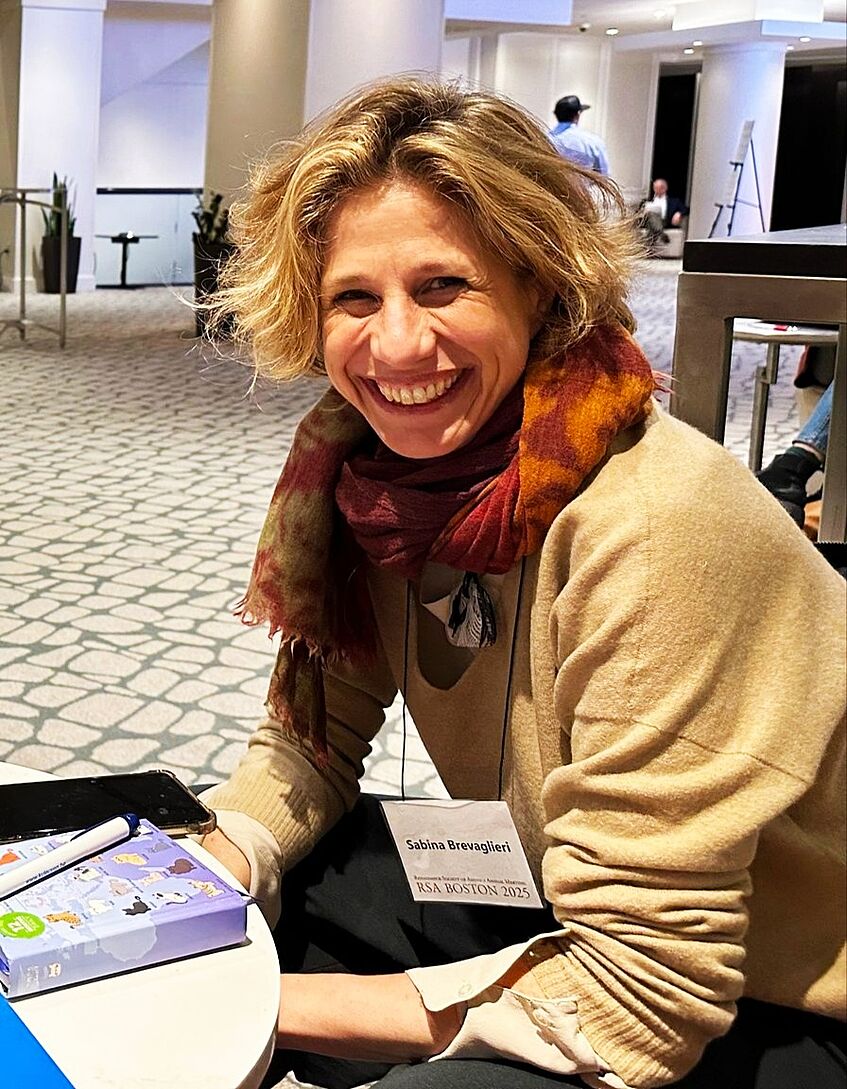
Sabina Brevaglieri is a Research Fellow at the University of Vienna's Department of Economic and Social History, holding the Elise Richter Fellowship (FWF) since 2025. She has held academic positions across Europe, including at Johannes Gutenberg Universität Mainz (2013–2022), Humboldt Universität zu Berlin, and the German Historical Institute. Her research focuses on material history, global history, and dissonant heritage, with a particular emphasis on the cultural history of Rome and religious agencies. Education: BA/MA in Art History, University of Rome ‘La Sapienza’ (1990–1995) PhD in Early Modern History, University of Florence (2002–2005) Postdoctoral Fellowships: European University Institute, Westfälische Wilhelms Universität Münster, and others Research Interests: Sabina’s work explores the intersection of material culture, global exchanges, and religious institutions. She investigates how objects and collections reflect colonial and postcolonial histories, particularly through projects like the “Rethinking ‘dissonant heritages’ of the old & new world” (2025–2030). Her studies often address the Vatican’s ethnological collections and Roman baroque urbanism. Awards & Grants: Elise Richter Fellowship (FWF) Marie Curie IEF Fellowship Max Weber Fellowship Italian Academy for Advanced Studies Fellowship (Columbia University) Advising & Grants: Sabina coordinates international research networks, such as the “Mapping ‘dissonant objects’” project (2024–2026) with institutions in Madrid and Catania. She also serves as Co-Editor of Quaderni Storici (Bologna, Il Mulino) and participates in the DFG network Mobile Matters of Religion . Labs/Teams: Active in interdisciplinary collaborations, including the German Historical Institute’s projects in Rome and Washington DC, and the Max Planck Institute for the History of Science in Berlin.
Hofrat Univ.-Doz. Mag. Dr. Stefan Groh is a Senior Research Fellow at the Austrian Archaeological Institute (ÖAI) of the Austrian Academy of Sciences. He holds the role of Assistant Director since 2009 and has been with the institute since 1996. His research focuses on Roman military infrastructure, transport routes, and urban planning, with special emphasis on the Amber Road and Noricum. Groh has led excavations such as Flavia Solva (1993-1995) and contributed to projects like Ephesos surveys and geophysical studies in Aquileia. Education: Degrees in Classical Archaeology and Ancient History from the University of Graz. Early career included roles at the Landesmuseum Joanneum (1989-1995), directing excavations at Flavia Solva from 1993–1995. Research interests center on military camps, road networks, and urban development. Key projects include studies on Legio II Italica’s fortifications, the Amber Road’s strategic role, and the urban layout of Aquileia. Over 65 journal articles and 16 monographs document his work, including seminal studies on Roman military infrastructure and settlement patterns. Publications highlight interdisciplinary methods like geophysical prospection and GIS analysis. Recent work includes analyses of the Marchfeld as a Roman military zone and the impact of the Antonine Plague on infrastructure. Groh has edited volumes on Celtic-Roman cult practices and contributed to exhibitions like Ephesos Upper City surveys. Grants and funding supported projects like the Legio II Italica studies and the Bruckneudorf villa research. His work bridges field archaeology with theoretical insights, influencing both academic discourse and public engagement through museum collaborations and media outreach. Labs/Teams: Leads ÖAI’s Roman frontier studies team and collaborates with international groups on projects like the Carnuntum-Aquincum comparative study. Active in the Scientific Advisory Board and promotes early career researchers through training programs.
Sophie Krausz is a Professor of European Protohistory at the University of Paris 1 Panthéon Sorbonne, School of Art History and Archaeology of the Sorbonne, specializing in Iron Age archaeology and Gallic societies. Previously, she served as a Lecturer at Bordeaux Montaigne University (2005–2021) and Director of Éditions Ausonius (2018–2021). Her academic journey includes a PhD (1992) and Habilitation (2014) from Paris 1-Panthéon Sorbonne. Her research focuses on fortifications, state emergence, and political systems in prehistoric and protohistoric Europe, with fieldwork spanning 91 excavations since 1986. Notable projects include Châteaumeillant, Vix, and Mont Beuvray. She leads the CNRS International Research Network NEMESIS, studying European Iron Age societies. Key contributions include over 70 published books and 121 invited lectures. Awards include the Chevalier de l'Ordre des Arts et des Lettres (2014) and Chevalier de l'Ordre national du Mérite (2017). She oversees archaeological sites, integrates paleoenvironmental studies, and collaborates on interdisciplinary projects like the GENETIX genetic study of Iron Age populations.
Paul Zanker is a renowned Professor of Storia dell’Arte Antica at the Scuola Normale Superiore di Pisa since 2001. Previously, he held prestigious roles such as Director of the German Archaeological Institute (DAI) in Rome (1996–2002), Sather Professor at UC Berkeley (1991), and Professor of Classical Archaeology at the University of Munich (1976–1996). His career spans over four decades of leadership in academic and archaeological institutions across Europe and North America. His scholarly focus lies in Hellenistic and Roman art, with a particular emphasis on Augustan-era imagery, Roman urbanism, and the socio-political dimensions of ancient art. Notable contributions include groundbreaking studies on Pompeii’s urban structure, Augustus’ visual propaganda, and the symbolic language of Roman sarcophagi. Zanker holds esteemed memberships in multiple academies: the Bavarian Academy of Sciences, British Academy, Academia Europaea, and the Danish Royal Academy of Sciences. These honors reflect his transformative impact on classical archaeology and art history. His research integrates archaeological evidence with historical context, exploring how art shaped and reflected ancient societies. While no specific grants or advising roles are documented, his prolific publication record (over 15 major works) underscores his dedication to advancing scholarly discourse on classical antiquity.
Immo Trinks is Associate Professor (Privatdozent) at the University of Vienna and Head of the Vienna Institute for Archaeological Science . He coordinates a comprehensive teaching programme in archaeological prospection, archaeometry and scientific documentation, and leads large-scale geophysical projects across Europe. Education & qualifications: Dipl.-Geophys. (Diploma in Geophysics) PhD (awarded) Habilitation (Privatdozent, Austrian post-doctoral lecturing qualification) Research interests revolve around non-destructive mapping of buried archaeological landscapes . He specialises in ground-penetrating radar , magnetometry and multi-sensor robotic platforms , developing workflows that fuse high-resolution geophysical data with 3D archaeological interpretation. Coastal wetlands, Roman towns, Viking harbours and prehistoric pile dwellings serve as key study areas. Recent publications demonstrate a clear trend toward automated, large-coverage surveys and multi-method data fusion . Papers in 2022-2025 report motorised GPR arrays on snow-covered fields, semi-autonomous driverless systems, and integrated interpretation frameworks that combine magnetics, GPR and remote sensing to reveal Roman military compounds, Etruscan cities, Swedish war camps and Neolithic monumental landscapes. Scientific awards & honours: No specific awards are listed in the supplied text; however, his continuous funding and invited keynote contributions (e.g., ArchaeoProspection conference series) indicate international recognition. Teaching & student supervision: Regular courses: Introduction to Archaeological Prospection, Archaeometry, Magnetic Prospection, GPR Practical, Underwater Prospection, Human Evolution & Archaeological Science, LaTeX for Archaeologists Excursions: 2-day field schools at Alpine pile-dwelling sites and around Vienna Thesis seminars: continuous Master Thesis Topic Search & Exposé and final thesis colloquia every semester Labs & facilities: Trinks heads the Vienna Institute for Archaeological Science (VIAS), operating several motorized multi-channel GPR systems, high-resolution magnetometer arrays, electromagnetic induction sensors, underwater sonar and multi-spectral cameras. The institute maintains dedicated GIS/visualisation labs and field vehicles for pan-European surveys within the international ArchPro and Stonehenge Hidden Landscapes initiatives.
Christoph Baier is a Research Fellow at the Austrian Archaeological Institute in Athens (ÖAI), part of the Austrian Academy of Sciences (OeAW). Since 2017, he has held a postdoctoral position under the OeAW's Post-DocTrack program. His research focuses on Hellenistic and Roman residential architecture, ancient urban planning, and architectural ornamentation. He has conducted excavations and architectural studies across Austria, Italy, Syria, Turkey, and Greece, with notable projects in Ephesos, Carnuntum, and Lousoi. Education: Magister degrees in Classical Archaeology, Ancient History, and Pre/Early History from the University of Vienna; M.Sc. in Monument Preservation from TU Berlin; doctoral degree from BTU Cottbus-Senftenberg. Professional roles include scientific staff positions at excavations and academic institutions, including the Department of Architectural History at BTU Cottbus-Senftenberg (2014-2015) and the ÖAI Athens branch (2016). Research interests emphasize the interplay between monumental architecture and urban development, particularly in Hellenistic/Roman contexts. His work combines field excavations with advanced analytical methods (e.g., multivariate analysis of ornamentation). Recent projects investigate Ephesos's palatial structures and Lousoi's Hellenistic urban layout. Publications span 20+ articles in journals like Jahreshefte des Österreichischen Archäologischen Institutes and conference proceedings. He co-edited the 2023 volume Ein anderes Griechenland , celebrating the ÖAI's 125 years of research in Greece. Active in international collaborations, he contributes to the Historical Archaeology in the Mediterranean series. Baier's research bridges archaeological practice with theoretical analysis, addressing questions of urban hierarchy, architectural memory, and cultural heritage preservation. His work often integrates multidisciplinary approaches to reconstruct ancient building techniques and urban dynamics.
Christian Gugl is a Professor and Deputy Head of the Department of Historical Archaeology at the Austrian Academy of Sciences' Institute for Cultural History of Antiquity. He holds a PD Dr. (habilitation) from the University of Innsbruck and has been a key figure in archaeological research since 2002. His work focuses on Roman provincial archaeology, digital archaeology, and the archaeology of the Roman provinces in the Latin West. Gugl has led major projects like the Carnuntum archaeological surveys and the Troesmis excavations in Romania, emphasizing non-invasive methods and interdisciplinary approaches. Education: Studium der Klassischen Archäologie, University of Graz Provinzialrömische Archäologie, Ludwig Maximilian University of Munich Habilitation in Roman Archaeology, University of Innsbruck (2012) His research spans Roman military installations, urban development, and late antique transformations. Notable projects include the discovery of Carnuntum's gladiator school and the analysis of the Roman town's suburban structures using geophysical methods. Gugl coordinates the 'Digital Archaeology and Classics' initiative, integrating GIS and remote sensing. Publications focus on Carnuntum's urban landscape, Troesmis' military history, and Roman frontiers. He has contributed to over 50 peer-reviewed articles and authored/co-authored monographs on Carnuntum's canabae and Virunum's amphitheater. His work bridges traditional excavation with cutting-edge digital technologies, shaping modern archaeological practice in Austria and beyond.
Paolo Poccetti is a full Professor of Comparative Philology at the University of Rome 2 'Tor Vergata' since 1990 and an Associated Professor of languages of Ancient Italy at the University of Naples 'L'Orientale'. His research focuses on Greek, Latin, and fragmentarily attested languages of ancient Italy, with a particular emphasis on comparative philology. Member of Societa Italiana di Glottologia Member of Société des Etudes Latines (Paris IV-Sorbonne) Member of Istituto di Studi Etrusclzi Member of Société de Linguistique de Paris Member of Indogermanische Gesellschaft Poccetti’s publications explore epigraphy, linguistic analysis, and cultural practices in ancient Italy. His recent work addresses synchronic procedures in Sabellic poetic texts, inscribed bronze tablets like the Tabula Bronzea di Roccagloriosa , and semantic-pragmatic relations in adversative structures. He has co-authored extensively on coordinative syntax, negation types, and theonomics in ancient Italic languages. As editor, he has curated the Ricerche sulle lingue di frammentaria attestazione series and proceedings of international conferences on ancient Italic onomastics. His research bridges historical linguistics, epigraphy, and cultural archaeology, offering critical insights into the linguistic diversity of pre-Roman Italy.
Roman Markiewicz is a Senior Scientist and Researcher at TU Wien's Research Area Foundation Engineering, Soil and Rock Mechanics. His work focuses on geothermal energy integration into urban and infrastructure systems, energy geostructures, and long-term monitoring of thermal activation in construction. Key projects include the thermo-active ground source system at Vienna's Taborstrasse metro station and geothermal utilization of the Lainzer Tunnel. His research emphasizes sustainable energy solutions, geotechnical applications, and infrastructure innovation to address global energy challenges. Markiewicz collaborates closely with professionals like Dietmar Adam and Adrian Brunner, contributing to advancements in energy-efficient construction and renewable energy systems. Research interests span geothermal energy extraction, energy piles, soil-rock mechanics, and the adaptation of infrastructure for thermal energy harvesting. His work bridges geotechnical engineering with environmental sustainability, aiming to optimize energy use in urban and civil engineering projects. Recent efforts highlight the analysis of long-term performance data from real-world installations to refine energy geostructure designs and improve system reliability.
Dr. Alexandra Kaar is a University Assistant PostDoc at the Institute for Austrian Historical Research, University of Vienna, since February 2022. She specializes in late medieval Central European history, focusing on Austria and surrounding territories, financial and cultural aspects of medieval warfare, comparative urban history, Luxembourg dynasty, and late medieval diplomatics. Education: 2010–2017 PhD at University of Vienna; 2006–2010 in historical research and archival science; 2001–2006 BA in History. Research: Analyzes economic warfare, trade embargoes, social control, and urban governance during the Hussite Wars and medieval conflicts. Awards: Foundation Prize of the Pro Civitate Austriae Foundation (2019), FWF Printing Grant, Graduation Scholarship (2017), Marietta Blau Scholarship (2016). Publications: Authored monographs like Wirtschaft, Krieg und Seelenheil and co-edited volumes on Sigismund’s reign. Key articles examine Regensburg’s military actions, anti-Hussite trade embargoes, and wartime social control.