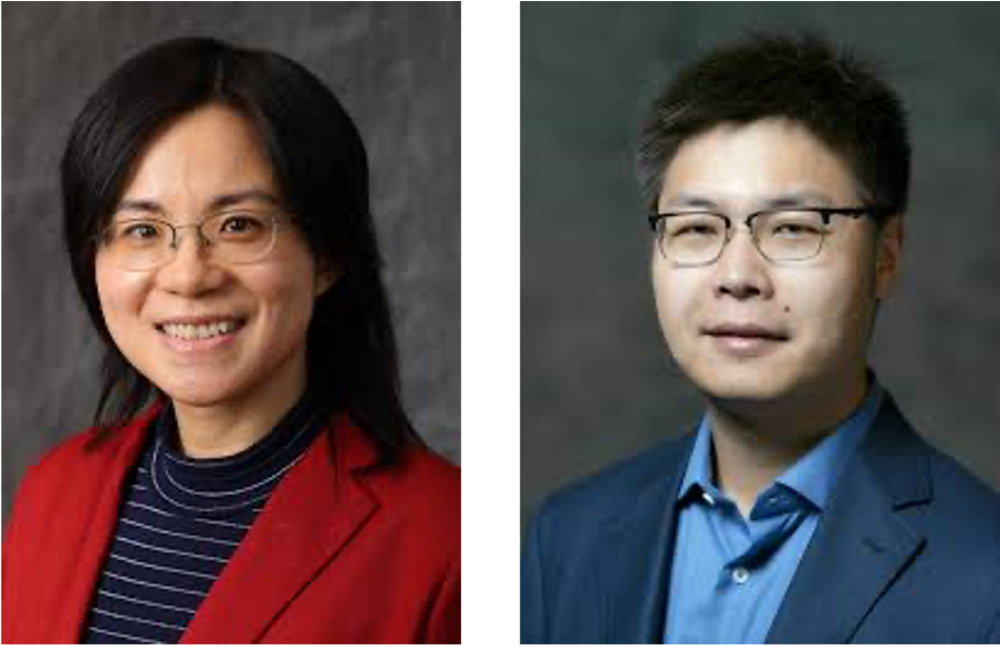
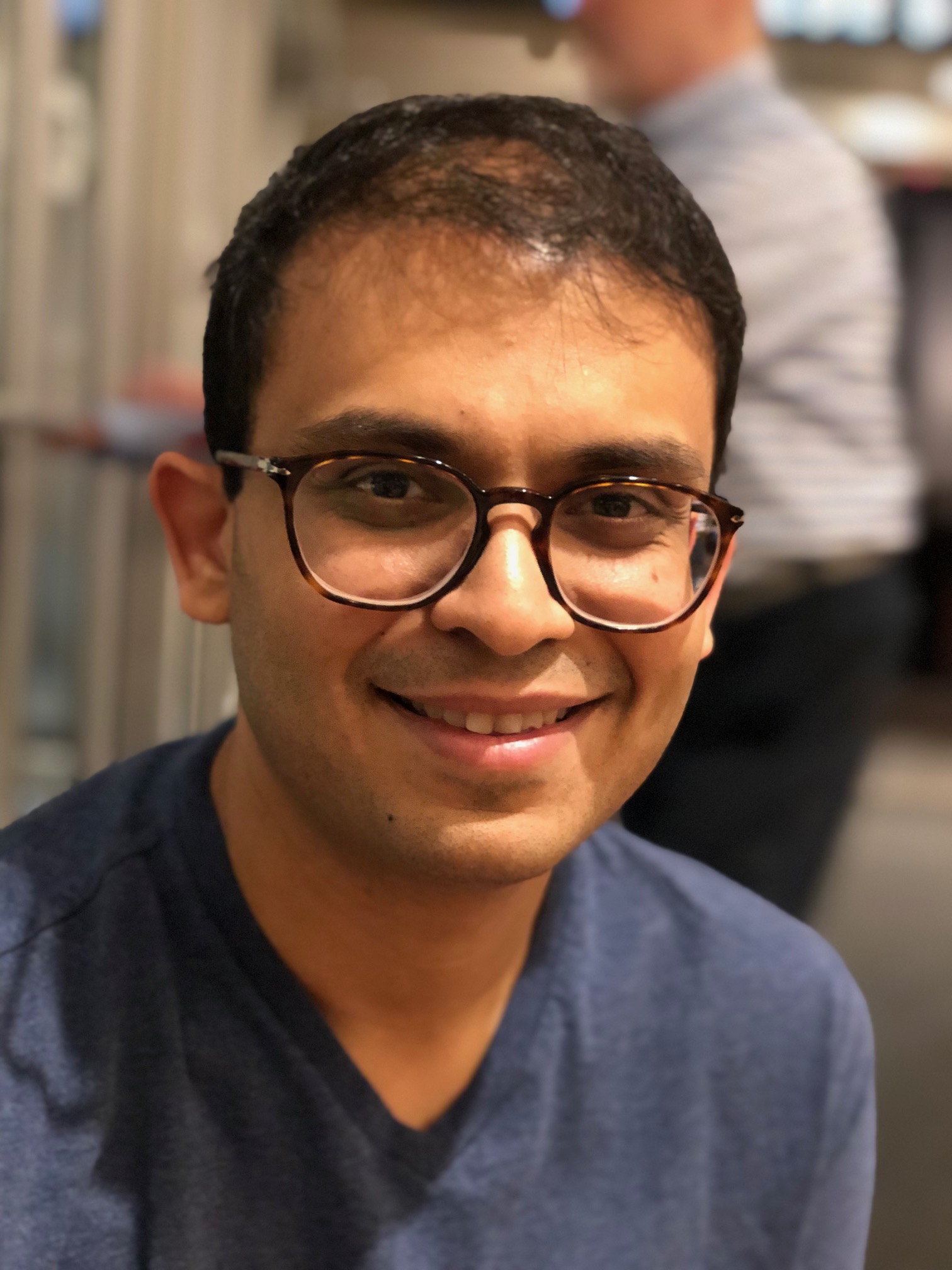
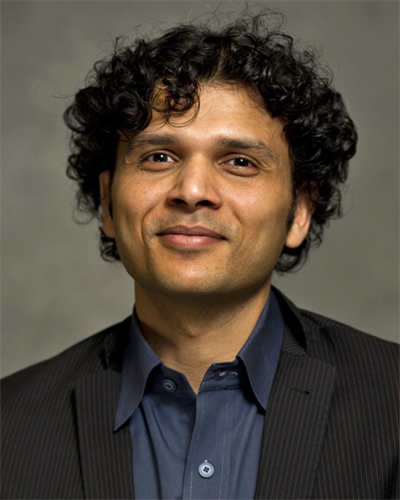
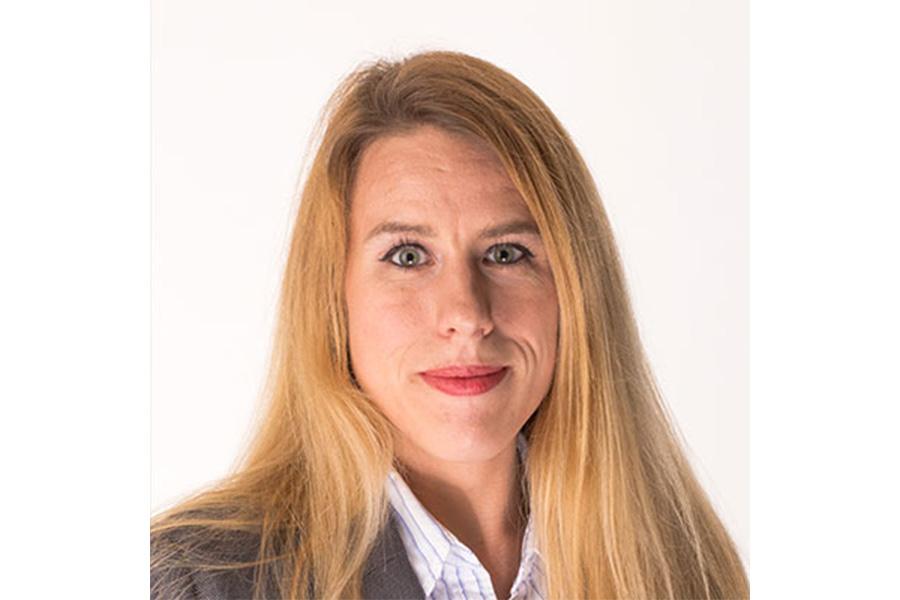
Dr. Ge (Christie) Zhang is a Professor in the Department of Biomedical Engineering at the University of Akron College of Engineering and Polymer Science. She holds a joint faculty position at the Department of Integrative Medical Science at Northeast Ohio Medical University and serves as a Consultant Staff at the Lerner Research Institute, Cleveland Clinic. B.Sc., Capital Medical University, China (2002) Ph.D., Biomedical Engineering, University of Minnesota (2006) Her research focuses on cardiovascular disease therapeutics , combining cardiac tissue engineering , stem cell therapy , and natural biomaterials to develop translational approaches for myocardial repair. Key innovations include aptamer-functionalized hydrogels for growth factor delivery and microfluidic sensors for single-cell analysis. Recent publications span double-network hydrogels , ECM scaffold applications , and microfluidic biosensing , reflecting her work at the intersection of biomaterial design and cardiac regeneration . Funding (~$6M) comes from the American Heart Association, NIH, and NSF. 2018 University of Akron College of Engineering Outstanding Researcher Award 2022 University of Akron Outstanding Researcher Award 2023–24 Mid-American Conference Academic Leadership Development Program Fellow Dr. Zhang leads a lab developing translational therapeutics , with expertise in cardiac extracellular matrix and bioassay development for cell secretome analysis.
Meng Wang is a Professor in the Department of Electrical, Computer, and Systems Engineering at Rensselaer Polytechnic Institute (RPI), where she was promoted to Full Professor in June 2025. She received her B.S. and M.S. degrees (both with honors) in Electrical Engineering from Tsinghua University, China, in 2005 and 2007, respectively, and her Ph.D. in Electrical and Computer Engineering from Cornell University in 2012. After a postdoctoral position at Duke University, she joined RPI in December 2012 as an Assistant Professor, was promoted to Associate Professor with Tenure in 2019, and then to Full Professor in 2025. Her research spans machine learning and artificial intelligence, high-dimensional data analytics, power system monitoring, signal processing, and optimization methods. She has made fundamental contributions in sparse signal recovery and monitoring and control of smart grid using high frequency data from phase measurement unit (PMU). More recently, she has collaborated with IBM to produce theoretical guarantees of modern AI architectures such as graph neural networks and transformers used in large language models (LLMs). Wang's recent publications (2023-2025) reveal a strong focus on theoretical foundations of deep learning, particularly transformer architectures and graph neural networks. Her work bridges theoretical guarantees with practical applications in power systems, demonstrating how fundamental insights in machine learning can solve real-world energy challenges. She has increasingly focused on the intersection of AI and energy systems, developing methods for building-level load forecasting, energy disaggregation, and smart grid monitoring with behind-the-meter solar integration. AFOSR Young Investigator Program (YIP) Award (2019) Army Research Office (ARO) YIP Award (2017) James M. Tien '66 Early Career Award and Grant for Faculty (2022) School of Engineering Research Excellence Award (2018) IEEE Signal Processing Society Best Reviewer Award (2018) Professor Wang has mentored numerous Ph.D. students who have gone on to successful careers in academia and industry, including HongKang Li (now postdoc at University of Pennsylvania), Yi Ming (postdoc at University of Michigan), and Shuai Zhang (Assistant Professor at New Jersey Institute of Technology). Her research has been supported by multiple grants from the National Science Foundation, Air Force Office of Scientific Research, Army Research Office, and industry partners including IBM. She is actively involved with research centers including the Center for Future Energy Systems (CFES) and the Center for Materials, Devices, and Integrated Systems (CMDIS), where her group develops cutting-edge methods for power system monitoring and control. Her recent work has increasingly focused on the theoretical foundations of large language models and their applications to energy systems, positioning her at the forefront of AI for critical infrastructure.
Yizhe Zhu is an Assistant Professor of Mathematics at the University of Southern California , specializing in theoretical and applied aspects of high-dimensional data analysis. His research bridges mathematics, computer science, and statistics, with a focus on random matrix theory, sparse data structures, and algorithmic analysis for machine learning and privacy-preserving data methods. Research Interests Yizhe Zhu’s work addresses fundamental questions in: Random Matrix Theory : Spectra of sparse and structured matrices, including outlier detection and universality. Graph and Hypergraph Analysis : Community detection, spectral properties, and non-backtracking algorithms for complex networks. Privacy and Data Synthesis : Theoretical frameworks for differentially private synthetic data generation. Tensor Completion : Efficient algorithms for recovering low-rank tensors from sparse observations. Publications Trends His recent research (2024–2025) emphasizes spectral analysis of random structures, optimization in non-convex settings, and privacy-preserving machine learning. Key themes include the interplay between sparsity, spectral theory, and algorithmic robustness in high-dimensional regimes.
Massachusetts Institute of TechnologyUnited States
Vivek F. Farias is the Patrick J. McGovern (1959) Professor at the MIT Sloan School of Management , where he is affiliated with the Operations Management group and the Operations Research Center (ORC) . His work bridges high-dimensional optimization, reinforcement learning, and stochastic modeling, with applications in commerce, healthcare, and biology. Education: Ph.D. in Electrical Engineering, Stanford University (Advisor: Prof. Benjamin Van Roy) Research Focus: Vivek’s research spans Reinforcement Learning , Dynamic Optimization , Approximation Algorithms , and Inference in Large-Scale Stochastic Systems . Recent applications include commerce platforms, protein networks, and healthcare operations. He has published extensively in top-tier venues like Management Science , Operations Research , NeurIPS , ICML , and Nature Communications . Editorial & Service Roles: Co-Editor, Data Science Area, Management Science Editorial Board, Operations Research Editorial Board, INFORMS Journal on Optimization Scientific Awards: 2022 RMP Jeff McGill Student Paper Award (First Prize) 2022 Applied Probability Society Student Paper Prize (First Prize) 2016 INFORMS MSOM Best Paper in Management Science 2015 INFORMS Revenue Management and Pricing Section Prize Best Simulation Publication Award, INFORMS Simulation Society (2014) George Nicholson Student Paper Competition, First Place (2017) Advising & Mentorship: Vivek has advised 14+ Ph.D. students and numerous MS students, many now faculty at top institutions (Columbia, NYU, CMU, INSEAD) or leaders in industry (Uber, Facebook, Lyft, McKinsey). His lab focuses on scalable algorithms for real-world decision-making under uncertainty. Industry & Entrepreneurship: He co-founded and served as CTO of Celect (acquired by Nike) and currently advises multiple technology startups in retail, healthcare, and finance.
Işın Erer is a Professor at the Department of Electronics and Communication Engineering, Faculty of Electrical and Electronic Engineering, Istanbul Technical University (ITU). She is actively involved in research on radar signal processing, artificial intelligence, and image analysis, with a focus on ground-penetrating radar (GPR) and remote sensing applications. University: Istanbul Technical University School: Faculty of Electrical and Electronic Engineering Department: Department of Electronics and Communication Engineering Academic Rank: Professor Email: ierer@itu.edu.tr Her research interests span signal processing, radar systems, clutter removal, target detection, deep learning, vision transformers, U-Nets, and vital signs detection using stepped-frequency radar . She applies advanced machine learning techniques to enhance radar imaging and improve performance in challenging environments such as debris fields and outdoor conditions. The recent publication trends indicate a strong focus on integrating deep learning models (e.g., Vision Transformers, YOLOv5, U-Net) with radar signal processing for clutter removal, image restoration, and segmentation . Her work combines low-rank approximations, autoencoders, B-spline activation functions, and attention mechanisms to improve accuracy and robustness in GPR and remote sensing imagery. Applications include parcel boundary delineation, road segmentation, and life detection in search-and-rescue scenarios. She has received notable recognition for her academic mentorship: Best PhD Thesis Advisor in Telecommunications Engineering Program, 2018 She leads multiple active research projects funded by TÜBİTAK and ITU-BAP, focusing on real-time AI-based radar systems, through-wall vital sign detection, and clutter removal in GPR. She has supervised numerous graduate students, with 47 theses in progress or completed. Her research group works on both theoretical algorithm development and practical system implementation, bridging the gap between academia and real-world deployment. Current projects include developing integrated AI models for real-time GPR systems and ultra-wideband radar methods for behind-obstacle detection.
Yuan Tian is a Visiting Assistant Professor in the Department of Computer Science at the University of Virginia. His research focuses on security and privacy, with a particular emphasis on cyber-physical systems, machine learning applications in vulnerability detection, and human-computer interaction challenges in privacy preservation. He has collaborated with industry leaders such as Google, Facebook, Microsoft, Samsung, and others to address real-world security and privacy issues in mobile systems and IoT devices. His work spans theoretical frameworks for automated vulnerability repair to practical tools like AuthSaber for OAuth security verification. Key research areas include: Development of LLM-powered systems for vulnerability detection (e.g., VulBinLLM) Post-fuzzing analysis of firmware (FirmRCA) Privacy perception studies in smart environments (e.g., WiFi services and commercial buildings) Hardware/software co-design security for IoT His recent work bridges machine learning and cybersecurity, addressing threats in smart contracts, federated learning, and adversarial attacks. Notable contributions include frameworks for privacy-preserving inference in edge networks and sonar-based authentication systems for smart speakers. Awards and recognition: No specific awards listed, though his work has been widely adopted by industry partners. His research has been published in top-tier venues, including S&P, CCS, and IEEE S&P, reflecting its technical impact.
Shuchin Aeron is an Associate Professor in the Department of Electrical and Computer Engineering at Tufts School of Engineering, with joint appointments in the Departments of Computer Science and Mathematics. He holds a Ph.D. from Boston University (2009) and completed postdoctoral research at Schlumberger Doll Research, focusing on borehole acoustic signal processing. His research spans statistical signal processing, machine learning, compressed sensing, and information theory, with applications in geophysics, bioengineering, and imaging. Aeron has authored over 175 publications and holds patents in acoustic signal processing. He received the NSF CAREER Award (2016) and is a Senior Member of the IEEE. Educations: Ph.D., Electrical Engineering, Boston University, 2009 M.S., Electrical Engineering, Boston University, 2004 B.Tech., Indian Institute of Technology, 2002 Research Interests: Statistical signal processing (SSP), inverse problems, compressed sensing, information theory, convex optimization Machine learning applications in geophysical signal processing, imaging, and bioengineering His work emphasizes optimal sampling and recovery of multidimensional signals, with contributions to compressed sensing architectures and generative models for particle physics experiments. He leads NSF-funded projects on data science and domain generalization, and collaborates with industry partners like Schlumberger and Mitsubishi Electric Research Labs. Awards: NSF CAREER Award (2016) Mitsubishi Electric Research Lab Research Gift (2015) Grants and Funding: NSF HDR TRIPODS (2019–2023) AFOSR: Enabling Trusted Human-Like Artificial Teammates (2018–2023) NSF: Optimal Sampling and Recovery for Multilinear Signals (2013–2016) Aeron teaches advanced courses in probabilistic systems analysis, information theory, and machine learning. He directs the Tufts Data Science undergraduate and graduate programs, and serves on editorial boards of journals including Frontiers in Signal Processing and IEEE Transactions on Geoscience and Remote Sensing .
Karen Gunderson is an Associate Professor in the Department of Mathematics at the University of Manitoba's Faculty of Science. Her research spans graph theory, combinatorics, random graphs, percolation, hypergraphs, and extremal combinatorics. Research Focus : Graph theory, combinatorics, random graphs, percolation, hypergraphs, extremal combinatorics Academic Role : Associate Professor, Acting Associate Head Graduate Contact : Karen.Gunderson@umanitoba.ca , karen.gunderson@umanitoba.ca Her work includes bootstrap percolation , random geometric graphs , and extremal hypergraph problems , with applications in network modeling and probabilistic combinatorics. Recent publications focus on adversarial burning densities, Erdos-Ko-Rado robustness, and Turán numbers in switching contexts. Academic Leadership : Co-organizer of the University of Manitoba Combinatorics Seminar and key organizer for the 2023 CanaDAM conference and Movement & Symmetry in Graphs retreat.
Changho Suh is a Professor in the Department of Electrical Engineering at Korea Advanced Institute of Science and Technology (KAIST), College of Engineering. His research spans information theory, machine learning, and data science with significant contributions to matrix completion, fairness in AI, and network communications. Dr. Suh's research interests focus on the theoretical foundations of information processing and machine learning. He has pioneered work in matrix completion with graph side information, developing efficient algorithms that leverage hierarchical structures and similarity graphs. His recent work emphasizes fairness in machine learning systems, addressing correlation shifts and developing methods for fair training and generative modeling. He has also made significant contributions to information theory, particularly in interference channels, network coding, and quantum key distribution. Analysis of his recent publications reveals a strong trend toward addressing fairness challenges in AI systems while maintaining theoretical rigor. His work bridges information theory with practical machine learning applications, particularly in recommender systems and community detection. Suh's research demonstrates how graph structures can enhance data recovery and how theoretical insights from information theory can improve modern machine learning systems. Dr. Suh has received recognition for his scholarly contributions through numerous publications in top-tier venues including IEEE Transactions on Information Theory, NeurIPS, ICML, and AAAI. His work has influenced both theoretical understanding and practical implementations in data science. As an academic advisor, Suh has mentored numerous graduate students who have gone on to publish significant research in their own right. His collaborative approach is evident in the diverse range of co-authors across his publications, indicating strong research partnerships both within KAIST and internationally. His laboratory work appears to focus on information-theoretic approaches to machine learning problems, with particular emphasis on structured data analysis, fairness considerations, and efficient algorithm design for large-scale data processing tasks.
Sylvain Sardy is an Associate Professor in the Department of Mathematics at the University of Geneva, where he conducts research at the intersection of statistics, optimization, and machine learning. He is affiliated with the Analysis, Mathematical Physics and Probability research group and has held significant editorial positions including Associate Editor for Computational Statistics and Data Analysis since 2020. Professor Sardy's research focuses on statistical machine learning, sparsity, and optimization with applications spanning astronomy, chemometrics, finance, and tomography. His work develops innovative methods for high-dimensional data analysis, particularly using wavelet-based approaches and LASSO regularization techniques for feature selection, denoising, and model selection. His publications reveal a consistent focus on finding sparse signals in complex datasets across diverse scientific domains. Professor Sardy has mentored numerous graduate students, currently supervising PhD candidate Maxime van Cutsem and having previously guided Dr. Xiaoyu Ma, Dr. Pascaline Descloux, Prof. Jairo Diaz Rodriguez, and Dr. Caroline Giacobino. His Master's students include Jairo Diaz (now Professor at Universidad del Norte, Colombia), Jean-Luc Baeriswyl, and others who have pursued careers in academia, industry, and education. His academic service includes leadership roles as Swiss representative at the European Regional Committee of the Bernoulli Society (2014-2018), President of the Doctoral School of Applied Statistics and Probability (2010-2013), and Student Advisor for the Mathematics Section (2008-2015). His teaching portfolio includes Optimization with Applications I, Statistical Machine Learning, and Pharmaceutical Statistics and Methodology, reflecting his expertise in statistical methodology and its practical implementation.
Rongrong Wang serves as Associate Professor in both the Department of Computational Mathematics, Science and Engineering (CMSE) and Department of Mathematics at Michigan State University, based in the Engineering Building with contact email wangron6@msu.edu . Her academic journey includes: B.S. in Mathematics and B.A. in Economics from Peking University, Beijing Ph.D. in Applied Mathematics from University of Maryland College Park under John Benedetto and Wojciech Czaja Postdoctoral fellowship at University of British Columbia with Ozgur Yilmaz and Felix Herrmann Her research spans Applied and Computational Harmonic Analysis , Machine Learning , and Compressed Sensing with focus areas including neural network training dynamics, learning theory, tensor analysis, and inverse problems. She investigates theoretical foundations of deep learning while developing applications for medical imaging and signal processing. Recent publications (2024-2025) demonstrate strong interdisciplinary work at the intersection of deep learning theory and medical imaging, particularly exploring edge-of-stability phenomena in neural networks and diffusion-guided reconstruction techniques. Her work also advances tensor decomposition methods and in-context learning mechanisms in language models. Professor Wang actively recruits self-motivated graduate and undergraduate students with backgrounds in mathematics, computer science, or electrical engineering for research opportunities in her lab.
Simone Brandenburg is a research scientist specializing in cellular senescence, oxidative stress, and related biological processes. Her work contributes significantly to understanding aging mechanisms, cancer biology, and potential therapeutic interventions for age-related conditions. Her primary research interests include: Cellular Senescence and Aging Mechanisms Oxidative Stress Response Pathways Cancer Biology and Therapeutics Wound Healing Processes Chronic Obstructive Lung Disease Pharmacological Interventions for Age-Related Conditions Dr. Brandenburg's research focuses on the molecular mechanisms of cellular senescence and how these processes contribute to aging and disease. Her work on PARP1 inhibition, CDK4/6 inhibition, and anti-apoptotic pathways has revealed novel approaches to target age-related conditions, cancer, and tissue damage. Recent publications demonstrate how manipulating senescent cells can improve recovery from oxidative injury, eliminate problematic melanocytes, and potentially treat age-related pathologies. Her scientific contributions have been published in high-impact journals including Nature Aging, Nature Communications, The EMBO Journal, and Molecular Cell, with multiple papers receiving significant attention and citations in the scientific community. Her research has been picked up by news outlets, referenced in patents, and widely shared across academic networks. Dr. Brandenburg collaborates extensively with researchers across international institutions, particularly with M. Demaria's group, contributing to a robust network of scientific inquiry in the field of aging and cellular stress responses.
Behtash Babadi is an Associate Professor in the Department of Electrical & Computer Engineering and a faculty member at the Institute for Systems Research and the Brain and Behavior Institute at the University of Maryland, College Park. He also holds affiliate appointments in the Program in Neuroscience & Cognitive Science and the Applied Mathematics & Statistics program. Education: Ph.D. in Engineering Sciences, Harvard University (2011) M.Sc. in Engineering Sciences, Harvard University (2008) B.Sc. in Electrical Engineering, Sharif University of Technology (2006) Research Interests: Dr. Babadi’s work focuses on statistical and adaptive signal processing frameworks for understanding neural systems. Key areas include: Neural signal processing and systems neuroscience Granger causality and functional connectivity analysis Dynamic modeling of neuronal assemblies Applications to auditory processing and cognitive recovery Scientific Contributions: His recent publications address cortical network dynamics, MEG source analysis, and robust causal inference. Notable methods include Network Localized Granger Causality (NLGC) for direct connectivity estimation and multitaper spectral analysis for neuronal spiking data. Awards: NSF CAREER Award (2016) E. Robert Kent Teaching Award (2019) GSAS Merit Fellowship (Harvard, 2010) Collaborations: Dr. Babadi collaborates with institutions like MIT, Harvard, and Massachusetts General Hospital, and participates in interdisciplinary initiatives such as the Brain and Behavior Initiative (BBI) and NIH BRAIN grants.
Catholic University of Eichstätt-IngolstadtGermany
Dominik Stöger is an Assistant Professor (tenure-track) in the Department of Mathematics at KU Eichstätt-Ingolstadt since 2021, affiliated with the Mathematical Institute for Data Science and Machine Learning (MIDS). His research bridges mathematical theory and data science applications. His educational background includes: B.Sc. in Mathematics, Technical University of Munich (2013) M.Sc. in Mathematics, Technical University of Munich (2015) Ph.D. in Mathematics, Technical University of Munich (2019) Stöger's research centers on mathematical foundations of data science, with emphasis on non-convex optimization in machine learning, theoretical analysis of overparameterized models, and low-rank matrix recovery. He combines optimization theory and high-dimensional probability to develop rigorous guarantees for modern algorithms, addressing critical challenges in deep learning theory. His recent publications (2020-2025) demonstrate consistent output in top venues including COLT, NeurIPS, and ICLR, with particular focus on implicit regularization phenomena and non-convex recovery guarantees. The 2025 pipeline shows active work extending theoretical boundaries in matrix sensing and neural network analysis. Stöger has received significant recognition: NeurIPS 2021 Spotlight Paper (top 3% of submissions) COLT 2025 paper presentation As a tenure-track faculty member, he maintains active collaborations across institutions (USC, TUM) and likely advises graduate students. His research program shows strong momentum with multiple concurrent projects advancing theoretical machine learning. He contributes to the research ecosystem through affiliation with MIDS, fostering interdisciplinary work in mathematical data science at KU Eichstätt-Ingolstadt.