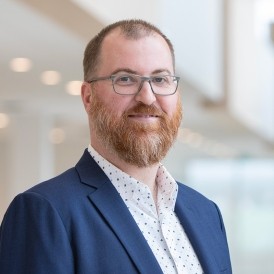
Prasanna Karunanayaka is an Associate Professor at Penn State University with dual appointments in the Department of Radiology and Department of Public Health Sciences . He contributes to the Penn State Neuroscience Institute with a focus on functional MRI and neurodegenerative diseases. Education : MS, PhD, MS His research spans Alzheimer's disease , olfactory processing , and neural correlates of consumer behavior . Recent work explores hormonal influences on olfaction and sleep, and the integration of sensory systems in the brain. His 2024 articles highlight advancements in understanding glymphatic functionality and brand preference mechanisms . He received the Junior Faculty Research Scholar Award in 2017 and leads a National Institute on Aging-funded project ( 2021–2026 ) linking olfactory deficits to Alzheimer's neurodegeneration. Collaborations include neuroscience and radiology experts, with a focus on memory impairment and olfactory deficits .
Tuhin Chakrabarty is an Assistant Professor in the Department of Computer Science at Stony Brook University. His research focuses on developing AI systems that address implicature, ambiguity, and human-aligned requirements, with applications in natural language processing and human-AI collaboration. Education: Ph.D. in Computer Science from Columbia University Research Interests: Tuhin explores methods to enhance AI reliability through Long Form Text Generation Evaluation, Benchmarks for Reasoning and Explainability, and Human-AI Collaboration frameworks. His work bridges computational linguistics, machine learning, and creative applications of AI. Scientific Awards: Columbia Center of Artificial Intelligence & Technology (CAIT) Research Support Amazon Science Ph.D. Fellowship Computational Journalism Fellow at NYTimes R&D (2021-2022) Publications Trends: His recent work spans AI safety, creativity support, figurative language understanding, and multimodal systems. Key themes include human-AI alignment, ethical considerations, and empirical studies on generative models. Additional Contributions: Tuhin collaborates with Stony Brook’s Institute for AI-Driven Discovery and Innovation, advancing interdisciplinary research in AI applications.
Elizabeth T. Welsh serves as Associate Professor in the Management Department at the University of St. Thomas' Opus College of Business, teaching graduate/undergraduate courses in interpersonal relationships, employee development, and human resources while leading the Health Care MBA capstone program. Her academic foundation includes: PhD in Human Resources & Industrial Relations (University of Minnesota) MS and MBA in Computer Science (University of California) BS in Electrical Engineering (Stanford University) Welsh's research interrogates mentoring dynamics and leadership relevance, with emphases on gendered mentoring perceptions, boss-employee relationship management, and translating academic insights into actionable leadership strategies. Her work consistently bridges theoretical rigor with executive applicability through qualitative and quantitative methodologies. Publication trends reveal sustained focus on mentoring evolution (2003–2019), expanding from foundational e-learning studies to contemporary examinations of boss management and gender dynamics. These contributions span organizational behavior, human resources, and vocational psychology domains with increasing methodological sophistication. Recognition includes: U of M - Herbie Award in HRIR Program (2008) Her industry pedigree—encompassing McKinsey consultancy, Microsoft program management, and InstallShield VP roles—informs pedagogical innovation through real-world case studies and experiential learning. Service activities include editorial reviewing for Career Development International and Human Resources Management alongside Academy of Management membership, though specific grant details remain unreported. Welsh operates within standard departmental structures without dedicated lab affiliations, leveraging her interdisciplinary background to connect engineering, business analytics, and human capital development through curriculum design and corporate engagement.
Chantal Martin Sölch is a full Professor at the Department of Psychology , University of Fribourg , Switzerland. She specializes in clinical psychology, neuroimaging, and mental health interventions, with a focus on trauma, depression, and chronic pain. Her research integrates neuropharmacological studies with mindfulness-based and psychedelic-assisted therapies. Current Projects : RESIST-D (neurobiology of resilience in depression), TIMED (digitalization’s impact on time perception), and mindfulness interventions for fibromyalgia. Methodologies : PET/fMRI neuroimaging, experience sampling, and cross-cultural studies. Research Trends : Recent articles examine psychedelic drug mechanisms, trauma’s long-term effects, and culturally adapted mental health interventions. Her work bridges neuroscience and clinical practice, emphasizing dopamine function, stress response, and intergenerational trauma. Grants : Funded by the Swiss National Science Foundation (SNSF) for projects on depression, fibromyalgia, and digital age mental health.
Elena Umili is an Assistant Professor (RTD-A) at the Department of Computer, Control and Management Engineering (DIAG) of Sapienza University of Rome, specializing in Neurosymbolic AI research. Her work bridges deep learning with symbolic reasoning systems. She received her PhD in Engineering in Computer Science from Sapienza University of Rome in 2023 under the supervision of Prof. Giuseppe De Giacomo and Prof. Roberto Capobianco. Her doctoral thesis focused on 'Discovering Logical Knowledge in Non-Symbolic Domains'. Her research interests center on Neurosymbolic AI integration , particularly: Combining deep machine learning with symbolic reasoning Temporal logic specifications in neural systems Automata learning through neural relaxations Non-Markovian reinforcement learning tasks Visual grounding of logical specifications Analysis of her recent publications reveals a strong focus on neural-symbolic integration where she develops frameworks like DeepDFA and Neural Reward Machines. Her work consistently addresses the challenge of incorporating logical constraints into deep learning systems, with applications spanning robotics, sequence generation, and visual reasoning. The research demonstrates increasing sophistication in handling temporal logic specifications within neural architectures. She is an active member of research groups focused on Artificial Intelligence and Knowledge Representation, as well as Artificial Intelligence and Robotics at Sapienza University. While no formal advisees or major awards are currently documented in her public profile, her recent publications indicate significant contributions to the neurosymbolic AI field through top-tier conferences including ECAI, KR, and specialized workshops. Her work shows strong potential for future impact in bridging the gap between neural and symbolic AI paradigms.
Justin P Boren is an Associate Professor in the Communication Department at Santa Clara University specializing in organizational communication, with research centered on workplace stress dynamics and social support networks. He developed the seminal concept of Communicatively Restricted Organizational Stress (CROS) and serves as vice chair of the County of Santa Clara's Human Rights Commission. Education: B.A. in Speech Communication, California State University at Long Beach (2002) M.A. in Communication, California State University at Long Beach (2005) Ph.D. in Communication, The Hugh Downs School of Human Communication, Arizona State University (2010) Research Focus: Boren's work pioneers the study of CROS—defined as employees' perceived inability to communicate about stressors—and its physiological health consequences. His research program integrates organizational communication with psychophysiology, examining how social support networks buffer stress in workplaces ranging from healthcare to academia. He investigates work-life balance mechanisms, conflict management strategies, and the biological correlates of communication behaviors through rigorous quantitative methodologies. Publication Trends: His 15 most recent publications (2014-2023) reveal three dominant trajectories: (1) Theoretical and measurement development of CROS across professions, (2) Physiological investigations linking social support to immune function and metabolic health, and (3) Contextual applications in nursing, academia, and marital relationships. This body of work demonstrates consistent interdisciplinary integration of communication theory with health psychology and biological markers. Professional Engagement: American Psychological Association Society for Industrial and Organizational Psychology Western States Communication Association National Communication Association Academic Leadership: Boren teaches core courses including Quantitative Research Methods, Organizational Communication, Conflict Management, and The Biology of Human Communication. His pedagogy bridges theoretical communication frameworks with biological and psychological applications, notably through courses examining the physiological dimensions of human interaction.
Eric A. Hurley is a Professor of Psychological Science and Africana Studies at Pomona College, where he has been since 2007. His research explores how cultural orientations influence educational outcomes for minority children, emphasizing the mismatch between home/community cultural values and mainstream classroom demands. He has conducted studies in the U.S., South Africa, and Central/South America, focusing on cultural integrity, communalism, and stereotype threat. Ph.D., Howard University Bachelor of Science, University of Florida Professor Hurley's work bridges psychology and Africana Studies, arguing that infusing students' home cultures into learning contexts can resolve conflicts between academic success and cultural identity. His DSC Lab examines deep-structure cultural values and their impact on cognitive development. He has also developed methodologies to assess cultural orientations across diasporas, highlighting differences between Asian and African diaspora groups. His recent publications focus on sociocultural factors in education, communalism in pedagogy, and cross-cultural continuities in African American and South African populations. Research trends emphasize cultural psychology, educational reform, and diaspora studies. Jeffrey S. Tanaka Memorial Dissertation Award, American Psychological Association Post-Doctoral Fellowship, Teachers College at Columbia University Pre-Doctoral Fellowship, Smith College Hurley's academic work includes advising students on projects like *Anthony M. Sylvester's research on communal math pedagogy and *Alan R. Lopez on African American cultural themes in South Africa. He has also contributed to discussions on educational psychology, race, and cultural identity through Sagecast podcast appearances, where he shared insights on his interdisciplinary approach and international research collaborations.
Bruce Draper is a Professor and Chair of the Department of Computer Science in the College of Natural Sciences at Colorado State University. His work bridges artificial intelligence, machine learning, and computer vision, with a strong emphasis on real-world applications involving visual data and intelligent systems. Research Interests: Draper's research centers on machine learning with a focus on visual learning, adversarial AI, and visual agents. He investigates how AI systems can perceive, interpret, and interact with visual environments through technologies like facial recognition, object tracking, augmented reality, and automated visual communication. His work addresses both the capabilities and vulnerabilities of modern AI, particularly in defending systems against adversarial attacks. Publication Trends: His recent scholarly output reflects a consistent trajectory in advancing computer vision and AI robustness. The articles span topics from adversarial defense mechanisms and visual agent autonomy to scalable learning frameworks and real-time video analysis. Collectively, they emphasize secure, efficient, and context-aware visual intelligence systems grounded in deep learning and representation learning. Scientific Awards: No specific awards mentioned in the provided text. Advising and Grants: While no students or grants are explicitly listed, his leadership role as department chair and prior experience as a DARPA program manager suggest extensive involvement in research funding, mentorship, and high-impact project direction. His background indicates likely supervision of graduate students and management of federally funded research initiatives in AI and computer vision. Labs and Teams: Although no specific lab or research group is named, his research scope implies leadership or affiliation with interdisciplinary teams working on AI security, computer vision, and augmented reality systems within the Department of Computer Science at CSU.
Dr. Julie Risien is an Adjunct Professor and Director of the NSF Polar STEAM program at Oregon State University, affiliated with the STEM Research Center and the Office for Research Advancement. She holds a joint role on the graduate faculty of the College of Earth, Ocean and Atmospheric Sciences (CEOAS) and the Environmental Sciences Program. Her work bridges science, education, and institutional change, focusing on broader impacts, faculty development, and transdisciplinary collaboration. Education: Ph.D. in Environmental Sciences (Social Science) M.S. in Marine Resource Management B.A. in Environmental Sciences (Marine Ecology) Dr. Risien’s research centers on the intersection of science and society, particularly how learning networks, organizational structures, and institutional incentives shape public engagement and research impact. She investigates transformative learning networks, broader impacts strategies, and reform in promotion and tenure systems. Her work supports scientists in developing meaningful public engagement and navigating institutional reward systems. Her recent publications reflect a strong trend in higher education reform, focusing on infrastructure for broader impacts, evaluation methods, and equity in academic advancement. She frequently publishes on institutional systems that support or hinder public engagement and the integration of innovation and entrepreneurship into tenure processes. Dr. Risien has led or co-led major NSF-funded initiatives including Polar STEAM, ARIS, ARC-Learn, and PTIE. She is a Principal Investigator and Co-PI on transformative projects aimed at redefining success in academia and enhancing research impacts in society. She advises and collaborates on graduate research through her roles in CEOAS and the Environmental Sciences Program, and leads national efforts to build research impact networks. Her leadership extends to co-developing tools for departmental self-assessment on equity in promotion and tenure. Dr. Risien is a key figure in OSU’s research impact ecosystem, leading the STEM Research Center’s efforts in transdisciplinary research and public engagement. She is central to the Polar STEAM initiative and collaborates with the Patricia Valian Reser Center for the Creative Arts and Precollege Programs to integrate arts and science.
Bertalan Polner is an Assistant Professor at the Institute of Psychology , Eötvös Loránd University, affiliated with the Department of Clinical Psychology and Addiction . He serves as a Member of the Research Ethics Committee and maintains an active research profile at Radboud University’s Donders Centre for Cognition as a PostDoc researcher. Academic Rank: Assistant Professor Current Institutions: Eötvös Loránd University (ELTE), Radboud University Research Focus: Schizotypy-psycho sis interactions, computational psychiatry, sleep-cognition links, memory mechanisms, and emotion regulation. Dr. Polner’s research explores how positive schizotypy interacts with sleep disturbances and visual perception anomalies , using network analysis to map relationships between personality traits and mental health outcomes. His work often integrates computational modeling (e.g., drift diffusion models, predictive coding) to understand cognitive deficits in psychotic disorders. Recent publications highlight his contributions to: Mapping schizotypy’s role in stress-reactivity (2025) Investigating REM sleep’s impact on mind-wandering (2023) Analyzing reward processing in borderline personality disorder through schema modes (2023) He also develops educational tools like the introduction_to_R and Structural Equation Modeling repositories on GitHub, supporting psychological research methodology.
Xingyu Zhou is an Assistant Professor in the Department of Electrical and Computer Engineering at Wayne State University. He earned his Ph.D. in ECE from Ohio State University under Prof. Ness Shroff, with prior degrees from BUPT (B.S.) and Tsinghua University (M.S.) in Electrical Engineering. His research bridges machine learning and stochastic systems, focusing on bandits, reinforcement learning, and cloud computing with differential privacy. His work addresses privacy-preserving sequential decision-making and optimal load balancing. Ph.D., Electrical and Computer Engineering, Ohio State University M.S., Electrical Engineering, Tsinghua University B.S., Electrical Engineering, BUPT His research explores machine learning (bandits, reinforcement learning, offline alignment techniques) and stochastic systems (load balancing, cloud computing). Recent work emphasizes differential privacy in federated learning, contextual bandits, and reinforcement learning frameworks. Publications span top venues like ICML , NeurIPS , and ICLR , with a focus on privacy-utility trade-offs and robust optimization. Key scientific awards include the NSF CAREER Award, Best Student Paper at WiOpt 2022, and Ohio State University’s Presidential Fellowship. He actively contributes to teaching , offering graduate courses in online decision-making and undergraduate programming courses in electrical engineering.
Nadia Steils is a Lecturer in the Business Administration Department at the Faculty of Economics, Management and Social Sciences, University of Namur (Belgium), with concurrent research affiliation at IAE Lille, University of Lille (France). Her academic home spans CeRCLe, LEM, and CCMS research centers, focusing on the intersection of consumer behavior and digital technologies. Education: PhD in Management Sciences - Marketing (University of Namur & IAE Lille, 2016) Master in Audit, Control, Research and Modeling in Marketing (IAE Lille, 2012) Bachelor in Applied Communications (IHECS Brussels, 2010) Her research centers on consumer e-learning processes , examining how digital interfaces shape knowledge acquisition and purchasing decisions. Specializing in consumer behavior in technology-mediated environments , she investigates the psychological mechanisms behind online learning adoption, gamification effects, and AI-driven service interactions. Recent work critically analyzes transparency paradoxes in influencer marketing and ethical dimensions of explainable AI systems, contributing directly to UN Sustainable Development Goals through consumer education frameworks. Analysis of her 16 research outputs (2013-2025) reveals evolving expertise from foundational e-learning studies toward contemporary AI/consumer behavior intersections. Current publications emphasize human-centric technology design , with strong focus on trust calibration in AI services and ethical implications of algorithmic manipulation. Research Leadership: Principal Investigator for Nestlé-funded social food trends project (2017-2018) Lead researcher on Creative Crowdsourcing knowledge-transfer initiative Key contributor to EU cultural experience knowledge-project Her 24 supervised student projects demonstrate active mentorship in consumer research methodology. Elected to departmental councils at both University of Namur and University of Lille, she shapes academic governance while maintaining rigorous teaching commitments across market research, marketing management, and database systems coursework.
Ralph Redden is an Assistant Professor of Psychology at St. Francis Xavier University , where he leads the Experimental & Translational Attention Lab (ETAL) . His work combines behavioral, neuroimaging, and computational approaches to study how attention mechanisms influence decision-making and action. He actively promotes open science practices and inclusive scientific processes. Current Research: Explores attentional networks, inhibition of return (IOR), and their ecological validity in real-world scenarios. Teaching: Offers courses in Intro Psychology, Attention, and Cognition. Previously taught at Dalhousie University and University of Alberta. Recent Student Highlights: Mentored honours students Julia Byron and Jack Lukeman on projects examining attentional predictors of bullying intervention and cueing effects in spatial tasks. Veda Haggarty's 2023/24 thesis on attachment styles and attention networks was presented at CPA and VSS conferences. Scientific Awards: 2021 President's Award for Graduate Student Teaching Collaborations: Works with Dr. Laura Lambe (StFX), Dr. Dana Hayward (VASP Lab), and Dr. Kyle Mathewson (AP&P Lab). Maintains ongoing ties with Dalhousie University labs.
Dr. Julia F. Christensen is a postdoctoral research fellow at the Warburg Institute, London, working with the B.I.A.S. project under Prof Manos Tsakiris, while maintaining an active affiliation with City St George's, University of London as an academic researcher. She is also an honorary member of University College London's Institute of Cognitive Neuroscience, reflecting her cross-institutional collaborations in cognitive neuroscience and psychology. Her educational background combines professional dance training with advanced neuroscience research, culminating in a PhD from the University of the Balearic Islands and University of Vienna. Her doctoral work investigated affective responses to expressive body movement, supervised by Professor Camilo Cela-Conde and Dr. Marcos Nadal. Dr. Christensen's research focuses on the cognitive and neural underpinnings of emotional expertise, particularly in dancers and artists. She examines how movement expertise modulates emotional perception, interoception, and sense of agency through behavioral, psychophysiological, and neuroimaging methods. Her work bridges dance science, moral psychology, and neuroethics, exploring topics from evolutionary functions of art to legal responsibility in emotional contexts. Analysis of her publications reveals strong interdisciplinary trends connecting emotion science with movement expertise, particularly in dance perception and agency modulation. Her research consistently demonstrates how specialized training alters neural processing of emotional stimuli, with significant contributions to understanding autism through interoceptive frameworks and exploring moral cognition through intentional binding paradigms. Her scientific recognition includes: Newton International Research Fellow (British Academy, 2015-2017) Dr. Christensen has secured competitive research funding from the British Academy (2015-2017) and Spanish Ministry of Science and Innovation (2010-2014). Her current collaborations include the B.I.A.S. project at the Warburg Institute and ongoing work with City St George's on emotion perception frameworks, building on previous affiliations with City University's Cognitive Neuroscience Research Unit and Autism Research Group. She is embedded in multiple research ecosystems including the Warburg Institute's dance movement library project, City St George's psychology department collaborations, and UCL's Institute of Cognitive Neuroscience networks, where she previously investigated sense of agency under Professor Patrick Haggard.
Daniele Marinazzo is a Full Professor in the Department of Data Analysis at Ghent University (Belgium), with a background in statistical physics and a focus on computational neuroscience and complex systems. He serves as Deputy Editor at PLOS Computational Biology , Co-Editor-in-Chief at Neurons, Behavior, Data Analysis, and Theory , and academic editor at Network Neuroscience and Imaging Neuroscience. His work spans theoretical physics, neuroscience methodology, and experimental neurophysiology. Academic Affiliation: Ghent University (Belgium) Editorial Roles: 3+ journals Research Initiatives: EBRAINS representative Research Interests combine computational neuroscience, complexity science, and network analysis. He investigates higher-order interactions in brain networks, synergistic information processing, and methodological advancements in neuroimaging. Recent work includes MEG/EEG analysis, gene expression modeling, and developing open-source tools like SPM-Python. Scientific Contributions include 15+ recent publications on topics ranging from individual brain fingerprinting to multisensory integration models. His work appears in venues like Nature Communications , Physics of Life Reviews , and Entropy , with methodological innovations in hidden factor localization and network synchronization analysis. Current projects include PhD/postdoc recruitment for fast-sampled fMRI analysis and organizing the Erice workshop Higher-Order Interactions: Mechanisms, Behaviors, and Networks (August 2025).