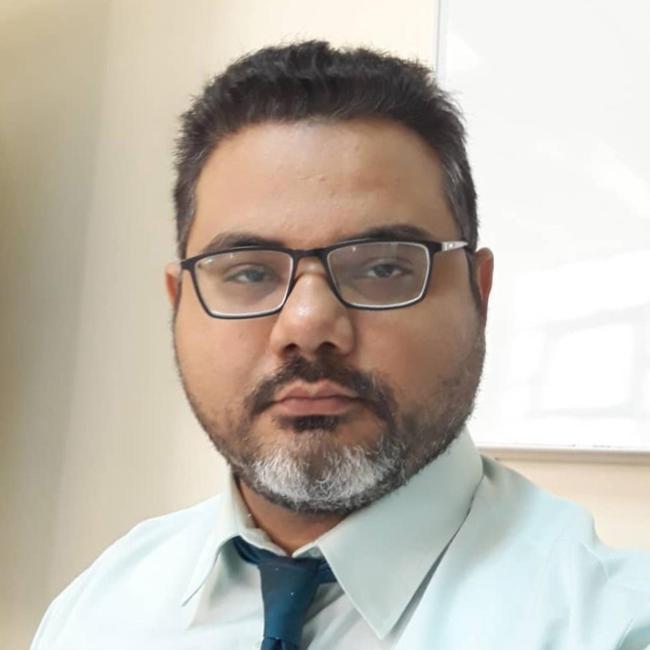
Dr. Muhammad Humayoun is a Senior Lecturer at Karlstad University, Sweden, specializing in informatics education and computational linguistics research. He holds a Ph.D. from University of Grenoble Alpes (2012) and M.Sc. from Chalmers University (2006). His academic career spans over 15 years across Pakistan and Sweden, including teaching roles at COMSATS University, University of Central Punjab, and Higher Colleges of Technology. Research Focus: His work centers on NLP applications for under-resourced languages like Urdu/Punjabi, including text summarization, abusive language detection, and formalization of mathematical texts. He has developed linguistic resources (corpora, lexicons) and contributed to plagiarism detection systems in programming courses. Teaching Contributions: Designed and taught over 15 courses across multiple universities, including advanced programming, AI, and cloud computing modules. Currently teaches graduate-level courses like 'Legal Tech, AI and Rules-as-Code' and undergraduate software engineering courses at Karlstad University. Awards: Recognized for Urdu threat detection system (3rd place, 2021) and top rankings in Urdu fake news competitions. His work on Urdu summarization corpora has been widely cited in computational linguistics research.
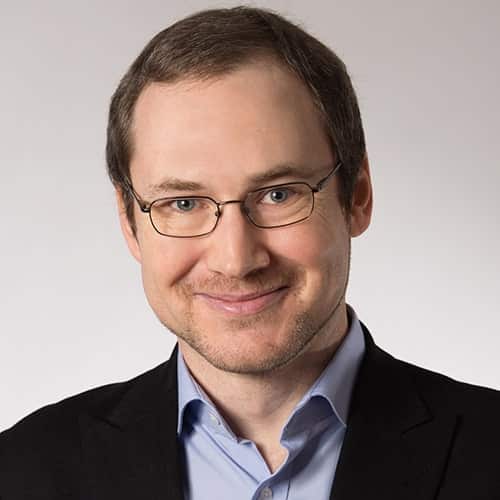
Thilo Stadelmann is the Founding Director of the Centre for Artificial Intelligence at the Zurich University of Applied Sciences (ZHAW) . A computer scientist by training, he earned his Doctor of Science degree from Marburg University, Germany, and has held engineering and leadership roles in the automotive industry before transitioning to academia. His research interests lie at the intersection of representation learning and the societal implications of artificial intelligence . He is particularly focused on understanding how AI systems can be designed to enhance human capabilities while addressing ethical concerns and societal challenges. Stadelmann is a prolific speaker and educator, delivering TEDx talks and lectures on topics such as "How Not to Fear AI" , "AI vs Human: Understanding the Fundamental Differences" , and "Decoding AI Fear: The Philosophy Behind It" . His work emphasizes the importance of demystifying AI and fostering a balanced perspective on its potential and limitations. His recent publications span a wide range of AI applications, from safety-critical network infrastructures and medical imaging to industrial process control and AI governance . Notable works include studies on AI risk assessment for public policy, document recognition, and the societal impact of AI technologies. Beyond his academic role, Stadelmann is actively involved in the digital ecosystem as a (co-)founder and senior leader in several organizations, bridging the gap between research and practical implementation in the AI space.
Dake Zhang is a faculty member at the David R. Cheriton School of Computer Science, University of Waterloo. His research focuses on reducing health misinformation through search systems, leveraging artificial intelligence and information retrieval techniques to improve online health information quality. Key collaborations with Mark D. Smucker, Amir Vakili Tahami, and Mustafa Abualsaud Active participant in TREC Health Misinformation Tracks (2021-2023) Developed ReadProbe system for lateral reading support using OpenAI models and Bing search His work demonstrates expertise in: Information retrieval systems for health domains Mitigating cognitive biases in search Transformer-based document analysis Automated answer prediction from web sources Search engine credibility modeling Human-AI interaction in information verification
Lane Harrison is an Associate Professor in the Department of Computer Science at Worcester Polytechnic Institute (WPI), where he directs the Visualization and Information Equity lab (VIEW). His research leverages cognitive and perceptual principles to improve information visualization and visual analytics systems, with critical applications in cybersecurity and health-risk communication for high-stakes decision-making. His educational background includes a BS (2009) and PhD (2013) in Computer Science from the University of North Carolina, Charlotte. Prior to WPI, he was a Postdoctoral Researcher at Tufts University's Visual Analytics Lab. Harrison's research focuses on empirical evaluation of visualization techniques , investigating how cognitive principles can optimize user performance with visual representations. He develops design guidelines for effective visualizations in domains like cybersecurity and healthcare, while creating adaptive systems that integrate models of user abilities. His work bridges theoretical foundations with practical applications to address real-world challenges in data interpretation. Analysis of his 2016-2021 publications reveals consistent emphasis on user-centered evaluation methodologies , including crowdsourcing and controlled experiments. Key trends include quantifying exploration behaviors in web visualizations, addressing cognitive biases in data reproduction, and developing healthcare-focused analytics for drug interactions and risk communication. His research demonstrates strong interdisciplinary connections between visualization, cognitive science, and domain-specific applications. His scientific recognition includes: Best Paper Award at ACM CHI 2016 for adaptive interface research Harrison secures significant research funding including an NSF Grant (2022) for visualization studies and participates in an 11-school AI collaboration for intelligence professionals (2025). He teaches data visualization and web programming courses, mentoring students through the VIEW lab on projects applying visualization techniques to social issues and scientific domains. He directs the VIEW lab at WPI, which develops computational methods to understand how people engage with data visualizations while emphasizing equitable information access. Current projects integrate user modeling with visualization systems to optimize design for diverse cognitive abilities and application contexts.
Dr Miao Xu is a Research Fellow at the University of Queensland (UQ), affiliated with the School of Electrical Engineering and Computer Science within the Faculty of Engineering, Architecture and Information Technology. She holds an Australian Research Council DECRA Fellowship (ARC DECRA), recognizing her early-career research excellence. Her research focuses on machine learning, data science, and time series analysis, with applications in healthcare, materials science, and algorithmic fairness. Dr Xu's work addresses challenges in noisy label handling, unlearning mechanisms, and adaptive modeling for irregular data. Education: She earned a Doctor of Philosophy (PhD) from Nanjing University. She is actively involved in supervising research and contributes to the Centre for Enterprise AI at UQ. Research Interests: Dr Xu’s expertise spans machine learning , time series analysis , deep learning , and unsupervised learning . Her recent work emphasizes robust learning with noisy or incomplete labels, model unlearning, and applications in alloy design and medical informatics. She explores methods like instance-attention GNNs for irregular time series and confidence-guided techniques for adversarial attack detection. Publications: Her recent work includes advancements in GNN-based time series modeling, bias mitigation in text classification, and active learning for alloy design. Key themes include improving generalization, reducing algorithmic bias, and enhancing model transparency. Awards: Her ARC DECRA fellowship (202X–202X) supports her research on data-driven methodologies. Supervision & Grants: Available for PhD supervision in machine learning and data science. Her grants include funding for projects in unlearning mechanisms and spatiotemporal modeling. Labs/Teams: Affiliated with the Centre for Enterprise AI at UQ, collaborating on enterprise-scale AI applications and interdisciplinary research.
David Kempe is a Professor in the Thomas Lord Department of Computer Science at the University of Southern California (USC), part of the Viterbi School of Engineering. His research focuses on algorithms, theoretical computer science, and their applications to networks, auctions, mechanism design, and information flow. He has advised numerous Ph.D., M.S., and undergraduate students, many of whom now hold prominent roles in academia and industry. His research has been supported by grants including NSF CAREER, Sloan Fellowship, and ONR Young Investigator awards. Kempe organizes conferences such as STOC 2018 and co-founded the USC Theory Group, fostering collaboration through regular meetings and seminars. His work bridges algorithmic foundations with real-world applications, addressing challenges in fairness, network dynamics, and machine learning. Key achievements include developing voting rules with optimal metric distortion and algorithms for fair matching under uncertainty. His publications span influential topics in social networks, game theory, and data science. Collaborations with industry (e.g., Facebook, Snapchat) highlight applied contributions to recommendation systems and media matching.
Camelia D. Brumar is a PhD Candidate in Computer Science at Tufts University and a Visiting PhD Student at Harvard University's Visual Computing Group. She co-founded Boston Vis , a collaborative network for visualization researchers in the Greater Boston Area. Education: B.S. in Theoretical Mathematics from University of Maryland, College Park Research Focus: Systematic visualization design for decision-making processes, bridging gaps between problem spaces and design spaces through qualitative methods Her work intersects Visual Analytics , Human-Computer Interaction , and Machine Learning , with recent publications on decision-making taxonomies, dimensionality reduction explanations, and knowledge graph visualization. Key trends include: Interactive predicate logic for pattern explanation Domain expert challenges in automated data science Anomaly reasoning frameworks Medical AI applications for embryo grading Scientific Achievements: Organizer of Boston Vis (2024) Tutorial presenter on LLMs for research paper interaction (2024) IEEE Visualization 2024 Doctoral Colloquium participant Contributor to Dagstuhl Seminar on provenance in automated data science (2023) Industry experience includes roles at Tableau Research , Alife Health , and Bose Corporation , with collaborations spanning MIT Lincoln Laboratory, National Renewable Energy Laboratory, and Worcester Polytechnic Institute.
Allan Hanbury is a Full Professor for Data Intelligence at the Faculty of Informatics, TU Wien, and a faculty member at the Complexity Science Hub Vienna. He leads the Data Science Research Unit and serves as the Faculty Representative for financial affairs and internationalization. He holds a PhD in Applied Mathematics from Mines ParisTech and a Habilitation in Practical Informatics from TU Wien. PhD in Applied Mathematics, Mines ParisTech, 2002 Habilitation in Practical Informatics, TU Wien, 2008 Bachelor’s and Master’s in Physics and Applied Mathematics, University of Cape Town His research focuses on information retrieval, data mining, natural language processing, and information extraction, with applications in healthcare, legal, and patent domains. He has coordinated major EU projects including Khresmoi, VISCERAL, KConnect, and DoSSIER, the latter training 15 PhD students. He is co-founder of contextflow, a spin-off commercializing radiology search technology. His recent publications (2024–2022) highlight a strong trend in systematic literature review automation, neural re-ranking, large language models, and domain-specific information extraction. Key themes include improving citation screening, patient-trial matching, evaluation metrics, and dataset creation for offensive language and legal text. His work combines technical innovation with real-world impact in medical, legal, and scientific communication contexts. Allan Hanbury has received no explicitly mentioned scientific awards in the provided text. He actively supervises numerous PhD and master’s students and leads large research projects such as DoSSIER, Transparent Automated Content Moderation, and PLFDoc, funded by FWF, WWTF, and EU. His group develops tools for evidence synthesis, clinical data extraction, and legal document analysis. He also contributes to AI and data strategy in Austria and Europe. He leads the Data Science Research Unit at TU Wien and is involved in multiple interdisciplinary projects including BRISE (building regulation analysis), CDL-RecSys, and TACo, focusing on legal and scientific document processing. His work bridges academia and industry through spin-offs like contextflow and collaborations with Deutsche Telekom, Siemens, and FMA.
Laxmidhar Behera is a Professor in the Department of Electrical Engineering at the Indian Institute of Technology Kanpur, specializing in Intelligent Systems and Control. With over two decades of academic experience at IIT Kanpur and international research experience at institutions including Fraunhofer Institute of Autonomous Intelligent Systems in Germany, ETH Zurich, and University of Ulster, he has established himself as a leading researcher in cognitive robotics and intelligent control systems. Dr. Behera's research spans multiple cutting-edge domains including Cognitive Robotics, Nano-robotics, Vision based Control, Soft Computing, Information Retrieval in music and language, Semantic Information Processing, Physics of Complex Systems, Cyber Physical Systems, Formation Control of UAVs, Brain-Computer Interface (BCI), and Sanskrit Computational Linguistics. His interdisciplinary approach bridges traditional control theory with modern computational intelligence techniques, creating innovative solutions for complex real-world problems. His extensive publication record in top-tier journals like IEEE Transactions demonstrates his leadership in areas such as brain-computer interfaces, visual servoing, multi-robot systems, and music information retrieval. Notably, his work on quantum neural networks for EEG filtering and multisatellite formation control has received significant attention in the research community. UKIERI Standard Research Award 2008 Best Paper at International Conf. on Intelligent Sensors and Information Processing (ICISIP-2004) Best Paper at WoSco,02, Int. Conf. High-Performance Computing (HiPC, 2002) AICTE career award for young teacher (1997) Senior Member IEEE Multiple IEEE top accessed articles (2009-2010) As an Associate Editor for Autosoft Journal and Technical Committee Member for Intelligent Control at IEEE Control System Society, Dr. Behera actively contributes to the academic community. His laboratory in the Western Lab - 212A of the Department of Electrical Engineering serves as a hub for research in intelligent systems, where he mentors students and collaborates with researchers worldwide on cutting-edge projects in robotics, control systems, and computational intelligence.
Teresa Cristina de Freitas Gonçalves is an Associate Professor at the Department of Informatics, School of Sciences and Technology, University of Évora, where she has been employed since 1999. She serves as an integrated researcher at the ALGORITMI research centre and is the Director of the VISTA Lab (Video, Image, Speech and text Analysis Lab), the unit of the ALGORITMI research centre at University of Évora. Her leadership roles include Director of the Master programme in Informatics Engineering and deputy Director of both the Master programme in Artificial Intelligence and Data Science and the Doctoral program in Computer Science. She earned her PhD in Computer Science from University of Évora and a MSc degree in Informatics Engineering from New University of Lisbon. Her academic journey at University of Évora has included significant leadership positions including Head of the Computer Science Department (2011-2015), Director of the Bachelor programme in Informatics Engineering (2016-2021), and Deputy Director roles for various undergraduate and graduate programs. Dr. Gonçalves' research focuses on intelligent systems, particularly Machine Learning approaches, with substantial contributions in evolutionary algorithms, information extraction and retrieval, and supervised learning across multiple data modalities including tabular data, text (in both Portuguese and English), and images (medical and satellite). Her work bridges theoretical advances with practical applications in healthcare, remote sensing, and natural language processing. She has successfully supervised 6 doctoral theses, 19 master theses, and 3 postdocs, and currently mentors 5 doctoral and 6 master students from diverse international backgrounds including Bangladesh, Cabo Verde, Nepal, Philippines, India, Sri Lanka, China, Mongolia, and Portugal. Her publication record includes over 100 scientific articles indexed by Scopus with 640 citations and an h-index of 12, demonstrating significant international impact with 56% of her work involving international collaboration. Her recent research shows a strong trend toward applying advanced machine learning techniques to healthcare applications, information retrieval systems, and remote sensing analysis, with particular emphasis on transformer networks, learning-to-rank methodologies, and multimodal data analysis. Dr. Gonçalves has made substantial contributions to the academic community through her service as a reviewer for over 50 articles in prestigious international journals and conferences, and as chair for major international conferences including IDEAL 2023, PROPOR 2020, SKIMA 2017 and 2018, and CLEF 2016. She serves on the board of APRP (Associação Portuguesa de reconhecimento de Padrões) and as a jury member for APRP prizes for best MSc and PhD theses. Her current research portfolio includes coordination of the Horizon Europe MSCA Staff Exchange HarmonicAI project and local coordination of WP6 in the NewSpace Portugal mobilising agenda. She is also actively involved in numerous other international research initiatives including Interreg VI-B Sudoe SenforFire, PRR CANTE, La Caixa INCOME, Erasmus+ KA220-HED REDINEST, Interreg POCTEP TID4AGRO, and ATTRACT DIH projects. Previously, she led the FCT AI in the Public Administration SNS24.Scout.IA project and coordinated the FEDER R&D NIIAA project. As Director of the VISTA Lab, Dr. Gonçalves leads a dynamic research team focused on video, image, speech, and text analysis. The lab serves as the Évora hub of the ALGORITMI research centre and has established strong international collaborations. Under her leadership, the VISTA Lab has developed innovative approaches in medical image analysis, natural language processing for Portuguese, and satellite image classification, with applications spanning healthcare, environmental monitoring, and public administration.
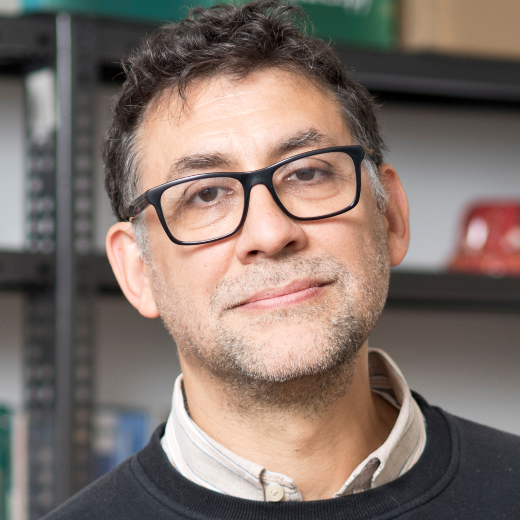
Enrico Franconi is a tenured full Professor in the Faculty of Engineering at the Free University of Bozen-Bolzano, Italy. He is the founder and director of the KRDB Research Centre for Knowledge-based Artificial Intelligence, established in 2002. His research focuses on applying database, AI, and semantic technologies to address challenges in information systems design, data integration, and big data analysis. He holds leadership roles including former Vice-Rector for Research (2005-2006) and director of the European Masters Program in Computational Logic (2004-2019). His academic contributions span Description Logics, knowledge representation, and ontology engineering, with a strong emphasis on theoretical foundations and practical applications. He has led numerous EU-funded projects, including ONTORULE and SeWAsIE, and contributed to international conferences as a program committee member and keynote speaker. His work bridges theory and practice, aiming to translate foundational results into real-world solutions. He is a prolific author with an h-index of 42 and has mentored researchers in areas like semantic web technologies and conceptual modeling. Key achievements include advancing ontology-driven data integration, developing tools like ICOM for conceptual modeling, and contributing to standards for semantic web languages. He is affiliated with the Computational Logic community and actively participates in international research networks such as CAIRNE. His research has been recognized through ANVUR evaluations ranking his department among Italy’s top computer science faculties.
Dr Lisa Evans is a Reader at the School of Psychology , Cardiff University , with a distinguished career in cognitive neuroscience and clinical psychology. Her research combines behavioral, EEG, MEG, and fMRI methodologies to investigate human episodic memory and schizophrenia-related cognitive deficits. Academic Rank: Associate Professor (Reader in UK system) Key Research Areas: Episodic memory retrieval processes, recollection-familiarity dynamics, reality monitoring in schizotypy, neurofeedback applications Research Highlights include multimodal investigations into how healthy individuals selectively retrieve memories without irrelevant interference, and dimensional approaches to schizophrenia spectrum cognitive impairments. She has supervised numerous memory-related undergraduate projects on topics like false memory and episodic future thinking. Scientific Awards : Senior Fellow of the Higher Education Academy. Article Trends show expertise in ERP/MEG signatures of memory control, schizotypy dimensions, and neurofeedback interventions. Her work bridges fundamental neuroscience and translational clinical applications.
Eugene Yang is a Research Scientist at the Human Language Technology Center of Excellence (HLTCOE) at Johns Hopkins University, where he focuses on cross language and multilingual information retrieval, multilingual multimodal report generation, and retrieval-augmented generation systems. He received his Ph.D. in Computer Science from Georgetown University in 2021 under the supervision of Ophir Frieder, David D. Lewis, and Jeremy Fineman. His research spans multiple domains within information retrieval, with particular emphasis on high recall retrieval systems, technology-assisted review frameworks, and multilingual processing. He is the developer of TARexp, an open-source Python framework for Technology-Assisted Review experiments, which demonstrates his commitment to creating practical tools for the research community. Yang's publication record shows a clear trend toward increasingly sophisticated multimodal and multilingual retrieval systems, with his recent work focusing on retrieval-augmented generation evaluation, cross-language model distillation, and modular fusion approaches for complex information needs. His research bridges theoretical advances with practical applications in legal technology, healthcare informatics, and multilingual information access. As an active contributor to the information retrieval community, Yang has presented at numerous conferences including SIGIR, ECIR, and TREC, and has collaborated extensively with researchers across institutions. His work demonstrates a strong commitment to reproducibility and practical evaluation methodologies in information retrieval research.
Mark D. Smucker is a Professor in the Department of Management Science and Engineering at the University of Waterloo , cross-appointed with the David R. Cheriton School of Computer Science (Faculty of Math). His research focuses on designing and evaluating interactive information retrieval systems, including search engines and recommendation systems. He co-organized the TREC Health Misinformation Track (2019–2022) and currently leads the TREC DRAGUN Track, addressing trustworthiness assessment of news. He holds a PhD in Computer Science from the University of Massachusetts Amherst, a Master's from the University of Wisconsin-Madison, and dual Bachelor's degrees in Physics and Computer Science from Iowa State University. His teaching includes courses like Search Engines (MSCI 541/MSE 541) and Introduction to Computer Programming (MSCI 121/MSE 121), emphasizing practical programming and information systems design. He has received awards including the ACM SIGIR 2012 Best Paper Award and the University of Waterloo Engineering Society Teaching Excellence Honourable Mention (2014). His work bridges theory and practice, with contributions to evaluation methodologies like time-based calibration of metrics and preference graphs. He collaborates on projects like the TREC tracks to improve search systems' real-world applicability, particularly in health contexts and misinformation detection.
Chenjuan Guo is an Associate Professor at the Department of Computer Science, Aalborg University, within The Technical Faculty of IT and Design. She is affiliated with the Data Engineering, Science and Systems group and the AI for the People initiative, and is part of the Daisy - Center for Data-intensive Systems. Her research focuses on machine learning, data engineering, spatio-temporal data analysis, and time series forecasting. Key projects include the Villum Foundation-funded 'Explainable AI for Complex Microbial Community Interactions and Predictions' (2021-2024) and the Astra project on time series analytics in spatial networks (2018-2021). Her research interests span representation learning, autoencoders, path representation, outlier detection, trajectory data analysis, and time series modeling. She has supervised 3 PhD students and contributed to over 60 publications, with a recent emphasis on transformer-based forecasting, neural architecture search, and continuous learning frameworks for spatio-temporal data. Her work bridges theoretical advancements with practical applications in environmental science, cloud computing, and urban mobility systems. Key achievements include developing frameworks like AutoCTS++ for automated time series forecasting and LightGTS for lightweight models. She actively collaborates internationally, contributing to conferences like ECML PKDD and CVPR. Her research is supported by grants from the Villum Foundation and other institutions.