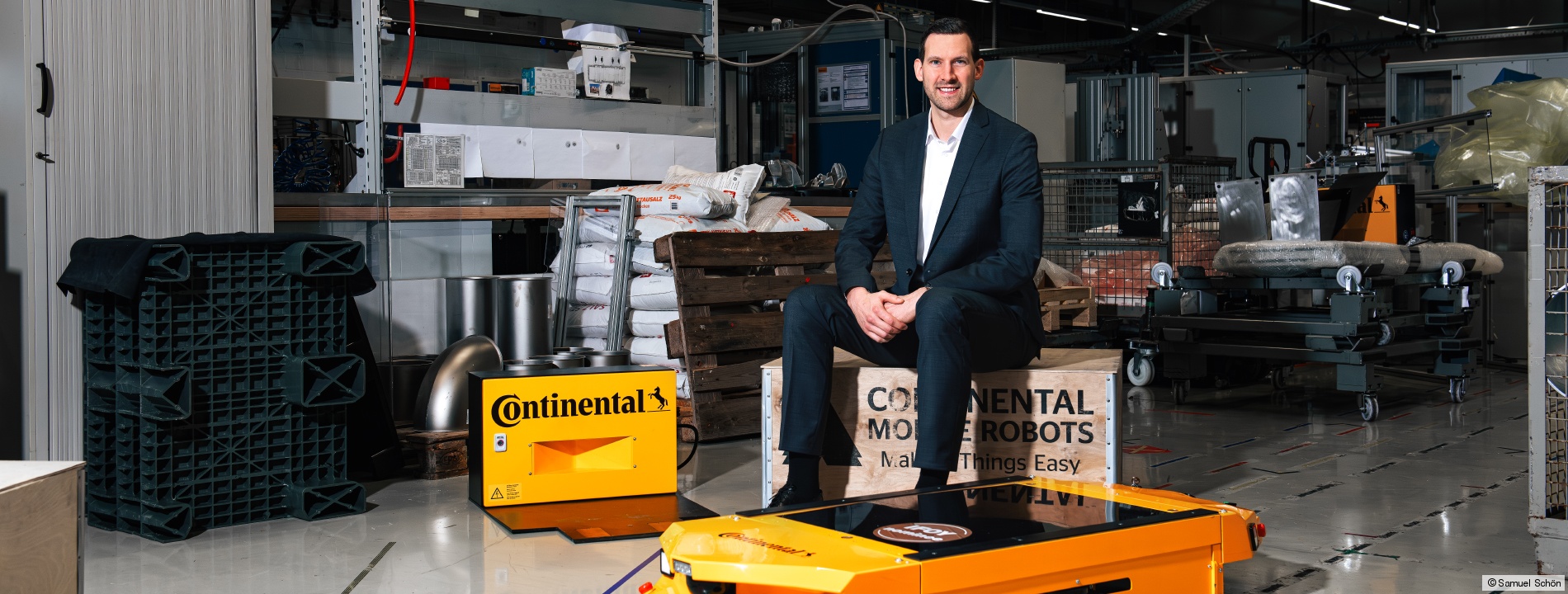
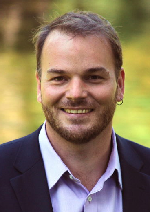
Prof. Dr.-Ing. Tobias Bornemann holds a Cooperative Professorship for Production & Lean Management at Frankfurt University of Applied Sciences , while also serving as Head of Product Management for Autonomous Mobile Robotics at Continental AG . His work bridges theory and practice in areas such as Lean Management , Industrial Engineering , and Smart Factory through teaching, research, and industry collaboration. His research focuses on Intralogistics , Autonomous Mobile Robotics , and Agile Product Development . He leads projects at the Research Lab for Urban Transport (ReLUT) and contributes to the House of Logistics and Mobility (HOLM) , where he co-developed a learning factory. His publications emphasize Industry 4.0 , AMR fleet management , and digital education tools . Cooperative Professorship at Frankfurt UAS Head of Industrial Engineering (M.Sc.) program Research Lab for Urban Transport (ReLUT) House of Logistics and Mobility (HOLM) collaboration Continental AG Tech Matinees and Ambassadorship His academic efforts include mentorship for students, interdisciplinary teaching , and industry-academia partnerships under the PROFfm initiative.
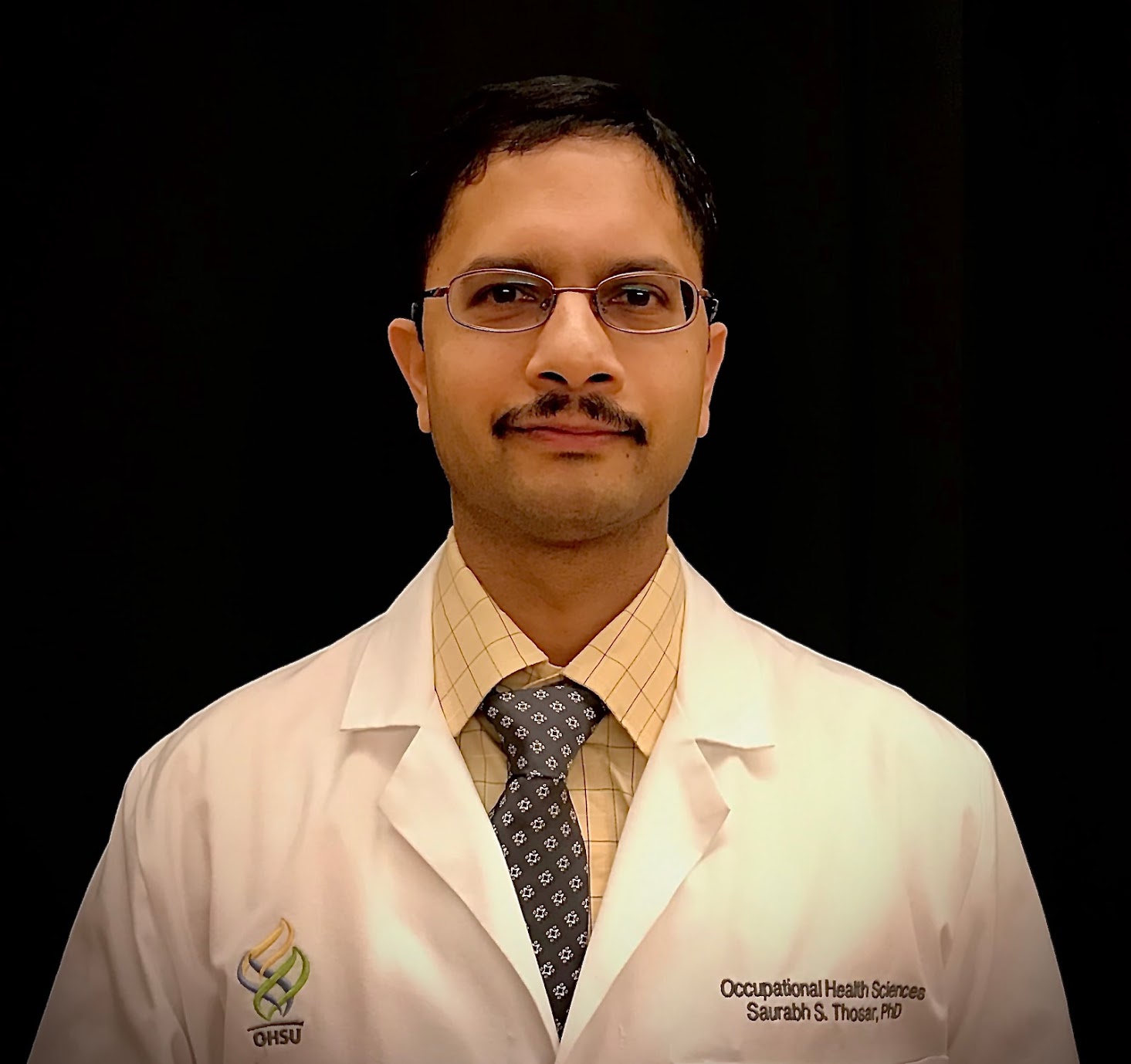
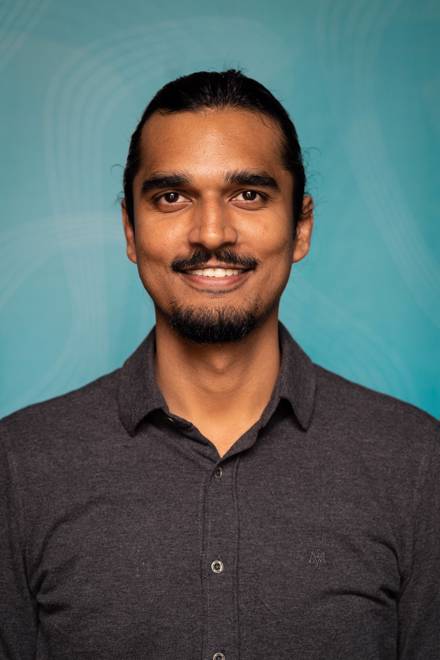
Dr. Saurabh S. Thosar is an Associate Professor at the Oregon Institute of Occupational Health Sciences with secondary appointments in the Schools of Nursing, Medicine, and Public Health at Oregon Health & Science University (OHSU) . His research explores the interplay between sleep , circadian rhythms , and physical inactivity in relation to cardiovascular disease and occupational health . Funded by an NIH R01 grant , his work bridges clinical research, exercise physiology, and public health. Education: B.Sc. in Occupational Therapy (Maharashtra University of Health Science), M.S. in Movement Sciences (University of Illinois at Chicago), Ph.D. in Human Performance (Indiana University Bloomington) Dr. Thosar's research program focuses on circadian physiology , vascular function , and sedentary behavior interventions . His work spans clinical studies on coronary flow reserve , population analyses of workplace health , and mechanistic investigations into sleep-cardiovascular links . Articles in journals like Frontiers in Public Health and Am J Physiol Heart Circ Physiol highlight trends in circadian-modulated cardiovascular biomarkers and sedentary risk mitigation. Scientific Awards: APS Select Award (2019) Sleep Research Society Travel Award (2016) OHSU Research Week First Place (2016) Implementation Science Workshop Travel Award (2015) AASM/NIH Young Investigator Awardee (2015) A culturally aware mentor trained by the OHSU Mentoring Academy , Dr. Thosar investigates chronobiology and occupational health while analyzing ambulatory blood pressure protocols and workplace wellness programs . His lab operates at the intersection of circadian medicine and preventive cardiology .
Kelly Klima is a Senior Engineer and Professor of Policy Analysis at the RAND School of Public Policy. She specializes in decision analysis related to energy systems, climate resilience, and infrastructure. Her work focuses on energy transitions, natural gas decommissioning, AI's energy demands, and urban heat mitigation strategies. She holds a Ph.D. in Engineering and Public Policy from Carnegie Mellon University and is an adjunct assistant professor there. Klima's research spans global applications, including projects in California, Pittsburgh, St. Paul, New Jersey, Washington, D.C., and New York City. She has contributed to Congressionally mandated studies and leads the SUCCEED summer program for K-12 educators on climate and energy decision-making. Her expertise includes policy analysis, modeling, and resilience strategies for critical infrastructure. Education: Ph.D. in Engineering and Public Policy from Carnegie Mellon University. Holds certifications as CFM (Association of State Floodplain Managers) and CCEA (International Cost Estimating and Analysis Association). Research Interests: Energy transitions, infrastructure resilience, climate adaptation, AI's energy impacts, and equity in disaster response. She employs modeling and simulation to address challenges in energy systems, urban heat islands, and policy design. Key Contributions: Co-authored reports on natural gas decommissioning in California, AI power demand projections, and cooling strategies for Los Angeles renters. Her work emphasizes actionable solutions aligned with long-term climate goals. She mentors summer associates and supports policy initiatives through RAND's research programs. Labs/Teams: Leads the SUCCEED program, fostering STEM education and climate literacy among students and educators. Collaborates with federal agencies and international organizations on resilience and adaptation projects.
Dr. Patrick X. Rault is a Professor and Department Chair at Idaho State University , with a focus on Matrix Analysis , Number Theory , and Inquiry-Based Learning (IBL) communities. He serves as President of the COMMIT Network and Co-Director of the Center for Undergraduate Research in Mathematics . His career spans multiple institutions including SUNY Geneseo, University of Arizona, and University of Nebraska at Omaha. His research bridges Numerical Ranges in finite fields with Undergraduate Research initiatives. Over 15 peer-reviewed publications explore topics like Gau-Wu invariants, matrix geometry, and number-theoretic bounds, often co-authored with students. He has secured over $2.8 million in grants, including NSF awards for IBL community development and CURM. Key awards include the 2022 Beckenbach Book Prize , 2015 Henry L. Alder Award , and 2008 Goldwater Scholarship . His teaching spans Abstract Algebra , Number Theory , and Proof-Writing , with hybrid/remote course design expertise. He leads the STEM TRAIL Center at UNO and national IBL networks.
Johannes Habel is an Associate Professor in the Department of Marketing & Entrepreneurship at the C. T. Bauer College of Business, University of Houston, where he holds the Michael J. Cemo Associate Professorship of Marketing. He has previously served as a Professor at Warwick Business School (UK) and Associate Professor at ESMT Berlin (Germany), reflecting a strong international academic background. His research focuses on the psychology of personal selling , digital transformation in sales , and sales force effectiveness . His work explores behavioral aspects of sales, including personality traits (e.g., introversion, neuroticism), ethical challenges, and the integration of predictive analytics and AI in sales processes. He examines how digital tools reshape customer interactions, negotiation strategies, and sales performance. The recent publications highlight a strong trend toward data-driven sales , behavioral insights in B2B and retail contexts , and ethical considerations in digital selling . His studies frequently appear in top-tier journals such as the Journal of Marketing , Journal of the Academy of Marketing Science , and Journal of Retailing , demonstrating consistent scholarly impact across marketing, operations, and organizational behavior domains. Recognized as one of the top-3 most productive sales scholars by ScholarGPS Johannes Habel is actively involved in mentoring and collaborative research, evidenced by frequent co-authorship with scholars like Sascha Alavi, Nathaniel Hartmann, and Nawar Chaker. While formal PhD advisees are not listed, his leadership in research teams and editorial roles suggests strong advisory and grant-related activities. He has developed executive education programs for major organizations and has taught at elite institutions including Stanford, Yale, and Darden, indicating significant engagement beyond traditional academia. He serves as Senior Editor of the Journal of Personal Selling & Sales Management and is a member of the editorial review boards of the Journal of Marketing , Journal of the Academy of Marketing Science , and Journal of Retailing . These roles reflect his influence in shaping the direction of sales and marketing scholarship.
Dr Holly Henderson is an Assistant Professor in Sport Business & Management at the School of Sport, Exercise and Rehabilitation Sciences, University of Birmingham. She is a National Teaching Fellow (2023) and a Principal Fellow of the Higher Education Academy, recognized for her innovative contributions to education. She contributes to the MSc Sport Business, Management and Leadership programme and supervises PhD/EdD students as a UKCEG Associate Supervisor. Educational Background: PhD in Drowning Epidemiology, University of Birmingham PG Cert Academic Practice, University of Exeter PG Cert Law (Maritime), University of Southampton BA (Hons) 1st Class, Maritime Leisure Management, Southampton Solent University Her research interests focus on pedagogy innovation , wellbeing , and sport events management , with a strong emphasis on play-based learning, particularly through LEGO® Serious Play® and Brick-By-Brick® therapy. She investigates how gamification enhances engagement, mental health, and transitions in sport, especially in women’s semi-elite football. Her work bridges leisure, education, and psychological wellbeing. Her recent publications demonstrate a consistent trend in applying creative, hands-on methodologies to complex educational and psychological challenges in sport and higher education. These works span applications in youth development, institutional culture, and hybrid learning environments. Scientific Awards: National Teaching Fellow (2023) Principal Fellow of the Higher Education Academy Dr Henderson is an active advisor and educator, with experience in supervising doctoral research. She integrates her professional expertise—including serving as LOCOG Operations Manager for the London 2012 Olympics and competing internationally in paddleboarding—into her academic practice. She is also a certified Mental Health First Aider and Play Therapist, emphasizing holistic student support. She is affiliated with interdisciplinary research teams and labs focused on pedagogical innovation and wellbeing, contributing to initiatives like the Coastal Learning Partnership. Her future work continues to explore the role of creative methodologies in education, mental health, and leadership development in sport.
Cresantus Biamba is a Senior Lecturer at the University of Gävle, specializing in Educational Science. His research bridges education theory with technological advancements, focusing on teacher training, sustainability in education, and inclusive pedagogy. Researcher at University of Gävle (Education, Educational Science) Research interests include: Education for Sustainable Development (ESD) in global contexts Teacher education reform and policy analysis Inclusive classroom practices in the Global South Technological integration in educational systems Curriculum development for post-pandemic resilience Publication trends reveal interdisciplinary work combining AI, cloud computing, and IoT applications with educational challenges, particularly in African institutions. His articles address security optimization, healthcare technology, and sustainability frameworks. Academic activities involve collaborations with researchers in cybersecurity, AI, and energy systems, though specific grants or mentoring roles are not explicitly documented here.
Adrian Spătaru serves as a Lecturer at the Faculty of Mathematics and Computer Science, West University of Timisoara, Romania, with his office located in room 058. He maintains active academic engagement through direct contact channels including email (adrian.spataru@e-uvt.ro) and phone ((0256) 592 157), reflecting ongoing institutional affiliation and research activities within computer science. His research centers on the integration of edge, cloud, and high-performance computing resources within the cloud continuum framework. Key focus areas include service orchestration, resource management, blockchain applications for decentralized systems, and AI-driven optimization of cloud infrastructures. His work addresses critical challenges in heterogeneous platform integration, fault tolerance, and predictive maintenance across large-scale distributed environments, with notable contributions to container deployment and accelerator-aware application specification. Analysis of his publication trends reveals sustained emphasis on the edge-cloud-HPC continuum since 2018, evolving toward intent-based AI orchestration and heterogeneous hardware integration in recent works. His research bridges theoretical distributed systems concepts with practical applications in environmental monitoring (solar forecasting, freshwater quality assessment) and industrial cloud reliability, demonstrating both academic rigor and real-world impact. No scientific awards are documented in the provided institutional information. Details regarding student supervision, research grants, or laboratory affiliations are not specified in the available materials. Current research directions appear focused on advancing the edge-cloud-HPC continuum through heterogeneous platform integration, with 2025 publications indicating active development in this domain.
Rob Basten is an Associate Professor in the Department of Industrial Engineering and Innovation Sciences at Eindhoven University of Technology (TU/e). He has been with TU/e since October 2014, initially as an Assistant Professor before being promoted. His work focuses on operations management and behavioral operations management, with particular expertise in maintenance, spare parts supply, and after-sales services for high-tech equipment. Basten's research is highly applied, often conducted in collaboration with industry partners such as ASML, NXP, Canon Production Printing, Marel Poultry, and the Ministry of Defence. Dr. Basten's educational background includes: Master's in Industrial Engineering and Management (2004) from University of Twente Master's in Computer Science (2005) from University of Twente PhD in Operations Management (2010) from University of Twente Rob Basten's research centers on improving after-sales services for high-tech equipment, with a focus on incorporating new technologies such as 3D printing and IoT. His work spans both analytical and empirical approaches, with increasing emphasis on behavioral operations management as human decision-makers interact with AI-based decision support systems. Basten investigates how to design and control after-sales service supply chains when spare parts can be 3D printed, and how to optimize maintenance policies for complex systems. His interdisciplinary research bridges operations management, maintenance engineering, and human behavior. Analysis of Basten's recent publications reveals a strong focus on the application of new technologies in after-sales services. Key trends include the integration of additive manufacturing in spare parts supply chains, condition-based and predictive maintenance driven by Industry 4.0 technologies, and the behavioral aspects of human-AI collaboration in maintenance decision-making. His work frequently addresses challenges in high-tech manufacturing contexts, particularly semiconductor equipment, with a growing emphasis on Industry 5.0 concepts that integrate human-centered approaches with advanced technologies. Dr. Basten has received recognition for his work, including: Finalist for the 2020 Daniel H. Wagner Prize for Excellence in Operations Research Practice ISIR Best Student Paper Award 2018 Rob Basten actively supervises numerous PhD students and has led several major research projects. He currently supervises nine PhD students including Maryam Azani, Ragnar Eggertsson, Bibi de Jong, Zhao Kang, Niccolò Maccarini, Aran Nasiri, Bas van Oudenhoven, İpek Tanıl, and Alireza Yazdani. He has successfully guided six PhD students to completion. Basten has been project leader and work package leader in significant research initiatives including ProSeLoNext (funded by NWO with industry co-funding), PrimaVera, SINTAS, and OCPROM projects. His research is consistently supported by both public funding agencies and industry partnerships, reflecting the practical relevance of his work. Basten is an active member of the Operations, Planning, Accounting & Control group at TU/e and contributes to the EAISI High Tech Systems initiative. He has organized key academic events including the first two editions of the Maintenance Research Day and the Behavioral Operations Conference 2019. His work connects academic research with industry practice through ongoing collaborations with leading high-tech companies, creating a dynamic research environment focused on solving real-world challenges in maintenance and service logistics.
Sebastian Kubasiński is a researcher at the Institute of Safety and Quality Engineering , Poznań University of Technology , affiliated with the Faculty of Management Engineering. His work focuses on proactive approaches to occupational safety, organizational resilience, and corporate social responsibility. Research Keywords: Occupational Safety, Proactive Management, CSR, ISO 45001, Organizational Resilience, Risk Mitigation Publications since 2018 demonstrate expertise in systemic safety strategies, pandemic-era communication challenges, and multi-criteria safety analysis. Key journals include European Research Studies Journal and Scientific Papers of the Silesian University of Technology . His doctoral dissertation Method of testing the effectiveness of proactive actions in systemic occupational safety management (2023) establishes frameworks for evaluating safety interventions. Collaborations include scholars like Anna Borucka and Małgorzata Sławińska.
Sabrina Corpino is a Full Professor in the Department of Mechanical and Aerospace Engineering at the Polytechnic University of Turin. She serves as a Member of the PhotoNext Interdepartmental Center for Applied Photonics and holds scientific advisory roles with the Partnership Agreement with ALTEC, the International Astronautical Federation (IAF), and NEREUS. Research Interests: Aerospace design, systems engineering, CubeSat missions, and space propulsion. Key Projects: Scientific Manager for PNRR NODES Spoke 1, SINAV, Hera Mission Phase B/C/D/E1, and RAMSES CubeSat-1 Development. Teaching: Lecturer for 'Aerospace Systems' in multiple academic years and collaborator in interdisciplinary courses. Students: Supervises PhD candidates including Nicola Di Gruttola Giardino, Serena Campioli, and Antonio D'Ortona. Awards: Recipient of the 2018 ICAS Casimiro Montenegro Filho Award for Innovation in Aeronautics.
Jusuf Zekiri is a full-time Professor at the Faculty of Business and Economics, South East European University (SEEU), with over two decades of experience in academia and research. His career spans roles such as Director of the E-Learning Center (2015-2020), Prodean at the Faculty of Business and Economics (2009-2010), and prior teaching positions in Macedonia, Egypt, and France. Education: Doctor of Business Administration (2007-2011), SMC University, Zug, Switzerland Doctor of Economic Sciences (2009-2011), Ss. Cyril and Methodius University, Skopje, Macedonia Master of International Trade and Foreign Languages (2002-2006), Ss. Cyril and Methodius & University of Rennes, France Professor of English Language and Literature (1990-1995), Al-Azhar University, Cairo, Egypt His research focuses on consumer behavior, digital marketing, blended learning, and entrepreneurial mindset, particularly in transition economies. He has explored topics like e-service quality, social media's role in purchasing decisions, and the impact of crises on education and entrepreneurship. His publications span journals such as the British Food Journal, Technological Forecasting and Social Change, and the International Journal of Emerging Markets. Recent work analyzes green food purchasing intentions in Türkiye, family business performance in the UAE, and digital transformation in Balkan enterprises. He collaborates with international researchers on cross-cultural studies in marketing and education. Scientific Awards: No specific awards mentioned in the text. As Director of the E-Learning Center, Zekiri contributed to digital education infrastructure at SEEU. He has advised on projects related to financial literacy, work-family conflict, and luxury brand purchasing in North Macedonia. Labs and Teams: No explicit details provided, but his leadership role in the E-Learning Center suggests involvement in digital learning innovation teams.
John Faulkner Burkhart is a Professor II (20% position) in the Section of Physical Geography and Hydrology at the Department of Geosciences, University of Oslo. His primary professional appointment is at Statkraft, Norway's largest renewable energy company, indicating a significant industry-academia connection. Based at the Geology Building on Sem Sælandsvei 1 in Oslo, he maintains dual institutional affiliations that bridge theoretical research with practical applications in water resources and energy. Dr. Burkhart's research expertise spans multiple interconnected environmental domains. His primary focus areas include Hydrology, Cryosphere dynamics, and Water resources management, with particular emphasis on mountainous and polar regions. His work investigates the complex interactions between atmospheric processes, snow and ice dynamics, and hydrological systems, especially in the context of climate change. Geographic regions of particular focus include the Himalayas, European mountain systems, and polar environments. Analysis of Dr. Burkhart's recent publication record reveals a clear trajectory toward integrating advanced computational methods with environmental observations. His research increasingly incorporates machine learning techniques for hydrological modeling and parameter identification, while maintaining strong foundations in traditional physical modeling approaches. A significant portion of his work focuses on improving hydrological predictions through innovative data assimilation techniques, particularly using remote sensing data for snow cover monitoring. This research has direct applications for water resource management, especially in the context of hydropower operations in mountainous regions. Dr. Burkhart maintains extensive international collaborations, as evidenced by his numerous multi-author publications involving researchers from institutions across Europe, Asia, and North America. His work consistently appears in high-impact journals across multiple environmental disciplines, reflecting the interdisciplinary nature of his research. Current research directions appear to focus on enhancing the predictive capabilities of hydrological models through the integration of diverse data sources and advanced computational methods, with particular relevance for climate change adaptation in water-stressed regions.
Samar Abbas Nawaz is a Senior Researcher at the Peace Research Institute Oslo (PRIO) with expertise at the intersection of law and technology. He holds a PhD in "Safe integration of civil drones: Law, self-operation & infrastructure" from the Department of Criminology & Sociology of Law at the University of Oslo. His current research focuses on regulatory challenges of emerging technologies, particularly Artificial Intelligence and unmanned systems. Dr. Nawaz has been professionally involved in the legal field for nearly a decade, serving as a practitioner, in-house advisor, and academic researcher. His doctoral research was conducted as part of the 'RegulAIR' project funded by the Research Council of Norway between 2021-2024 under the supervision of Bruno O. Martins and Kristin B. Sandvik. His primary research interests lie in the regulatory frameworks governing emerging technologies, with special focus on: Legal challenges of integrating civil drones into civilian airspace Regulation of artificial intelligence in security and border management contexts Human oversight requirements for autonomous systems Infrastructure challenges for drone operations (U-Space) Policy coherence in EU regulatory approaches to drone technology and AI Conceptual issues in defining "autonomous operation" and "remote pilot" Dr. Nawaz's scholarly work demonstrates a consistent focus on the intersection of law, technology, and regulatory frameworks. His publications reveal an evolving research trajectory from foundational drone law analysis towards more complex issues of AI integration, autonomy spectrums, and institutional policy coherence. A notable trend in his work is the application of Science and Technology Studies (STS) perspectives to legal analysis of emerging technologies, highlighting regulatory lag and conceptual challenges in current frameworks. As a Senior Researcher at PRIO, Dr. Nawaz is currently working on the EU-funded 'TRANSCEND' project, researching challenges for civil society engagement in border management technologies. He is also engaged in an internal project analyzing AI-related frameworks in Kenya, Brazil, and South Korea. Between 2021-2024, he conducted doctoral research as part of the 'RegulAIR' project funded by the Research Council of Norway. In 2022 and 2025, he co-facilitated the 'Peace Research' summer course in collaboration with the University of Oslo.
Charlotte Bay Hasager serves as Professor in the Department of Wind and Energy Systems at the Technical University of Denmark (DTU), specializing in offshore wind energy meteorology with expertise in remote sensing, boundary-layer processes, and environmental load impacts on wind turbines. Her research directly supports UN Sustainable Development Goals through renewable energy innovation and climate action initiatives. Her primary research domains include: Offshore wind resource assessment using satellite and radar technologies Boundary-layer meteorology and surface flux dynamics Leading edge erosion mechanisms from rain-wind interactions AI-driven operational strategies for wind farm durability Synthetic Aperture Radar (SAR) applications for wind field mapping Recent publications (2024-2025) demonstrate converging trends in erosion risk modeling, reinforcement learning for turbine operation, and advanced remote sensing techniques. These works span renewable energy engineering, meteorological science, and artificial intelligence applications, with strong emphasis on practical solutions for offshore wind farm challenges under extreme weather conditions. Professor Hasager actively secures major research funding through projects including: AIRE Horizon Europe project (2023-2026): Atmospheric flow integration for wind farm design Thunderbolt project (2023-2025): Wind power optimization initiatives ESA WAII project (2023-2025): Explainable AI for SAR wind assessment CCA LEE project (2022): Leading Edge Erosion cross-cutting research INOWER project (2022-2023): International offshore wind energy networks She maintains significant scientific leadership through conference organization (6th International Symposium on Leading Edge Erosion, 2025), workshop participation (Sandia Blade Workshop, 2024), and media contributions on wind energy topics including North Sea wind farm impacts and satellite Earth observation.