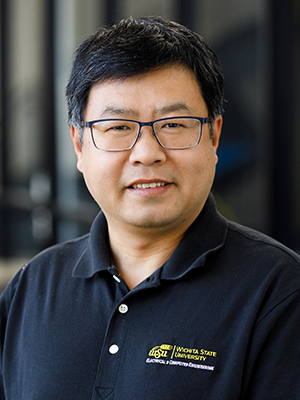
Chengzong Pang is an Associate Professor and MSECE Graduate Coordinator at the Department of Electrical and Computer Engineering, College of Engineering, Wichita State University. His work focuses on power systems, electrical engineering innovations, and renewable energy integration. He specializes in transient stability analysis, control systems, and smart grid technologies. Research Interests: Dr. Pang's expertise includes advanced control strategies for power electronics (e.g., PMSM, UPQC), machine learning applications for grid stability (LSTM/SVM), and energy storage solutions for renewable integration. His research also addresses challenges in microgrid operation, subsynchronous oscillation mitigation, and battery storage systems. Key Trends in Publications: Over 20 years of publications (2002–2022) emphasize: (1) Machine learning for power system analysis, (2) Control system design for renewable integration, (3) Grid stability enhancement via advanced algorithms, and (4) Smart grid infrastructure optimization. Recent works (2021–2022) highlight transient stability prediction and ANFIS-based power quality solutions. Labs/Teams: Active in energy systems research groups focusing on renewable integration and grid modernization, though specific lab names are not explicitly stated in the provided texts.
Prof. Juin J. Liou serves as the UCF Pegasus Distinguished Professor and Lockheed Martin St. Laurent Professor of Engineering in the Department of Electrical and Computer Engineering at the University of Central Florida, where he has held faculty positions since 1987. Education: B.S. (Honors) in Electrical Engineering, University of Florida, 1982 M.S. in Electrical Engineering, University of Florida, 1983 Ph.D. in Electrical Engineering, University of Florida, 1987 Research Focus: Prof. Liou specializes in Electrostatic Discharge (ESD) protection systems critical for integrated circuit reliability, semiconductor device modeling, and RF circuit design. His pioneering work addresses ESD challenges in next-generation technologies including silicon nanowire, organic semiconductors, and gallium nitride (GaN) devices, where miniaturization intensifies vulnerability to electrostatic damage. His research bridges theoretical modeling with practical implementation to solve industry-critical protection failures. Awards and Leadership: Ten teaching/research excellence awards from University of Central Florida Six major awards from IEEE IEEE-EDS Distinguished Lecturer Multiple honorary professorships Research Impact: Secured over $14.5 million in funding from NSF, DARPA, NASA, NIST, and semiconductor industry leaders including Intel, Texas Instruments, and Analog Devices. Authored 10 books, 270+ journal papers (18 invited reviews), and 220+ conference papers while holding 8 U.S. patents (4 pending). Served as IEEE EDS Vice-President, Treasurer, and Board of Governors member, plus editorial roles for Microelectronics Reliability and IEEE journals.
Professor Ahmad Hariri is a faculty member in the Department of Psychology & Neuroscience at Duke University, part of the Trinity College of Arts & Sciences. He holds affiliations with the Duke-UNC Brain Imaging and Analysis Center, the Duke Institute for Brain Sciences, and the Duke Initiative for Science & Society. His research integrates neuroimaging, pharmacology, and molecular genetics to study biological pathways underlying individual differences in behavior and psychopathology risk. Education: Ph.D. in Psychology from UCLA (2000), M.S. and B.S. in Psychology from the University of Maryland, College Park (1997, 1994). Research interests include understanding how genetic and environmental factors influence brain function and behavior, with a focus on psychopathology, stress, and resilience. His work explores neural correlates of traits like psychopathy, childhood adversity effects on brain structure, and biomarkers of aging. Recent studies highlight links between lead exposure and neurodegeneration, neighborhood disadvantage and dementia risk, and the role of brain connectivity in self-regulation. Key achievements include over 200 publications, including high-impact papers in Nature Aging , Neuron , and Biological Psychiatry . Honors include the APA Distinguished Scientific Award for Early Career Contribution (2009) and being named a Highly Cited Researcher (2014). Grants include leadership roles in the Duke-NCCU Postdoctoral Training Program in Child Psychiatric Conditions and the Duke Psychiatry Physician-Scientist Residency Program. He has contributed to editorial boards of journals like Cortex and Biology of Mood and Anxiety Disorders . Professional activities include mentoring in the Summer Neuroscience Program and serving as a Bass Connections Faculty Team Leader.
Jonathan Huggins is an Assistant Professor at Boston University, affiliated with the Department of Mathematics & Statistics and the Faculty of Computing & Data Sciences. He holds a Ph.D. in Computer Science from MIT (2018) and a B.A. in Mathematics from Columbia University (2012). His research focuses on developing fast, trustworthy machine learning and Bayesian methods that balance computational efficiency and statistical optimality, with applications in ecological forecasting and genomic data analysis. Education: Ph.D. in Computer Science, Massachusetts Institute of Technology (2018) B.A. in Mathematics, Columbia University (2012) Research Interests: Large-scale machine learning and Bayesian computation Robust statistical inference Applications in genomics and ecological modeling Algorithmic development for scalable inference Key Projects: Stochastic Methods for Data Science: A book on stochastic processes and algorithms VIABEL: A Python package for variational inference and diagnostics ShorTeX: A LaTeX package for mathematical writing Recent Articles: Focus on scalable Bayesian methods, error bounds for iterative algorithms, and mutational signature discovery. His work emphasizes reproducibility and robustness in statistical inference. Awards: Blackwell–Rosenbluth Award (Outstanding Junior Bayesian Researcher) Grants & Funding: Supported by NIH, NSF, and the Department of Defense. Active in advising students across multiple BU programs. Labs/Teams: Affiliated with the BU URBAN Program, Program in Bioinformatics, and Department of Computer Science.
Baishakhi Ray is an Associate Professor at Columbia University, specializing in improving software reliability and developers' productivity for both traditional and AI-driven systems. She leads the ARiSE Lab, focusing on interdisciplinary research at the intersection of software engineering and artificial intelligence. Her research interests include software testing for AI systems, adversarial robustness, automated testing of autonomous systems, and leveraging AI techniques such as neural networks for dynamic analysis and fuzzing. Notable projects include DeepTest for autonomous car testing and NEUZZ for efficient fuzzing. Awards: VMware Early Career Faculty Award (2020), IBM Faculty Award (2019), NSF CAREER Award (2019), and multiple best paper awards including EAPLS FASE (2020) and ACM Distinguished Papers (FSE 2017, MSR 2017). Grants: NSF CAREER grant (2019-2024) for deep learning testing, NSF grants for workshops and security bug detection, and collaborative grants on persistent memory and SSL/TLS implementations. Her recent work emphasizes advancing code generation with large language models (LLMs), evaluating model robustness under data contamination, and developing tools like CodeSense and CrashFixer for code semantics and kernel debugging. The ARiSE Lab also explores causal performance debugging and transfer learning for configurable systems.
Professor Coral Dando is a Professor of Psychology at the University of Westminster, leading research in forensic cognition and investigative interviewing. With a background as a London Police Officer, she completed a BSc (Hons) Psychology and PhD in Applied Forensic Cognition. She is a Chartered Psychologist, National Teaching Fellow, and Registered Forensic Psychologist. Her research focuses on eyewitness memory, deception detection, and cross-cultural interviewing, with a particular emphasis on improving investigative methods in security and forensic contexts. Her academic roles include teaching forensic psychology modules (e.g., detecting deception, investigative interviewing) and supervising PhD students researching topics like virtual environments in interviews and neurodivergent credibility. She has secured significant research funding from entities like the Home Office, FBI, and CPNI, totaling over £2M across projects addressing insider threats, county lines exploitation, and aviation security. Key Research Themes: Eyewitness reliability, cognitive interviewing techniques, cross-cultural persuasion, and insider threat detection. Grants: Includes a 2024 €97,000 COST grant for implementing the Mendez Principles and a 2016 $469,000 FBI-funded study on intelligence interviewing. Professor Dando’s work bridges academia and practice, training professionals from police forces, security agencies, and NGOs. She contributes to policy development and has authored over 100 peer-reviewed publications, including seminal works on the cognitive interview and WAFA (Witness-Aimed First Account) for neurodivergent individuals. Her research emphasizes ethical, context-aware methodologies to enhance justice outcomes.
Jeffrey C. Suhling is the Quina Distinguished Professor and Department Chair of Mechanical Engineering at Auburn University . His research focuses on the mechanical and thermal behavior of lead-free solder alloys , particularly in automotive electronics and high strain rate applications . He has extensively studied the reliability of hybrid SAC-LTS solder joints under thermal cycling, vibration, and shock. Scientific awards : Quina Distinguished Professor His work integrates finite element modeling , microstructural analysis , and machine learning to predict solder joint failure and optimize material performance. Key areas include creep behavior , damage accumulation , and interfacial reliability in extreme environments.
Professor Petros Elia is a faculty member at EURECOM, holding the position of Professor within the Department of Communications systems. He specializes in Information Theory , Coding Theory , Caching , Distributed Computing , and Wireless Networks , with additional research in Biometrics . His work focuses on advancing theoretical foundations and practical applications in distributed systems and wireless communication efficiency. He received a prestigious ERC Consolidator Grant for his DUALITY project (2016) and a four-year Fulbright Scholarship (1993-1997). He is also a recipient of the Newcom++ Network of Excellence Distinguished Achievement Award (2008-2011) and the Best Student Paper Award at SPAWC 2011, awarded to his advisee Arun Singh. His research explores cutting-edge topics such as tessellated distributed computing , hypergraph decomposition , and topology-aware caching , with recent contributions presented at venues like the IEEE International Symposium on Information Theory (ISIT 2025). His work bridges theoretical advancements with real-world applications in wireless networks and distributed systems. Education: Supported by his Fulbright Scholarship, he pursued studies in the U.S. during 1993-1997. Grants: ERC Consolidator Grant (2016), and others. Advising: Mentor to Arun Singh , whose work earned a student paper award. He actively contributes to teaching Mobile Communications at EURECOM and remains a key figure in advancing the field through interdisciplinary collaborations and leadership in the Communication Systems department.
Brian Horsak is a Professor and Head of the Center for Digital Health and Social Innovation at Fachhochschule Steyr. He holds an endowed professorship in Applied Biomechanics and Rehabilitation Research, focusing on integrating advanced technologies like VR/AR, machine learning, and wearable devices into clinical gait analysis and motor rehabilitation. His roles include leading the Institute of Health Sciences and contributing to the Department of Health Sciences and Media and Digital Technologies. Education: Dr. rer. nat. (2012, University of Vienna), Habilitation in Kinesiology (2020, University of Vienna), Master's in Sports Science (2002–2008, University of Vienna). Research interests revolve around improving patient care through biomechanical innovations, including musculoskeletal simulations, gait pattern analysis, and rehabilitation technologies. He leads projects like ReMoCap-Lab (motion capture for motor rehabilitation) and chairs the Applied Biomechanics in Rehabilitation Research initiative. Key achievements include the Lower Austria Innovation Prize (2021), multiple best paper awards, and grants for projects like TRUST AI and VReeze. His work bridges clinical practice with digital health solutions, emphasizing explainable AI (XAI) in gait classification and VR-based balance training. Notable contributions include developing the GaitRec dataset and studies on smartphone-based motion capture reliability. He collaborates internationally, publishing widely in Gait & Posture , Scientific Reports , and IEEE journals. Current projects focus on AI-driven gait analysis, musculoskeletal modeling, and XR applications in healthcare.
Guang Lin is the Associate Dean for Research and Innovation in the College of Science and a Full Professor in the School of Mechanical Engineering and Department of Mathematics at Purdue University. He leads the Data Science Consulting Services and has dual appointments in Statistics and Earth, Atmospheric, and Planetary Sciences. His research focuses on AI, machine learning, uncertainty quantification, and computational science, with applications in fluid mechanics, materials science, and healthcare. Lin holds a Ph.D. from Brown University (2007) and has received numerous awards, including the NSF CAREER Award and Purdue’s University Faculty Scholar distinction. He has authored over 250 publications and secured grants totaling millions, including DOE and NIH funding. His interdisciplinary work bridges academia and industry, emphasizing AI-driven solutions for complex systems. Education: Ph.D. Applied Mathematics (Brown, 2007), M.S. Applied Mathematics (Brown, 2004), M.S. Mechanics (Peking University, 2000), B.S. Mechanics (Zhejiang University, 1997). Research Grants: Includes DOE-funded projects on machine learning for plasma-wall interactions and NSF grants for multiscale modeling. Service: Editorships in SIAM MMS, ASME Journal, and leadership in Purdue’s AI initiatives. Teaching: Courses on Uncertainty Quantification, Fluid Mechanics, and Data Science.
Nickolai Zeldovich is the Joan and Irwin M. Jacobs Professor of Electrical Engineering and Computer Science at MIT, and a member of the Computer Science and Artificial Intelligence Laboratory (CSAIL). He received his PhD from Stanford University in 2008 and focuses on building practical secure systems, including encrypted databases, undefined behavior detection tools, formally verified file systems, and cryptocurrency protocols. His work spans both theoretical and applied aspects of computer security and distributed systems. Research interests include: Secure system design Distributed consensus mechanisms Formal verification of software/hardware Cryptographic protocols Privacy-preserving web technologies Publications & Verification Tools Recent work focuses on modular verification of complex systems, including: Shipwright (2025): Byzantine-fault-tolerant distributed system verification PoWER (2025): Crash consistency verification framework K2 Architecture (2023): Trustworthy hardware security modules Grove (2023): Separation-logic-based verification library Tiptoe (2023): Private web search protocols Major Awards Best paper award, ACM SOSP (2011, 2015, 2017) Sloan Research Fellowship (2010) NSF CAREER award (2011) MIT Jamieson Award for Teaching (2024) Active in multiple startup ventures including Algorand (cryptocurrency), MokaFive (virtualization), and PreVeil (end-to-end encryption).
Professor Mohan Lal Kolhe is a distinguished academic at the University of Agder , serving as a Full Professor in Smart Grid and Renewable Energy within the Faculty of Engineering and Science and the Department of Engineering Sciences . With over three decades of international academic experience, he has held positions at prestigious institutions including University College London, University of Dundee, and Hydrogen Research Institute in Canada. His career spans technical innovation, policy development (e.g., as a member of South Australia’s Renewable Energy Board), and extensive research leadership in sustainable energy systems. Research Leadership : Focus on Smart Grid integration, Electric Vehicles, Hydrogen Energy, Solar/Wind Systems, and Techno-Economic Energy Analysis. Global Recognition : Listed in the top 2% of scientists worldwide (2020-2023) by Stanford University, with 10 publications averaging 200+ citations. Recent publications emphasize advanced optimization techniques for renewable integration, EV charging infrastructure, hydrogen production, and power system stability. His work has secured competitive funding from entities like the Norwegian Research Council and EU programs. Awards and Expert Roles : Top 2% Global Scientist (Stanford, 2020-2023) Highly Cited Researcher (Top 10 publications, 200+ avg. citations) Expert evaluator for European Commission, Royal Society London, EPSRC, and Cyprus Research Foundation He actively contributes to international conferences as keynote speaker and editorial board member, with leadership roles in research groups like Autonomous and Cyber-Physical Systems and Energy Systems .
Karthik Dantu is an Associate Professor in the Department of Computer Science and Engineering at the University at Buffalo, State University of New York, within the School of Engineering and Applied Sciences. His research focuses on mobile sensor networks, robot networks, networked embedded systems, mobile computing, wireless networks, and embedded operating systems. He leads the Distributed Robotics and Networked Embedded Sensing (DRONES) Lab and has received significant funding including an NSF CAREER Award. Dr. Dantu's educational background includes: PhD in Computer Science from University of Southern California (2009) BE in Computer Science from Sri Jayachamarajendra College of Engineering (1999) His research interests center on algorithmic and systems challenges in Edge Computing Systems, with particular focus on enabling seamless vision sensing in cloud-edge environments. Dantu's work bridges mobile systems and robotics, developing novel approaches for UAV software, visual SLAM, and distributed sensing. His research addresses critical challenges in resource-constrained environments, security, and real-time performance for mobile and robotic systems, with emphasis on practical implementations that solve real-world problems in autonomous systems. Dr. Dantu's publication record shows a strong trajectory in mobile systems and robotics research, with increasing focus on edge computing applications for visual sensing. His recent work demonstrates expertise in adapting visual SLAM to edge environments, securing mobile systems through technologies like Rushmore, and developing novel approaches for UAV software reliability and depth sensing. The research spans theoretical algorithms and practical system implementations, with particular strength in bringing academic research to practical applications in robotics and mobile computing. Dr. Dantu has received several scientific honors: NSF CAREER Award on Enabling Seamless Vision Sensing in Cloud-Edge Systems Outstanding service award from the Office of International Services NSF Travel Grant for SenSys 2005 Conference Travel Grant for SIGCOMM 2002 As an advisor, Dr. Dantu has mentored numerous PhD students to completion, with graduates now working at companies like Samsung Research and Zoox Inc., or continuing academic careers as Assistant Professors. His research is supported by substantial grants including a DARPA OFFSET Sprint 4 award ($470k), an NSF CAREER award ($550k), and multiple NSF collaborative grants totaling over $1.5 million. He serves on numerous conference committees including Mobicom, MobiSys, and ICRA, demonstrating leadership in the mobile systems and robotics research communities. Dr. Dantu leads the Distributed Robotics and Networked Embedded Sensing (DRONES) Lab at UB, which focuses on developing algorithms and systems for mobile sensor networks, robot networks, and embedded sensing applications. The lab's work spans theoretical foundations to practical implementations, with particular expertise in UAV systems, visual SLAM, and edge computing for robotics, maintaining strong collaborations with industry partners and other academic institutions to advance the state of the art in mobile and robotic systems.
Dr. Arman Khoshghalb is a Senior Lecturer in Geotechnical Engineering at the School of Civil and Environmental Engineering, UNSW Sydney, where he has been a faculty member since 2012. His academic credentials include a PhD in Geotechnical Engineering from UNSW (2012), an MSc from Sharif University of Technology (2005), and a BSc in Civil Engineering from the same institution (2003). His research focuses on numerical modeling of multi-phase porous media , with emphasis on unsaturated soils, large deformation analysis, and dynamic soil behavior. Key areas include meshfree computational methods, soil-structure interaction, bio-cementation, and thermo-hydro-mechanical processes in geotechnical systems. His work bridges theoretical advancements with practical applications in slope stability, foundation engineering, and sustainable ground improvement. Dr. Khoshghalb's publications predominantly explore geomechanical modeling, experimental soil mechanics, and computational techniques. Recent trends highlight innovations in bio-cemented soils, thermal properties of unsaturated soils, and adaptive numerical methods for complex geotechnical simulations. Awards & Honors: IACMAG Excellent Paper Award (2017) UNSW Research Excellence Award (2012) Advising & Grants: He has supervised 7+ PhD students on topics ranging from weak rock mechanics to computational geomechanics. Funded projects include: ARC Discovery Project (2019–2021): "Non-isothermal dynamic strain localisation in unsaturated porous media" ($298,257) ARC Linkage Infrastructure Grant (2015): "Earthquake shaking table for soil-structure interactions" ($320,000) ARC Linkage Project (2014–2017): "Constitutive modelling of weak rocks" ($314,280) He leads research within UNSW's geotechnical engineering group, collaborating on large-scale experimental testing and computational frameworks for infrastructure resilience.
Abdol-Hossein Esfahanian is a Professor and Chairperson of the Computer Science and Engineering (CSE) Department at Michigan State University (MSU), part of the College of Engineering. He joined MSU in 1983 and has held leadership roles, including Graduate Director for 10 years and Associate Chair. His research focuses on applying graph theory to computer networks, algorithm design, and fault-tolerant computing. He has published extensively in journals like IEEE Transactions on Computers and Discrete Applied Mathematics, and serves as an editor for professional journals. Education: Ph.D. in Electrical Engineering and Computer Science from Northwestern University (1983), M.S. in Computer, Information, and Control Engineering from the University of Michigan (1977), and B.S. in Electrical Engineering from the University of Michigan (1975). Research interests include graph theory applications in network design, distributed systems, and fairness-aware algorithms. Notable awards include the Withrow Teaching Excellence Award (2005, 2015) and recognition as an IEEE Senior Lifetime Member. Teaching includes courses like CSE 835 (Algorithmic Graph Theory). He has contributed to curriculum development, emphasizing computational competencies for engineering students. His work integrates theoretical foundations with practical applications in networking and distributed systems.