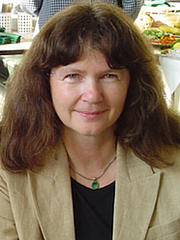
Katharina Metzger is a researcher at the Research Institute for Farm Animal Biology (FBN) in Dummerstorf, Germany, specializing in porcine muscle physiology and transcriptomic responses to environmental stressors . She works within the Psychophysiology Group , focusing on cellular and molecular mechanisms in swine muscle development. Email: metzger@fbn-dummerstorf.de Research Focus: Metzger's work examines how thermal stress and developmental age affect gene expression, energy metabolism, and biomolecular pathways in porcine myoblasts and myotubes. Her methods include RNA sequencing, cell culture, and biochemical assays. Publication Trends: Recent articles highlight her expertise in animal cell biology , gene regulation under stress , and methodological innovations for analyzing milk proteins and muscle metabolism. Collaborations include scientists from the Leibniz Institute and international institutions. Collaborations: Regular co-authors include Claudia Kalbe, Siriluck Wimmers, and SPONSUKSILI (S. Ponsuksili). Her work often intersects with animal welfare and agricultural biotechnology research.
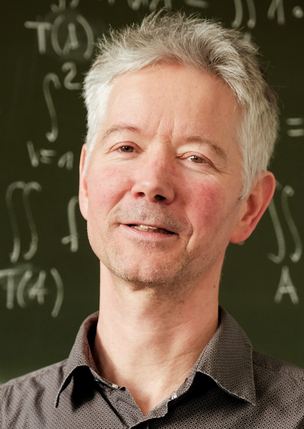
Lars Kunz is a research group leader at the Division of Neurobiology, Faculty of Biology, Ludwig-Maximilians-University Munich . He holds the title of PD Dr. (Privatdozent) and is a regular member of the Munich Center for Neuroscience (MCN) and full member of the Graduate School of Neuroscience (GSN). His work bridges neuroenergetics and reproductive endocrinology through experimental and theoretical approaches. Key research areas: Neuronal metabolism , Reactive oxygen species (ROS) , Auditory system physiology , Gonadal ion channels Current affiliates: LMU Research Group , collaborations with Artur Mayerhofer (LMU), Martin Biel (LMU), Hans Straka (LMU), and Magdalena Götz (LMU & HelmholtzZentrum München) His research focuses on metabolic costs of neuronal activity using Mongolian gerbils for auditory studies and amphibian models for in vivo-like neuroenergetics. Techniques include patch-clamp recordings , fluorescence imaging of NADH/FAD/ATP/ROS, and computational modeling . Recent work explores photodynamic therapy , TRPM2 channels , and endocannabinoid regulation in neural circuits. Article trends show interdisciplinary work across neuroscience (38%), reproductive biology (32%), and cell signaling (30%). Subfields include neural energy demand , ROS signaling , ion channel physiology , steroidogenesis , optogenetics , and cell death mechanisms . Collaborators span neurophysiology (Grothe, Straka) and reproductive endocrinology (Mayerhofer, Dissen). Students include Dr. Barbara Trattner and Dr. Stefanie Götz . His lab investigates juxtavascular astrocyte properties , ovarian neuroendocrinology , and photodynamic membrane effects . Methods: whole-cell patch-clamp , live fluorescence imaging , immunohistochemistry , and computational modeling .
Peter zu Eulenburg is a Professor and Research Group Leader at the Institute for Neuroradiology and the German Vertigo Center, University Hospital of LMU Munich. He is a full member of the Graduate School of Systemic Neurosciences (GSN) and a regular member of the Munich Center for Neurosciences (MCN), where he leads research in functional neuroimaging and vestibular neuroscience. His research focuses on the cartography of the human vestibular and ocular motor systems using structural and functional neuroimaging techniques. Key areas include self-motion perception, egocentric referencing, and the structural effects of spaceflight and microgravity on the brain and eye. He employs advanced methods such as deep-learning assisted video-oculography and blood-based brain biomarkers. The selected publications highlight a strong trend in space neuroscience and neuroplasticity, particularly in how long-duration spaceflight alters brain structure and ventricular volume. His work also explores visual-vestibular integration and central compensation mechanisms in vestibular disorders using fMRI and meta-analytic approaches. Scientific Contributions: Shared senior authorship in high-impact studies on cosmonaut brain changes published in NEJM and PNAS Pioneering meta-analytical mapping of the human vestibular cortex Investigation of inner ear and ocular structural segmentation He advises several PhD students, including Ge Tang, Berk Olcay, Theresa Raiser, Juditha Huber, and Pauline Popp. His research is supported by institutional affiliations with LMU Munich’s neuroimaging and vertigo research units, contributing to both clinical and space medicine advancements. He leads a research team focused on multimodal imaging at the German Vertigo Center, integrating clinical neurology with advanced computational and imaging techniques to study sensorimotor integration and neuroadaptation.
Peter K. Friz is Einstein Professor in Mathematics at Technische Universität Berlin (TU-Berlin), where he leads research in the Probability Theory and Mathematical Finance group. He is also affiliated with the Weierstrass Institute for Applied Analysis and Stochastics (WIAS), a major research institute in Berlin focused on applied mathematics. Professor Friz's research spans several interconnected areas of mathematics and finance: Stochastic analysis and rough path theory Quantitative finance and volatility modeling Partial differential equations driven by rough paths Applications of rough path theory to financial mathematics His recent publications demonstrate a continued focus on advancing rough path theory and its applications. The research trends show increasing sophistication in handling nonlinear rough differential equations, connections to machine learning through signature methods, and deeper applications to financial modeling, particularly in volatility analysis. His work bridges pure mathematical theory with practical financial applications, maintaining relevance to industry problems while advancing theoretical foundations. Professor Friz has received significant recognition for his work: ERC Starting Grant "Rough path theory, differential equations and stochastic analysis" (2010-2016) ERC Consolidator Grant "Geometric aspects in pathwise stochastic analysis and related topics" (2016-2021) Einstein Professorship at TU-Berlin He actively mentors students and researchers, with a list of former PhD students available through his academic profile. Professor Friz coordinates the DFG research unit "Rough paths, stochastic partial differential equations and related topics" (2016-2019) and has secured substantial funding from the European Research Council, DFG, and other sources. His research group regularly hosts seminars and collaborates with institutions worldwide, including recent invited courses at Cambridge, Paris (IHP), and Bonn (HIM). Professor Friz maintains active research collaborations through his position at TU-Berlin and affiliation with WIAS, contributing to Berlin's status as a hub for mathematical finance and stochastic analysis in Europe.
Prof. Dr. Holger Brandt serves as Professor of Psychometrics at the Methods Center within the Department of Social Sciences, Faculty of Economics and Social Sciences, Eberhard Karls University of Tübingen since August 2021. Previously, he held Assistant Professor positions at the University of Zurich (2019-2021) and University of Kansas (2016-2019), following a postdoctoral fellowship at Tübingen's Hector Institute for Empirical Educational Research (2013-2016). His educational background includes a PhD (Promotion) from Goethe University Frankfurt's Institute of Psychology in 2013. Brandt's research pioneers advanced methodological frameworks at the intersection of psychometrics, statistics, and machine learning. He specializes in developing dynamic models for intensive longitudinal data, Bayesian estimation techniques, causal mediator analysis, and identification of inattentive response behaviors in surveys. His work rigorously addresses challenges in measurement invariance, structural equation modeling, and handling complex dependencies in social science data. Analysis of his recent publications reveals a dominant focus on Bayesian approaches for latent variable modeling, particularly spike-and-slab priors and latent class methods. His research consistently targets data quality issues in survey methodology while advancing causal inference techniques that relax traditional no-unmeasured-confounder assumptions. Applications span educational research, psychological assessment, and therapeutic alliance dynamics. As a core member of Tübingen's Methods Center, Brandt provides critical methodological infrastructure for social science research across the university, supporting researchers through statistical consulting and advanced methodology development.
Augustin Kelava is a Professor at the Department of Quantitative Methods, Eberhard Karls University of Tübingen. He has held this position since 2018 and leads the Methods Center as Managing Director. Previously, he was Professor at the Hector Institute for Empirical Educational Research (2013-2018) and Junior Professor at Technical University of Darmstadt (2011-2013). PhD in Psychology (Goethe University Frankfurt, 2009) Diploma in Psychology (Goethe University Frankfurt, 2004) Kelava specializes in latent variable modeling, machine learning in social sciences, and educational research. His work spans dynamic latent class models, Bayesian regularization techniques, and prediction of human behavior using intensive longitudinal data. He contributes to psychometric theory (e.g., item response theory extensions) and applies these methods to diverse fields including sports science and emotion regulation. Editor of "Testtheorie und Fragebogenkonstruktion" (3rd ed., Springer, 2020) Key researcher in the Cluster of Excellence "Machine Learning in Science" Active in methodological conferences (FGME 2017, SEM 2019) Review activities for 20+ journals and foundations including Psychometrika, DFG, and SNSF His recent publications focus on integrating machine learning with psychometrics, addressing identifiability in complex models, and evaluating personality assessment validity for large language models. He collaborates with researchers across psychology, education, and computational fields.
Mark Peletier is a Professor at the Department of Mathematics and Computer Science of the Eindhoven University of Technology (TU/e) in the Netherlands. His research centres on the rigorous mathematical analysis of partial-differential equations, variational problems and gradient flows, recently with applications to machine-learning optimisation. He is a regular speaker at international workshops and conferences. Research interests Professor Peletier’s current work focuses on: Gradient-descent dynamics and their singular-limit behaviour Noise-injection techniques in deep-learning training Sharp versus flat minima in loss landscapes Variational methods and optimal transport Recent work In March 2024 he presented the talk “Singular-limit Analysis of Training with Noise Injection” at the Humboldt University of Berlin. The talk provides a rigorous mathematical framework for understanding how injected noise affects the convergence of gradient descent, and how it biases the solution toward flat minima that generalise better.
Gabriel Peyré is a Research Professor affiliated with the French National Centre for Scientific Research (CNRS) and École Normale Supérieure (ENS) in Paris, France, specializing in mathematical approaches to data science and machine learning. His research focuses on optimal transport theory and its applications in computational biology, particularly for single-cell genomics analysis. Dr. Peyré develops mathematical frameworks for comparing cellular distributions and integrating multi-omics data using advanced transport methods. His work bridges theoretical mathematics with practical biological applications, addressing challenges in cellular heterogeneity analysis and genomic data integration. Dr. Peyré has made significant contributions to robust high-dimensional optimal transport, including entropic regularization techniques that enable efficient computation of transport metrics. His research on ground metric learning provides innovative approaches for learning appropriate distance metrics directly from genomic data, advancing the field of computational biology and data science.
Alexander Omelchenko serves as Professor of Mathematics and Dean of the School of Computer Science & Engineering at Constructor University in Bremen, Germany. His academic leadership extends to prior roles including Dean at the Higher School of Economics and Vice-Rector positions at the Academic University of the Russian Academy of Sciences and St. Petersburg University of Technology and Design. His educational foundation includes: PhD in Fluid Dynamics from Baltic State Technical University "VOENMEH" (1996-1999) M.Sc. in Mathematics from St. Petersburg State University (1993-1997) M.Sc. in Mechanics from Baltic State Technical University "VOENMEH" (1990-1996) Professor Omelchenko's research spans Enumerative Combinatorics, Graph Theory, Topology, Knot Theory, and Asymptotic Methods in Mathematical Physics. His work integrates discrete mathematics with physical applications, particularly in optimal control systems and nonlinear hyperbolic equations, demonstrating rigorous theoretical frameworks with engineering relevance. Analysis of his 2017-2021 publications reveals dominant themes in combinatorial enumeration: systematic classification of graph embeddings on surfaces (torus, projective plane, Klein bottle), Hamiltonian cycle enumeration in multipartite graphs, and topological invariants for textile structures. This work establishes foundational contributions to algebraic topology and discrete mathematics through novel enumeration techniques. Scientific Awards: No scientific awards were mentioned in the provided text. Advising and Grants: Information regarding student supervision, research grants, or funding sources was not specified in available materials. Labs and Teams: The documentation does not reference specific laboratories, research groups, or collaborative teams led by Professor Omelchenko.
Paweł Sobociński is a Professor of Trustworthy Software Technologies at the Department of Software Science, School of Information Technologies, Tallinn University of Technology (TalTech), where he also leads the Laboratory for Compositional Systems and Methods. He is a principal investigator in several major research projects including the Estonian Research Council’s PRG1210 (ALICE), the EU-funded CHESS cybersecurity hub, and the EXAI Centre of Excellence in AI. His academic background includes faculty positions at the University of Southampton and research roles at the University of Cambridge and institutions in France and Italy. His research lies at the intersection of computer science and mathematics, with a focus on applied category theory. He investigates compositional modeling of systems, where the behavior of complex systems emerges from the structured interaction of their components. His work employs string diagrams, process algebras, Petri nets, and categorical semantics to develop formal methods for verifying and reasoning about concurrent and cyber-physical systems. He is particularly known for his contributions to graphical linear algebra and diagrammatic reasoning. The recent publications highlight a strong trend in diagrammatic methods, especially string diagrams, for expressing logic, algebra, and system behavior. These works span from foundational categorical structures to applications in electrical circuits, concurrency, and formal verification, demonstrating a unifying thread of compositional reasoning. His leadership in organizing conferences like LICS 2024 and ICALP 2024 underscores his central role in the theoretical computer science community. His scientific recognition includes numerous invited talks and tutorials at major international venues such as CONCUR, QPL, MFPS, and ETAPS, as well as leadership roles in academic organizations. He is an Associate Editor for journals including Compositionality , Mathematical Structures in Computer Science , and Logical Methods in Computer Science , and has served on the steering committee of ETAPS. Sobociński has supervised multiple PhD students and postdoctoral researchers, including Owen Stephens, Fabio Zanasi, Mario Román, and Elena di Lavore. He is also the director of the PhD programme in ICT at TalTech and has received research grants from the Estonian Research Council, the European Commission, and the Estonian Ministry of Education and Research, supporting his work in trustworthy software, AI, and cybersecurity. He leads the Laboratory for Compositional Systems and Methods at TalTech, a research group focused on developing and applying compositional techniques in software science, with applications in AI, security, and formal verification. The lab fosters international collaboration and is active in organizing workshops and summer schools.
Wojciech Czerwiński is an Associate Professor at the Institute of Informatics, Faculty of Mathematics, Informatics and Mechanics, University of Warsaw. His research lies at the intersection of automata theory, logic, and computational complexity, with a focus on infinite-state systems such as vector addition systems (VASS) and Petri nets. His research interests include: Automata and logic Infinite-state systems Reachability and separability problems Complexity of computational models Formal verification and concurrency theory His recent work has significantly advanced the understanding of the complexity of reachability in VASS, proving it to be Ackermann-complete. This line of research has been published in top venues including FOCS, STOC, LICS, and CONCUR, where several papers received Best Paper Awards. His publications reflect a strong trend toward resolving long-standing open problems in decidability, complexity, and logical definability in infinite-state models. Scientific awards include: Best Paper Award, CONCUR 2022 Best Paper Award, STOC 2019 He leads an ERC-funded project and is actively recruiting PhD students and post-docs. He organizes the Friday Afternoon Seminar and co-organized the Infinite Automata Workshop (2024). He has also contributed to public understanding of science as an editor and author for the journal Delta from 2013 to 2022. His work involves collaboration with leading researchers such as Sławomir Lasota, Jérôme Leroux, Georg Zetzsche, and others. He has made foundational contributions to problems like bisimilarity, language equivalence, and regular separability in various automata models.
Christiane Tammer is a full Professor at the Institute of Mathematics , Faculty of Natural Sciences II, Martin Luther University Halle-Wittenberg. Her research spans variational methods, optimization, nonlinear functional analysis, approximation theory, duality principles, location theory, and inverse problems. She is actively involved in editorial roles as Editor-in-Chief of Optimization and serves on multiple journal editorial boards. Current affiliation: Theodor-Lieser-Str. 5, Halle (Saale), Germany Email: christiane.tammer@mathematik.uni-halle.de Her funded research includes projects on novel algorithms for combined tour and location optimization and multicriteria stochastic optimization and stochastic control theory . Recent publications focus on vector optimization under uncertainty, nonconvex separation techniques, and proximal gradient methods for multiobjective problems.
Prof. Dr. Frank Haußer is a Professor at Beuth University of Applied Sciences Berlin in the Department II Mathematics - Physics - Chemistry. He serves as the academic advisor for the Applied Mathematics program and teaches courses including Numerical Mathematics, Mathematical Methods of Digital Image Processing, and Computational Engineering. His consultation hours are held during semesters and by appointment, with availability both in-person and online. Haußer's research focuses on: Numerical mathematics and scientific computing Mathematical modeling with applications in MATLAB/Octave Machine learning for medical imaging and insect monitoring Digital image processing techniques for biomedical applications Partial differential equations and computational engineering methods He has authored a textbook on mathematical modeling with MATLAB/Octave and leads interdisciplinary projects at the intersection of mathematics and technology. Analysis of his 15 most recent publications shows strong emphasis on: Medical imaging algorithms (especially retinal OCT analysis) Nanostructure dynamics and material science Computational physics and finite element methods Machine learning applications in biology and medicine Advanced mathematical modeling techniques His work consistently bridges theoretical mathematics with practical engineering applications. Haußer actively supervises student research, including: Machine learning for insect classification and localization Medical image processing algorithms Computational methods in engineering Finite element analysis applications Optimization and simulation techniques He has guided over 30 bachelor's and master's theses since 2009. His research projects include: KInsekt (2020-2023): AI-based insect monitoring funded by BMUV BeCRF (2015-2017): Medical image quality validation funded by BMWi QM ROCT (2013-2015): Automated OCT quality management funded by IFAF These interdisciplinary collaborations involve institutions across Germany.
Dr. Constantin Christof is a researcher at the University of Duisburg-Essen, Germany, leading the AG Optimal Control of Partial Differential Equations research group. His academic activities include teaching Mathematical Imaging (lectures/exercises), Practical Course in Numerical Mathematics (case studies), and Bachelor Seminar Mathematics for the Summer Semester 2025. His research spans Variational Inequalities , Optimal Control , Numerical Analysis , PDE-Constrained Optimization , and Nonsmooth Optimization . Key contributions focus on theoretical foundations of obstacle problems, directional differentiability, and stability analysis for variational inequalities. Recent work extends to machine learning applications like physics-guided neural networks for gas source localization and neural network optimization landscapes. Christof's publication trend (2021-2025) reveals deep specialization in nonsmooth optimization for PDE-constrained problems, with 15+ high-impact journal articles in SIAM, ESAIM, and IEEE venues. His work bridges theoretical analysis (e.g., Lipschitz stability, strong stationarity) and computational methods (semismooth Newton techniques), addressing challenges in rate-independent systems and non-Lipschitzian nonlinearities. Scientific Awards: No awards documented in available records. Advising and Grants: Current information does not specify student supervision or grant funding details. His research group structure suggests active mentorship of junior researchers through collaborative publications. Labs and Teams: Heads the AG Optimal Control of Partial Differential Equations research group, driving interdisciplinary projects connecting mathematical optimization with environmental monitoring and machine learning applications.
Dehan Chen is an Associate Professor at the School of Mathematics & Statistics, Central China Normal University, and currently a Researcher at the University of Duisburg-Essen. His research lies at the intersection of applied analysis and inverse problems, with a strong focus on partial differential equations and regularization theory. His research interests include: Inverse Problems in PDEs Regularization Theory Evolution Equations Ill-Posed Problems Mathematical Modeling Nonlinear Dynamics The analysis of his recent publications reveals a consistent and deep engagement with variational source conditions, Tikhonov regularization in Banach spaces, and inverse problems in both elliptic and parabolic systems. His work often bridges theoretical analysis with applications in physics and biology, such as electromagnetic modeling and population dynamics. A strong emphasis is placed on convergence rates and stability in ill-posed settings. His notable scientific recognition includes the prestigious Alexander von Humboldt Fellowship. This award highlights his international research impact and collaborative work in Germany. While no formal students are listed, his frequent collaborations with prominent mathematicians such as Jun Zou, Bernd Hofmann, and Irwin Yousept suggest active participation in research teams and potential advisory roles. He has not received mention of external grants, but his sustained publication record in top-tier journals indicates strong research productivity. He is affiliated with research groups focusing on optimal control and inverse problems at the University of Duisburg-Essen, particularly within the AG Optimal Control of Partial Differential Equations, contributing to a vibrant mathematical research environment.