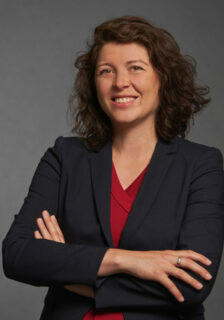
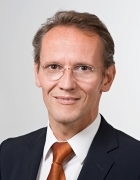
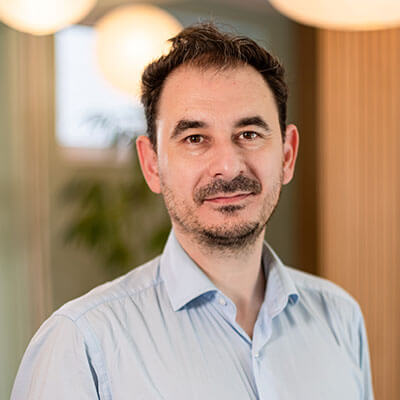
Prof. Dr. Franziska Mathis-Ullrich is a Professor at Friedrich-Alexander-University Erlangen-Nuremberg (FAU) leading the Surgical Planning and Robotic Cognition Lab (SPARC) in the Department of Artificial Intelligence in Biomedical Engineering. Previously, she was an Assistant Professor at Karlsruhe Institute of Technology (KIT) from 2019 to 2023. Her research focuses on minimally invasive robotic systems, soft robotics, and embedded machine learning for surgical applications. She holds a PhD in Microrobotics from ETH Zurich (2017), with earlier degrees from the same institution. Education: B.Sc. and M.Sc. in Mechanical Engineering and Robotics (ETH Zurich, 2009–2012) Ph.D. in Microrobotics (ETH Zurich, 2017) Research Interests: Minimally invasive medical robotics, soft robotic systems, AI-driven surgical assistance, microrobotics, and robot-assisted surgery. Her work emphasizes translating robotics innovations into clinical applications through interdisciplinary collaboration. Key Awards: IEEE ICRA Best Paper Award in Medical Robotics (2014) IEEE BioRob Best Student Paper Award (2016) ICRA Microassembly Challenge First Prize (2014 & 2015) Forbes 30 under 30 (2017) Grants & Projects: Leading a Bavarian State Ministry-funded project on endometriosis diagnostics (€3M). Active in multidisciplinary collaborations with Erlangen University Hospital. Serves as Vice-President of the German Society for Computer- and Robot-assisted Surgery (CURAC). Labs & Teams: Directs the SPARC Lab, which develops cognitive robotic systems for surgical planning and execution. Collaborates with institutions like Max Planck, Fraunhofer, and Helmholtz.
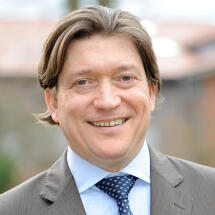
Thomas Pap serves as Professor at the Department of Molecular Medicine within the Institute of Musculoskeletal Medicine (IMM) at the University of Muenster. He actively participates in the "Cells in Motion" research cluster and the Imaging Network, focusing on cell dynamics and imaging applications in musculoskeletal pathologies. His research centers on molecular mechanisms of inflammatory joint diseases, with key emphases on: Destructive arthritis pathogenesis through fibroblast transformation and adherens junction dynamics Regulation of alarmin activity (S100A8/S100A9) in sterile inflammation TRP channel modulation of osteoclast function and bone loss Translational models for tendon healing and microsurgical reconstruction Advanced imaging techniques for monitoring inflammatory lesions Analysis of his 2013-2021 publications reveals consistent interdisciplinary work bridging immunology, cell biology, and clinical applications. His studies frequently employ molecular imaging and translational models to investigate rheumatoid arthritis mechanisms, neutrophil chemotaxis, and bacterial immune evasion, with strong emphasis on therapeutic targeting of inflammatory pathways. The Pap Group operates within the Multiscale Imaging Centre (MIC), collaborating on pilot projects and the "Train Gain Fellowships" graduate program. Their work integrates with the university's broader Imaging Network, utilizing advanced microscopy and molecular techniques to study cell dynamics in inflammatory conditions.
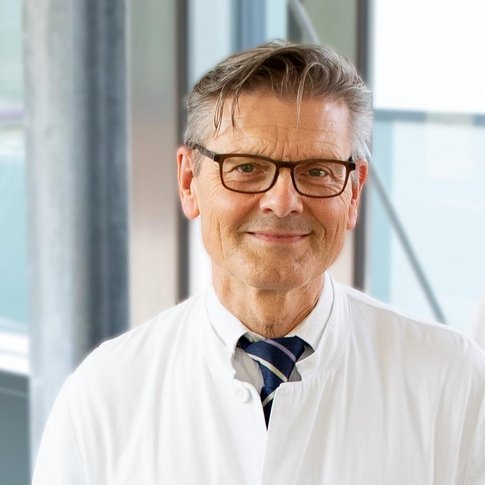
Peter M. Vogt serves as Professor and Head of the Department of Plastic, Hand and Reconstructive Surgery at Hannover Medical School, where he also directs the Burn Center. His clinical leadership spans reconstructive surgery using autologous tissue, peripheral nerve surgery, and aesthetic procedures. Dr. Vogt's research focuses on wound healing , tissue engineering , regenerative biology , and burn treatment . His work integrates clinical trials with translational approaches to improve outcomes in complex reconstructive cases. Recent publications emphasize infection management in hand surgery, burn reconstruction techniques, and biomaterial applications in skin regeneration. His scientific contributions have earned prestigious recognitions including the Langenbeck Award, National Biotechnology Award, and the Mowlem Lecture honor. Professional memberships span the American Association of Plastic Surgeons, European Burn Association, and multiple German surgical societies. As an educator, Dr. Vogt has held academic appointments since 1991 including Research Fellow at Harvard Medical School and Full Professor at Hannover since 2001. His clinical expertise covers trauma reconstruction, congenital malformations, and functional restoration after nerve paralysis.
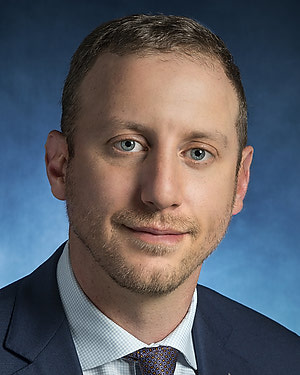
Dr. Sami H. Tuffaha serves as Associate Professor of Plastic and Reconstructive Surgery at Johns Hopkins University School of Medicine with cross-appointments in Orthopaedic Surgery, Neurosurgery, and Biomedical Engineering. He directs the Johns Hopkins Peripheral Nerve Surgery Center and maintains an active clinical practice specializing in hand and upper extremity surgery with emphasis on microsurgery and peripheral nerve disorders. His clinical expertise spans treatment of hand and wrist trauma, arthritis, vascular disorders, tendon injuries, and peripheral nerve conditions, including surgical restoration of function in patients with paralysis from spinal cord injury, cerebral palsy, and stroke. Dr. Tuffaha completed his medical education at University of Pittsburgh Medical Center (MD, 2011), followed by residency training in the Johns Hopkins/University of Maryland Plastic and Reconstructive Training Program (2018), and fellowship training in Hand and Upper Extremity Surgery at Mayo Clinic College of Medicine with emphasis on Microsurgery and Peripheral Nerve Surgery (2019). He is board certified by the American Board of Plastic Surgery (2020) and maintains active clinical practice at the Johns Hopkins Outpatient Center. His research program focuses on developing novel therapies to enhance functional recovery from nerve injuries, with particular emphasis on peripheral nerve regeneration and treatment/prevention of symptomatic neuromas. Dr. Tuffaha leads a comprehensive research initiative that integrates basic science, translational work, and clinical trials aimed at advancing care for patients with peripheral nerve and spinal cord injuries. His laboratory investigates growth factors, biomaterials, and nanotechnology approaches to improve nerve regeneration and functional outcomes after nerve injuries. Analysis of Dr. Tuffaha's recent publications reveals a strong focus on translational research bridging basic science discoveries with clinical applications. His work spans multiple domains including nerve regeneration mechanisms, surgical techniques for nerve repair and transfer, management of neuromas, and rehabilitation strategies for nerve injuries. A notable trend is his increasing investigation into pharmacological approaches (such as growth hormone, IGF-1, and agrin) to enhance nerve regeneration and prevent complications of denervation. J. Leonard Goldner Pioneer Research Award, American Society for Surgery of the Hand (2016) Adrian Flatt Basic Science Research Award, American Federation for Surgery of the Hand (2016) Discovery Award, Johns Hopkins University (2018, 2020) Dr. Chi-Tsung Su, M.D., Memorial Research Award, Johns Hopkins Department (2018) Scholarly Concentrations Excellence in Mentoring Award (2020) Cohen Translational Engineering Award (2021) Gelberman Scholar Award, American Society for Surgery of the Hand (2022) ASPN Travelling Fellowship, American Society for Peripheral Nerve (2022) Dr. Tuffaha serves as principal investigator for multiple research grants focused on nerve regeneration and peripheral nerve injury treatment. His research program includes over 180 publications with more than 39,000 reads and 2,000+ citations on ResearchGate. He has co-chaired major society meetings including the American Society for Peripheral Nerve (2023) and American Association for Hand Surgery (2020). His mentorship activities include the Scholarly Concentrations program at Johns Hopkins where he received the Excellence in Mentoring Award in 2020. Dr. Tuffaha leads the Johns Hopkins Peripheral Nerve Surgery Center, which integrates expertise from plastic surgery, neurosurgery, orthopaedic surgery, neurology, pain medicine, and physical medicine and rehabilitation. His research laboratory focuses on developing strategies to enhance nerve regeneration, including growth factor delivery systems, biomaterials, and novel surgical techniques. Current projects include clinical trials assessing therapeutic agents for nerve injury and translational work on nanoparticle-based drug delivery systems for peripheral nerve repair.
Prof. Klaus-Dietrich Wolff is a full Professor of Oral and Maxillofacial Surgery at TUM's Klinikum rechts der Isar, affiliated with the TUM School of Medicine and Health. He specializes in facial plastic and reconstructive surgery, focusing on microsurgical tissue transfer, extracorporeal oxygenation systems, and perforator flaps for soft tissue replacement. Education: Studied medicine and dentistry at Free University of Berlin (M.D./D.D.S. 1987), habilitation in 1994, and served as adjunct professor there (1999). Held the Chair of Oral, Maxillofacial, and Plastic Facial Surgery at Ruhr University Bochum (2000–2007) before joining TUM in 2007. Research interests emphasize surgical innovation in oncological and reconstructive procedures. Notable contributions include development of extracorporeal perfusion systems and clinical advancements in perforator flap techniques. Awards include the Norman Rowe Lecture (2018), Martin Waßmund Prize (1994), and leadership roles in professional societies like the European Association for Cranio-Maxillofacial Surgery (2016–2018) and AHMO (2009).
Prof. Dr. Dr. med. Evangelos Sarantopoulos is an Adjunct Professor of Clinical and Surgical Anatomy and Medical Ethics at Dresden International University. He holds extensive academic appointments across Europe, including roles at Friedrich-Schiller-Universität Jena, TUM Graduate School München, and the University of Edinburgh. His expertise spans medical law, ethics, breast surgery, and surgical education. He has conducted groundbreaking research on topics such as patient safety in cross-border cosmetic procedures, quality of life post-breast reconstruction, and ethical dilemmas in transplantation. Education: Master of Surgery (Oncoplastic Breast Surgery), University of East Anglia (2023) LLM in Medical Law and Ethics, University of Edinburgh (2022) PhD in Medical Sciences (Quality of Life in Breast Surgery), University of Nicosia (2021) MPH (Public Health), University of Nicosia (2021) MMEdEd (Medical Education), University of South Wales (2020) MA in Medical Ethics, Johannes Gutenberg Universität Mainz (2017) MBA in Health Economics, National and Kapodistrian University of Athens (2017) Dr. med. (Medicine), Technical University of Munich & National & Kapodistrian University of Athens (2015) MSc in Aesthetic Plastic Surgery, Queen Mary University of London (2014) Research Focus: Sarantopoulos bridges clinical practice with ethical and legal dimensions of healthcare. His work on breast surgery outcomes, regulatory frameworks for cosmetic procedures, and surgical training methodologies has influenced policy and clinical practice. He advocates for standardized training protocols to reduce complications in aesthetic surgeries performed by non-specialists. Academic Contributions: His publications span medical ethics, surgery, and public health, emphasizing patient-centered care and interdisciplinary collaboration. Notable studies include comparisons of breast reconstruction techniques and analyses of DGS certification impacts on breast units. He also contributes to sports medicine through performance diagnostics for elite athletes in cycling, skiing, and team sports.
Dr. Saral Mehra is Associate Professor of Surgery (Otolaryngology) at Yale School of Medicine and Chief of Head and Neck Surgery. He directs the Head and Neck Tumor Board and leads Yale's internationally recognized Fellowship in Head and Neck Oncologic and Reconstructive Surgery. His clinical practice focuses on tumors of the mouth, throat, salivary glands, and thyroid, utilizing robotic surgery and microvascular reconstruction techniques. Dr. Mehra's research examines quality-of-life outcomes in head and neck cancer patients and health service delivery improvements. Key interests include: Treatment guideline adherence and survival outcomes Minimally invasive surgical innovations Value-based cancer care delivery systems HPV-associated oropharyngeal cancer patterns His recent publications demonstrate strong focus on clinical outcomes research (2020-2025), with themes including: Optimization of surgical quality metrics Palliative care integration Environmental sustainability in surgery Disparities in cancer survival Honors include: Yale Cancer Center Award for Excellence in Clinical Care (2023) Otolaryngology Faculty Teaching Awards (2019, 2022) Department of Surgery Extra Mile Award (2020) Distinguished House Staff award from New York Hospital As fellowship director, Dr. Mehra trains one surgeon annually in advanced oncologic techniques. He leads multidisciplinary tumor boards coordinating care across surgical oncology, medical oncology, and radiation oncology teams.