Lauren TompkinsView profile
Associate Professor
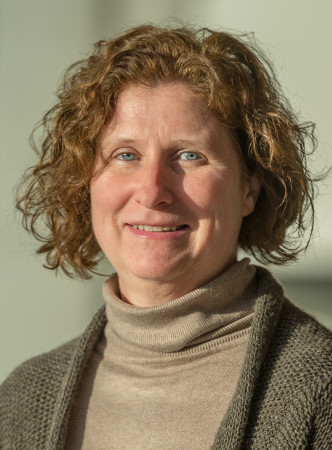
Lauren Tompkins is an Associate Professor of Physics in the School of Humanities and Sciences at Stanford University, holding appointments in the Physics Department. Her research focuses on fundamental particle interactions through participation in major international experiments including the ATLAS experiment at CERN's Large Hadron Collider, the Light Dark Matter Experiment (LDMX) at SLAC, and the Heavy Photon Search (HPS) at Jefferson Laboratory. Her research interests span particle physics , dark matter detection , and advanced trigger systems . She investigates the Higgs boson's properties, searches for evidence of dark sectors through heavy flavor fermions, and develops FPGA-based real-time processing systems for particle detectors. Her group specializes in custom electronics for high-rate collision environments, particularly focusing on identifying rare events like Higgs boson production and potential dark matter signatures. Professor Tompkins' recent publications demonstrate strong focus on dark matter searches, Higgs boson physics, and advanced computing techniques. Her work bridges experimental particle physics with cutting-edge computational methods, particularly in deep learning applications for vertex reconstruction and FPGA-based trigger systems for the High Luminosity LHC upgrade. CAREER Award, National Science Foundation (2016-2021) Terman Fellow, Stanford University (2014-2017) US ATLAS Education and Public Outreach Award (awarded to group member Rocky Bala Garg) She actively mentors doctoral students and postdoctoral researchers, currently advising Elizabeth Berzin, Noe Gonzalez, Sadaf Kadir, and Rory O'Dwyer as Doctoral Dissertation Advisor. Her group participates in multiple collaborative projects including the NSF Institute for Research and Innovation in Software for High Energy Physics (IRIS-HEP) and contributes to the development of the ACTS open source software project. The Tompkins Group maintains active research programs across three major experimental facilities in Switzerland, California, and Virginia.