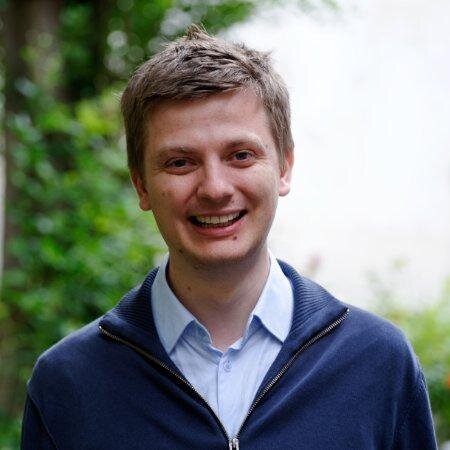
Markus EnzweilerView profile
Professor
Markus Enzweiler serves as Professor of Computer Science and Autonomous Systems at Esslingen University of Applied Sciences within the Department of Computer Science and Engineering. He concurrently holds the leadership position of Director at the Institute for Intelligent Systems, where he oversees research initiatives focused on intelligent systems development for real-world autonomous applications. His research program centers on computer vision for autonomous systems , with specialized expertise in visual-inertial SLAM, collective perception, and neural rendering techniques. Key investigation areas include environmental robustness across agricultural and urban settings, real-time processing constraints for embedded systems, sensor fusion methodologies (particularly camera-radar integration), and the application of generative models for perception enhancement. His work consistently addresses practical implementation challenges such as computational efficiency and sensor calibration in unstructured environments. Analysis of his 2023-2025 publications reveals three dominant research trajectories: (1) Advancement of lightweight perception systems through stixel-based representations and neural rendering; (2) Development of infrastructure-supported collective perception frameworks with datasets like CoopScenes and OPNV; and (3) Rigorous benchmarking of SLAM components in domain-specific contexts including agricultural robotics and multi-season navigation. His recent systematic review on LLM-based vulnerability detection also demonstrates expanding interest in software security for autonomous systems. As Director of the Institute for Intelligent Systems, Prof. Enzweiler leads a research ecosystem focused on translating theoretical advances into practical autonomous vehicle technologies. His team develops specialized datasets (Rover, OPNV) and software stacks for smart city environments, emphasizing the integration of novel perception approaches with vehicle dynamics modeling and real-time operational constraints.