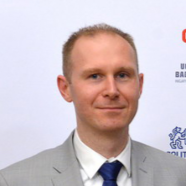
Paweł Rogaliński is a PhD researcher at the Department of Computer Engineering within the Faculty of Information and Communication Technology at Wrocław University of Science and Technology. His work focuses on robotics, autonomous systems, and medical imaging technologies. Research Interests: Autonomous systems, mobile applications, genetic programming, and ultrasonography. Email: pawel.rogalinski@pwr.edu.pl His publications span 1998-2005, with key contributions in RoboCup multi-agent coordination, LEGO Mindstorms educational programming, and 3D medical imaging systems. No awards or student advisory information is publicly available.
Dr. Michał Jakubiak is affiliated with the Department of Logistics at Wrocław University of Economics. His research focuses on optimizing logistics and supply chain systems, with a particular emphasis on ERP implementations, warehouse management, municipal waste collection, and simulation-based process improvement. He has contributed to advancing methodologies for order picking efficiency, product availability metrics, and the application of the SCOR model in supply chain analysis. His work spans theoretical and applied aspects of logistics, including studies on master data minimization in production planning, the impact of storage methods on warehouse efficiency, and the use of simulation tools to evaluate order picking concepts. He also explores challenges in the construction and pharmaceutical industries related to supply chain accessibility and inventory management. His publications consistently address practical applications of logistics research, bridging academic theory with real-world operational challenges in both private and public sectors.
Maciej Woźniak serves as a university professor at the Institute of Computer Science within the Faculty of Computer Science at AGH University of Science and Technology in Kraków, actively contributing to research and teaching staff while participating in the Computer Science Discipline Council and College of the Faculty. His office is located at D-17, ul. Kawiory 21, III, 4.58, with primary contact via macwozni@agh.edu.pl. His research spans computational mathematics and high-performance computing, specializing in parallel algorithms for numerical simulations including isogeometric analysis, finite element methods, and multi-frontal solvers. Key applications address environmental challenges like hail suppression and urban smog reduction, alongside biomedical modeling of tumor growth and airborne pathogen dispersion. Methodological innovations focus on GPU acceleration, shared-memory architectures, and efficient integration techniques for partial differential equations. Analysis of his 2019-2024 publications reveals consistent advancement in parallel computational frameworks for environmental and biomedical applications, demonstrating interdisciplinary impact through experimental validation of hail cannons, smog reduction technologies, and pathogen dispersion modeling during the COVID-19 pandemic. His work bridges theoretical algorithm development with real-world problem solving across physics, engineering, and life sciences. Scientific Awards: No specific awards were documented in the provided sources. Student advising, research grants, laboratory affiliations, and educational background details beyond his PhD, DSc, and Eng. titles remain unspecified in the available materials, though his extensive publication record suggests active mentorship and collaborative research leadership.
Piotr Burnos serves as a Professor at the Department of Metrology and Electronics within the Faculty of Electrical Engineering, Automatics, Computer Science and Biomedical Engineering at AGH University of Science and Technology in Kraków, Poland. His office is located in room 211 of building B-1 (second floor), with contact details including telephone +48 12 617 28 27 and email burnos@agh.edu.pl. Burnos specializes in Weigh-in-Motion (WIM) technology for vehicle enforcement, focusing on sensor accuracy under real-world conditions including temperature fluctuations and pavement mechanics. His research addresses critical challenges in dynamic vehicle weighing systems, particularly for administrative enforcement applications where measurement precision directly impacts road infrastructure protection and legal compliance. Key contributions include thermal error compensation, multi-sensor fusion, and Polish implementation frameworks. Analysis of his 15 most recent publications (2015-2018) reveals consistent advancement in WIM system reliability through temperature modeling, pavement interaction studies, and administrative integration. His work bridges metrological precision with practical enforcement needs, emphasizing Polish regulatory contexts while contributing to broader transportation engineering knowledge. No scientific awards were documented in the source materials. While specific student advisement or grant information isn't provided in available sources, Burnos' research demonstrates sustained focus on applied transportation engineering problems with direct societal impact through infrastructure protection and regulatory enforcement.
Andrzej Bień, PhD, DSc, Eng., is a university professor at AGH University of Science and Technology in Kraków, Poland, serving within the Faculty of Electrical Engineering, Automatics, Computer Science and Biomedical Engineering and specifically the Department of Power Electronics and Automation of Energy Conversion Systems . He is a member of the College of his faculty and is based at building B-1, room 120. Research Interests: Prof. Bień’s work revolves around advanced power-quality metrology , smart-grid instrumentation , and renewable-energy integration . He develops measurement techniques for harmonic analysis, islanding detection, and power system diagnostics, employing digital signal processing, embedded systems, and novel sensor technologies. His investigations span from laboratory validation of phasor-based methods to field studies on icing detection for high-voltage lines. Publication Trends: From 2020 to 2024 his output reflects a strong focus on smart-grid data analytics, PMU-based monitoring, and the impact of harmonics on metering accuracy. Earlier work (2002–2019) concentrated on flickermeter design, power theory under non-sinusoidal conditions, and hardware for non-invasive voltage measurement, illustrating a continuous evolution toward cyber-physical energy systems. Scientific Contributions & Awards: Although no specific awards are listed, Prof. Bień has contributed numerous patents (e.g., optoelectronic cables, galvanically isolated current sensors) and has been instrumental in the development of IEC-compliant flickermeters and power-quality analyzers. Contact: Email: abien@agh.edu.pl Web: http://home.agh.edu.pl/~abien/ Phone: +48 12 617 28 57
Sebastian Ernst is a Lecturer at the Department of Applied Informatics, Faculty of Electrical Engineering, Automatics, Computer Science and Biomedical Engineering, AGH University of Science and Technology in Kraków. His research focuses on Computer Science , Artificial Intelligence , and Smart Cities , with a strong emphasis on Geographic Information Systems (GIS) and Energy Efficiency in urban environments. University: AGH University of Science and Technology Faculty: Electrical Engineering, Automatics, Computer Science and Biomedical Engineering Department: Applied Informatics Position: Lecturer Contact: ernst@agh.edu.pl Office: C-2, 4th floor, room 424 Phone: +48 12 617 51 95 His recent publications highlight trends in Graph-Based Modeling , Smart Lighting Systems , and Robust Algorithm Design for urban infrastructure. He explores Pairwise Comparisons , GIS Applications , and Energy Conservation through computational methods.
Konrad Kułakowski is a Professor at the Department of Applied Informatics within the Faculty of Electrical Engineering, Automatics, Computer Science and Biomedical Engineering at AGH University of Science and Technology in Kraków. His research spans multiple domains including decision support systems, operations research, and robotics, with a focus on pairwise comparisons methods and their applications in optimization problems and automated systems. Affiliation: AGH University of Science and Technology School: Faculty of Electrical Engineering, Automatics, Computer Science and Biomedical Engineering Department: Applied Informatics His research interests center on improving accuracy and resilience in pairwise comparisons methods, detecting manipulation in decision-making processes, and optimizing path planning for automated guided vehicles (AGVs) in constrained environments. His work bridges theoretical advancements in decision analysis with practical applications in robotics, real-time systems, and biomedical engineering. Key trends in his recent publications include: Advancements in heuristic algorithms for pairwise comparisons matrices Applications of Monte Carlo simulations for method validation Path planning optimization for AGVs in irregular layouts Detection of manipulation in peer assessment frameworks Resilient aggregation techniques for secure judgments in AHP
Prof. Andrzej Wetula is a faculty member at AGH University of Science and Technology in Kraków, Poland. He currently holds the academic rank of Professor within the Faculty of Electrical Engineering, Automatics, Computer Science and Biomedical Engineering , specifically at the Department of Metrology and Electronics . His work focuses on... Academic Rank: Professor Department: Metrology and Electronics Research Focus: Electrical Metrology, Power Systems, Automotive Sensors Prof. Wetula’s research interests span several domains of electrical engineering and metrology, particularly... The 15 most recent publications reflect trends in: high-voltage sensor design , automotive system validation , harmonic impedance analysis , and distributed real-time control . His work consistently integrates metrology principles with modern applications in smart grids and autonomous vehicles. As of available records, Prof. Wetula has not been recognized with scientific awards explicitly mentioned in public-facing data. His contributions primarily manifest through technical publications and patented sensor technologies.
Professor Mieczysław Jessa is a distinguished faculty member at Poznań University of Technology, serving in the Faculty of Information Technology and Telecommunications within the Institute of Multimedia Telecommunications. With a scientific discipline focused 100% on Information and Communication Technology, he has established himself as a leading researcher in random number generation, signal synchronization systems, and spectrum sensing techniques. His research interests center around hardware-based random number generators for cryptographic applications, precise synchronization of oscillators using GNSS signals, and advanced spectrum sensing methodologies. Professor Jessa's work bridges theoretical foundations with practical implementations, particularly in telecommunications security and precision timing systems. His recent publications demonstrate continued innovation in applying machine learning to spectrum sensing and developing low-complexity random number generation solutions for FPGAs. Professor Jessa maintains an active publication record with multiple articles in 2024-2025, reflecting his ongoing research contributions. His work spans both theoretical aspects of stochastic processes and practical implementations in measurement systems and secure communications. As an academic supervisor, Professor Jessa has guided doctoral research in areas including FPGA-based random sequence generation and spectrum sensing techniques, with documented supervision of three doctoral students through 2019. His technical contributions include the development of synchronization systems like the DST-16 clock distributors and SP-4000 measurement systems, demonstrating the practical application of his research in real-world telecommunications infrastructure.
Andrzej Sobecki serves as an Assistant Professor at Gdańsk University of Technology , affiliated with the Task Informatics Center . His contact details include email andrzej.sobecki@pg.edu.pl and phone +48 58 347 12 30 . He manages the SOA SOWI plagiarism detection system project funded by Poland's Operational Programme Knowledge Education Development. His research spans critical domains in modern computing: Blockchain applications for industrial infrastructure monitoring and healthcare data security Distributed systems integration in untrusted multi-vendor environments (IoMT) Advanced natural language processing for legal information retrieval Knowledge representation using neural embeddings of semantic graphs Software engineering challenges in service-oriented deployment pipelines Analysis of his 2020-2023 publications reveals consistent innovation in overcoming security and interoperability barriers through cryptographic methods and neural language models. Key contributions address real-time data processing in industrial contexts, trust frameworks for medical IoT, and efficient legal document analysis – demonstrating strong interdisciplinary collaboration across computer science, law, and healthcare engineering. Scientific recognition: No awards or fellowships documented in source materials Academic service and funding: Principal investigator for SOA SOWI project (Operational Programme Knowledge Education Development) No student advisement records or additional grant details provided Institutional context: Active member of Gdańsk Tech's Task Informatics Center research group Collaborates with multiple academic and industry partners as evidenced by co-authored publications
mgr inż. Alicja Olejniczak serves as a Lecturer at the Department of Radiocommunication Systems and Networks within the Faculty of Electronics Telecommunications and Informatics at Gdańsk University of Technology. Her work focuses on the intersection of wireless communications and artificial intelligence, particularly applying deep learning techniques to solve challenging problems in modern radio systems. Her primary research interests include: Deep learning applications in wireless communication systems Line-of-Sight (LOS) and Non-Line-of-Sight (NLOS) identification in indoor environments Signal processing for GMSK modulation schemes Software-defined radio implementations for NB-IoT technologies Train detection using LTE reference signals Radiolocation systems and multilateration techniques Analysis of her recent publications reveals a strong trend toward applying deep learning methods to solve practical problems in wireless communications. Her work spans both theoretical development and practical implementation of algorithms for signal processing, channel estimation, and radio interface design. A significant portion of her research focuses on NB-IoT and LTE technologies, with applications ranging from Internet of Things to transportation systems like train detection. Dr. Olejniczak actively participates in multiple research projects at Gdańsk University of Technology, including: SDIDS - Software-Defined Device for Detecting and Mitigating Interferences in 4G-LTE and 5G-NR radio interfaces DUCH IoT - A software-defined, universal radio interface for intelligent IoT devices VCS-MLAT - Innovative method of aircraft locating in distributed VCS systems AEGIS - Mobile Device for Generating Electromagnetic Curtain Her laboratory work involves hands-on implementation of software-defined radio systems and conducting measurements in real-world environments to validate theoretical models. She collaborates extensively with colleagues including O. Błaszkiewicz, K. Cwalina, P. Rajchowski, and J. Sadowski on various research initiatives.