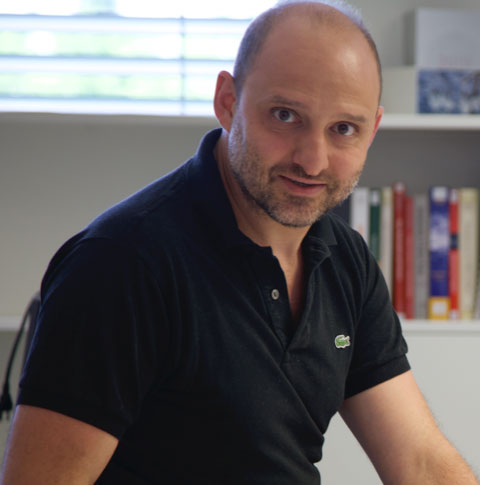
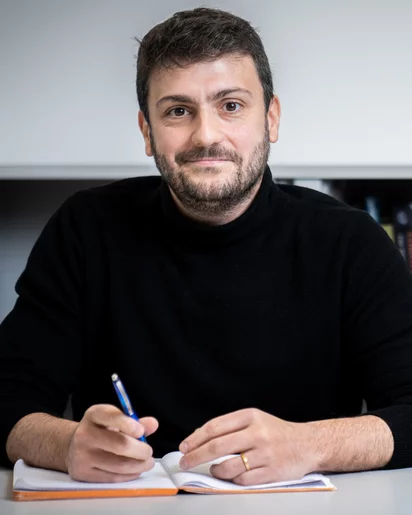
Kathrin Lang is a Full Professor at the Department of Chemistry and Applied Biosciences, ETH Zurich, and Head of the Organic Chemistry Laboratory. Her research focuses on chemical biology, particularly the development of tools for genetic code expansion to incorporate non-canonical amino acids into proteins and advance bioorthogonal chemistries for studying biological processes. Keywords: Genetic Code Expansion, Bioorthogonal Chemistry, Protein Engineering, Ubiquitylation Networks, Post-Translational Modifications. Lang’s work emphasizes proximity-triggered crosslinking reactions, bioorthogonal labeling, and in vivo chemistries to address challenges in protein interaction mapping and structural elucidation. Her group’s recent publications highlight methodologies for dual protein labeling, deciphering ubiquitin code, and enhancing cycloaddition reactivity. Current projects include exploring cyclopropene-fused dibenzocyclooctynes for improved labeling and investigating methylated lysine as a conformational regulator in Hsp90. Funding sources include the ERC (Ubl-tool), DFG (SFB1035, SPP1926), and ETH Zurich. She contributes to education through courses like Genetic Code Expansion for Studying Posttranslational Modifications and Chemical Biology and Synthetic Biochemistry . Collaborative efforts span structural biology, microbiology, and synthetic biochemistry, with applications in ubiquitin research and cellular imaging.
Swiss Federal Institute of Technology in LausanneSwitzerland
Tom Ian Battin is a Full Professor at the École Polytechnique Fédérale de Lausanne (EPFL), affiliated with the School of Architecture, Civil and Environmental Engineering (ENAC). He holds roles in three departments: the River Ecosystems Research Laboratory (RIVER), the Laboratory of Management of Infrastructures, Networks and Construction (LIMNC-GE), and the SSIE Teaching Unit (ENS). His research focuses on aquatic ecosystems, microbial communities in glacier-fed streams, climate change impacts, and biogeochemical processes in alpine environments. He advises numerous doctoral students and has supervised over ten theses at EPFL. Battin teaches courses such as 'Fundamentals in Ecology,' 'Aquatic Ecosystems,' and 'Global Change Ecology and Fluvial Ecosystems.' He is actively involved in academic governance, serving on the EPFL Academic Strategic Committee (ASC) and the ENAC Academic Evaluation Committee (CEA). His work investigates how glacier retreat affects stream microbiomes, dissolved organic carbon dynamics, and ecosystem resilience. Key themes include microbial metabolism, biofilm functionality, and the interplay between hydrology and biogeochemistry. Battin leads research projects on global glacier-fed stream biogeography and the resistome of stream biofilms. His interdisciplinary approach bridges ecology, microbiology, and environmental engineering, addressing critical questions about mountain ecosystems under climate change.
Pietro de Anna is an Associate Professor at the Institute of Earth Sciences (ISTE), University of Lausanne, since August 2021. He holds an Italian nationality and completed a Master's in Theoretical Physics (2009) at the University of Florence, followed by a PhD in Earth Sciences at the University of Rennes 1 (2012). His research focuses on reactive transport in porous media, filtration, and interactions between bacteriological activity and flow dynamics. He directs the Environmental Fluid Mechanics Laboratory since 2015, employing microfluidics, numerical simulations, and theoretical models to study coupled physical, biological, and chemical mechanisms in confined systems. He has published 21 peer-reviewed articles, teaches environmental science courses at the Bachelor's and Master's levels, and supervised two PhD theses and four postdoctoral researchers. His work includes investigations into microbial biomass accumulation in porous media, diffusion-limited mixing, and biocementation processes. Key research themes are spatial heterogeneity effects, chemotaxis, and quorum sensing in microbial systems. He has pioneered methods combining microfluidics with microscopy to analyze transport at pore scales.
Dr. Imad El Haddad serves as Group Head of the Molecular Cluster and Particle Processes group at the Laboratory of Atmospheric Chemistry (LAC), part of the Center for Energy and Environmental Sciences at Paul Scherrer Institute (PSI), Switzerland, since 2018. Previously, he held positions as Tenured Scientist and Deputy Head (2018-2019), Senior Scientist in the Smog Chamber group (2015-2018), and Postdoctoral Fellow (2011-2015) at PSI. His research aims to quantify how anthropogenic emissions alter atmospheric pollutant composition and impact Earth's climate and public health through molecular-level analysis using advanced mass spectrometry techniques. His academic background includes: Ph.D. in Atmospheric Chemistry, University of Provence, Marseille (2007-2011) Master's in Environmental Sciences (with distinction, rank 1/9), University of Provence (2006-2007) Master's in General Chemistry (with distinction, rank 1/10), Saint-Joseph University of Beirut (2005-2006) Bachelor of Science in Chemistry (with distinction, rank 1/14), Saint-Joseph University of Beirut (2002-2005) El Haddad's work centers on molecular fingerprinting of atmospheric aerosols , utilizing mass spectrometry (GC/MS, HPLC/APCI-MS2, HPLC/ESI-MS2) to identify primary and secondary molecular markers. He conducts smog chamber experiments to characterize emissions from wood burning, traffic, and cooking processes, determining secondary organic aerosol potential and oxidation state evolution. His group also studies in-cloud aqueous-phase aging and collaborates with global modelers to link aerosol composition to climate forcing and health outcomes like oxidative stress. Recent publications (2025-2024) reveal three dominant trends: (1) rigorous molecular-scale analysis of secondary aerosol formation under varying humidity/temperature, (2) source apportionment breakthroughs in diverse regions (India, Europe, Arctic) using 14C and AMS data, and (3) quantification of health-relevant aerosol properties such as oxidative potential through DTT assays. High-resolution mass spectrometry is a consistent methodological thread across these studies. His scientific awards include: MENRT research fellowship from French ministry of research (2007-2010) Excellence Scholarship (top 1% student, University of Saint Joseph, 2005) Distinction Prize (best student, University of Saint Joseph, 2005) As Group Head, El Haddad oversees the Molecular Cluster and Particle Processes group's research direction and mentorship of junior scientists. While specific grant details are absent from the text, his leadership in multi-institutional publications (e.g., CERN CLOUD, iCUPE) implies active grant management and international collaboration. The group's work bridges laboratory simulations, field deployments, and health/climate modeling to address air pollution complexities. The Molecular Cluster and Particle Processes group develops cutting-edge online/offline mass spectrometers for 1 Hz-resolution atmospheric analysis. They deploy instruments in laboratory smog chamber experiments and global field studies, focusing on molecular marker identification, emission source characterization, and aging process quantification. Collaborations with biochemists and climate modelers extend their impact beyond pure aerosol physics into health risk assessment and policy-relevant climate science.
Prof. Dr. Oliver Schilling is an Assistant Professor of Hydrogeology at the University of Basel and affiliated with Eawag , the Swiss Federal Institute of Aquatic Science and Technology. He leads research on surface water-groundwater interactions using integrated surface-subsurface hydrological models (ISSHM) and novel tracer techniques including dissolved atmospheric noble gases, environmental DNA, and radioactive tracers. Research Focus : Surface-subsurface hydrology, ecohydrology, groundwater-surface water interactions, tracer hydrogeology, climate change adaptation in water systems Key Projects : Integrated Hydrological Modeling for Operational Forecasting, Sustainable Nitrogen Fertilization, Slow Water Initiatives, Cryosphere-Groundwater Connectivity in Alpine Regions Scientific Contributions include developing HGS-PDAF (modular data assimilation framework), advancing microbial transport algorithms in HydroGeoSphere, and pioneering online flow cytometry for microbial analysis in high-turbidity environments. His work addresses drinking water production via bank filtration along alluvial rivers, critical for 30% of Swiss and 50% of European drinking water supply. Scientific Leadership : Editor, Hydrogeology Journal (since 2025) Associate Editor, Frontiers in Water (since 2021) Coordinator, Swiss Water-Earth Systems (WES) PhD School (2020–2022)
Christoph Müller is a Full Professor of Energy Science and Engineering at ETH Zürich's Department of Mechanical and Process Engineering. He leads the Laboratory of Energy Science and Engineering, focusing on sustainable energy generation, heterogeneous catalysis, and granular systems. His research integrates experimental methods like Magnetic Resonance Imaging (MRI) and Discrete Element Modelling (DEM) with mathematical modeling to address industrial energy challenges. Education: Dipl.-Ing. from Technical University of Munich (2004), PhD in Chemical Engineering from the University of Cambridge (2008). Notable awards include the Danckwerts-Pergamon Prize (2009) and DAAD Scholarship (2005). He teaches courses such as Thermodynamics I and Thermo- and Fluid Dynamics. Research interests span CO₂ capture via chemical looping, catalytic hydrogenation, and granular flow dynamics. Recent work explores catalyst design for propane dehydrogenation, MXene-based ammonia synthesis, and MgO-based CO₂ sorbents. His lab employs advanced techniques like operando X-ray absorption spectroscopy to study catalyst behavior under reaction conditions. Key achievements include developing stable PtGa propane dehydrogenation catalysts and advancing understanding of Na₂CO₃-promoted CO₂ sorbents. His work on fluidized bed hydrodynamics via MRI contributes to reactor design optimization. Müller's interdisciplinary approach bridges fundamental science and industrial application, addressing global energy sustainability challenges.
Swiss Federal Institute of Technology in LausanneSwitzerland
Nicola Marzari is a Professor of Theory and Simulation of Materials at EPFL, where he also serves as Director of the National Centre for Computational Design and Discovery of Novel Materials (NCCD). He is Chairman of Psi-k, an international network for advanced materials' computational design. Previously, he held the Toyota Chair of Materials Engineering at MIT and leadership roles at the University of Oxford, including Director of the Materials Modeling Laboratory and a Statutory Chair in Materials Modeling. His education includes a Laurea in Physics (summa cum laude) from the University of Trieste, a PhD in Physics from the University of Cambridge under Prof. Michael C. Payne, and postdoctoral work at Rutgers University with Prof. David Vanderbilt. Marzari's research focuses on computational materials science, electronic structure theory, and high-throughput simulations. He develops methods for predicting material properties using first-principles approaches, machine learning, and quantum espresso software. Key areas include energy materials (batteries, thermoelectrics), magnetic materials, and optoelectronic systems. His work bridges fundamental physics and practical material design, emphasizing reproducible workflows and open-source tools like koopmans and AiiDA . His recent articles highlight advancements in machine learning for materials interfaces, dynamical Hubbard functionals, and thermal conductivity modeling. He actively contributes to EuroHPC initiatives for exascale materials design and OPTIMADE standards for materials data exchange. Marzari leads interdisciplinary teams at EPFL and collaborates globally on projects ranging from defect engineering in semiconductors to AI-driven materials discovery. His research aims to accelerate the development of sustainable energy and electronic technologies through computational innovation.
Dr. Sung Sik Lee serves as a Lecturer in the Department of Materials at ETH Zurich, Switzerland. Affiliated with ScopeM (Scientific Center for Optical and Electron Microscopy), he develops microfluidic platforms for real-time cellular analysis at the HPM C 52.2 facility (Otto-Stern-Weg 3, Zürich). His research bridges engineering and biology to investigate cellular responses to mechanical and chemical stimuli. His primary research domains include: Microfluidics : Design of microfabricated devices for cell stretching, particle separation, and dynamic stimulation Cellular Aging : Mechanisms of chromosome loss and nuclear pore complex reorganization in yeast models Nanotoxicology : Impact of nanoplastics on macrophage inflammation and intestinal barrier integrity Advanced Imaging : Application of holotomography and Raman spectroscopy for label-free cellular analysis His work consistently targets translational applications in disease modeling and diagnostics. Analysis of his 50+ publications reveals strong interdisciplinary integration, particularly the convergence of machine learning with microscopy (e.g., automated vacuole quantification in yeast) and the development of open-access resources like MicrobioRaman. Recent trends emphasize nanoparticle-cell interactions and microfluidic solutions for inflammatory conditions including IBD and acute kidney injury. Dr. Lee actively contributes to ScopeM's mission of advancing microscopy techniques, maintaining collaborations across ETH Zurich's research ecosystem. His laboratory focuses on microfluidic device fabrication, cellular mechanotransduction studies, and biophysical characterization of particles and cells, with ongoing projects extending through 2025.
Prof. Patrick Jenny is a Full Professor at the Department of Mechanical and Process Engineering and Head of the Institute of Fluid Dynamics at ETH Zurich. His research focuses on computational fluid dynamics (CFD), numerical methods for turbulent and multiphase flows, and reservoir simulation. He has held positions at ChevronTexaco and Cornell University, and received the National Latsis Prize 2005. PhD in CFD from ETH Zurich (1997) Postdoctoral work at Cornell University (1997–1999) Senior Researcher at ChevronTexaco (1999–2003) Research interests include: turbulent reactive flows, PDF modeling, multi-scale reservoir simulation, and data assimilation in engineering systems. He teaches courses on fluid dynamics, turbulence, and computational methods. Over 100 peer-reviewed publications span topics like fracture modeling, LES/RANS coupling, and particle-laden flows. His work bridges academia and industry, addressing challenges in energy systems, environmental engineering, and numerical algorithms. Winner: National Latsis Prize 2005 Led over 20 PhD projects and collaborates with institutions globally. His lab develops open-source tools for CFD and energy systems analysis.
Swiss Federal Institute of Technology in LausanneSwitzerland
Carlo D'Eramo is Professor and Head of the Reinforcement Learning and Computational Decision-Making professorship at the Center for Artificial Intelligence and Data Science (CAIDAS) of University of Würzburg. He additionally serves as an independent group leader of hessian.AI, focusing on developing lightweight methods to obtain adaptive autonomous agents that can handle real-world complexity. His academic journey includes: B.Sc. in Computer Engineering from Politecnico di Milano (2011) M.Sc. in Computer Engineering from Politecnico di Milano (2015) Double degree in Computer Science from University of Illinois at Chicago (2015) Ph.D. in Information Technology from Politecnico di Milano (2019) Postdoctoral research at TU Darmstadt's Intelligent Autonomous Systems group (2019-2022) D'Eramo leads the LiteRL research group investigating how agents can efficiently acquire expert skills accounting for real-world complexity. His research spans multiple reinforcement learning domains including multi-task, curriculum, adversarial, options, and multi-agent RL. His work bridges theoretical advances with practical applications, particularly in robotics and decision-making systems. His recent publications (2023-2025) demonstrate significant contributions across exploration strategies, neural network architectures, multi-agent coordination, and physics-informed machine learning. His work frequently appears in top-tier venues including TMLR, RLJ, IEEE PAMI, ICML, and ICLR, with multiple papers receiving spotlight or oral presentation designations. Professional activities include: Senior area chair for RLC Area chair for AAAI, ACML, AISTATS, NeurIPS, and ICLR Reviewer for DFG and ERC proposals Creator of MushroomRL reinforcement learning framework D'Eramo actively contributes to academic community service while mentoring researchers in his group. His work on lightweight methods aims to make reinforcement learning more practical for real-world applications across various domains.
Prof. Kristopher McNeill is a Full Professor at ETH Zurich's Department of Environmental Systems Science, where he heads the Institute of Biogeochemistry and Pollutant Dynamics. Born in 1970 in Tucson, Arizona, he earned his BA in Chemistry from Reed College (1992) and PhD from UC Berkeley (1997), followed by postdoctoral work at MIT. His academic career includes positions as Assistant and Associate Professor at the University of Minnesota and Visiting Professorship at Stanford. McNeill's research focuses on environmentally relevant chemical reactions, particularly catalytic and photocatalytic transformations in aquatic systems. Key areas include environmental fate of emerging contaminants, photochemistry in surface waters, and metal-mediated dehalogenation reactions. His group emphasizes mechanistic studies using modern spectroscopic techniques like NMR and time-resolved laser spectroscopy to understand degradation pathways of contaminants. His publication trends show consistent focus on photochemical processes in environmental systems, with recent work expanding into polymer degradation, DNA photochemistry, and atmospheric chemistry. The research demonstrates increasing interdisciplinary integration of analytical chemistry, materials science, and environmental modeling. McNeill teaches multiple courses including: Introduction to Environmental Organic Chemistry Organic Chemistry Term Paper seminars Human Health, Nutrition and Environment
Swiss Federal Institute of Technology in LausanneSwitzerland
Julia Schmale is a Tenure Track Assistant Professor at the Institute of Environmental Engineering (IEE) within the School of Architecture, Civil and Environmental Engineering (ENAC) at École Polytechnique Fédérale de Lausanne (EPFL), based at the Extreme Environments Research Laboratory (EERL) in Sion, Switzerland. She also holds an academic position in the School of Sustainable Industrial Engineering (SSIE) and is a member of the Diversity Office at ENAC (DOENAC). Her research focuses on atmospheric aerosols, cloud formation, and air-sea interactions in polar and remote marine environments. She leads and participates in major international field campaigns such as MOSAiC and ACE, utilizing in-situ measurements to study new particle formation, aerosol sources, and their climatic impacts. Her work integrates observational data with modeling to understand climate-relevant processes in the Arctic and Southern Ocean. The analysis of her recent publications reveals a strong emphasis on aerosol microphysics, halogen chemistry, biogenic emissions, and cloud nucleation processes in extreme environments. Her studies frequently involve advanced instrumentation and collaborative efforts across disciplines, including chemistry, physics, and biology. Best teacher in the Best teacher in Environmental Sciences and Engineering Section, EPFL teaching award : EPFL (2023) SIE Best Teacher Award : Environmental Science and Engineering Section (2023) SMT Best Teacher Award : Enterprise 4 Society SMT Master Program (2024) Julia Schmale supervises multiple PhD students and contributes to teaching courses such as "Physics and Chemistry of the Atmosphere" and "Science of Climate Change." She is actively involved in science-policy engagement and diversity initiatives within academia. Her laboratory, the Extreme Environments Research Laboratory (EERL), develops and deploys cutting-edge measurement systems for field studies in polar regions, fostering interdisciplinary research on climate change and environmental processes.
Dr. John Provis is the Group Leader for Cement Systems at the Paul Scherrer Institute (PSI) in the Laboratory for Waste Management (LES). He holds a PhD in Chemical Engineering from the University of Melbourne, Australia, and was previously the Professor of Cement Materials Science and Engineering at the University of Sheffield, UK (2012–2023). His research focuses on cement chemistry, sustainable construction materials, and nuclear waste management, with a strong emphasis on standardization and beamline analysis. Provis has authored over 300 journal articles and secured major grants, including an ERC Starting Grant. He is a Fellow of multiple prestigious societies and has received awards such as the RILEM Robert L'Hermite Medal and a Doctor Honoris Causa from Universiteit Hasselt. He has supervised over 100 PhD/postdoc researchers and serves as an editorial board member for journals like Cement and Concrete Research and Materials and Structures . His research interests span cement durability, geopolymer development, and the environmental impact of construction materials. Provis also advises governments and agencies globally on funding and policy, contributing to projects like the Hanford Nuclear Reservation review. His work bridges academic research with industrial applications, emphasizing innovation in low-carbon materials and waste management solutions.
Prof. Ilya Karlin is a Lecturer at the Department of Mechanical and Process Engineering at ETH Zürich. His research focuses on advanced computational fluid dynamics, particularly leveraging lattice Boltzmann methods for simulating complex fluid phenomena. Key areas include non-ideal fluid behavior, multiphase flows, combustion processes, and hydrodynamic closures. He has contributed extensively to improving numerical methods for compressible flows, turbulent systems, and reactive mixtures in porous media. His work bridges kinetic theory with continuum mechanics, addressing challenges in hydrodynamic manifolds and non-local effects. Dr. Karlin's publications emphasize rigorous mathematical analysis alongside computational innovation, such as spectral closure techniques and entropy-based models. His research often explores the interplay between microscopic kinetic descriptions and macroscopic hydrodynamic equations. He has developed novel algorithms like the 'particles on demand' method for handling strong discontinuities in flows. Recent work includes studies on rarefaction effects, capillarity-viscosity balance, and exact hydrodynamic manifolds for BGK equations. His studies span diverse applications from microfluidics and phase transitions to detonation modeling and environmental fluid mechanics. While no specific awards are listed in the provided text, his prolific publication record indicates significant contributions to the field of computational fluid dynamics.
Swiss Federal Institute of Technology in LausanneSwitzerland
Ivo Furno is an Adjunct Professor at the École Polytechnique Fédérale de Lausanne (EPFL) within the School of Basic Sciences ( SB ) and affiliated with the Swiss Plasma Center ( SPC ). He holds a joint appointment with the SPH-ENS unit and previously contributed to EDPY-ENS teaching initiatives. His research spans fundamental plasma physics, tokamak experiments (TCV program), and applied plasma technologies including plasma agriculture. Key Collaborations: AWAKE Run 2, DEMO Neutral Beam Injectors, SPIDER, RAID linear device Teaching: General Physics (Thermodynamics), Plasma Diagnostics in Tokamaks Research focuses on plasma turbulence , negative ion sources , self-modulation of relativistic proton bunches , and plasma-seed treatments . His work includes experimental validation of edge turbulence codes , microwave interferometer design , and helicon plasma characterization for fusion applications. Publications highlight 3D plasma dynamics , Langmuir probe analysis , and ion transport phenomena . He has supervised numerous PhD students, including those working on fast ion transport , negative hydrogen ion dynamics , and millimeter-wave diagnostics . Scientific Awards: No explicit awards listed in the data. Students & Collaborations: Mentored PhD candidates such as Riccardo Agnello (helicon plasmas), Rita Agus (plasma diagnostics), and Fabio Avino (dielectric barrier discharges). Past advisees include researchers in plasma agriculture (e.g., Alexandra Waskow) and tokamak experiments (e.g., Federico Nespoli).