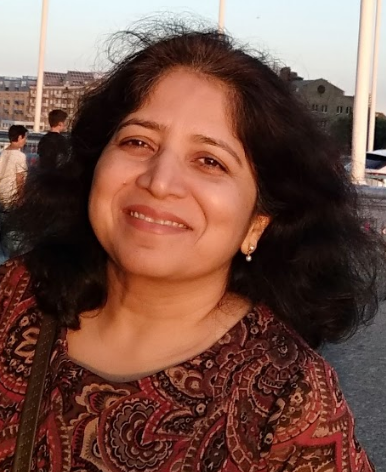
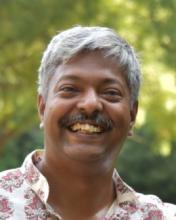
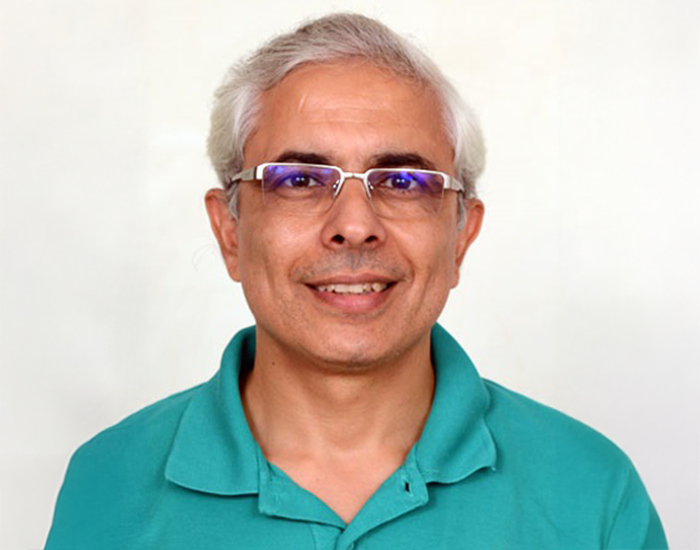
Sunita Sarawagi is a Professor at Computer Science and Engineering , IIT Bombay, and a member of AI Labs@CSE . She is also associated with the Center for Machine Intelligence and Data Science (CMInDS), which she founded in 2020. Education: PhD in Computer Science from UC Berkeley (Thesis: Query Processing in Tertiary Memory Databases), BTech in Computer Science from IIT Kharagpur Research Interests span machine learning , data analytics , graphical models , and structured learning , with applications in text segmentation, sequence modeling, domain adaptation, and human-in-the-loop systems. Her publications reveal a strong focus on integrating data mining with database systems , temporal data analysis , and information extraction using probabilistic methods. Professional Activities include serving on the IEEE John Von Neumann Medal committee (2017-), VLDB 2011 Research Track Co-chair , and multiple program committee roles at top conferences like ICML, KDD, and SIGMOD. Labs & Teams : Leads the SS Lab , a research group focused on probabilistic graphical models, sequence modeling, and data integration techniques.
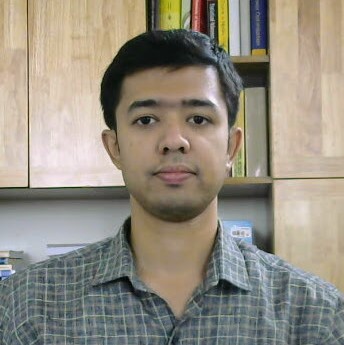
Nitin Saxena is a Professor in the Department of Computer Science and Engineering at the Indian Institute of Technology Kanpur. He holds a PhD from IIT Kanpur (2006) and a B.Tech from the same institution (2002). His academic career has been centered at IIT Kanpur, where he has made significant contributions to theoretical computer science. His research focuses on Theoretical Computer Science, particularly Computational Complexity Theory, Algebra, and Algebraic Geometry. His work bridges computer science with advanced mathematical concepts, creating innovative approaches to computational problems. His research has established important connections between algebraic geometry and computational complexity, advancing our understanding of fundamental computational limits. Saxena's publication record shows consistent high-impact research from 2004 through 2012, with multiple papers appearing in top theoretical computer science venues including STOC, ICALP, and IEEE Conference on Computational Complexity. His work spans circuit complexity, identity testing, algebraic independence, and primality testing, demonstrating both depth and breadth in theoretical computer science. Best Paper at ICALP Conference 2011 IEEE Conference on Computational Complexity Best Paper Award 2006 IEEE Conference on Computational Complexity Best Student Paper Award 2006 Goedel Prize 2006 Fulkerson Prize 2006 Distinguished Alumnus Award of IIT Kanpur 2003 Global Indus Technovators Awards 2003 Professor Saxena has received prestigious recognition for his work, most notably the Goedel Prize and Fulkerson Prize in 2006 for the groundbreaking 'PRIMES is in P' paper, which resolved a fundamental question in computational number theory. His research has been consistently supported by the academic community through invitations to special journal issues following conference presentations. Based in Room 203 of the Department of Computer Science and Engineering at IIT Kanpur, Professor Saxena continues to contribute to theoretical computer science through research, teaching, and academic service.
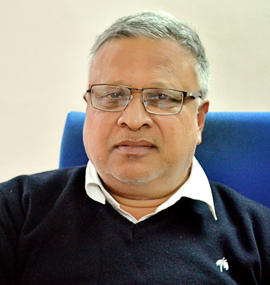
Shashank Vatedka is an Assistant Professor in the Department of Electrical Engineering at the Indian Institute of Technology Hyderabad . His research focuses on information theory , coding theory , and their applications to data compression , statistical inference , and security . He holds a PhD from IISc, Bengaluru and has postdoctoral experience at Institut Polytechnique de Paris and The Chinese University of Hong Kong . Education : PhD and MSc (Engg) in Electrical Communication Engineering, IISc, Bengaluru (2011-17) Academic Positions : Assistant Professor, IIT Hyderabad (2019-present) Postdoctoral Fellow, Telecom Paris (2018-19) Research Assistant/Postdoctoral Fellow, Institute of Network Coding, CUHK (2016-18) His research spans three main areas: distributed inference (federated learning, wireless sensor networks), compression with locality constraints (local decoding, low-complexity algorithms), and communication in adversarial environments (jamming, list decoding). Recent work includes distributed mean estimation with limited communication and adversarial channel coding with partial information. He has received several honors including the Seshagiri Kaikini Medal for best PhD thesis at IISc in 2017, Best Paper Awards at NCC 2023 and Stanford Compression Workshop 2021, and the TCS Research Fellowship (2014-17). He serves as a Faculty Placement Coordinator at IIT Hyderabad and organizes international conference tracks. His research group advises students across PhD, MTech, BTech , and internships , with alumni pursuing advanced degrees at institutions like UCSD , Columbia University , and TU Delft . Collaborations include theoretical work with colleagues like Yihan Zhang and Sidharth Jaggi .
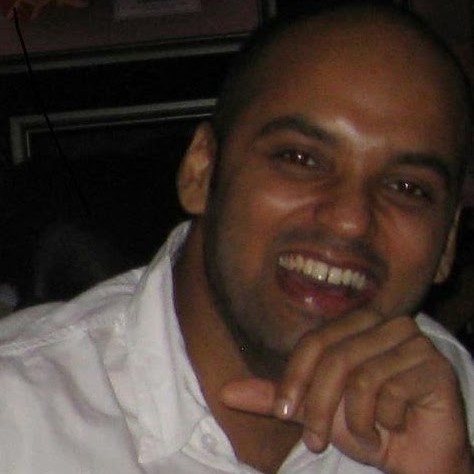
R K Bansal is a Professor in the Department of Electrical Engineering at Indian Institute of Technology Kanpur (IIT Kanpur). He has been actively contributing to the fields of Detection Theory and Information Theory for several decades with a strong academic background including a PhD from University of Connecticut (1987). His research interests include: Universal data compression with applications Sequential detection of a change in distribution Robust detection Ergodic theory and large deviation theory applications Stochastic processes Dr. Bansal's recent publications primarily focus on data compression algorithms, particularly variations of the Lempel-Ziv algorithm, and detection theory applications. His work demonstrates a strong theoretical foundation with practical applications in information processing and analysis, showing consistent research activity from the 1980s through 2013. He has received significant recognition for his teaching excellence: Letter of commendation from Director on best teaching (2011) Outstanding tutor for Mathematical Statistics (BSO209) based on student feedback (1998-II) Consistently high teaching evaluations exceeding institute averages Dr. Bansal has advised students and maintained active research in his specialized areas, though specific names of current advisees are not mentioned in the available information. His research has been published in prestigious venues including IEEE Transactions on Information Theory. His laboratory is located in room 202 ACES (Advanced Centre for Electronic Systems) at IIT Kanpur, serving as the base for his research activities in detection theory and information theory applications.
Rameshwar Pratap is an Associate Professor in the Department of Computer Science and Engineering at the Indian Institute of Technology Hyderabad (IIT Hyderabad). Previously, he served as an Assistant Professor at the School of Computing and Electrical Engineering, IIT Mandi for three years. Education: Ph.D. in Theoretical Computer Science, Chennai Mathematical Institute Research Interests: His research lies at the intersection of theory and practice, focusing on extremely simple yet practical approximation algorithms with provable guarantees . Key themes include: Sketching and dimensionality reduction algorithms for tensors and similarity measures Improving speed, scalability, and accuracy of existing sketching methods Applications in machine learning: node embedding in large-scale networks, itemset mining, model compression He extensively employs techniques from matrix and tensor algebra, sampling, random projection, and randomized hashing . Publications Overview: Across 2021–2025 his work has appeared in top venues such as IEEE Globecom, Theoretical Computer Science, Acta Informatica, Information Processing Letters, Algorithmica, UAI, ICALP, Machine Learning, TKDE, and ACML. Recurring themes are randomized sketching, locality-sensitive hashing, compressed matrix multiplication, variance reduction, and subspace approximation , demonstrating both theoretical depth and practical impact. Awards & Honors: Early Career Research Grant (PM-ECRG) 2025, Anusandhan National Research Foundation (ANRF) Best Paper Award, COCOON 2020 Students & Funding: First Ph.D. student: Bhisham Dev Verma (co-advised with Prof. Manoj Thakur) graduated June 2025 MS by Research student: Punit Pankaj Dubey graduated October 2022 Currently hiring 1 Junior Research Fellow for the PM-ECRG project “Improving Similarity Search in Practice” Labs & Teams: Works within the Algorithms & Theory group at IIT Hyderabad, collaborating with national and international researchers. Erdös number is 3.
Anirban Chakraborti is a Professor at the School of Computational and Integrative Sciences, Jawaharlal Nehru University (JNU), New Delhi, India, where he has been a faculty member since 2014. He previously held academic positions at École Centrale Paris (France) as Chercheur Senior (Associate Professor) and Chargé de Recherche (Assistant Professor), and earlier roles at Banaras Hindu University, Brookhaven National Laboratory (USA), and Helsinki University of Technology (Finland). He is a leading figure in the interdisciplinary field of econophysics and complex systems. Education: Diplôme d’Habilitation à Diriger des Recherches (2013), Université Pierre et Marie Curie – Paris VI, France (Physics) Ph.D. in Physics (2003), Saha Institute of Nuclear Physics, Jadavpur University, India Post-M.Sc. in Physics (1999), Saha Institute of Nuclear Physics, Jadavpur University, India (Ranked First) M.Sc. in Physics (1998), University of Calcutta, India (Ranked First) B.Sc. in Physics (1996), Scottish Church College, University of Calcutta, India His research interests lie at the intersection of physics, economics, and data science. He is particularly known for pioneering work in econophysics , including the statistical mechanics of money, wealth distribution, agent-based market models, and network-based analysis of financial and social systems. He also works on complex systems , computational finance , statistical physics , and nanosciences , with applications in sensing and imaging. His work often involves modeling socio-economic phenomena using tools from statistical physics. His recent publications span topics such as financial fluctuations, wealth inequality, network analysis of conflicts, order book dynamics, and nanomaterial characterization. These works reflect a strong trend toward interdisciplinary research combining physics, economics, and data analytics, with a focus on real-world applications in finance, inequality, and social systems. Scientific Awards: Indian National Science Academy Young Scientist Medal (2009) He has advised Ph.D. students such as Kiran Sharma and leads the ETC (Experimental-Theoretical-Computational) Lab at JNU, which brings together physicists, computer scientists, and mathematicians. The lab has been involved in international collaborations, including projects funded by the Estonian Ministry of Education and Research and consultancies with TCS Innovation Labs and DONO Consulting. His research has been supported through grants and collaborative projects, reflecting strong industry and global academic engagement.
Arijit Bishnu is an Associate Professor at the Indian Statistical Institute in the Advanced Computing and Microelectronics Unit (ACMU). He has taught courses such as Design and Analysis of Algorithms , Randomized Algorithms , Computational Geometry , and Algorithms for Big Data over multiple years (2008–2025), focusing on theoretical and applied aspects of computer science. Research Interests: His work spans Theoretical Computer Science , Randomized and Approximation Algorithms , Computational Geometry , and Combinatorics . He explores problems in sublinear algorithms, streaming computation, geometric data analysis, and complexity theory. Publications: Recent papers include contributions to STOC 2025 , RANDOM 2025 , and APPROX 2024 , covering topics like property testing, triangle counting complexity, and streaming algorithms. Collaborations with researchers like Sourav Chakraborty, Gopinath Mishra, and Sayantan Sen highlight his interdisciplinary approach. Academic Leadership: He has co-organized research courses such as Approximation Algorithms and Topics in Algorithms and Complexity , emphasizing mentorship and knowledge dissemination in theoretical computer science. His comprehensive work integrates algorithmic innovation with rigorous mathematical analysis, advancing computational techniques for large-scale and geometric data.
Ajit A Diwan serves as a Professor in the Department of Computer Science and Engineering at the Indian Institute of Technology Bombay, where he has maintained continuous faculty membership since 1988. His work bridges theoretical computer science and discrete mathematics, with emphasis on structural graph properties and combinatorial optimization. His academic foundation includes a B.Tech from IIT Bombay (1983) and a Ph.D. from the Tata Institute of Fundamental Research Bombay (1989). These qualifications underpin his decades-long research trajectory in discrete structures. Diwan's research program focuses on graph theory, combinatorics, and algorithm design. He investigates decomposition theorems, factorization problems, and extremal properties of graphs, particularly examining planar graphs, cubic graphs, and cycle structures. His methodological approach combines combinatorial reasoning with algorithmic applications, contributing to fundamental understanding in discrete mathematics. Analysis of his 23+ publications (2000-2024) reveals persistent investigation into graph decomposition patterns, with recent work exploring modular cycle constraints (2024), clique factors in graph powers (2022), and structural properties of planar cubic graphs (2022). These contributions consistently appear in premier venues like the Journal of Graph Theory and Discrete Mathematics. Professor Diwan has mentored three Ph.D. students to completion on topics including upward planar drawings, locally connected planar graphs, and degree-constrained subgraphs. His M.Tech supervision spans five projects covering graph subdivisions, factorization in graph powers, and partitioning algorithms, demonstrating active engagement in graduate education.
Minerva Mukhopadhyay is an Assistant Professor in the Department of Mathematics and Statistics at the Indian Institute of Technology Kanpur. She earned her PhD in Statistics from the Indian Statistical Institute (ISI), Kolkata, and completed postdoctoral work at Duke University under Professors David Dunson and Sandeep Dave. Her research focuses on Asymptotic Statistics, Bayesian Variable Selection, and Nonparametric Inference, with applications to high-dimensional data analysis. Her academic work includes developing distribution-free tests for high-dimensional data, consistency analysis of Bayesian variable selection methods, and novel approaches for sparse linear models. She has contributed to journals like Biometrika , Annals of the Institute of Statistical Mathematics , and Statistica Sinica , reflecting her expertise in theoretical and computational statistics. Research Trends: Her recent articles emphasize scalable Bayesian methods for ultra-high-dimensional data, random projections for predictive modeling, and nonparametric extensions using Gaussian processes. Scientific Awards: Best Student Paper Award (IISA 2015) Pillar Iglesias Travel Award (ISBA 2016) O’Bayes Travel Award (2017) Academic Roles: Previously taught at Bethune College (Kolkata) and Duke University, with experience in interdisciplinary statistical research at ISI. Skills: C, R, MATLAB, and journal reviewing for TEST , JSPI , Stat , and CSDA .
Palash Dey is an Assistant Professor in the Department of Computer Science and Engineering at the Indian Institute of Technology, Kharagpur. His research lies at the intersection of theoretical computer science and algorithmic game theory, with a primary focus on computational social choice, voting theory, and parameterized algorithms. His research interests include: Theoretical Computer Science Parameterized Algorithms Approximation Algorithms Algorithmic Game Theory Computational Social Choice Voting Theory Algorithmic Fairness Network Games His recent publications, spanning from 2023 to 2025, demonstrate a strong and consistent research trajectory in the analysis of voting systems, manipulation, and fairness. The articles focus on complex problems such as bribery, gerrymandering, rank aggregation, and networked public goods, primarily using tools from parameterized complexity and algorithmic game theory. Key venues for his work include AAMAS, IJCAI, AAAI, and Theoretical Computer Science, indicating a high impact in the fields of AI and theoretical computer science. His professional service includes being the Newsletter and Social Media Chair of the IEEE Kharagpur Section and serving on the Senior Program Committee for AAAI (2021-2024) and the Program Committee for AAAI, IJCAI, AAMAS, and COMSOC. He has also organized significant workshops such as CALDAM 2019 and GAME-ARTS. Palash Dey actively advises Ph.D. students, including Sipra Singh, Koustav De, Ashlesha Hota, and Narayan Sharma. He teaches courses such as Algorithms II, Randomized Algorithm Design, and Algorithmic Game Theory. His email is palash.dey@cse.iitkgp.ac.in.
Surender Baswana is a Professor and Tapas Mishra Memorial Chair Professor in the Department of Computer Science and Engineering at IIT Kanpur. His research focuses on the design and analysis of computer algorithms, with specializations in graph algorithms, dynamic algorithms, fault-tolerant structures, and randomized algorithms. He holds a PhD (2005), M.Tech. (1999), and B.Tech. (1997) from IIT Delhi. Research Interests: His work spans fundamental algorithmic domains including minimum cuts (with recent breakthroughs in Steiner mincuts), fault-tolerant data structures (handling edge failures in DFS trees and mincuts), dynamic graph algorithms (efficient updates for DFS and matching), and approximate shortest paths. He develops theoretically optimal solutions with applications in network reliability and optimization. Awards and Honors: Alexander von Humboldt Fellowship (2018) Wagner Prize Finalist for Operations Research (2018) IIT Kanpur Distinguished Teacher Award (2017) Young Engineer Award (2009) Best Faculty Award (8-time recipient) PhD Dissertation Award (IBM, 2005) PhD Supervision: Mentored 5+ PhD students including ACM India Dissertation Award recipient Keerti Choudhary and Manas Mandal Award winner Koustav Bhanja, now faculty at IIT Delhi and Weizmann Institute postdoc respectively. Professional Journey: From software engineer at Lucent Technologies (1999), he transitioned to academia via postdoctoral research at Max Planck Institute (2003-2006), rising through ranks at IIT Kanpur from Assistant Professor (2006) to Professor (2016-present).
Swagato Sanyal is an Assistant Professor in the Department of Computer Science and Engineering at the Indian Institute of Technology Kharagpur, actively teaching courses across eight academic years from 2018-19 to 2024-25. His research centers on Analysis of Boolean functions , Computational Complexity , and Algorithms , with theoretical depth evident in course content like Computational Complexity (CS60069) covering NP-completeness and reductions, and Randomized Algorithm Design (CS60029) emphasizing probabilistic methods, concentration inequalities, and statistical learning theory applications. Scientific Awards: No scientific awards were mentioned in the provided texts. Advising and Grants: The texts exclusively document course instruction without listing any PhD or Master's students advised by Sanyal. Similarly, no research grants, funding sources, or collaborative projects are referenced beyond standard teaching responsibilities.
Sayandeep Saha is an Assistant Professor in the Department of Computer Science and Engineering at Indian Institute of Technology Bombay. His research focuses on Hardware Security and Cryptography, with emphasis on Fault Attacks, Side-Channel Attacks, and Post-Quantum Cryptography. He leads the SHarC research group and actively collaborates with international institutions. Education: PhD in Computer Science and Engineering from Indian Institute of Technology Kharagpur Postdoctoral Experience: NTU Singapore (2022-2023), UCLouvain Belgium (2023-2024) His research explores hardware vulnerabilities in cryptographic systems, covering: Fault Attacks on Symmetric and Post-Quantum Cryptosystems Side-Channel Analysis of Power/EM Radiation Microarchitectural Attacks (Spectre/Meltdown variants) Countermeasure Development and Formal Verification Recent research trends include Rowhammer attacks, randomized cache designs, and fault propagation in cryptographic circuits. His work has been recognized in top conferences like ICCAD, USENIX Security, and CHES. Awards: Top Picks in Hardware and Embedded Security 2024 (EUROCRYPT 2020 paper) He is currently hiring Project Research Assistants for the RISC-V-based SISHAM project and supervises PhD students in hardware security research.
Sumit Ganguly is a Professor in the Department of Computer Science and Engineering at the Indian Institute of Technology Kanpur (IIT Kanpur), where he has established himself as a leading researcher in database systems and algorithms. Education: PhD in Computer Science, University of Texas, Austin (1992) MS in Computer Science, University of Texas, Austin (1989) B.Tech in Computer Science, IIT Kanpur (1987) Professor Ganguly's research primarily focuses on database systems with special emphasis on algorithms for data streams. His work explores the theoretical foundations and practical implementations of database technologies, particularly in the context of streaming data where traditional database approaches face significant challenges. His research has contributed to developing efficient algorithms for frequency estimation, sampling techniques, and processing hybrid frequency moments in data streams, addressing critical challenges in big data analytics. His publications demonstrate a consistent focus on data stream algorithms, with significant contributions spanning from 2008 to 2012. These works explore connections between expander graphs and data stream processing, deterministic data structures, and methods for estimating various statistical properties of streaming data. His research bridges theoretical computer science with practical database applications. Professor Ganguly maintains an active research program within the Department of Computer Science and Engineering at IIT Kanpur, contributing to the institution's reputation for excellence in theoretical computer science and database systems research.
Dr. Ashwitha A. is an Assistant Professor (Senior Scale) in the Department of Information Technology at the School of Computer Engineering, Manipal Academy of Higher Education, Bengaluru. She holds a B.E., M.E., and Ph.D. and has accumulated 10 years of teaching experience. Her academic profile includes an h-index of 6 and 117 Scopus citations. Her primary research domains include: Machine Learning algorithms and applications Artificial Intelligence systems development Deep Learning architectures Internet of Things implementations Recent publications demonstrate applications across environmental sustainability, healthcare technology, agricultural systems, sports analytics, and biomedical engineering, consistently utilizing predictive modeling and neural network approaches.