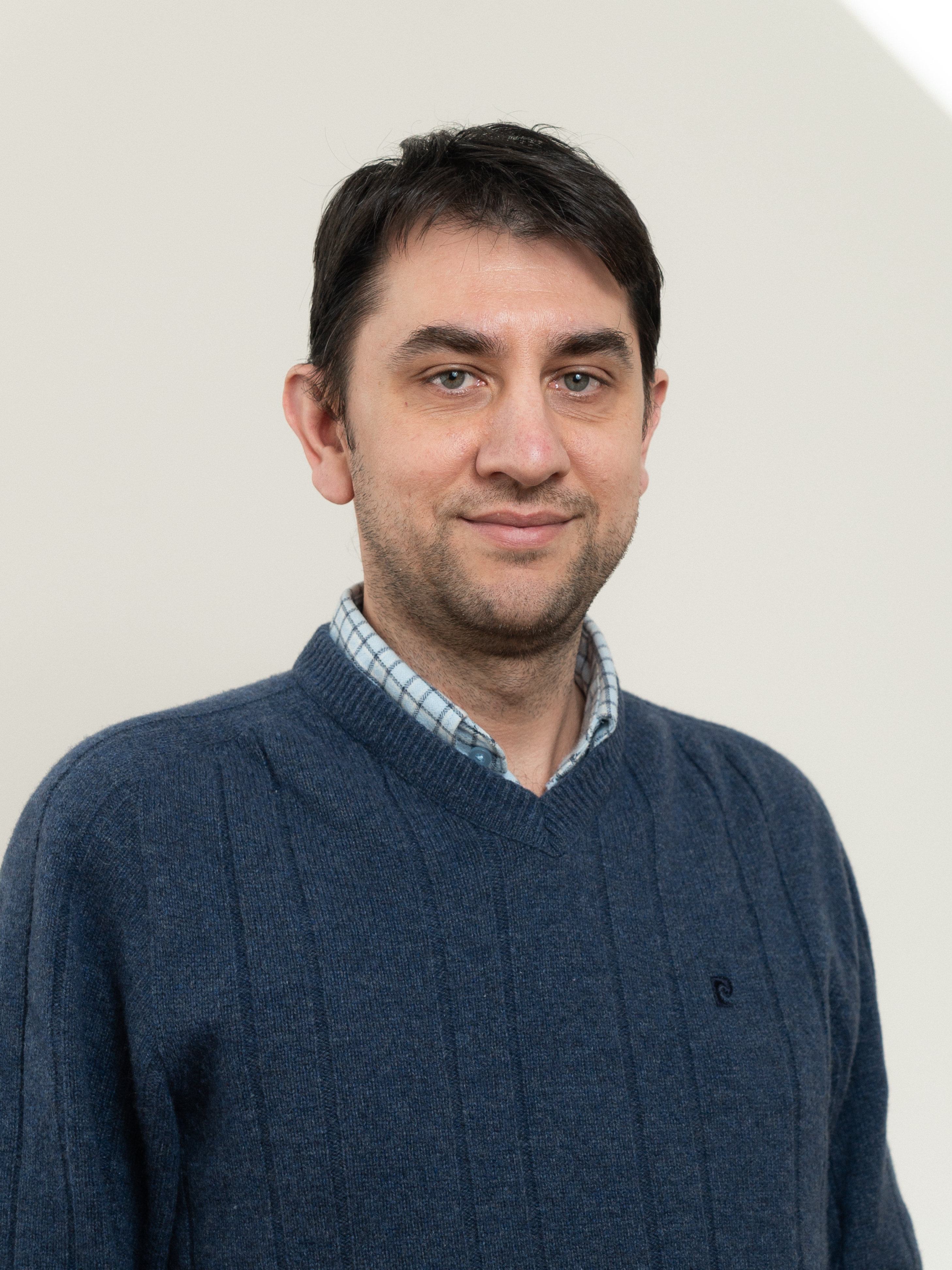
Mindaugas Bloznelis is a Professor at Vilnius University's Faculty of Mathematics and Informatics. His academic career spans decades, with active involvement in teaching and research as evidenced by his continuous presence in the university's schedules from 2016/2017 to 2025/2026. Professor Bloznelis specializes in Random Graph Theory , Network Analysis , and Probability Theory . His research focuses on connectivity thresholds, clustering coefficients, and statistical approximations in complex networks. Recent work includes advancements in modeling sparse and clustered dynamic networks, connectivity thresholds for Bernoulli random graph superpositions, and Edgeworth approximations for symmetric statistics. He co-authored the 2025 Modelling and Mining Networks workshop proceedings, highlighting his leadership in network analysis. His publications demonstrate deep expertise in stochastic processes, asymptotic theory, and finite population statistics. While no formal awards or student advisories are listed in the provided texts, his extensive publication record underscores significant contributions to probability and network science.
Dr. Marijus Vaičiulis is a researcher at the Institute of Mathematics and Informatics (Vilnius University) , affiliated with the Interdisciplinary Statistical Research Group . He holds a Doctor of Mathematics degree (awarded in 2004 by Vilnius Gediminas Technical University and MII). Education Bachelor's degree in Mathematics and Computer Science from Šiauliai University (1995) Master's degree in Mathematics and Computer Science from Šiauliai University (1997) Research interests focus on random processes with distant dependence and applied statistics , particularly in extreme value theory, tail index estimation, and network analysis. His work bridges theoretical probability with practical applications in stochastic processes and heavy-tailed data modeling. Publications demonstrate expertise in tail index estimation techniques, evolving random graph analysis, and extreme value statistics. Collaborations with Natalia Markovich and Maxim Ryzhov highlight interdisciplinary approaches to network theory and statistical inference. Pedagogical activities include teaching probability theory , mathematical statistics , and random processes at Šiauliai University and Vilnius University. Current affiliation is with the Interdisciplinary Statistical Research Group at Vilnius University's Institute of Mathematics and Informatics. His work address is Akademijos St. 4, room 218, Vilnius.
Kanišauskienė Karolina is an Assistant and Lecturer at Vilnius University Šiauliai Academy. Her academic career spans roles as an Assistant (2007-2014), Lecturer (2014-2017, 2021-present), and Associate Professor (2017-2020) at Šiauliai University and its successor institution. Doctoral studies in Mathematics at Vilnius University Multiple degrees in Mathematics and Humanities from Šiauliai University Her research focuses on random processes and their prediction , statistical analysis for olympiads , and graphical models with linguistic applications . She teaches courses in Graph Theory , Algorithms , and Statistical Modeling . Key affiliations include: Institute of Education Researchers Researchers' Excellence Network (RENET) Doctoral Studies at Vilnius University
Dr. Ernestas Filatovas is a Senior Researcher and Chief Researcher in the Project at Vilnius University's Institute of Data Science and Digital Technologies (formerly Institute of Mathematics and Informatics), where he has been affiliated since 2013. He leads the Blockchain and Quantum Technologies Group, focusing on cutting-edge research at the intersection of quantum computing, blockchain, and artificial intelligence. Previously, he served as an Associate Professor and Lecturer at Vilnius Gediminas Technical University's Faculty of Fundamental Sciences from 2013 to 2019. Dr. Filatovas earned his Doctor of Technology in Computer Science Engineering from Vilnius University Institute of Mathematics and Informatics in 2012. His dissertation, supervised by Prof. Dr. Olga Kurasova, focused on the interactive solution of multi-criteria optimization problems. His research spans multiple high-impact domains, with particular expertise in blockchain technologies, quantum computing, artificial intelligence, and machine learning. He has pioneered work in quantum blockchain implementations, reproducibility of AI research through blockchain verification, and quantum machine learning applications. His research bridges theoretical computer science with practical applications in financial markets, healthcare, and distributed systems. His extensive publication record—over 50 scientific papers, with more than 25 in Clarivate Analytics-indexed journals—demonstrates consistent productivity and international collaboration. Recent work shows a clear trajectory toward quantum-enhanced AI systems, blockchain-based research verification frameworks, and quantum algorithms for practical problems. Laureate of the 4th LMA Young Scientists' Conference (2014) INFOBALT scholarship 2nd place winner (2014) Lithuanian State Science and Studies Foundation funding recipient (2009, 2010) Recognized as one of Lithuania's most active doctoral students Master's degree with honors (2006) Dr. Filatovas leads multiple significant research projects, including the 2021-2024 project 'Solving the problems of reproducibility of scientific research in the field of artificial intelligence using blockchain technologies' as team leader, and the 2023-2027 project 'Development and validation of quantum machine learning methods using prepared datasets' as Chief Researcher. He has also contributed to international collaborations such as the Spanish-funded 'High Performance Solutions for Modern Scientific Computing Challenges' (2019-2021). His popular science contributions, including the VU news portal article 'Quantum Computing: Who and Why?', demonstrate his commitment to science communication. As a key member of Vilnius University's Blockchain and Quantum Technologies Group, Dr. Filatovas contributes to Lithuania's growing reputation in quantum computing research and blockchain innovation, working closely with international collaborators across Europe.
Dr. Daniele Ettore Otera is a Senior Researcher at the Institute of Data Science and Digital Technologies (DMSTI) and the Faculty of Mathematics and Informatics of Vilnius University , Lithuania. His work is centered on geometric group theory, low-dimensional topology, and group theory, with a focus on asymptotic topology and topological tameness of groups and manifolds. Education: He earned a Mathematics degree from the University of Palermo (1999), a DEA (Master’s) from Université Paris-Sud 11 (2001), and a co-tutored PhD from both University of Palermo and Université Paris-Sud 11 (2006). Research Interests: Geometric group theory: quasi-isometries, ends of groups, lattices in Lie groups Low-dimensional topology: topological tameness, simple connectivity at infinity, geometric simple connectivity Group theory: subgroup permutability, commutativity degrees, probability in group theory Publications: His recent work spans graph theory, spectral invariants, group actions, and geometric topology, reflecting a deep interdisciplinary approach combining algebra, topology, and combinatorics. Labs & Teams: He is affiliated with the Interdisciplinary Statistical Research Group within DMSTI, contributing to collaborative research in mathematical sciences.