Raphael Hauser is an Associate Professor in Numerical Mathematics at the University of Oxford's Mathematical Institute, Director of Graduate Studies - Teaching, and Tanaka Fellow in Applied Mathematics at Pembroke College. His affiliations include membership in the Data Science, Numerical Analysis, and Mathematical and Computational Finance research groups, as well as a fellowship at the Alan Turing Institute. Education: PhD in Operations Research, Cornell University, Ithaca, USA Dipl. Math. ETH, Swiss Federal Institute of Technology (ETH Zurich), Switzerland Research interests span data science, numerical optimisation, medical imaging, distributed computing, and applied probability/statistics. His work integrates mathematical rigor with practical applications, particularly in optimization algorithms, machine learning theory, and medical imaging technology. Publications focus on optimization theory, stochastic processes, medical imaging systems, and computational finance, with recurring themes in non-convex optimization guarantees, PCA variants, and X-ray tomography innovations. Awards: Oxford University Teaching Award (2007) SIAM Optimization Prize (2005) SIAM Student Paper Prize (2000) Advising includes 15+ DPhil students and 40+ MSc students, with projects in optimization, finance, imaging, and machine learning. Current postdocs and students are affiliated with the Alan Turing Institute and industrial partners like Siemens and Macquarie Group. He leads teams in the Mathematical Institute's research groups and collaborates with the Alan Turing Institute on large-scale data science initiatives.
Dr. Konstantin (Kostia) M. Zuev serves as Teaching Professor in the Computing + Mathematical Sciences Department at California Institute of Technology , where he has made significant contributions to network science and computational statistics since 2016. His dual PhDs in Mathematics (Moscow State University, 2008) and Civil Engineering (HKUST, 2009) underpin his interdisciplinary research spanning differential geometry, stochastic simulation, and network dynamics. Education PhD in Mathematics, Lomonosov Moscow State University (2008) PhD in Civil Engineering, Hong Kong University of Science & Technology (2009) His research focuses on network science , particularly course-prerequisite networks and complex financial systems , with recent work extending to network navigability in cosmological models and rare event simulation. Over his career, he has developed innovative Bayesian inference methods and geometric preferential attachment theories while maintaining active collaborations across mathematics, physics, and biomedical domains. Recent publications highlight network analysis in education ( 2023 ), hyperbolic graph theory ( 2024 ), and pandemic-informed cancer mortality studies ( 2023 ). His 15 most recent articles demonstrate methodological innovations across disciplines including statistics, physics, finance, and cosmology. Scientific recognition includes Humboldt Research Fellowship (2021) Carver Mead Seed Fund Grant (2023) ASCIT Teaching Award (2018, 2023) Northrop Grumman Teaching Excellence Prize (2019) As Graduate Option Representative for Information and Data Sciences at Caltech and faculty advisor for multiple student organizations including the Caltech Karate Club and Caltech Chess Club , he actively bridges academic rigor with community engagement through outreach initiatives like the virtual math education channel and university math circles for K-12 students.
Asaf Ferber is Associate Professor in Mathematics at University of California, Irvine, School of Physical Sciences. His research spans discrete mathematics including combinatorial games, random graphs, extremal hypergraph theory, and quantum computation. Research explores Hamiltonian cycles in random graphs, structural properties of pseudorandom graphs, and quantum algorithms for combinatorial problems. Recent work develops quantum approaches to graph learning and sparse recovery in random matrices. Awards: NSF CAREER Award Sloan Fellowship Distinguished Early Career Faculty Award for Research Air Force Research Grant NSF-BSF Grant Organizes conferences including SoCalDM Symposium and Desert Discrete Math Workshop, mentoring graduate students through UCI's Probability and Combinatorics Seminar.
Andre Wibisono serves as Assistant Professor in Yale University's Department of Computer Science with a secondary appointment in Statistics & Data Science, joining the faculty in 2021 after postdoctoral research at University of Wisconsin-Madison and Georgia Institute of Technology. His educational background includes: Ph.D. in Computer Science, UC Berkeley M.A. in Statistics, UC Berkeley M.Eng. in Computer Science, MIT S.B. in Mathematics and Computer Science, MIT Wibisono's research focuses on algorithm design for machine learning through optimization, sampling, and game theory , leveraging dynamical systems and information theory to develop accelerated discrete-time algorithms from continuous dynamics. His work provides theoretical foundations for efficient machine learning systems with applications in generative modeling and constrained optimization. Recent publications (2023-2025) demonstrate consistent innovation in Hamiltonian-based optimization , constrained-space sampling , and min-max game convergence , characterized by rigorous mathematical analysis connecting continuous dynamics to discrete algorithms. Key trends include randomized integration for acceleration, phi-divergence convergence guarantees, and symplectic geometry applications to mirror descent. Scientific recognition includes: NSF CAREER Award for developing algorithmic frameworks bridging continuous and discrete dynamics He actively mentors current students (Siddharth Mitra, Kaylee Yang, Jane Lee, Qiang Fu, Peter Wang) and has guided two postdocs to faculty positions. Research is funded through the NSF CAREER award and collaborative CIF grants focused on Hamiltonian dynamics for sampling and optimization. His Yale research group develops theoretical foundations for next-generation machine learning algorithms, emphasizing mathematical rigor in optimization and sampling with applications to generative modeling and constrained inference problems.
Jean-François Le Gall is a full Professor at Université Paris-Saclay and a member of the Orsay Mathematics Laboratory (LMO) since 2006. He has held prominent positions at Pierre and Marie Curie University (1988-2006) and École Normale Supérieure (1997-2007). A Senior Member of the University Institute of France (2007-2017) and an elected member of the Academy of Sciences since 2013, he served as Vice-President of Research for the Mathematics Department at Orsay (2020–present) and led the ERC Advanced Grant GeoBrown (2017–2023). Education: Ecole Normale Supérieure (1978–1982), PhD in stochastic differential equations (1982), State Doctorate on Brownian motion (1987) Research Interests focus on probability theory , particularly Brownian motion , superprocesses , random trees , planar maps , and their connections to PDEs and geometric models. His work bridges stochastic analysis , branching processes , and coalescence phenomena . Selected Publications include foundational studies on the Brownian map , random geometry , and spatial branching processes . His 2025 paper on The area of spheres in the Brownian plane explores fractal properties of random metric spaces, while the 2020 Growth-fragmentation processes work links Brownian trees to fragmentation models. Scientific Distinctions : 1986 Rollo Davidson Prize 1997 Loève Prize in Probability 2005 Sophie Germain and Fermat Prizes 2019 Wolf Prize in Mathematics 2022 BBVA Frontiers of Knowledge Award Academic Leadership includes directing the Probability and Statistics Team (2013–2019) and the Master 2 in Probability and Statistics (2007–2015). He chairs editorial roles in Grundlehren der mathematischen Wissenschaften (since 2020) and Probability Theory and Related Fields (2005–2010).
Clark Olson is a Professor in the Division of Computing & Software Systems at the University of Washington Bothell, part of the School of Science, Technology, Engineering & Mathematics. He earned his Ph.D. in Computer Science from UC Berkeley (1994), M.S. in Electrical Engineering (1990), and B.S. in Computer Engineering (1989) from the University of Washington, Seattle. Education: Ph.D. in Computer Science (2017) from University of California, Berkeley M.S. in Electrical Engineering (1990) from University of Washington, Seattle B.S. in Computer Engineering (1989) from University of Washington, Seattle His research focuses on computer vision, robot navigation, and clustering algorithms. He has developed techniques for Mars rover terrain mapping, subspace clustering, and geometric feature matching. His work bridges theory and application in autonomous systems and image analysis. Analysis of his publications reveals expertise in computer vision (8 papers), clustering algorithms (4 papers), and robotics (5 papers). Key subtopics include Mars exploration (3 papers), Hough transforms (3 papers), and probabilistic methods (3 papers). Professor Olson teaches courses ranging from introductory programming (CSS 161-162) to advanced topics in computer vision (CSS 487-587) and algorithm design (CSS 549). He also advises on the CSSE Capstone (CSS 497) projects requiring rigorous prerequisites and structured evaluation criteria.
Kenneth J. Falconer is the Regius Professor of Mathematics at the University of St Andrews, where he is a member of the School of Mathematics and Statistics and the Analysis Research Group. He has held prestigious positions at the University of Bristol and Corpus Christi College, Cambridge, and has been a visiting professor at institutions including Oregon State University and the Australian National University. Regius Professor of Mathematics, University of St Andrews (2017–present) Professor of Mathematics, University of St Andrews (1993–2017) Reader, University of Bristol Lecturer, University of Bristol Research Fellow, Corpus Christi College, Cambridge His research centers on fractal and multifractal geometry, geometric measure theory, and related fields. He has made seminal contributions to the understanding of fractal projections, dimensional analysis of self-affine sets, and fractal processes. His work includes the concept of the digital sundial and the introduction of the affinity dimension and Falconer’s distance problem. His research spans dimensional analysis, random fractals, PDEs on fractal domains, and combinatorial geometry. The most recent publications show a sustained focus on intermediate dimensions, projections of fractal sets and measures, and the dimensional properties of stochastic processes. His work frequently involves collaboration with leading mathematicians and appears in top journals such as Transactions of the American Mathematical Society , Ergodic Theory and Dynamical Systems , and Journal of Fractal Geometry . Fellow of the Royal Society of Edinburgh (1998) Shephard Prize, London Mathematical Society (2020) CBE, King’s New Year’s Honours (2024) Kenneth Falconer has supervised numerous students and collaborated with many researchers including Jonathan Fraser, Pertti Mattila, and Xiong Jin. He has served on editorial boards for Fractals , Journal of Fractal Geometry , and Mathematical Proceedings of the Cambridge Philosophical Society . He has been active in professional service, including as Chair of the British Mathematical Colloquium 2018 and Publications Secretary of the London Mathematical Society (2006–2009). He organized major programs at the Isaac Newton Institute and Mittag-Leffler Institute. He is also known for his involvement in the Long Distance Walkers Association, where he served as Chairman and Editor of Strider , and for his mathematical poetry featured in publications like the London Mathematical Society Newsletter .
Marco Castronovo serves as an Assistant Professor in the Mathematics Department at Columbia University, with his office located in Mathematics Hall 614. His academic work bridges continuous and discrete mathematical structures through the lens of symplectic geometry and topology. His research focuses on Symplectic Topology , particularly exploring symplectic structures as frameworks for quantization of classical invariants. Key interests include: Developing open-string versions of Schubert calculus Investigating cluster structures in positroid varieties Constructing Landau-Ginzburg models for Grassmannians Studying Lagrangian cobordisms and exotic tori Analyzing connections between Dubrovin spectra and Fukaya algebras His recent publications reveal a consistent trajectory toward unifying symplectic geometry with combinatorial algebraic structures, particularly through Grassmannian varieties and their mirror symmetric counterparts. The work demonstrates increasing sophistication in connecting Fukaya categories with cluster algebraic frameworks, while maintaining strong ties to quantum topological invariants. As an academic mentor, Castronovo supervises undergraduate researchers including B. Basson (Barnard Summer Research Institute) and S. Kesavan (Columbia Summer Research Fellowship). He actively contributes to the mathematical community through refereeing and co-organizing the Columbia SGGTC Seminar, demonstrating commitment to both research dissemination and academic service. His computational work manifests through three significant open-source projects: Posetroids for exploring Zariski closure orders in Grassmannians, DubrovinDynamics for visualizing spectral evolution in truncated Dubrovin operators, and ClusterExplorer for conducting random walks on cluster structures of Grassmannians. These tools have become valuable resources for researchers working at the intersection of symplectic geometry and combinatorics.
Pan Xu is a tenure-track assistant professor with joint appointments in the Department of Biostatistics & Bioinformatics, Department of Computer Science, and Department of Electrical & Computer Engineering at Duke University. Previously, Xu was a Postdoctoral Scholar Research Associate at Caltech's Department of Computing and Mathematical Science and earned a Ph.D. in Computer Science from UCLA. Xu's research focuses on developing computationally- and data-efficient machine learning algorithms with strong empirical performance and theoretical guarantees. Xu's research interests center around Machine Learning with broad applications in Artificial Intelligence, Data Science, Optimization, Reinforcement Learning, and High Dimensional Statistics. The research specifically targets real-world problems in Bioinformatics and Healthcare, with recent work emphasizing distributionally robust decision making, efficient exploration strategies, and multi-agent systems. Xu has developed novel algorithms that address the challenges of exploration in sequential decision making and robustness to distributional shifts between training and deployment environments. Xu's recent publications demonstrate a strong trend toward developing theoretically grounded yet practical algorithms for reinforcement learning and bandit problems, with particular emphasis on distributionally robust methods, efficient exploration techniques, and applications to healthcare. The work spans both theoretical analysis (providing minimax optimal regret bounds) and practical implementations (validated on benchmarks like Atari games and real healthcare datasets). Whitehead Scholar award from Duke University School of Medicine (2023) Best Paper Award at ACM FAccT 2023 for Queer In AI paper PIMCO Postdoctoral Fellowship in Data Science (2022) TMLR Featured Certification (2023) NSF award on approximate sampling based exploration (2023) Xu actively mentors multiple Ph.D. students across Duke's Biostatistics & Bioinformatics, Computer Science, and Electrical & Computer Engineering programs, with several alumni now pursuing doctoral studies at top institutions. The research group has secured competitive funding including an NSF award for approximate sampling based exploration for sequential decision making. Xu serves as an action editor for TMLR and as an area chair for major conferences including ICML, NeurIPS, AAAI, ICLR, and AISTATS. Xu leads a dynamic research group focused on sequential decision making, with projects spanning theoretical algorithm development, implementation of practical systems, and applications to healthcare and bioinformatics. The group maintains active collaborations across Duke's medical and engineering schools, with recent work applying machine learning to epidemic forecasting during the pandemic.
Prof. Dr. Michael Ulbrich is a full professor and Chair of Mathematical Optimization at the Technical University of Munich (TUM), within the School of Computation, Information and Technology. He has held this position since 2006 and previously served as Dean of Studies (2007–2010) and Vice Dean of the Faculty of Mathematics (2012–2015). His research focuses on nonlinear optimization, optimal control, and numerical analysis, with applications in fluid dynamics, shape optimization, and PDE-constrained systems. He leads projects in the DFG SPP 1962 and IGDK 1754, and has received prestigious awards including the Howard Rosenbrock Prize (2015) and the Doctoral Award from the TUM Association of Friends (1996). Ulbrich is Editor-in-Chief of Optimization and Engineering and contributes to multiple journals. His work bridges theoretical foundations and practical applications, including CO2 sequestration, fluid-structure interaction, and distributed optimization algorithms. Education: PhD (1996), Habilitation (2002) in Mathematics at TUM. Research stays at Rice University (USA) under DFG funding. Research Areas: Semismooth Newton methods, PDE-constrained optimization, optimal control of Navier-Stokes equations, and distributed parameter systems. Awards: Rosenbrock Prize, Teaching Excellence Awards, and recognition for doctoral work. Leadership Roles: Department Head of Mathematics (2022–), Member of TUM Senate (2019–2022), and Co-Chair of GAMM 2018. Ulbrich has authored influential textbooks like Semismooth Newton Methods for Variational Inequalities and Nichtlineare Optimierung . His recent projects include OptiGeoS (2024–2026) and collaborations on nonsmooth optimization and stochastic algorithms. His academic contributions span over 100 publications, emphasizing both algorithmic innovation and rigorous mathematical analysis.
Jonathan A. Kelner is a Professor of Applied Mathematics in the Department of Mathematics at the Massachusetts Institute of Technology (MIT) and a member of the MIT Computer Science and Artificial Intelligence Laboratory (CSAIL). His research focuses on applying techniques from pure mathematics to solve fundamental problems in algorithms and complexity theory, with the goal of developing practical algorithms for real-world questions. Dr. Kelner received his undergraduate degree from Harvard University and his Ph.D. in Computer Science from MIT in 2006. Before joining the MIT faculty, he spent a year as a member of the Institute for Advanced Study. His educational background has provided a strong foundation for his interdisciplinary research spanning mathematics and computer science. His research interests include combinatorial optimization, mathematical programming, spectral graph theory, distributed computing, machine learning, computational geometry and topology, computational biology, signal processing, and random matrix theory. Kelner's work demonstrates how deep theoretical insights can lead to practical algorithmic improvements, particularly in graph algorithms and optimization problems. His approach often involves connecting seemingly disparate areas of mathematics to create novel algorithmic techniques. Analysis of his recent publications reveals a strong focus on spectral graph theory, optimization algorithms, and the Sum-of-Squares method. His work frequently addresses fundamental questions in theoretical computer science with practical implications for algorithm design. A notable trend in his research is the development of nearly-linear-time algorithms for various graph problems, which represents significant improvements over previous approaches. NSF CAREER Award Alfred P. Sloan Research Fellowship NEC Award for Research in Computers and Communication Sprowls Doctoral Dissertation Award Best Student Paper Award at STOC 2004 Best Paper Award at STOC 2011 Kokusai Denshin Denwa Junior Faculty Chair 2008 Harold E. Edgerton Faculty Achievement Award 2011 School of Science Award for Excellence in Undergraduate Education 2012 Professor Kelner has been actively involved in mentoring students and has received recognition for his teaching excellence, including the School of Science Award for Excellence in Undergraduate Education in 2012. His research has been supported by prestigious grants including the NSF CAREER Award. He has collaborated extensively with researchers across multiple institutions, often working with other leading figures in theoretical computer science to produce groundbreaking results in algorithm design. At MIT, Kelner is part of both the Mathematics Department and CSAIL, positioning him at the intersection of theoretical mathematics and practical computer science. This dual affiliation reflects the interdisciplinary nature of his work, which bridges pure mathematical theory with concrete algorithmic applications.
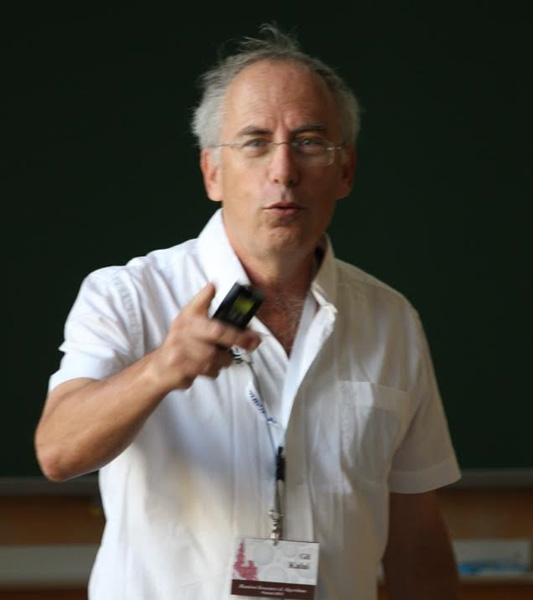
Gil Kalai is a Professor of Mathematics at the Hebrew University of Jerusalem since 1992, where he holds the Henry and Manya Noskwith Chair. He also serves as an Adjunct Professor of Mathematics and Computer Science at Yale University since 2004 in a long-term part-time visiting position. His academic career includes visiting positions at prestigious institutions including MIT, Cornell, IAS Princeton, Berkeley, Bell-labs, IBM, and Microsoft. Professor Kalai's research spans multiple areas within mathematics and theoretical computer science. His work in combinatorics encompasses geometric, probabilistic, and topological approaches. He has made significant contributions to the study of convex sets and polytopes, linear programming, and theoretical computer science. His influential 1988 paper with Kahn and Linial on Boolean functions pioneered applications of Fourier analysis in theoretical computer science. Kalai's research has evolved to include the application of Fourier analysis to thresholds, influences, symmetries, noise, percolation, and social choice. He has developed theories in algebraic shifting and studied face-numbers and other combinatorial invariants of polytopes. His work on the diameter of polytopes and randomized simplex algorithms has been influential in optimization theory. In 1993, his collaboration with Kahn produced a groundbreaking counterexample to Borsuk's Conjecture in 1325 dimensions. Professor Kalai's publications reveal a consistent focus on the intersection of combinatorics, geometry, and theoretical computer science. His work shows a progression from foundational combinatorial geometry to increasingly sophisticated applications of harmonic analysis in discrete mathematics. The recurring themes across his 30+ year career include Boolean functions, polytope theory, and probabilistic methods in combinatorics, demonstrating remarkable coherence in his research trajectory. 2016 European congress of Mathematics, plenary speaker 2013 ERC advanced grant 2012 Rothschild Prize 1994 International Congress of Mathematicians invited section talk, Zurich 1994 Fulkerson Prize 1993 Erdos Prize 1992 Polya Prize Though specific details of his advising are not provided in the source material, Kalai has written over 70 scientific papers and maintains an active research blog entitled "Combinatorics and More." His 2013 ERC advanced grant indicates significant research funding for his work. His extensive collaborations with researchers across multiple institutions suggest a robust research program with numerous PhD students and postdoctoral researchers, though specific names are not mentioned in the provided texts. Professor Kalai maintains active research connections across multiple institutions including Hebrew University, Yale, and various research centers worldwide. His work bridges pure mathematics and theoretical computer science, creating a unique interdisciplinary research environment that influences both fields.
David Jerison is a Professor of Mathematics at the Massachusetts Institute of Technology (MIT), where he conducts research in Fourier analysis and partial differential equations. His work focuses primarily on free boundary problems and, more recently, on internal Diffusion Limited Aggregation (internal DLA), a stochastic growth model. He maintains an active research program with numerous publications in leading mathematical journals. Professor Jerison's research spans several interconnected areas of mathematical analysis. His primary interests include Fourier analysis and partial differential equations, with particular emphasis on free boundary problems. In recent years, he has expanded his research to include internal Diffusion Limited Aggregation, a stochastic growth model that has connections to probability theory and mathematical physics. His work often bridges geometric analysis, spectral theory, and probabilistic methods, demonstrating the deep connections between different branches of mathematics. Analysis of Professor Jerison's recent publications reveals a consistent focus on geometric aspects of partial differential equations, particularly free boundary problems. His research shows progression from classical PDE theory toward more stochastic and probabilistic approaches, as evidenced by his work on internal DLA. The publications demonstrate interdisciplinary connections between mathematical analysis, probability theory, and mathematical physics, with applications ranging from geometric measure theory to quantum mechanics. Professor Jerison is actively involved in teaching and mentoring at MIT. He has taught courses including Differential Equations (18.03), Fourier Analysis and Applications (18.103), and Differential Analysis (18.155). He also directs the Summer Program for Undergraduate Research (SPUR), which is exclusively for MIT undergraduates, and organizes the mathematics section of the Research Science Institute (RSI) for high school students. His teaching materials are available through MIT's Open Courseware platform, indicating his commitment to educational outreach and accessibility.
Jon Keating is a Professor at the University of Oxford affiliated with the Mathematical Institute . His research spans Mathematical Physics , Number Theory , and Stochastic Analysis , with a focus on Random Matrix Theory and its applications to quantum systems and number theory. Research Trends: His recent work explores connections between random matrices and number-theoretic functions, with contributions to understanding moments of L-functions, characteristic polynomials, and quantum chaos. Key themes include asymptotic analysis, recursive structures, and interdisciplinary applications in nonlinear systems. Publications: Highlights include studies on CUE characteristic polynomials, the Ratios Conjecture, and collaborations in Nonlinearity , International Mathematics Research Notices , and Transactions of the American Mathematical Society .
Vladimir Spokoiny is a Professor at the Departments of Mathematics and Economics of the Humboldt University of Berlin and Head of the Research Group "Stochastic Algorithms and Nonparametric Statistics" at the Weierstrass Institute for Applied Analysis and Stochastics (WIAS) in Berlin, Germany. His research spans multiple areas of statistics, machine learning, and financial mathematics, with significant contributions to nonparametric statistics, high-dimensional data analysis, and statistical methods in finance. Spokoiny received his M.Sc. in applied mathematics from the Moscow Institute of Railway Engineering in 1981 and his Ph.D. in mathematics from Lomonosov Moscow State University in 1988. He completed his Habilitation at Humboldt University in 1996. His academic career includes positions at the All-Union Institute of Railway Transport in Moscow, the Institute for Information Transmission Problems in Moscow, and the Institute for Applied Analysis and Statistics in Berlin before joining the Weierstrass Institute and Humboldt University where he has been a professor since 2002. Spokoiny's research focuses on adaptive nonparametric smoothing and hypothesis testing, high dimensional data analysis, statistical methods in finance, image analysis with applications to medicine, classification, and nonlinear time series. His work often addresses the challenges of nonstationarity in time series data and develops innovative methods for volatility estimation and risk management. He has made significant contributions to the development of adaptive weights smoothing procedures, which have applications in image processing, community detection, and manifold learning. His recent work has expanded into high-dimensional statistics, Bayesian inference, and optimization methods for machine learning, with publications demonstrating novel approaches to Gaussian approximation, Laplace methods, and statistical inference in non-Euclidean spaces. Spokoiny has supervised numerous PhD students including Oliver Reiss, Danilo Mercurio, Ying Chen, Elmar Diederichs, and Mstislav Elagin, whose research has focused on mathematical finance, time series analysis, and statistical methods. He serves as an Associate Editor for The Annals of Statistics (since 2004) and Statistics and Decisions (since 2002), and has previously served on the editorial board of the Journal of Statistical Planning and Inference. His professional activities include reviewing for major statistical journals including Annals of Statistics, Bernoulli, Econometrica, and Journal of American Statistical Association, as well as reviewing grant proposals for the National Science Foundation (USA), German Research Foundation, and Netherlands Organisation for Scientific Research. Spokoiny is a member of several professional societies including the International Statistical Institute, American Statistical Association, Institute of Mathematical Statistics, and Bernoulli Society. He is fluent in Russian (mother tongue), English, and German, and has good knowledge of French. His research group at WIAS focuses on developing novel statistical methodologies with applications across various scientific domains, particularly emphasizing adaptivity and robustness in complex data environments. The group's work has significant implications for financial risk management, medical imaging, and machine learning applications, with recent publications addressing fundamental questions in high-dimensional statistics and nonparametric inference.