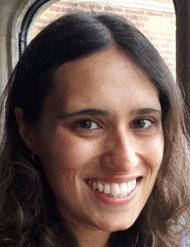
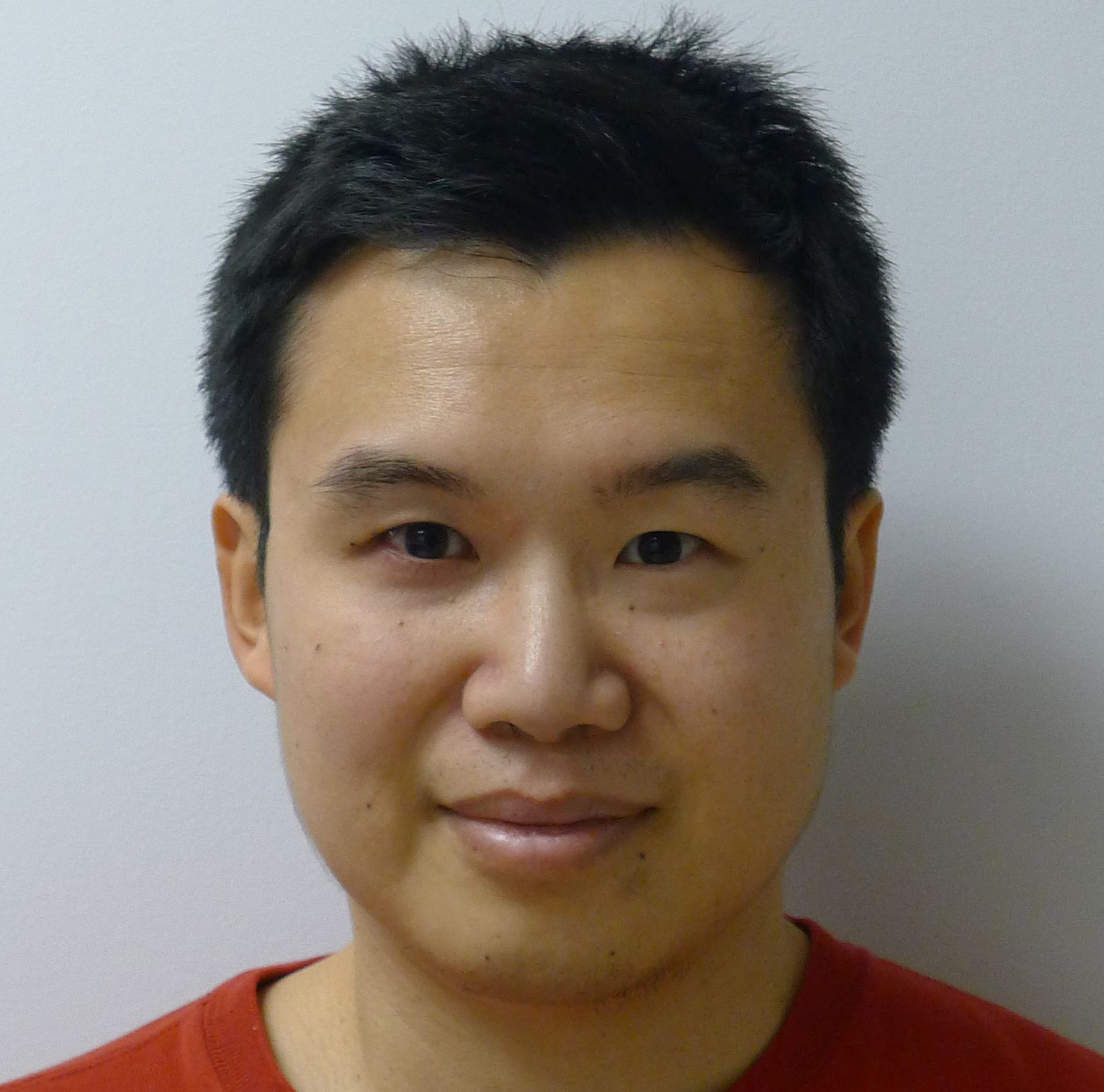
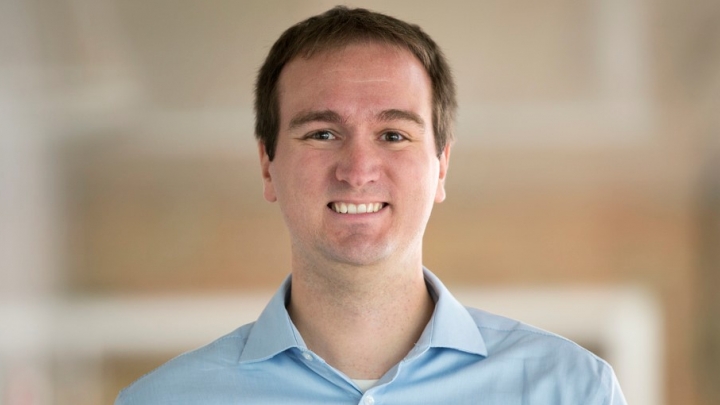
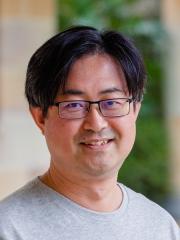
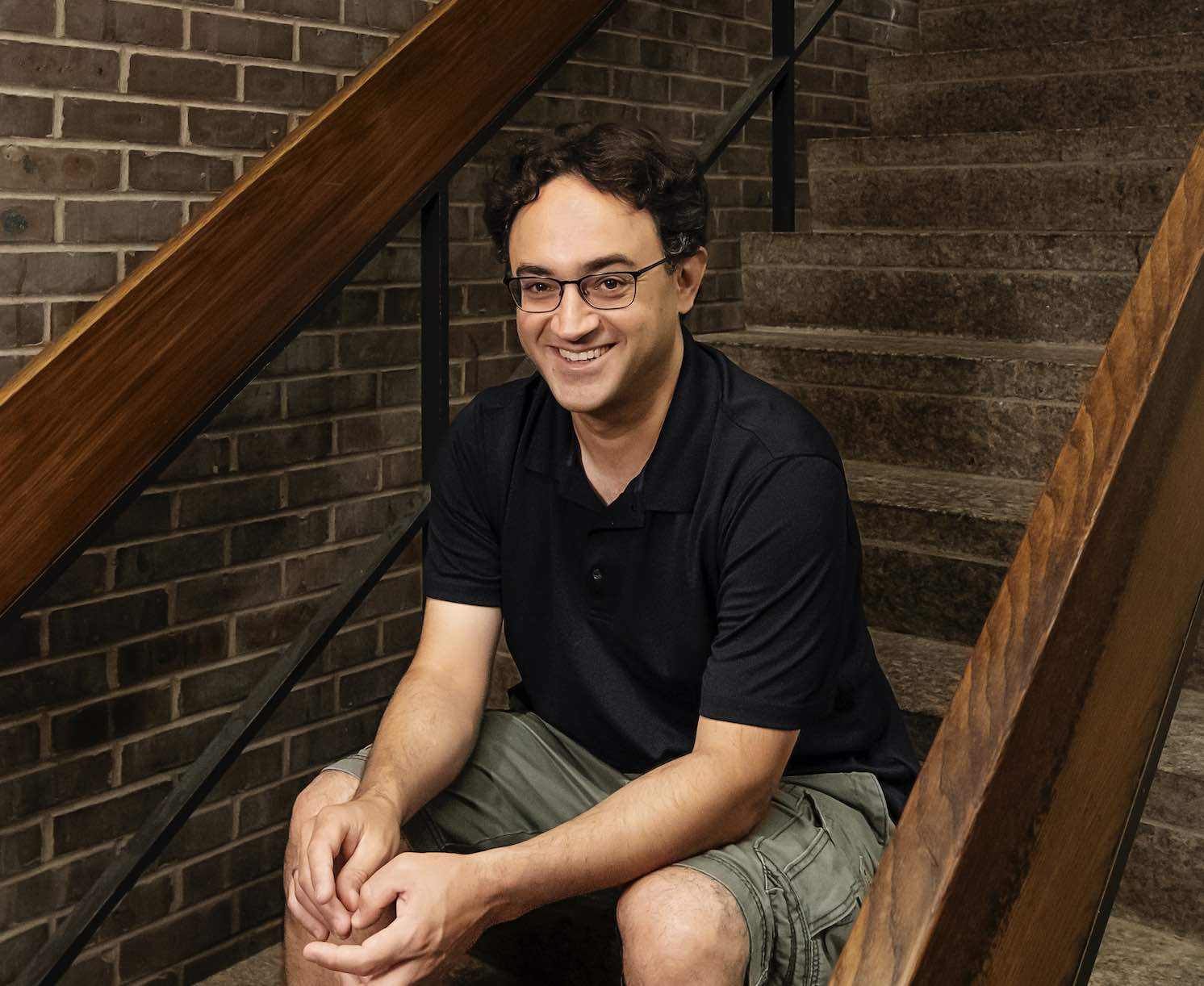
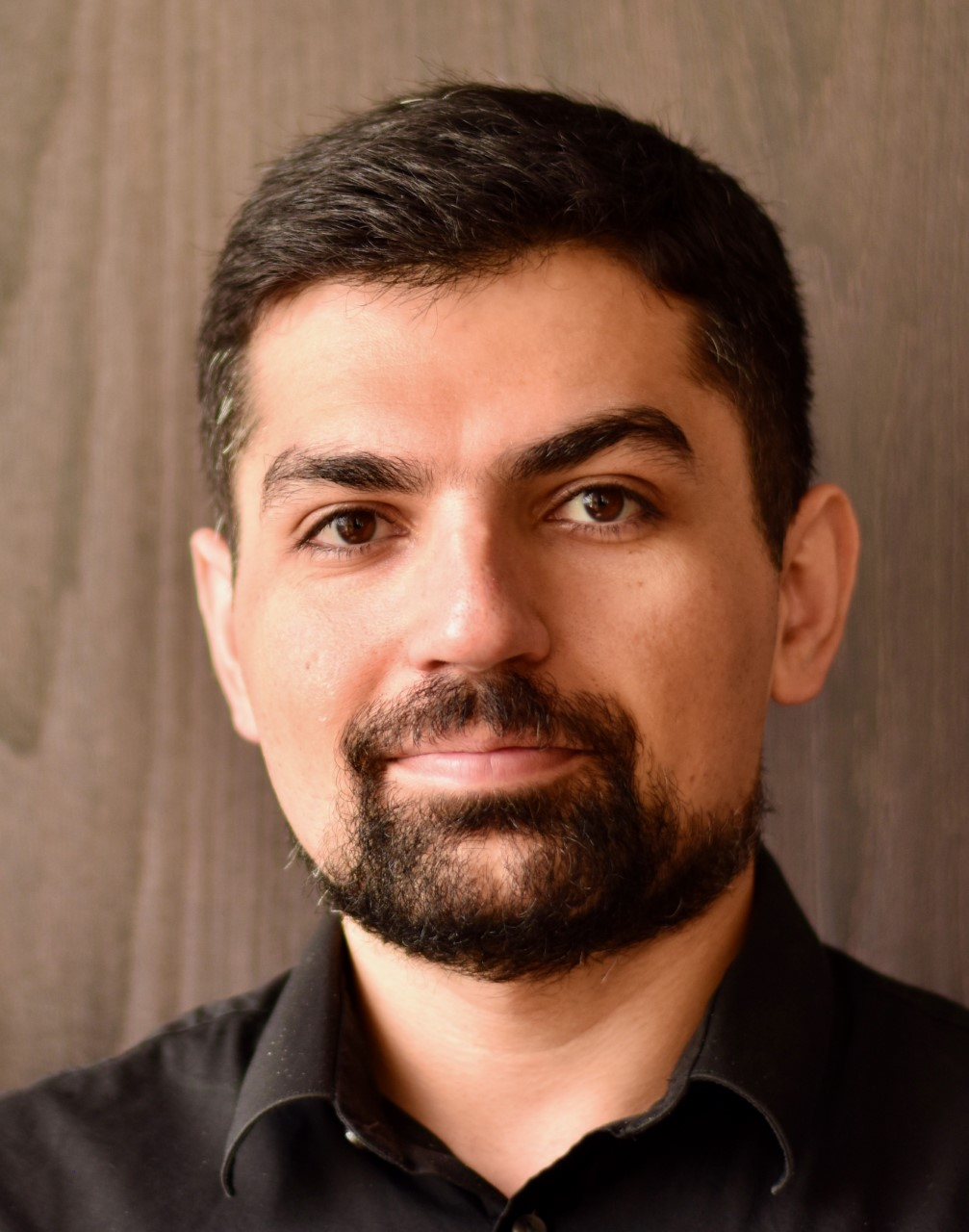
Natasha Morrison is an Assistant Professor in the Department of Mathematics and Statistics at the University of Victoria, Canada. She holds a PhD from the University of Oxford (supervised by Alex Scott) and completed her undergraduate studies at Durham University. Previously, she was a Research Fellow at Sidney Sussex College, Cambridge, and a Postdoctoral Research Fellow at IMPA in Brazil under Rob Morris. Her research focuses on extremal and probabilistic combinatorics, including extremal graph theory, random graphs, bootstrap percolation, Ramsey Theory, and additive combinatorics. She teaches courses such as Matrix Algebra and Graph Theory. She actively collaborates with researchers globally and supervises PhD, Master's, and undergraduate students. Morrison’s work has been published in leading journals like Journal of Combinatorial Theory, SIAM Journal on Discrete Mathematics, and Duke Mathematical Journal. She is known for contributions to topics like graph saturation, cross-Sperner systems, and pseudorandom graphs. Her research often bridges theoretical insights with probabilistic methods. Students supervised include Shannon Ogden (PhD), Ashna Wright (Master’s), and Akina Kuperus (Master’s). She collaborates with notable researchers such as Jonathan Noel, Shoham Letzter, and Rob Morris. Her academic journey includes postdoctoral work in Brazil and UK, reflecting her international research network.
Marini Andrea is an Associate Professor affiliated with the University of L'Aquila and the CNR Institute for Superconductors, Innovative Materials, and Devices. His work focuses on nonlinear optics, plasmonics, nanomaterials, and ultrafast phenomena. Key research areas include phase-matched nonlinear processes in layered semiconductors, chiroptical sensing using plasmonic nanostructures, and the development of novel photonic devices. He has over 120 peer-reviewed articles, with recent contributions published in Nature Photonics , Physical Review A , and ACS Photonics . His studies explore topics such as topological light bullets in graphene-based metamaterials and nonlinear dynamics in near-zero-index materials. Research interests span quantum optics, nanostructured materials, and ultrafast optical processes, with applications in photonics and sensing. His work often integrates theoretical and computational approaches, leveraging tools like the Yambo code for excited-state simulations. Collaborations involve institutions worldwide, including CLEO, Frontiers in Optics, and international conferences on metamaterials and plasmonics. Marini’s contributions address challenges in optical signal processing, energy-efficient photonics, and novel materials for next-generation photonic technologies. His lab focuses on advancing fundamental understanding and practical applications of light-matter interactions at nanoscale dimensions.
Dr. Partha Pratim Ghosh is a Postdoctoral Researcher at the Institute of Mathematical Stochastics, Faculty of Mathematics, Braunschweig University of Technology, mentored by Prof. Benedikt Jahnel. He holds a Ph.D. in Statistics (2022) from the Indian Statistical Institute under Antar Bandyopadhyay, with prior Bachelor's and Master's degrees from the same institution. His position includes teaching graduate courses in Stochastic Processes, Markov Processes, and Point Processes for Mathematics Masters programs. His research focuses on theoretical and applied probability with emphasis on: Branching Random Walks (extremal processes, perturbed systems) Percolation theory (Voronoi/confetti models) Telecommunication network traffic flow (drainage networks, Poisson navigations) Interacting Particle Systems and Ising Models on Random Graphs His work bridges statistical physics, combinatorics, and computer science through discrete probabilistic frameworks. Analysis of his 9 most recent publications (2017-2025) reveals dominant trends in: Extremal behavior of modified branching structures (60% of output) Geometric probability applications to networks (25%) Fundamental copula/percolation theory (15%) His methodology combines large deviation principles, asymptotic analysis, and stochastic geometry. As an associate scientist of the DFG Priority Programme on Random Geometric Systems, he collaborates internationally with researchers from INRIA, Weierstrass Institute, and Indian Statistical Institute. His Erdős number is 3. Dr. Ghosh maintains active research profiles via ORCID (0000-0002-4801-4538), Google Scholar, and ResearchGate, with office location at Room 618, Universitätsplatz 2, Braunschweig.
Kevin Cheung is an Associate Professor at Carleton University's School of Mathematics and Statistics. His academic focus includes combinatorial optimization, discrete mathematics, and programming language applications. Research Interests: His work spans combinatorial optimization, integer/logic programming, machine learning integration with mathematical methods, Lean 4 theorem proving, and computational mathematics. Key areas include algorithm design for numerical problems and discrete structures. Article Analysis: Recent publications (2022-2024) concentrate on computational mathematics, featuring Haskell implementations of algorithms for: numeral systems (negative bases), polynomial interpolation, diophantine equations, and combinatorics (balanced parentheses, compositions). Theoretical work includes convex optimization proofs. Teaching: Instructs calculus, discrete/linear algebra, mathematical logic, numerical analysis, and optimization courses. Contact: Primary email: kcheung@math.carleton.ca. Office: 4360 HP, Carleton University, 1125 Colonel By Drive, Ottawa, ON K1S 5B6, Canada.
Richard Arratia is a Professor of Mathematics at the University of Southern California, affiliated with the College of Letters, Arts and Sciences and the Center for Applied Mathematical Sciences. His research focuses on discrete probability, combinatorics, and number theory, particularly the interplay between dependence and independence in probabilistic systems. Education : B.S. from Massachusetts Institute of Technology, Ph.D. from University of Wisconsin, Madison. His work explores approximations of probabilities for rare events, continuum limits of discrete systems (e.g., coalescing Brownian motions), and logarithmic combinatorial structures such as permutations with cycle decompositions and prime factorizations of integers. He has co-authored a foundational book on logarithmic combinatorial structures and published extensively on topics including Poisson approximation, random walks, symmetric exclusion processes, and interlace polynomials for graphs. His recent publications highlight applications of probabilistic methods to integer partitions, graph theory, and statistical analysis. Key themes include exact simulation techniques, graphical sequences, and connections between analytic number theory and probabilistic models. Professor Arratia serves as faculty advisor to Pi Mu Epsilon, the undergraduate mathematics honors society, and has contributed to research in probability asymptotics, logistic regression, and algebraic function fields.
Louigi Addario-Berry is a Professor in the Department of Mathematics and Statistics at McGill University. He holds the Canada Research Chair Tier 1 and was awarded the Coxeter-James Prize in 2016. His research focuses on probability theory, discrete mathematics, and their applications. Key areas include random graphs, tree structures, stochastic processes, and combinatorial optimization. He has contributed to foundational work on the scaling limits of random graphs, properties of branching random walks, and algorithmic aspects of random discrete structures. His academic career includes notable collaborations on topics such as the minimum spanning tree of random graphs, critical phenomena in percolation models, and probabilistic methods in combinatorics. Addario-Berry’s work bridges theoretical probability with applications in computer science and statistical physics. He oversees research projects funded by NSERC and the Canada Research Chairs program, and his international collaborations span institutions in Europe and North America. Notable awards include recognition for his innovative contributions to probability theory and combinatorics. His research group explores cutting-edge questions in random discrete structures, with a focus on rigorous mathematical analysis of complex stochastic systems. He has supervised numerous graduate students and postdoctoral researchers, advancing the field through both theoretical insights and interdisciplinary applications.
Aaron Towne is an Assistant Professor in the Department of Mechanical Engineering at the University of Michigan's College of Engineering. His research focuses on developing physics-based and data-driven reduced-complexity models for understanding, predicting, and controlling turbulent fluid dynamical systems. Prior to joining the University of Michigan faculty, he was a Postdoctoral Fellow at Stanford University's Center for Turbulence Research. Towne received his PhD and MS degrees from the California Institute of Technology and his BS from the University of Wisconsin-Madison. His educational background has provided a strong foundation for his work at the intersection of fluid dynamics, computational methods, and data science. Towne's research interests span fluid mechanics, reduced-complexity modeling, data-driven modeling, flow control, and aeroacoustics. His group develops innovative methods for analyzing turbulent flows, with particular emphasis on resolvent analysis, spectral proper orthogonal decomposition, and space-time model reduction techniques. Their work addresses fundamental questions about coherent structures in turbulent flows while developing practical tools for flow estimation and control. The publication record demonstrates a strong trend toward developing scalable computational methods for analyzing complex fluid systems, with particular focus on turbulent jets, airfoil wakes, and boundary layers. Recent work has increasingly integrated data-driven approaches with physics-based modeling, creating hybrid methods that leverage the strengths of both paradigms. The research spans from fundamental fluid mechanics to practical applications in aerospace engineering and aeroacoustics. Towne has received numerous prestigious awards including the Air Force Office of Scientific Research Young Investigator Program (YIP) award in 2020, an NSF CAREER Award in 2023, and an Office of Naval Research YIP award in 2024. He has also received multiple best paper awards from the American Institute of Aeronautics and Astronautics (AIAA) and American Society of Mechanical Engineers (ASME). Towne actively mentors a diverse group of graduate students, currently advising seven PhD candidates and pre-candidates along with two master's students. His research has been supported by multiple grants from federal agencies including the Air Force Office of Scientific Research, National Science Foundation, and Department of Defense. His group has developed several open-source software tools including RSVD-Δt, RSVD-LU, and various implementations of spectral proper orthogonal decomposition. Towne leads a vibrant research group focused on turbulence modeling and control. The group maintains the AIAA Database for Reduced-Complexity Modeling, which provides publicly available flow data to support research in the fluid mechanics community. Their work bridges theoretical fluid dynamics with practical applications, particularly in the areas of jet noise reduction and flow control.
Emmanuel Abbé is a Full Professor at the École Polytechnique Fédérale de Lausanne (EPFL) , holding the Chair of Mathematical Data Science jointly under the School of Basic Sciences (SB) and School of Computer and Communication Sciences (IC) . His research focuses on the mathematical foundations of data science, combining probability, statistics, and discrete mathematics to advance machine learning and information theory. Research Interests : Community detection and stochastic block models Information theory and coding Deep learning theory and generalization bounds Graph-based data analysis and spectral methods Neural network regularization and optimization Mathematical aspects of AI and ML Scientific Awards : Foundation Latsis International Prize Bell Labs Prize NSF CAREER Award Google Faculty Research Award Walter Curtis Johnson Prize von Neumann Fellowship IEEE Information Theory Society Paper Award Simons-NSF Mathematics of Deep Learning Collaborative Research Award Advising and Grants : Prof. Abbé supervises multiple PhD students including Lotfi Jandaghi Aryo, Pushkin Denys, and Senouf Ortal Yona. His research is supported by grants from the Swiss National Science Foundation and other international bodies.
Alexander A. Razborov is the Andrew MacLeish Distinguished Service Professor of Computer Science and Mathematics at the University of Chicago and Adjoint Professor at the Toyota Technological Institute. His primary research focuses on complexity theory, including circuit complexity, proof complexity, quantum computations, and communication complexity. Previously he worked in combinatorial group theory and is actively exploring extremal combinatorics. He leads the Theoretical Computer Science Group, which connects computer science with physics, statistics, and mathematical sciences. His educational contributions include teaching Honors Discrete Mathematics, Mathematics of Quantum Computing, Complexity Theory, and other advanced topics. Razborov has received numerous prestigious awards including the Rolf Nevanlinna Prize (1990), Gödel Prize (2007), and election to the American Academy of Arts & Sciences (2020). He has supervised over 12 PhD and Master's students, with research spanning combinatorial open problems in proof complexity, continuous combinatorics, and communication complexity.
Dr. Dong-Hyuk Kim is a Senior Lecturer in the School of Economics at the University of Queensland, within the Faculty of Business, Economics and Law. He holds a PhD in Bayesian Econometrics for Auction Models from the University of Arizona (2010). His research focuses on Industrial Organization, Econometrics, and Microeconomics, with emphasis on auction theory, risk aversion, and development economics. Dr. Kim is affiliated with the Centre for Efficiency and Productivity Analysis and has published in top journals such as Journal of Econometrics and European Economic Review . His work bridges theoretical econometrics with applied economic problems, including optimal reserve pricing strategies, bidder behavior analysis, and the empirical relevance of ambiguity in auction models. Recent projects include studies on drought-resistant maize varieties in Malawi and government expenditure impacts in Sri Lanka. Dr. Kim is available for PhD supervision and actively contributes to methodological advancements in structural estimation techniques. Publications span topics like procurement mechanisms, risk-averse bidding strategies, and demand modeling using random coefficients frameworks. Ongoing research explores carbon emission trading in China's coal sector and managerial impacts on firm performance post-privatization in Vietnam.
Zeev Dvir is a Professor jointly appointed in the Department of Computer Science and the Department of Mathematics at Princeton University. His research interests span theoretical computer science, discrete mathematics, and their intersections with algebra and combinatorics. He focuses on computational complexity, pseudo-randomness, coding theory, and combinatorial geometry. Notable contributions include work on the Kakeya conjecture in finite fields, incidence theorems, and applications to coding theory. He has published extensively in top venues such as computational complexity conferences and journals. His work has been highlighted in Quanta Magazine for its impact on geometric problems. Zeev Dvir holds grants from the National Science Foundation (NSF), including awards for research on dimension expanders and line-point incidence problems. His research also intersects with areas like matrix rigidity and data structure lower bounds. He maintains an active research program and collaborates on foundational questions in theoretical computer science and mathematics. His homepage hosts surveys on incidence theorems and their applications, reflecting his commitment to bridging algebraic methods with discrete geometry. He is a prominent figure in the Princeton academic community, contributing to both departments through teaching and interdisciplinary research.
Todd Brun is a Professor at the University of Southern California, holding appointments in Electrical Engineering-Systems, Computer Science, and Physics and Astronomy. His research focuses on quantum information theory, quantum computing, and quantum error correction, with contributions to quantum cellular automata and relativistic quantum mechanics. He is affiliated with the Center for Information and Quantum (CILQ), part of the Viterbi School of Engineering and USC Dornsife College. Education: Ph.D. in Physics, California Institute of Technology (Caltech), Pasadena, CA Research Interests: Professor Brun explores foundational and applied aspects of quantum information science, including quantum error correction codes, quantum steganography, and quantum metrology. His work bridges theoretical frameworks (e.g., quantum field theories from cellular automata) with experimental implementations, such as steganographic entanglement sharing and noise-resilient quantum simulation. Recent Article Trends: Recent work emphasizes fault-tolerant quantum computation, continuous-time error correction, and the interplay between quantum systems and spacetime structure. Notable topics include steganographic protocols, QCA-based models, and hybrid machine learning approaches for quantum control. Grants & Funding: Includes NSF grants like FET: Small for decoding quantum error-correcting codes and exploring weak measurements with feedback. Labs/Teams: Active in the Center for Information and Quantum (CILQ), collaborating on multi-disciplinary projects in quantum computing and communication.
Kaave Hosseini is an Assistant Professor in the Department of Computer Science at the University of Rochester. He holds a PhD from UC San Diego and a BSc from Sharif University of Technology. His research focuses on theoretical computer science and additive combinatorics, emphasizing approximate algebraic structures and pseudorandomness. Education: PhD in Computer Science, UC San Diego (advisor: Shachar Lovett) BSc in Mathematics and Computer Science, Sharif University of Technology Research Interests: His work bridges theoretical computer science and mathematics, particularly in: Computational complexity Combinatorial structures Discrepancy theory Algebraic methods in computer science Key Publications: Recent works include advancements in communication complexity, pseudorandomness, and lower bounds. Notable achievements include a Best Paper Award at ICALP 2023. Awards: Best Paper Award at ICALP 2023. Teaching: He has taught courses such as Advanced Algorithms (CSC 484/284) and Analytic Methods in Computer Science (CSC 488/288) at the University of Rochester, and combinatorics and probability courses at Carnegie Mellon University. Professional Activities: Organized the Eastern Great Lakes (EaGL) workshop in Theory of Computation.
Nathan Kaplan is a Professor of Mathematics at the University of California, Irvine (UCI). He specializes in Number Theory, Arithmetic Algebraic Geometry, Coding Theory, and Combinatorics. He holds a PhD from Harvard University (2013) and has held postdoctoral positions at Yale University and the NSA. His research focuses on rational points on varieties over finite fields, arithmetic statistics, and cokernels of random matrices. Kaplan has authored over 40 publications and has been recognized with awards such as the UCI Outstanding Contributions to Undergraduate Education Award (2022) and the AMS-MAA-SIAM Morgan Prize (2008). He has advised numerous PhD students and mentors postdoctoral researchers, including Harold Polo and Gilyoung Cheong. His editorial roles include serving on the Springer Undergraduate Texts in Mathematics Advisory Board and as a Communicating Editor for Semigroup Forum. Kaplan is actively involved in organizing conferences like the Southern California Number Theory Day and has secured grants from the NSF and Simons Foundation. Teaching includes undergraduate and graduate courses in Number Theory, Algebra, and Combinatorics. He emphasizes undergraduate research, mentoring programs like SUMRY and REU initiatives. His outreach spans talks at museums, math circles, and national competitions, reflecting his commitment to mathematical education and diversity in STEM.
Dr. Irene Kyza is a Lecturer in Computational Mathematics at the University of St Andrews' School of Mathematics and Statistics. Her research focuses on developing advanced numerical methods for solving complex partial differential equations arising in physical systems. Core research areas include: Structure-preserving algorithms for Schrödinger-type equations A posteriori error analysis for nonlinear evolution equations Adaptive numerical methods for blow-up detection Wave dynamics and instability phenomena Her publication portfolio demonstrates consistent focus on numerical analysis of wave phenomena, particularly Schrödinger equations and hydrodynamic models. Recent work emphasizes efficient approximation techniques for ocean wave modeling and stochastic sea states. She currently supervises PhD candidate Yilin Wang and contributes to research on adaptive time-stepping schemes and regularization techniques for singular solutions.