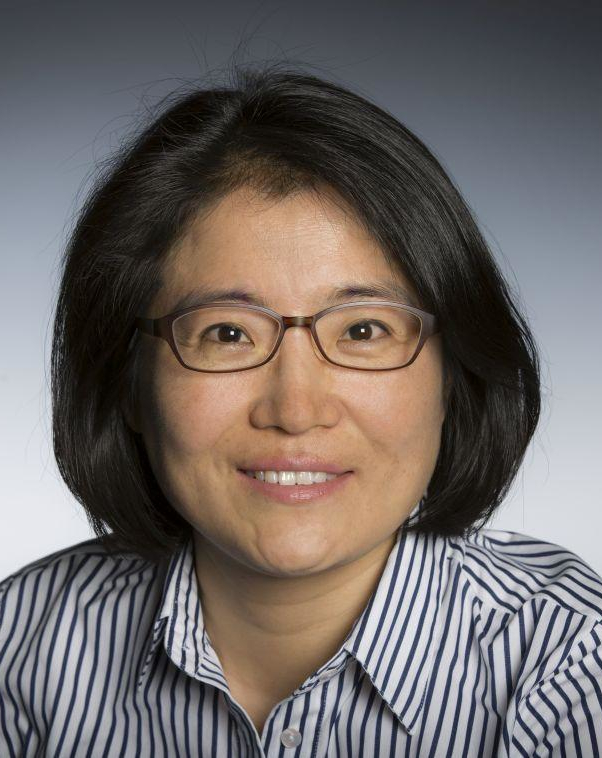
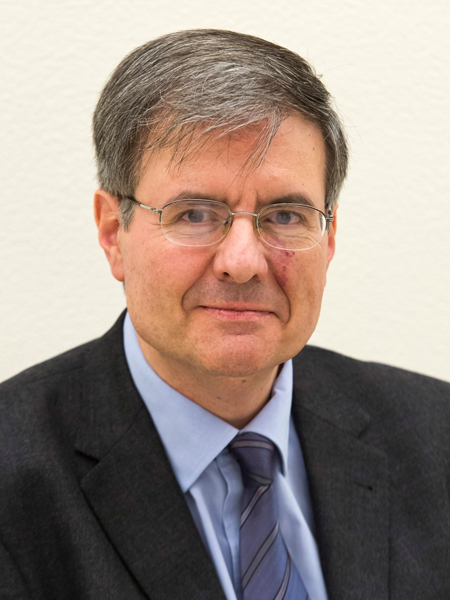
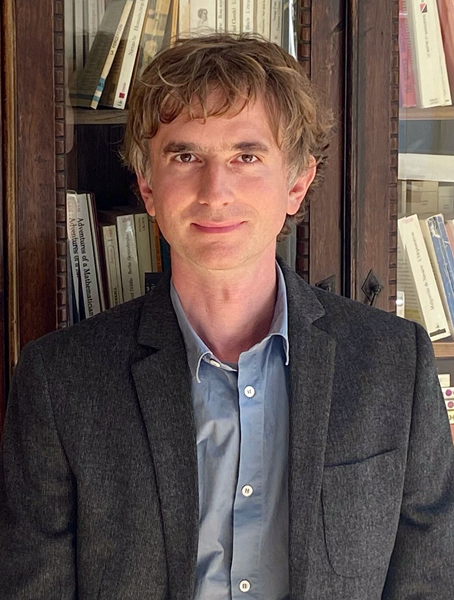
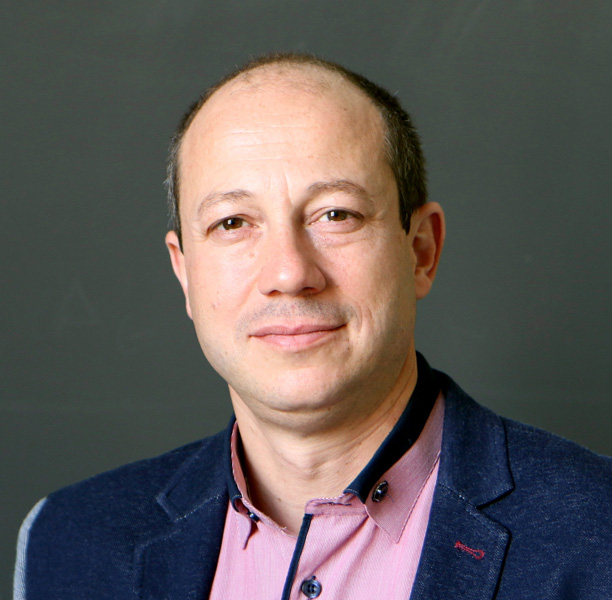
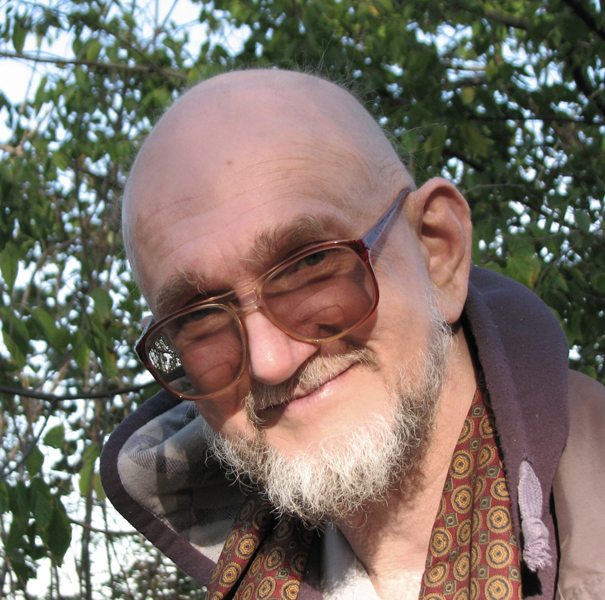
Jan Dreier is a Research Fellow at the Institute of Logic and Computation at Vienna University of Technology. His research centers on structural graph theory and algorithmic meta-theorems, particularly exploring the boundaries of tractability for model checking problems. Dreier's work bridges theoretical computer science and discrete mathematics, focusing on graph decompositions, parameterized complexity, and logical expressiveness. Key research themes include monadic stability in graph classes, applications of model theory to computer science, and efficient algorithms for logical queries on structured graphs. His publication record shows consistent focus on graph sparsity concepts and algorithmic applications of logic, with recent work expanding into approximation methods for counting queries. Research demonstrates sophisticated applications of combinatorial methods to fundamental problems in computational complexity.
Mihyun Kang is a Professor in the Institute of Discrete Mathematics at Graz University of Technology (TU Graz), leading the Combinatorics Group. She holds significant academic positions and has been recognized with a Heisenberg Fellowship (German Research Foundation) and a Friedrich Wilhelm Bessel Research Award (Alexander von Humboldt Foundation). Her research focuses on combinatorics, discrete probability, and algorithms, with a specialization in random graph theory. She contributes to editorial boards, including Random Structures & Algorithms . Her research interests emphasize high-dimensional graphs, percolation processes, and structural properties of random graphs. She explores topics such as phase transitions, graph enumeration, and algorithmic applications in combinatorial problems. Her work bridges theoretical foundations with practical applications in algorithm design and probabilistic modeling. Dr. Kang’s scientific achievements include pioneering studies on hypergraphs, bootstrap percolation, and the evolution of random graph processes. Her recent publications highlight advancements in understanding graph components, connectivity thresholds, and universality phenomena in random structures. She collaborates widely, contributing to conferences and international initiatives like the SFB “Discrete random structures: enumeration and scaling limits.” Her professional activities include advising doctoral students and supervising research projects at TU Graz. She leads the Combinatorics Group, which hosts the Graz Combinatorics Seminar and actively engages in academic outreach. Her contributions extend to textbook authorship, including Diskrete Mathematik für die Informatik , and she maintains an active presence in discrete mathematics education and research.
Manuel Arellano is Professor of Economics at the Center for Monetary and Financial Studies (CEMFI) in Madrid since 1991, with prior appointments at the University of Oxford (1985-89) and London School of Economics (1989-91). A leading econometrician specializing in panel data analysis, his work bridges theoretical econometrics and labor economics applications. He earned his undergraduate degree from the University of Barcelona and Ph.D. from the London School of Economics. Arellano's research focuses on econometric methodology for panel data, particularly dynamic models with heterogeneity. His seminal book Panel Data Econometrics (2003) established foundational frameworks for nonlinear and dynamic panel estimation. Current work extends to distributional analysis of random coefficients and robust inference under uncertainty, maintaining consistent emphasis on labor market applications like unemployment duration and policy evaluation. His publication history reveals a 30-year trajectory advancing panel data econometrics, evolving from specification testing (1987-1995) to sophisticated dynamic and nonlinear models (2003-2014), with persistent focus on practical implementation and labor economics applications. Major honors include: President of the Econometric Society (2014) Foreign Honorary Member of the American Academy of Arts and Sciences (2014) Rey Jaime I Prize in Economics (2012) ISI Highly Cited Researcher status (2010) Fellow of the Econometric Society (2002) No information on student advising or research grants appears in the source materials. Similarly, details about research laboratories or collaborative teams are not documented in the provided texts.
Emmanuel Breuillard is a Professor of Pure Mathematics at the University of Oxford. Previously, he held positions as Sadleirian Professor at the University of Cambridge (2017-2021), Professor at Université Paris-Sud (2008-2017), and Associate Hadamard Professor at École Polytechnique (2006-2008). His academic journey includes a PhD from Université Paris-Sud and Yale University, supervised by Frédéric Paulin and Gregory Margulis, and a Master in Mathematics from Cambridge. PhD: Université Paris-Sud (2004), supervised by Frédéric Paulin; Yale University, supervised by Gregory Margulis Master: University of Cambridge (2000) Ecole Normale Superieure (1997-1999) His research spans Combinatorics , Geometric Group Theory , Ergodic Theory , and Number Theory , focusing on approximate groups, expansion in finite simple groups, and Diophantine geometry. His recent work analyzes Elekes-Szabo problems in projective geometries. He has authored 50+ publications in prestigious journals, addressing topics like random polynomials, C*-simplicity, and uniform independence in linear groups. Fellow of the Royal Society (2024) ERC Consolidator Grant (2014-2019) Prix Charles-Louis de Freycinet (2013) European Mathematical Society Prize (2012) ERC Starting Grant (2008-2013) Cours Péccot, Collège de France (2006)
Nathanael Berestycki is a University Professor (Univ.-Prof.) in the Department of Mathematics within the Faculty of Mathematics. His research spans multiple areas of probability theory and mathematical physics with a particular focus on stochastic processes and their connections to statistical mechanics and quantum gravity. Professor Berestycki's research interests center around probability theory, with significant contributions to the understanding of Gaussian free fields, Liouville quantum gravity, and random processes. His work explores deep connections between statistical mechanics and mathematical physics, particularly in the context of conformal invariance and scaling limits. He has made substantial contributions to the theory of dimers, Brownian motion, random graphs, and branching processes, often revealing unexpected connections between seemingly disparate areas of mathematics. Analysis of his recent publications shows a consistent focus on the intersection of probability theory and mathematical physics, with particular emphasis on conformal invariance properties, scaling limits of discrete models, and the mathematical structure of quantum gravity. His work often bridges theoretical developments with concrete applications in statistical mechanics, demonstrating how deep mathematical structures emerge from seemingly simple probabilistic models. The breadth of his research is reflected in publications across top probability and mathematical physics journals. Throughout his career, Berestycki has maintained a high level of productivity with consistent publication output across leading journals in probability theory and mathematical physics. His collaborative work with researchers across institutions demonstrates strong connections within the mathematical community, particularly in the European probability research network.
Benjamin Sudakov is a Professor of Mathematics at ETH Zurich, where he has held positions since 2013. Previously, he served as a Professor at UCLA (2007-2014) and as an Assistant Professor at Princeton University (2002-2007). He has also been affiliated with the Institute for Advanced Study (2005-2006) and held prestigious fellowships including the Veblen Instructorship (1999-2002). His academic journey began with a Ph.D. from Tel Aviv University in 1999 under the supervision of Noga Alon. Education: Ph.D. in Mathematics, Tel Aviv University (1999) Advisor: Noga Alon Sudakov is a leading expert in combinatorics, with primary research interests in probabilistic and extremal combinatorics, random structures, and the application of combinatorial methods to theoretical computer science and mathematics. His work spans algebraic combinatorics, Ramsey theory, and graph theory, addressing foundational questions and developing novel methodologies. His publications and talks highlight his contributions to Ramsey graphs, equiangular lines, hypergraph theory, and submodular optimization. Key themes include structural graph theory, extremal problems, and probabilistic techniques in discrete mathematics. Scientific Awards: Humboldt Research Award (2014) Fellow of the American Mathematical Society (2013) Invited Speaker, ICM 2010 David Saxon Presidential Term Chair (2007-2011) NSF CAREER Award (2006-2011) Alfred P. Sloan Fellowship (2004-2006) Sudakov has mentored 21 Ph.D. students, including prominent mathematicians like Peter Keevash, Jacob Fox, and Matija Bucic, many of whom hold academic positions globally. He has received significant funding, including the SNSF grant 200021_196965, and actively participates in editorial boards and workshops on extremal combinatorics and related fields. Notable among his collaborative efforts is a series of workshops and seminars at institutions like Banff Research Center, IPAM, DIMACS, and BIRS, focusing on probabilistic and extremal combinatorics. His teaching includes graduate-level courses such as Graph Theory, Probabilistic Methods in Combinatorics, and Algebraic Methods in Combinatorics.
Michał Karoński is a Professor of Mathematics at the Faculty of Mathematics and Computer Science, Adam Mickiewicz University, Poznań, Poland, and serves as head of the Department of Discrete Mathematics. He has held visiting professorships at Emory University, The Johns Hopkins University, Purdue University, and Southern Methodist University since 1975, with ongoing engagements at Emory University since 1992. Research Focus: Discrete mathematics, random discrete structures, graph theory, and theoretical computer science. Leadership Roles: Editor-in-Chief of Random Structures & Algorithms (since 1990), Chairman of the Council of National Science Centre (2010–2016), and organizer of 17 bi-annual conferences on random structures. His research group in random structures gained international recognition in the 1970s. He has authored 60 publications, delivered over 30 plenary lectures, and collaborated globally at institutions like Microsoft Research, Bellcore, and BRICS. Scientific Awards: 2016 Medal 'Homini Vere Academico' (AMU Rector) 2013 Polonia Restituta Officer Cross (President of Poland) 1990 Minister of Science and Higher Education Prize His work spans probabilistic combinatorics, algorithm theory, and graph irregularity, with influential publications on stochastic Kronecker graphs, random intersection graphs, and distributed complexity in matchings.
Nikolay Konstantinovich Vereshchagin is a Professor at Lomonosov Moscow State University's Faculty of Mechanics and Mathematics. He also holds affiliations with the Poncelet Lab (since 2005), Yandex School of Data Analysis (since 2007), and Higher School of Economics (since 2013). Education: Moscow State University (Faculty of Mechanics and Mathematics) Degrees: Ph.D. (1987), Doctor of Physical and Mathematical Sciences (1996), Full Professor (1997) His research focuses on computational complexity, Kolmogorov complexity, Shannon entropy, and tiling problems. His work connects algorithmic information theory with machine learning, cryptography, and theoretical computer science. Publications demonstrate expertise in algorithmic statistics, oracle complexity, and randomness foundations, with collaborations in theoretical computer science journals and conferences like CiE (Computability in Europe).
Ecaterina Sava-Huss is a Full Professor in Mathematics at the University of Innsbruck, Austria, affiliated with the Department of Mathematics within the Faculty of Mathematics, Computer Science and Physics. She holds a PhD from Graz University of Technology (2010) and a Habilitation in Mathematics (2019). Previously, she served as an associate professor and tenure-track assistant professor at the University of Innsbruck, and as an assistant professor and visiting scholar at institutions including TU Graz and Cornell University. Her research focuses on stochastic processes, particularly random walks and rotor walks on graphs, fractals, and aggregation models. Key interests include the interplay between structural properties of infinite state spaces and stochastic processes. She has organized conferences such as the Austrian Stochastics Days and is the outreach coordinator for the Institute of Mathematics, engaging in public science initiatives like the MIP Day and Girls' Day. Her funding includes an FWF Grant P34129 (2021–2025) on growth models and quasi-random walks, and a prior Erwin Schrödinger Fellowship (2015–2016). She has supervised numerous PhD and Master’s students, with research topics ranging from branching processes to quantum probability. Her work has been published in journals such as Advances in Applied Probability , Bernoulli , and Journal of Fractal Geometry .
Professor Jaroslav Nesetril is affiliated with Charles University's Faculty of Mathematics and Physics since 1970 and serves as Director of the Institute of Theoretical Informatics (ITI) since 2000. He holds a full professor position since 1993 and has maintained adjunct roles at University of Waterloo (2000-2003) and visiting positions at prestigious institutions including University of Bonn (John von Neumann Professor) and University of Chicago. Fields of scholarship: Combinatorics, Graph Theory, Algorithmics, and Discrete Mathematics Leadership roles: Department Chairman (1986-1999), Director of ITI (2000-present) His research focuses on combinatorial structures, graph homomorphisms, and computational complexity. As a leading figure in discrete mathematics, he has contributed extensively to Ramsey theory, sparsity, and combinatorial number theory through both research and editorial leadership. Scientific honors include: Doctor Honoris Causa from Universite Bordeaux I (2009) and University of Alaska (2005) Gold medal from Charles University's Faculty of Mathematics and Physics (2011) State prize of Czechoslovakia (1985) Memberships in Academia Europaea (2012) and Hungarian Academy of Sciences (2013) He has served on editorial boards of major journals including Combinatorica, Journal of Graph Theory, and Random Structures and Algorithms, while maintaining active research leadership through DIMATIA Centre and European networks like COMBSTRU.
Jin-Yi Cai is a distinguished Professor of Computer Science and Steenbock Professor of Mathematical Sciences at the University of Wisconsin at Madison, where he has been a faculty member since 2000. Previously, he held academic positions at State University of New York at Buffalo (Professor 1996-2000, Associate Professor 1993-1996), Princeton University (Assistant Professor 1989-1993), and Yale University (Assistant Professor 1986-1989). He has also been a Radcliffe Institute Fellow at Harvard University (2007-2008) and a Guggenheim Fellow and Visiting Professor at the University of Toronto (1999-2000). Dr. Cai earned his Ph.D. in Computer Science from Cornell University in 1986, an M.A. in Mathematics from Temple University in 1983, and a Certificate in Mathematics from Fudan University in 1981. His academic journey spans prestigious institutions across the United States and demonstrates a consistent trajectory of scholarly excellence. Professor Cai's research focuses on theoretical computer science, particularly computational complexity theory, with significant contributions to holographic algorithms, counting constraint satisfaction problems, and graph homomorphisms. His work bridges computer science and mathematics, developing sophisticated algorithms and proving fundamental complexity results. His research has evolved from foundational work in structural complexity and oracle separations to specialized work in holographic algorithms and counting problems, demonstrating both depth and breadth in theoretical computer science. His publication record shows a consistent output of high-impact research, with major contributions spanning over three decades. His work on holographic algorithms represents a particularly innovative strand of research that has opened new avenues in computational complexity. The progression of his research demonstrates increasing specialization in counting problems while maintaining connections to broader theoretical frameworks in computer science and mathematics. 2022 Simons Fellowship 2022 CCF Award for Overseas Outstanding Contribution 2022 Fellow, American Mathematical Society (AMS) 2021 Fulkerson Prize in Discrete Mathematics 2021 Gödel Prize in Theoretical Computer Science 2014 Steenbock Professorship, UW Madison 2001 ACM Fellow 1998 John Simon Guggenheim Fellowship 1994 Sloan Fellowship Professor Cai has served as Editor of the Journal of Computer and System Sciences and Associate Editor of the Journal of Computational Complexity. His work has been recognized with numerous prestigious fellowships including the Guggenheim Fellowship, Sloan Fellowship, and Humboldt Research Award. His research has had significant impact in theoretical computer science, earning him the Gödel Prize and Fulkerson Prize, two of the most prestigious awards in theoretical computer science and discrete mathematics respectively.
Emo Welzl has been a Full Professor of Computer Science at the Institute for Theoretical Computer Science, ETH Zurich since 1996. His academic journey spans institutions including Free University of Berlin, University of Denver, Rijks University Leiden, and collaborations through graduate programs like the Berlin-Zurich Graduate Program in 'Combinatorics, Geometry, and Computation'. 1996–Present: Full Professor of Computer Science, ETH Zurich 1987–1996: Full Professor of Mathematics (theory of computation), Free University of Berlin Education Diplom in Applied Mathematics, Graz University of Technology (1981) Ph.D. in Formal Languages, Graz University of Technology (1983) Habilitation in Foundations of Computer Science, Graz University of Technology (1988) Research Interests Welzl's work focuses on foundations of computer science , with emphasis on algorithms , data structures , and computational geometry . Key subfields include combinatorial optimization , randomized methods , and discrete geometry . His recent interests extend to satisfiability problems. Honours and Awards Max Planck Prize (1992) Gottfried Wilhelm Leibniz-Prize (1995) ACM Fellow (1998) Member of Leopoldina (2005), Academia Europaea (2006), and Berlin-Brandenburg Academy (2007) Service and Leadership He has chaired program committees for major conferences like the ACM Symposium on Computational Geometry (1995), ICALP (2000), and European Symposium on Algorithms (2007). He served on editorial boards of journals including the Journal of Discrete and Computational Geometry and ACM Transactions on Computation Theory .
Alexander Glazman is an Associate Professor at the University of Innsbruck , leading the FWF-funded project on Order-disorder phase transitions in 2D lattice models . His research focuses on the intersection of Probability Theory and Mathematical Physics, particularly studying phase transitions and critical phenomena in models like the Loop O(n), Six-Vertex, Ashkin-Teller, and Ising models. Education : PhD in Mathematics, University of Geneva (2016), supervised by Stanislav Smirnov. Candidate of Physico-Mathematical Sciences, St. Petersburg State University (SPbU) and PDMI (under Dmitry Karpov). Master's degree in Mathematics, St. Petersburg. Research Interests : Glazman investigates statistical mechanics models, emphasizing rigorous analysis of phase transitions, loop models, and critical phenomena. Key areas include: Loop O(n) and Six-Vertex models on hexagonal/triangular lattices. FK-percolation, Ashkin-Teller model, and their connections to random-cluster representations. Height functions, interface fluctuations, and conformal invariance. Self-avoiding walks and their universality. Recent Work Trends : His articles address interface convergence in Potts models, delocalization in Lipschitz functions, and phase diagrams of Ashkin-Teller and six-vertex models. Collaborations emphasize techniques like coupling methods, renewal theory, and Benjamini-Schramm limits. Grants & Projects : Principal Investigator (PI) of FWF Stand-Alone Grant P 34713 (€399k), studying 2D lattice models' phase transitions. Labs/Teams : Active in the Department of Mathematics at Innsbruck, contributing to probabilistic and mathematical physics research groups.
Imre Z. Ruzsa is a Research Professor at the Alfréd Rényi Institute of Mathematics of the Hungarian Academy of Sciences since 1989, head of the Department of Number Theory since 1991. He is also part-time faculty at Central European University. Education: B.S. in Mathematics, Eötvös Loránd University, Budapest (1976) Candidate of Sciences (Ph.D. equivalent) (1979) Doctor of Sciences (D.Sci.) (1990) Research Interests: A leading expert in Additive Combinatorics and Number Theory , his work bridges Probabilistic Number Theory and Combinatorics , focusing on sumsets, Sidon sequences, and entropy connections. His Additive Number Theory contributions include structural theorems and linear equation solutions in integer sets. Scientific Awards: Fellow of the American Mathematical Society (2012) Rollo Davidson Prize (1986) Pichoridis Distinguished Lecturer (2007) Academy Prize (1995) Erdõs Prize (1988) Corresponding Member (1998) and Full Member (2004) of the Hungarian Academy of Sciences Labs/Teams: Head of the Department of Number Theory at the Alfréd Rényi Institute, leading collaborative research in additive structures and probabilistic methods in number theory.
Daniel Krenn is an Assistant Professor in the Mathematics Department at Paris Lodron University of Salzburg. He holds a Ph.D. in Technical Mathematics from TU Graz (2013) and a Habilitation in Mathematics from Alpen-Adria Universität Klagenfurt (2019). His research focuses on discrete mathematics, including asymptotic enumeration, analysis of algorithms, analytic combinatorics, digit expansions, and graph theory. He has contributed to software development in SageMath, particularly in automata and transducer modules. Education: 2003–2009: Diploma in Electrical Engineering (TU Graz) 2005–2008: Bachelor's in Technical Mathematics (TU Graz) 2008–2010: Master's in Mathematical Computer Science (TU Graz) 2010–2013: Ph.D. in Technical Mathematics (TU Graz) 2019: Habilitation in Mathematics (Alpen-Adria Universität Klagenfurt) Research Interests: Discrete Mathematics Analysis of Algorithms and Data Structures Digit Expansions and Cryptography Combinatorics and Analytic Number Theory Key Awards: Promotio sub auspiciis Praesidentis rei publicae (2013) Austrian Mathematical Society Study Prize (2013) Austrian Federal Ministry of Science and Research Prize (2013) Professional Contributions: Coordinator of the doctoral program “Discrete Mathematics” at TU Graz (2015) Contributions to SageMath software development Over 30 peer-reviewed publications in journals like Algorithmica, Theoretical Computer Science, and Journal of Number Theory