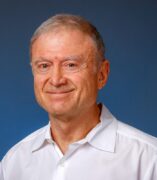
Svein Erik Bratsberg is a Professor at the Norwegian University of Science and Technology (NTNU) in the Department of Computer Science, Faculty of Information Technology and Electrical Engineering. His research focuses on databases, distributed systems, and high-velocity big data. Current Affiliation: NTNU/IDI Research Focus: Velocity in Big Data, Scalable Indexing, Structured Queries Previous Affiliation: Clustra (real-time databases) Research Centers: SFI iAD (2007-14), SFU Excited He has developed next-generation search engines and optimized distributed inverted indexes. His work includes entity linking, query processing, and dynamic optimization of pivot-based indexing systems. Scientific awards are not documented in the provided text. His recent publications focus on entity search, query processing techniques, and distributed retrieval architectures. Courses: TDT4145 Data Modeling, TDT4225 Distributed Data Volumes, TDT02 Distributed Systems Contact: sveinbra@ntnu.no
Gruia-Catalin Roman is a Professor in the Department of Computer Science at the University of New Mexico, within the College of Engineering. He has maintained a long-standing and impactful career in computer science research and education, with a focus on mobile computing, distributed systems, and the Internet of Things. His work bridges theoretical foundations and real-world applications, particularly in sensor networks and smart environments. Ph.D., Computer and Information Sciences, University of Pennsylvania, 1976 M.S., Computer and Information Sciences, University of Pennsylvania, 1974 B.S., Computer Science and Engineering, University of Pennsylvania, 1973 Roman's research interests center on enabling natural, responsive, and personalized interactions between people and smart environments. He explores middleware, formal methods, and human-centered computing to support IoT, mobile systems, and distributed applications. His work emphasizes paradigm shifts in how users interact with technology, particularly through spatial characteristics, augmented reality, and context-aware automation. The recent articles reflect a strong trajectory toward intelligent, user-aware IoT systems. Themes include conflict prediction, seamless automation, AR-based control, and abstraction layers like the Space Broker. These works demonstrate a shift from device-centric to human-centric computing, leveraging machine learning, middleware, and distributed algorithms to reduce user cognitive load and enhance personalization. SenSys 2022 Test of Time Award for early efforts to introduce sensor networking technology into clinical practice Roman has supervised 19 doctoral students, many of whom have pursued academic careers. He has secured significant research funding, including an NSF grant on context-assisted interactions in IoT with UT Austin. His leadership extends to organizing flagship conferences such as ICSE 2005 and FSE 2010, and serving on editorial boards of top software engineering journals. He is known for his innovative teaching, mentoring, and advocacy for active learning and multidisciplinary collaboration. Roman leads the Mobile Computing Laboratory (MobiLab), where students and researchers prototype and evaluate IoT interaction paradigms. The lab explores smart glasses, QR-based interfaces, and spatial control algorithms. His work often involves collaborations across institutions and disciplines, reflecting his commitment to impactful, real-world computing solutions.
Philippe Cudré-Mauroux is a Full Professor at the University of Fribourg, Switzerland , where he leads the eXascale Infolab . He has held visiting researcher positions at MIT and Microsoft CISL , and serves on the Research Council of the Swiss National Science Foundation and the Scientific Advisory Board of the CHIST-ERA EU Research Programme . Research Interests: His work spans exascale information management , big data , AI , knowledge graphs , linked data , time series data repair , and emergent semantics . He focuses on building scalable, intelligent data systems that integrate storage, computation, and semantics. Publication Trends: His recent work emphasizes schema-aware knowledge graph completion , time series imputation and benchmarking , hardware-accelerated data systems , and large language models for data cleaning . His research bridges database systems, AI, and systems architecture, often targeting high-performance, real-world applications. Scientific Awards: ERC Consolidator Grant (2016) Google Faculty Research Award (2013) Verisign Internet Infrastructures Award (2012) Best Paper Awards at VLDB (2020), AAMAS (2019), and Swiss Data Science Conference (2020) EPFL Doctorate Award and Press Mention (2007) Best Mentor Award at ISWC (2010) Advising and Grants: He mentors a large group of researchers and students, many of whom are co-authors on his publications. He has secured significant funding, including a €2M ERC Grant and multiple Google and Amazon grants, supporting a vibrant research lab focused on next-generation data infrastructure. Labs and Teams: He leads the eXascale Infolab at the University of Fribourg, a dynamic research group actively publishing in top-tier venues and developing innovative tools for data management and AI integration.
Kerstin Schneider is a full-time Professor for Databases at Harz University of Applied Sciences since 2007. She operates within the Faculty of Automation and Informatics , focusing on database theory, data engineering, and AI-driven educational technology solutions. Current research emphasizes adaptive e-learning platforms (ALEA system) Interdisciplinary projects in AI Engineering (AiEng 2021-2025) Custom database applications for SMEs (TEA project) Her research interests span: Reliable workflow execution in distributed systems Multimedia information systems Semantic data recommendations Temporal XML database models Recent publications (2021–2017) highlight trends in: Academic database foundations Intelligent e-learning architectures Life science data analytics Historical data visualization Scientific Awards : 2004 Research and Innovation Award of the Rhine-Neckar Triangle Foundation She contributes to academic governance through roles in: Steering Committee for Fundamentals of Databases Examination Board AI Engineering Senate Deputy at Harz University Equal Opportunities Officer for AI Department Key collaborative projects include: APRICOTS (CORBA-based workflow systems) GEIST (Intelligent History Information Systems) Team projects with international universities Open Educational Resources (OER) development
Xiaoxing Ma is a Professor at the State Key Laboratory for Novel Software Technology , Nanjing University , focusing on Software Engineering , Self-adaptive Software Systems , and Software Engineering for Machine Learning . His recent work bridges neuro-symbolic reasoning and formal verification. Key research areas: Software Engineering, Self-adaptive Systems, Neuro-symbolic AI Awards: China National Awards (2006, 2011), MOE Award (2010), CVIC SE Award (2009) His 2023-2024 publications emphasize: Formal semantics for hardware description languages (Verilog) Neuro-symbolic frameworks for mathematical reasoning Dynamic update verification and CRDT model checking LLM-driven API migration and traceability recovery He serves as Program Co-Chair for SEAMS 2024 and contributes to major software engineering conferences (ICSE, ASE, FSE, PLDI).
Lingkun Kong is a researcher at Rice University, United States, actively contributing to programming languages, compiler optimization, and high-performance computing. His work focuses on regular expression matching, bit-parallel algorithms, and hardware-software co-design. Recent Research Trends: Analysis of automata-based regex engines, GPU acceleration for pattern matching, and domain-specific languages for streaming data. Publications span venues like SPLASH, PLDI, and OOPSLA tracks.
Wei Hu is a full Professor and Ph.D. supervisor in the Department of Computer Science and Technology at Nanjing University, China. He earned his Ph.D. and B.S. from Southeast University in 2009 and 2005, respectively, and joined Nanjing University faculty in 2009. He has held visiting positions at Stanford University (2014-2015), University of Texas at Arlington (2016-2017), and University of Toronto (2017) as a visiting scholar/professor. Research Interests focus on Knowledge Graphs : Representation learning, foundation models, and error detection Databases : Entity alignment, crowdsourcing, and blockchain integration Digital Medicine : Collaboration with Nanjing University's National Institute of Health Data Science Publication Trends show expertise in knowledge graph reasoning, federated learning, and biomedical applications. Recent works include in-context learning for graph reasoning and blockchain-based data fusion systems. Scientific Awards include Huawei 2025 Challenges Spark Award ASE 2024 Distinguished Paper Award CHIP 2021 Best Paper Award CCKS 2018 Best English Paper Award Nanjing University Study Abroad Program Awardee (2013) IBM China Excellent Student (2008) Advising involves leading the Knowledge Fusion Group at Nanjing University, mentoring 18 current and former Ph.D. and Master's students. Professional services include editorial roles at Transactions on Graph Data and Knowledge and Big Data Research , plus committee memberships in CCF, CIPSC, and JSCS.
Jan Hidders is a Lecturer in the School of Computing and Mathematical Sciences at Birkbeck, University of London. He joined Birkbeck in 2020 after holding academic positions at Vrije Universiteit Brussel (Associate Professor, 2016–2020), Delft University of Technology (Assistant Professor, 2008–2016), and the University of Antwerp (Postdoctoral Researcher, 2001–2008). He holds a PhD from Eindhoven University of Technology (2001) and has industry teaching experience at Avans Hogeschool (1996–2001). Research Focus Hidders' research centers on three interconnected domains: Graph Data Management : Design of graph query languages, schema definition systems (PG-Schema), and theoretical properties like expressive power and optimization. He contributes to ISO standardization for SQL/GQL graph extensions. Workflow Modelling : Hierarchical decomposition of Petri nets for workflow correctness verification and orchestration of multi-actor systems. Conceptual Data Models : Formal semantics of ORM2 and its relationship to graph data models, including ORM-native DBMS design. His recent publications emphasize graph database schemas , threshold query optimization , and scalable data processing , reflecting his involvement in LDBC benchmarks and ISO standards. No awards are documented. Academic Roles Programme Director for MSc Computer Science at Birkbeck. Researcher at Birkbeck Knowledge Lab and Birkbeck Institute for Data Analytics. ACM and IEEE member since 2003 and 2006, respectively. He teaches Software Engineering II and Computer Systems , with 1 recorded PhD supervision.
Daniel Grier is an Assistant Professor at the University of California, San Diego in the Computer Science and Engineering and Mathematics departments. His research focuses on quantum complexity theory , particularly near-term quantum computing paradigms and proving quantum advantage over classical systems. PhD in Computer Science from MIT under Scott Aaronson Postdoc at the Institute for Quantum Computing (University of Waterloo) B.S. in Computer Science and Mathematics from University of South Carolina His work spans quantum algorithms , complexity theory , and quantum simulation , with notable contributions to BosonSampling , Clifford circuits , and classical shadow tomography . He has developed open-source tools like gridCHP++ , a C++ stabilizer simulator for planar quantum circuits. Publications highlight collaborations with researchers including Scott Aaronson , David Gosset , and Luke Schaeffer , covering topics such as quantum query complexity , quantum simulation efficiency , and quantum-classical separations .
A. Finkelstein is a prominent researcher at City, University of London with an extensive publication record spanning over three decades from 1989 to 2021. Their scholarly work demonstrates significant contributions to software engineering, particularly in requirements engineering, viewpoint-oriented development, and aspect-oriented programming. Research interests encompass both traditional software engineering domains and interdisciplinary applications. Early work focused on foundational aspects of software development including requirements specification, consistency management, and software process modeling. More recently, research has expanded into biomedical applications, systems pharmacology, and computational biology, demonstrating the versatility and applicability of software engineering principles across domains. Analysis of publication trends reveals a progression from theoretical software engineering foundations to practical applications in diverse fields. The most recent publications show increasing interdisciplinary work, particularly at the intersection of software engineering and biological/medical domains, including agent-based modeling for pandemic response and systems pharmacology approaches. While specific advising information isn't detailed in the publication record, the extensive collaborative work suggests significant mentorship and team leadership throughout their career. The publication pattern indicates sustained research productivity with consistent contributions to major conferences and journals in the field. Research appears to be organized around multiple collaborative projects, particularly evident in the later publications which frequently involve interdisciplinary teams spanning computer science, biology, and medicine. The work on OpenABM-Covid19 demonstrates application of computational modeling techniques to urgent public health challenges.
Fabio Mogavero is an Associate Professor in Theoretical Computer Science at the Department of Electrical Engineering and Information Technology, Università degli Studi di Napoli Federico II. His research spans formal specification, verification, and synthesis of systems, with a strong focus on logics, automata, games, and database theory. Ph.D. in Computer Science, Università degli Studi di Napoli Federico II, 2011 M.Eng. in Computer Science Engineering, Università degli Studi di Napoli Federico II, 2007 B.Eng. in Computer Science Engineering, Università degli Studi di Napoli Federico II, 2005 His primary research interests include formal verification, temporal and strategic logics, automata over infinite structures, decidability, and database theory—particularly bag semantics. He has made significant contributions to the theory of parity and mean-payoff games, strategy logic, and SHACL/RDF validation. His recent work explores fragments of first-order and monadic second-order logic, and he actively publishes in top venues such as LICS, ICALP, and IJCAI. The most recent articles highlight a sustained focus on logical characterizations (e.g., automata-theoretic models for temporal logics), game-solving algorithms, and foundational database theory, especially around SHACL and multiset semantics. His work bridges theoretical computer science with practical formal methods. Scientific Awards and Recognition: Erdös number at most 3 (via Erdös → J.H. Spencer → M.Y. Vardi → F. Mogavero) Fabio Mogavero has served on the program committees of major conferences including IJCAI, AAMAS, ECAI, and LICS. He has co-edited proceedings for the Strategic Reasoning (SR) and OVERLAY workshops. He has collaborated with leading researchers such as Moshe Y. Vardi, Orna Kupferman, and Michael Benedikt. He has held postdoctoral and teaching positions at the University of Oxford and Università di Verona. He is actively involved in the theoretical computer science community through conference organization and editorial work. He maintains research collaborations across Europe and the U.S. and continues to contribute to foundational and applied aspects of logic in computer science.
Jan Vitek is a Professor of Computer Science at Northeastern University's Khoury College of Computer Sciences. He also holds an appointment at Charles University in Prague supported by an ERC.CZ grant. With a background rooted in Czechoslovakia (birth) and Switzerland (education), Prof. Vitek has established himself as a leading researcher in programming languages and systems. Prof. Vitek's research spans programming language design, implementation, and application across multiple domains. His work has significantly impacted real-time embedded systems, concurrent and distributed systems, and more recently, scalable data analytics. He has published extensively in top venues including Programming Languages, Virtual Machines, Compilers, Software Engineering, Real-time Computing, and Bioinformatics. His publication record shows a clear evolution from foundational work on programming language theory to practical implementations and modern data science applications. Early work focused on ownership types and real-time Java systems, while recent publications center on dynamic languages (particularly R and Julia), compiler optimizations, and large-scale code analysis. His research demonstrates consistent innovation in bridging theoretical foundations with practical implementations. Selected Awards: Dahl-Nygaard Senior Prize (2020) ACM SIGPLAN Distinguished Service Award (2019) ECOOP Test of Time Award (2018) ISSTA Distinguished Artifact Award (2018) OOPSLA Distinguished Artifact Award (2017) As an advisor, Prof. Vitek has mentored numerous PhD students through successful thesis defenses on topics ranging from type stability in Julia to analyzing large code repositories. He has also been deeply involved in the research community through conference organization, having chaired major events including SPLASH, PLDI, ECOOP, ISMM and LCTES. Currently serving as Editor in Chief of TOPLAS, he continues to shape the field while actively conducting research with his team at the PRL lab. His research group, the PRL (Programming Research Laboratory) and PRL-PRG, focuses on creating beautiful code that solves real-world problems, with particular emphasis on making software development more efficient, reliable, and accessible.
Ouri Wolfson is the Richard and Loan Hill Professor of Computer Science at the University of Illinois at Chicago (UIC), with a joint appointment at the University of Illinois at Urbana-Champaign (UIUC). He earned his Ph.D. in Computer Science from NYU's Courant Institute in 1984 and has previously held faculty positions at Columbia University and Technion. His research focuses on database systems, distributed systems, mobile/pervasive computing, and computational transportation science. His work bridges theoretical foundations with practical applications in intelligent transportation, urban computing, and mobile data management. Wolfson has authored over 200 publications spanning databases, transportation systems, and computational neuroscience. His recent work demonstrates strong focus on: Spatio-temporal algorithms for transportation networks Intelligent urban mobility solutions Computational neuroscience applications Resource management in distributed environments Honors include: ACM Fellow AAAS Fellow IEEE Fellow University of Illinois Scholar (2009) ACM Distinguished Lecturer (2001-2003) He founded two technology companies (Mobitrac, Pirouette Software) and has secured significant research funding from NSF, DARPA, NASA, and others, including a $3.1M NSF grant establishing a Ph.D. program in Computational Transportation Science.
Jaap Kamps is a Professor at the University of Amsterdam, Netherlands , with a focus on information retrieval , natural language processing , and machine learning . His work spans theoretical and applied research, including contributions to neural ranking models domain adaptation scientific text simplification exploratory search digital libraries for enhanced user access. Recent research highlights include revisiting bag-of-words representations for transformers, context embeddings for retrieval-augmented generation, and positional bias analysis in generative systems. He actively contributes to the CLEF SimpleText Track , promoting simplified scientific communication for diverse audiences. His collaborations involve co-authors like David Rau , Mostafa Dehghani , and Hosein Azarbonyad , with publications in venues such as ACM Transactions on Information Systems and ECIR . He mentors students and participates in conferences like ICTIR and SIGIR , driving advancements in efficient text ranking and user-centric search.
Tatiana Starikovskaya is an Assistant Professor (Maître de Conférences) in the Computer Science Department at École normale supérieure (ENS), Paris, France. She leads the PARSe project (ANR-20-CE48-0001) focusing on approximation and randomized string processing, and participates in AlgoriDAM (ANR-19-CE48-0016). Co-supervises PhD students T. El Ghazi and Gabriel Bathie Co-chaired CPM 2021; served on program committees for STACS, ESA, ICALP, and others Organized CPM summer school (2023) and 'New Horizons of Stringology' workshop (2024) Research Focus Her work centers on algorithms on strings , small-space algorithms , and streaming models , with applications in bioinformatics and data security. Recent research explores trade-offs between time/space complexity in pattern matching, wildcards, and error-tolerant string analysis. Publications Trends Her recent work spans streaming algorithms , compressed data processing , and approximate pattern matching , with collaborations on challenges like k-mismatch problems, Dyck edit distances, and language distance estimation. Education PhD in Mathematics, Lomonosov Moscow State University (2013) M.Sc. in Data Science (Moscow Institute of Physics and Technology/Yandex, 2009) M.Sc. in Mathematics, Lomonosov Moscow State University (2009)