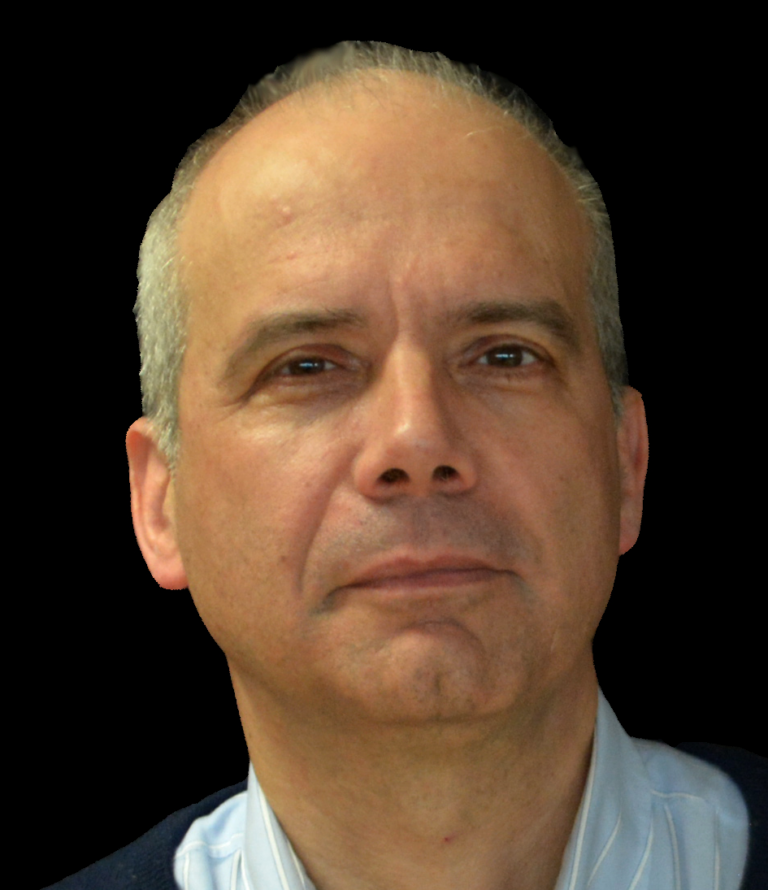
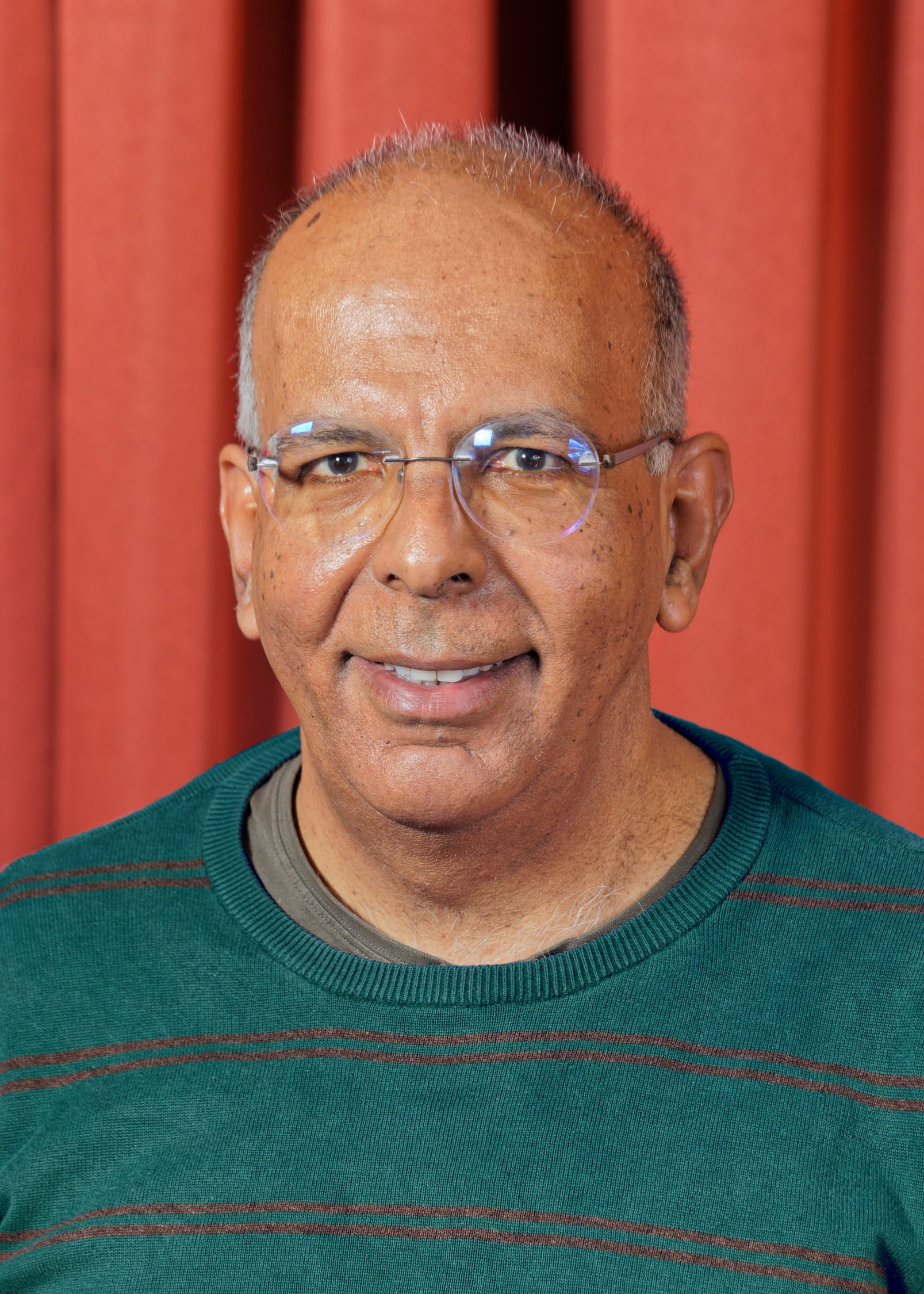
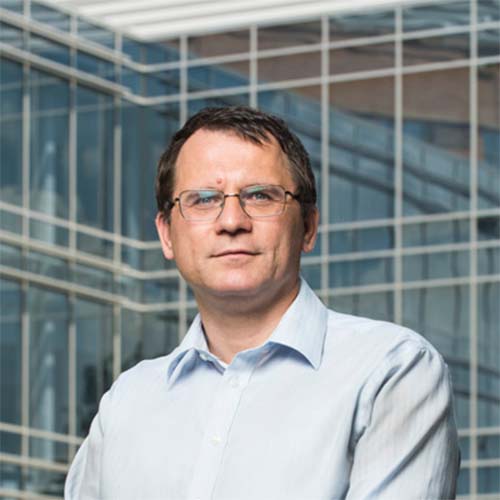
Euripedes Montagne is a Senior Lecturer in the Department of Computer Science at the University of Central Florida (UCF). He teaches courses in operating systems, system software, computer architecture, programming languages, and social networks. Ph.D. in Computer Science – Universidad Central de Venezuela His research focuses on program optimization for irregular problems, particularly sparse matrix operations, parallel processing, non-standard computer architectures, and computer science education. His work spans algorithm design for systolic arrays, granularity modeling in parallel systems, and performance analysis of block-structured programs. The trends in his publications highlight advancements in systolic array design, sparse matrix optimization, and parallel computing. His 2006 paper on quantum circuits demonstrates interdisciplinary applications, while older works (1986–1994) emphasize foundational contributions to parallel architectures and performance modeling. No scientific awards or honors are explicitly documented in the provided text. No students, labs, teams, or grants are mentioned in the given information.
Vidhyasaharan Sethu is an Associate Professor at the School of Electrical Engineering and Telecommunications, UNSW Sydney. His educational background includes a PhD from UNSW, a Master of Engineering Science in Signal Processing from UNSW, and a Bachelor of Engineering in Electronics and Communication Engineering from Anna University. His research focuses on speech signal processing with emphasis on machine learning applications. Primary interests include: Speech-based emotion and mental state recognition systems Affective computing and voice biometrics Integration of machine learning with signal processing Uncertainty quantification in speech systems Adaptive audio front-ends and acoustic modeling Recent publications (2021-2025) demonstrate strong focus on: Ambiguity-aware emotion recognition using advanced ML techniques Speaker verification and biometric security systems Novel acoustic modeling frameworks Applications of large language models in speech processing Cross-disciplinary work in materials science via ML approaches Research Funding: ARC Discovery Projects (2020, 2019) ARC LIEF Grant (2019) UNSW Research Infrastructure grants (2018-2019) Huawei Innovation Research Program (2018) ARC Linkage (2017) NICTA International Postgraduate Award (2006-2009) Teaching includes courses in: Data Science for Electrical Engineers (ELEC9741) Speech Processing (ELEC9723) Digital Signal Processing (ELEC3104) Electrical Systems Design (ELEC2117)
Ilie Parvu is a distinguished Professor at the Department of Theoretical Philosophy and Logic , Faculty of Philosophy , University of Bucharest , where he has worked since 1990. A leading figure in the Romanian school of analytical philosophy , his academic journey began with studies in philosophy (1959-1964) and mathematics (1964-1967) at the University of Bucharest, culminating in a PhD in Philosophy in 1973. He has held visiting professorships at institutions like the University of Paris-X and contributed to international societies such as the Goedel Society and the Kant Society. Research Interests: Philosophy of Science, Metaphysics, Kantian Studies, Formal Ontology, History and Foundations of Physics. Leadership Roles: Head of the Department of Theoretical Philosophy and Logic (1990-2000), coordinator of advanced studies in theoretical philosophy (1993-2000), and member of the Council for Scientific Research (1994-1997). Awards and Honors: Prize for Scientific Research (1968), Prize of the Romanian Academy (1981), and Lucian Blaga Society Prize for exegesis of Blaga's philosophy. His philosophy of science research explores structuralist methodologies, complementarity, and the convergence of models in scientific theories. He emphasizes metaphysical systems through formal ontological frameworks and Kantian transcendental arguments, particularly in works like The Architecture of Existence series. His analysis of history and foundations of physics includes interdisciplinary approaches and historiographical methods. Scientific Awards: Prize for Scientific Research (1968) Romanian Academy Prize for 'Scientific Theory' (1981) Lucian Blaga Society Prize for exegesis of Blaga's philosophy As a doctoral supervisor since 1990, he has mentored numerous students and coordinated national research programs, including evaluations for international grants like Tempus and Phare. His work bridges Kantian epistemology with modern scientific methodology, particularly in quantum mechanics and mathematical cognition.
Fabio Palomba is an Associate Professor at the Department of Computer Science , University of Salerno, Italy. He earned a European PhD in Management & Information Technology (2017), funded by University of Salerno and University of Molise, under advisor Prof. Andrea De Lucia. His research spans software maintenance and evolution , empirical software engineering , and ML systems quality . Recipient of IEEE Computer Society Best PhD Thesis Award (2017) Multiple Distinguished Paper Awards from ACM/SIGSOFT and IEEE/TCSE Recipient of prestigious SNSF Ambizione grant (2019) and IEEE Rising Star Award (2023) His work investigates fairness-aware practices in ML , technical debt in AI systems , and LLM applications in software engineering . Recent studies focus on automated requirements generation via RECOVER, quantum software engineering , and socio-technical community smells in ML-enabled systems, with empirical analyses across large datasets. Key editorial roles include Elsevier's Information and Software Technology Journal (2022-), Springer's Empirical Software Engineering Journal (2021-), and IEEE Transactions on Software Engineering (2020-). He has served as program co-chair for SANER 2024 , ICPC 2021 , and multiple conference tracks. 16 Distinguished Reviewer Awards for his refereeing work Co-authored 80+ journal papers , 100+ conference papers , and advised 300+ theses
Ian Arawjo is an Assistant Professor at the Université de Montréal in the Department of Computer Science and Operations Research (DIRO), affiliated with Mila – Quebec AI Institute. He leads the Montreal HCI group, focusing on human-centered AI, prompt engineering, and LLM evaluation. His work bridges programming, AI, and HCI, emphasizing tools like ChainForge for visual prompt design. He holds a PhD from Cornell University in Information Science, advised by Tapan Parikh. Research interests include AI-driven tools for design, LLM evaluation methodologies, and multimodal programming interfaces. Notable projects include ChainForge, EvalGen for evaluation criteria generation, and disaster early warning systems funded by CRSNG and MITACS. His work has won awards at top conferences like CHI, CSCW, and UIST. Education: PhD in Information Science (Cornell University), MS/BS in Computation Arts and Computer Science (Concordia University). Active in teaching and mentoring, currently recruiting PhD students for HCI/AI research. Professional activities include conference organizing (e.g., Dynamic Abstractions workshop), industry collaborations, and open-source contributions.
Roles and Affiliations: José Nuno Oliveira is a Full Professor at the University of Minho's School of Engineering, Department of Computer Science. He is a member of the HASLab (High-Assurance Software Laboratory) and the Formal Methods Europe (FME) Association. He has held roles such as General Chair of the 3rd World Congress on Formal Methods (FM'19) and served on numerous international conference committees. Education: Habilitation in Computing Foundations (2010), University of Minho Ph.D. in Computer Science (1984), University of Manchester, UK M.Sc. in Computer Science (1981), University of Manchester, UK Lic. Eng. Elect. (Digital Systems & Computers) (1978), University of Porto, Portugal Research Interests: Oliveira focuses on formal methods, program calculation, and algebraic programming. His work emphasizes improving software design through mathematical rigor, including applications of relational algebra, functional programming, and program transformation. He has contributed to frameworks like Alloy and QAlloy for software verification. Publications: His recent work spans topics like quantum programming (e.g., quantamorphisms), typed linear algebra for data analysis, and formal methods in education. Over 80 publications include influential papers on Galois connections, metaphorisms, and coalgebraic systems. Awards and Grants: Not explicitly listed, but his leadership roles and extensive conference involvement highlight his recognition in formal methods. Active in projects like IBEX (cyber-physical systems) and TRUST (Alloy-based design). Teaching and Service: Teaches courses on program calculation and formal methods. Serves on editorial boards (e.g., Formal Aspects of Computing ) and chairs international conferences. Active in promoting formal methods education through workshops and training initiatives. Labs and Teams: Co-leads the HASLab (INESC TEC & University of Minho), focusing on high-assurance software systems. Collaborates on projects like EVEREST (railway network verification) and LeanBigData (big data analytics).
Alexandre Madeira is an Associate Professor in the Mathematics Department at the University of Aveiro (Portugal), affiliated with CIDMA and collaborating with HASLab-INESC TEC. He holds a PhD in Computer Science from the University of Minho, awarded the Portuguese IBM Scientific Prize 2013. His research focuses on formal methods, dynamic logics, algebraic specifications, and cyber-physical systems. **Education**: PhD in Computer Science (University of Minho, 2013), MSc in Mathematics (University of Aveiro, 200?), and a degree in Applied Mathematics and Computation (University of Aveiro). **Research Interests**: Formal specification of software, combination of logics, modal/hybrid/dynamic logics, algebraic specification, and applications to quantum programming and cyber-physical systems. Projects include DaLí, Ibex, and Klee. **Awards**: Portuguese IBM Scientific Prize 2013. **Editorial Roles**: Editor for journals and conferences such as *Journal of Logical and Algebraic Methods in Programming* and *SEFM 2024*. **Teaching**: Coordinates courses like Elements of Logic, Computational Logic, and Analysis and Development of Algorithms at the University of Aveiro. Also teaches at the University of Minho on topics like Quantum Computing and Algebraic Logic. **Supervision**: Supervises PhD and MSc students in formal methods, paraconsistent systems, and quantum logics. Notable advisees include Juliana Cunha and Leandro Gomes.
Tobias Grosser is an Associate Professor in the Department of Computer Science and Technology at the University of Cambridge. His research focuses on rethinking performance programming by bridging the gap between developers and compilers. He holds a PhD from École Normale Supérieure Paris and has held positions including Reader at the University of Edinburgh and Ambizione Fellow at ETH Zurich. His research interests span compilers, programming language design, static/dynamic analysis, and the integration of machine learning into compiler development. He emphasizes making compilation more modular, automatic, and trustworthy, with applications in quantum computing, climate science, and open-source hardware. Key projects include xDSL (a Python-native compiler framework), LoopOpt, and the Open Earth Compiler for climate simulations. Recent publications highlight advancements in multi-level intermediate representations (IR), formal verification in MLIR, and performance optimization for GPUs and FPGAs. His work often addresses barriers between programmers and compilers, aiming for intuitive collaboration between developers and automated systems. Tobias mentors a dynamic team of PhD students, postdocs, and researchers, including notable contributors like Siddharth Bhat, Arjun Pitchanathan, and Mathieu Fehr. His lab focuses on compiler toolchains for domain-specific hardware accelerators, quantum computing ecosystems, and verified compilation techniques.
Professor Anuj Dawar is a leading academic in Theoretical Computer Science at the University of Cambridge's Department of Computer Science and Technology. He holds a PhD from the University of Pennsylvania (1993) and has been a faculty member since 1999. His research focuses on computational complexity via logic, descriptive complexity, and finite model theory, with applications to databases, verification, and games. Education: PhD in Computer Science, University of Pennsylvania (1993) Masters, University of Delaware Bachelor's, Indian Institute of Technology (Delhi) Research Interests: His work bridges logic and computation, investigating limits of symmetric algorithms and complexity through formal languages. Notable themes include: Descriptive complexity and homomorphism preservation Finite model theory and its applications Algorithmic model theory and constraint satisfaction Professional Activities: Editor-in-Chief, ACM Transactions on Computational Logic Former president of European Association for Computer Science Logic Committee roles for Gödel Prize, Church Award, and Nerode Award Advising & Teaching: Supervised over 15 PhD students and taught advanced courses like Quantum Computing, Complexity Theory, and Foundations of Functional Programming. Currently on sabbatical (2024–25).
Harry Lane is a Dame Kathleen Ollerenshaw Fellow in the Theoretical Physics Group at the University of Manchester, actively engaged in research at the theory-experiment interface with a focus on spin systems and neutron scattering methodologies. He participates in the University of Manchester at Harwell (UoMaH) initiative strengthening university-facility partnerships and currently accepts PhD students. His academic qualifications include: Doctor of Philosophy from the University of Edinburgh (awarded June 15, 2022) Master of Science in Theoretical Physics from University College London (awarded July 1, 2018) Dr. Lane's research investigates exotic order and dynamics in spin systems, particularly examining spin-orbital-lattice coupling in magnetic insulators. His work develops theoretical frameworks for neutron scattering experiments, advancing understanding of quantum spin liquids , magnetoelastic phenomena , and phase transitions in correlated materials. Expertise spans condensed matter theory, spin dynamics, and quantum computing physics applications. His 2025 publications reveal strong emphasis on iron-based chalcogenides (e.g. $$ \text{FePSe}_3 $$) and computational tool development, bridging theoretical models with experimental neutron data. Key themes include thermal-quantum mimicry effects, magnetoelastic coupling mechanisms, and cluster excitation dynamics across multiple high-impact journals. Recognized through the Dame Kathleen Ollerenshaw Fellowship, his work receives institutional support via the UoMaH project. Research impact is evidenced by coverage in 3 news outlets, 36+ X posts, and 7 Mendeley readers. As a supervisor, Dr. Lane mentors PhD students while collaborating internationally through the UoMaH network. His projects demonstrate significant cross-institutional engagement with national facilities, particularly in tomography and nanoparticle research.
Dr. Giacomo Gabrielli is a Research Fellow at the Department of Computer Science and Technology , University of Cambridge. His work aligns with the department's focus on advanced computing research. Research Interests His research spans key areas in computer science, including: Computer Architecture and Semiconductor Design Machine Learning and Artificial Intelligence Security Systems and Networking Quantum Computing Programming Languages and Verification
Martha Lewis serves as Assistant Professor of Neurosymbolic AI at the Institute of Logic, Language, and Computation (ILLC) within the Faculty of Science at the University of Amsterdam. Her primary affiliation is with the Natural Language Processing & Digital Humanities research group. Previously, she held positions as a Lecturer at Bristol University's School of Engineering Mathematics and Technology, completed postdoctoral research at the ILLC (funded by a Veni fellowship), and worked with the Quantum Group at the University of Oxford's Department of Computer Science. Her academic background includes a PhD from the Bristol Centre for Complexity Sciences, an MSc in Evolutionary and Adaptive Systems from the University of Sussex, and undergraduate studies at Balliol College, Oxford. Dr. Lewis employs interdisciplinary methodologies spanning computational linguistics, conceptual spaces theory, quantum theory, and category theory to investigate human concept composition. Her research focuses on three interconnected domains: compositional approaches to language and meaning (examining how humans generate novel concept combinations), quantum-theoretic applications in language modeling (using density matrices for hyponymy, entailment, and lexical ambiguity), and evolutionary approaches to language change. Her work bridges theoretical frameworks with practical NLP applications, particularly in metaphor processing and neurosymbolic integration. Her research has attracted significant funding including a €250,000 Veni Postdoctoral Fellowship and multiple international collaboration grants. She has organized major interdisciplinary workshops including the Semantic Spaces series co-located with IWCS and ESSLLI. RIS Collaboration Grant (£5,000) Veni Postdoctoral Fellowship (€250,000) KNAW Conference Fund (€6,000) Lorentz Center Workshop grant (€25,000) EPSRC Doctoral Training Account Scholarship Dr. Lewis actively supervises 11 current graduate students across PhD and MSc programs in Data Science, AI, Logic, and Psychology at the University of Amsterdam, with several past students producing conference publications from their thesis work. She has developed novel educational initiatives including the "Conceptual Spaces for AI" undergraduate module and has served as Unit Director for Bristol's MSc Introduction to Artificial Intelligence course serving 200 students. Her academic service includes editorial roles for Compositionality Journal and Cognitive Processing, along with extensive conference reviewing for top NLP and AI venues. She leads research within the NLP&DH group at ILLC, maintaining strong collaborations with the Quantum Group at Oxford and Edinburgh's NLP researchers. Her methodological approach integrates conceptual spaces with categorical compositional distributional semantics, creating bridges between symbolic reasoning and statistical language models.
Sebastian Schrittwieser is a Researcher in the Research Group Security and Privacy, part of the Faculty of Computer Science. His work focuses on cybersecurity, code obfuscation, malware analysis, and machine learning applications in security. He leads and contributes to projects like INODES (Cyber Defense Strategies) and EMRESS (Resilience Evaluation Models). His research bridges theoretical foundations and practical applications, addressing challenges in software protection and threat detection. Key research interests include: Code Obfuscation Techniques and Resistance Adversarial Machine Learning and Risk Assessment Malware Analysis and Program Simulation User Behavior in Cybersecurity Contexts Recent publications emphasize empirical studies on IT/OT infrastructure security, graph neural network vulnerabilities, and quantum-inspired machine learning. He actively collaborates with institutions like SBA Research and presents at international conferences. Grants include Research Funding for projects on optimal cyber defense strategies (INODES) and software resilience evaluation (EMRESS). His work aligns with interdisciplinary efforts in security engineering and privacy-preserving technologies.
Joao Pedro Leal Abalada de Matos Carvalho is a researcher at Lusofona University 's School of Communication, Architecture, Arts and Technologies , focusing on Artificial Intelligence, Machine Learning, and Unmanned Aerial Vehicle systems. He contributes to projects like ANTIDOTE (AI Attack & Defense) and REMARKABLE (Rural Environmental Monitoring). Active in AI-driven environmental monitoring and cyber-physical systems Collaborates with Horizon Europe and Marie Skłodowska-Curie Actions Key research areas: Deep Learning, Federated Learning, High-Energy Physics His work involves LoRaWAN engineering , satellite data processing , and hydroelectric forecasting models , with 55 scientific publications and 382 h-index citations. Current collaborations span Europe and Brazil , with active projects in smart healthcare , AI literacy , and radiation-hardened electronics for CERN experiments.
Mihai Boicu is an Associate Professor at George Mason University's Volgenau School of Engineering , Department of Applied Information Technology, and Associate Director of the Learning Agents Center (LAC) . His research spans Artificial Intelligence , structured analytical methods, personalized education, and collective intelligence. He is the architect of the Disciple agent development platform and has secured grants from the US Department of Defense , VentureWell , and Oculus Info Inc. . His work includes over 100 publications, with three defense-focused textbooks and contributions to journals like AI Magazine and International Journal of Intelligence and CounterIntelligence . He has co-organized premier AI conferences such as ICMLA and AAAI Symposia . His research focuses on AI in defense , education technology , and metacognition in STEM , published in venues ranging from AAAI to IEEE and Hawaii International Conference on System Sciences . Scientific Awards : Innovative Application Award from AAAI Certificates of Appreciation from U.S. Army War College and Air War College GMU Teacher of Distinction (2015) His recent articles (2023–2025) analyze machine learning in education, quantum computing , LLM feedback systems , and metacognition , with projects like SugarNet (diabetes management) and FlightList (Air Force compliance). He advises PhD students in applied AI, education technology, and innovation.