Prof. Joaquin GARCIA ALFARO is a Professor at Telecom SudParis, affiliated with the SCN department. His research focuses on cybersecurity, network security, quantum computing applications, and resilience engineering in cyber-physical systems. He has contributed to advancements in intrusion detection systems, blockchain integration in cellular networks, and privacy-preserving frameworks for IoT and healthcare. University: Telecom SudParis Key Research Areas: Cybersecurity, Quantum Computing, IoT Security, Resilience Engineering Labs: SAMOVAR laboratory His work emphasizes practical solutions for real-world challenges, including secure data provenance, digital twin implementations, and energy-efficient edge computing. Recent research explores quantum-resistant protocols and collaborative drone systems.
Oliver Bühler is a Professor of Mathematics and Atmosphere/Ocean Science at New York University. His research focuses on theoretical fluid dynamics, particularly asymptotic methods applied to geophysical fluid systems. He holds a Ph.D. in Applied Mathematics from the University of Cambridge (1996), an M.S. in Aerospace Engineering from the University of Michigan (1990), and a B.S. in Physical Engineering from Technical University Berlin (1988). Education: Ph.D., Applied Mathematics, University of Cambridge, 1996 M.S., Aerospace Engineering, University of Michigan, 1990 B.S., Physical Engineering, Technical University Berlin, 1988 His research interests include nonlinear wave-vortex interactions, climate dynamics, and applications of fluid dynamics to quantum mechanics and particle diffusion. He authored a seminal textbook on waves and mean flows and has contributed to high-impact studies in Physics of Fluids and Journal of Fluid Mechanics . While no awards or grants are explicitly listed, his work is part of the Center for Atmosphere Ocean Science at NYU.
Mika Göös is a Tenure Track Assistant Professor at EPFL in the School of Computer and Communication Sciences, Department of Computer Science. Previously, he held postdoctoral positions at Stanford, Princeton IAS, and Harvard. He earned his PhD from the University of Toronto under Toniann Pitassi, an MSc from the University of Oxford, and a BSc from Aalto University. Education PhD: University of Toronto MSc: University of Oxford BSc: Aalto University His research focuses on computational and communication complexity, exploring fundamental limits of algorithms and their applications in cryptography, circuit design, and distributed computing. He co-developed lifting theorems connecting query complexity to communication complexity and investigates lower bounds in randomized algorithms, TFNP problems, and monotone circuits. Recent work emphasizes quantum communication advantages, direct sum theorems, and hardness condensation. His 15 most recent publications span topics like k-Hamming distance, parity decision trees, depth-3 circuits, and separations in TFNP classes. Scientific awards include the Machtey Award (2015), Best Paper at DISC (2012), EATCS Distinguished Dissertation Award (2017), and Best Paper at FOCS (2020). He has advised numerous PhD and MSc students, including Weiqiang Yuan, Ziyi Guan, and Alexandros Hollender. Currently, he leads a team comprising PhD students (Guan, Imbach, Riazanov, Sofronova, Yuan), postdocs (Nathaniel Harms), and scientists (Dmitry Sokolov). His work has appeared in top venues like STOC, FOCS, CCC, and ITCS, often with recorded talks and published in journals such as JACM and SICOMP.
Dr. Nicolas Francois is an Associate Professor in the Department of Materials Physics at Australian National University (ANU), specializing in experimental geomaterials physics, soft matter, and fluid hydrodynamics. He leads the X-ray Tomography and Applications Research Group, combining curiosity-driven and applied research in out-of-equilibrium systems. ARC Industry Fellow (2024-2030): Improving Australian iron ore comminution for green steel production ARC DECRA Fellow (2016-2018): Biofilms in two-dimensional turbulent flows His research spans fundamental questions in: Fragmentation of solid materials Autonomous devices powered by chaotic flows Hydrodynamic waves Stochastic thermodynamics Granular matter Polymer rheology and applied areas in: Comminution of geomaterials Mechanics of fractured rocks Wave-energy conversion Environmental fluid mechanics Publications reveal a trajectory focused on X-ray tomography applications, granular dynamics, and turbulence-driven systems. He utilizes advanced imaging techniques to study material failure mechanisms and fluid-structure interactions, contributing to fields ranging from green steel production to biofilm dynamics. Current student projects and grants emphasize sustainable resource processing and fundamental fluid physics.
Lili Qiu is a Professor in the Department of Computer Science at The University of Texas at Austin, where she has been a faculty member since January 2005. She is an active member of the Wireless Networking and Communications Group (WNCG) and has made significant contributions to the field of networking research. Dr. Qiu previously spent 2001-2004 as a researcher at Microsoft Research in Redmond, WA, before joining UT Austin. Dr. Qiu's research spans Internet and wireless networking with a current focus on wireless network management and content distribution in mobile networks. Her work extends into diverse applications including acoustic imaging, metasurface applications, healthcare sensing technologies, and AI systems. She has pioneered research in areas such as acoustic motion tracking, passive RFID sensing, and wireless network optimization. Her research demonstrates a consistent pattern of innovation that bridges theoretical networking concepts with practical real-world applications, particularly in mobile and wireless systems. Her extensive publication record shows a clear evolution from fundamental networking research to increasingly interdisciplinary work that combines wireless systems with healthcare applications, AI, and novel sensing technologies. Recent publications demonstrate growing integration of machine learning techniques with traditional networking problems, as well as expansion into healthcare applications like Parkinson's disease modeling and non-invasive glucose monitoring. ACM Fellow IEEE Fellow National Academy of Inventors (NAI) Fellow ACM Distinguished Scientist NSF CAREER award Google Faculty Research Award Best paper award at ACM MobiSys'18 Best paper award at IEEE ICNP'17 Dr. Qiu has supervised numerous students, including a PhD dissertation that won the SIGMOBILE best dissertation award in 2020. She has served in significant leadership roles including chair of ACM SIGMOBILE, General co-chair for ACM MobiCom 2025, and various conference chair positions for IEEE ICNP, ACM CoNEXT, and other major networking conferences. Her research has been supported by substantial grants from NSF, Google, and other organizations, enabling her to lead cross-disciplinary research teams. As a member of the Wireless Networking and Communications Group at UT Austin, Dr. Qiu leads research efforts that combine networking expertise with innovations in sensing technologies, metasurfaces, and AI systems. Her lab has produced numerous influential results in mobile networking, wireless sensing, and network management, with applications spanning healthcare, consumer electronics, and communication infrastructure.
Kohei Nakajima is an Associate Professor at the Department of Intelligent Mechano-Informatics, Graduate School of Information Science and Technology, The University of Tokyo. He holds concurrent positions at the Department of Creative Informatics and the Next Generation Artificial Intelligence Research Center (AI Center). As an Endowed Chair in Advanced Artificial Intelligence Education, he leads the Physical Intelligence Lab, which focuses on the intersection of soft robotics, nonlinear dynamics, and physical computing. His research interests center on Physical Reservoir Computing (PRC), a paradigm that exploits the natural dynamics of physical systems for computation, with applications in soft robotics, spintronics, and quantum machine learning. Nakajima's work demonstrates how physical systems can inherently process information without traditional digital computation, leveraging phenomena like chaos, bifurcations, and embodied intelligence. Nakajima's publications reveal a strong focus on understanding how physical systems can perform computational tasks. His recent work spans from biological applications (jellyfish cyborgs, ostrich-inspired robotics) to fundamental theoretical advances in reservoir computing. The research demonstrates how physical phenomena can be harnessed for information processing, with implications for energy-efficient computing and novel robotic control paradigms. As the organizer of the Reservoir Computing Seminar, Nakajima has built a vibrant research community exploring the nature of information processing across disciplines. His lab actively recruits graduate students and postdocs, indicating strong research momentum and institutional support for his work in physical intelligence.
Duong Nguyen serves as an Assistant Professor in the School of Electrical, Computer and Energy Engineering at Arizona State University. His research integrates operations research, artificial intelligence, economics, and engineering to develop mathematical models for decision-making in large-scale networked systems including cloud/edge computing, smart grids, and crowdsourcing. He directs the NEMO research group focused on building intelligent multi-agent platforms through optimization and market design. His educational credentials include: Ph.D. in Electrical and Computer Engineering from the University of British Columbia (2020) M.Sc. in Telecommunications from INRS, University of Quebec (2014) B.Sc. in Electronic and Telecommunications from Hanoi University of Science and Technology (2011) Dr. Nguyen's research spans Operations Research, Artificial Intelligence, Decision-Making, Market Design, and Optimization with applications in edge computing, power systems, and network economics. His work emphasizes robust algorithms for uncertain environments and secure multi-agent platforms, recently expanding into quantum machine learning and privacy-preserving distributed systems. Current projects address decentralized federated learning, dynamic pricing, and EV charging network design. Analysis of his publication record reveals consistent focus on distributed optimization techniques for edge/cloud systems, with increasing integration of game theory and quantum computing. His work demonstrates strong methodological innovation in handling spatio-temporal uncertainty while addressing practical challenges in energy flexibility and secure genomic computation. His scientific recognition includes: Finalist for Best Student Paper Award at American Control Conference (ACC) 2024 Finalist for Best Paper Award at International Symposium on Modeling and Optimization in Mobile, Ad Hoc, and Wireless Networks (WiOpt) 2023 Dr. Nguyen actively mentors Ph.D. students including Jiaming Cheng and Long Vu, with student-led research achieving significant recognition. His NEMO group collaborates with institutions including ETH Zurich on projects spanning autonomous driving, edge AI, and quantum optimization. Current research directions emphasize fair resource allocation, privacy-preserving learning, and dynamic pricing frameworks for next-generation networked systems.
Professor Carsten Welsch is a leading physicist in accelerator science and technology at the University of Liverpool. He founded the QUASAR Group in 2008 and served as Head of the Physics Department from 2016 to 2023. His work bridges cutting-edge research in antimatter physics, beam diagnostics, and innovative accelerator design with strategic leadership in education and international collaboration. PhD in Accelerator Physics, University of Frankfurt Postdoc, Max Planck Institute for Nuclear Physics CERN Fellow (2005) His research focuses on low-energy antimatter physics , plasma wakefield acceleration , and dielectric laser accelerators , with applications in medicine and global challenges. Recent publications highlight advancements in betatron radiation modeling, positronium cooling, and plasma-driven acceleration techniques. He has secured over 25M€ in EU funding for networks like AVA and EuPRAXIA, trained 100+ Marie Curie Fellows, and founded D-Beam Ltd for beam instrumentation. Awards include the Viddy Platinum Award (2022) and Helmholtz-University YIG Award (2006). As Director of the LIV.INNO Center for Doctoral Training, he champions data-intensive science education. His outreach efforts have impacted millions globally, emphasizing discovery science and accelerator technology's societal benefits.
Witold "Witek" Nazarewicz is a John A. Hannah Distinguished Professor in the Department of Physics & Astronomy at Michigan State University and serves as the Chief Scientist at the Facility for Rare Isotope Beams (FRIB). He is also a Corporate Fellow Emeritus at Oak Ridge National Laboratory (ORNL) and maintains a professorship at Warsaw University, Poland. Nazarewicz previously held positions as James McConnell Distinguished Professor at the University of Tennessee and served as Scientific Director of ORNL's Holifield Radioactive Ion Beam Facility from 1999-2012. His academic career spans multiple international institutions including Lund University, University of Cologne, Kyoto University, University of Liverpool, and Peking University. Nazarewicz's research focuses on theoretical nuclear physics with particular emphasis on exotic nuclei at the limits of nuclear existence. His work spans quantum many-body problems, physics of open quantum systems, superheavy elements, and nuclear fission. He has pioneered approaches to unify structure and reaction aspects of nuclei based on open quantum system many-body formalism, including the Gamow Shell Model. His research connects nuclear physics with high-performance computing, developing comprehensive descriptions of all nuclei through theoretical and experimental investigations of rare atomic nuclei. An analysis of Nazarewicz's recent publications reveals a strong focus on cutting-edge nuclear structure research, particularly concerning exotic nuclei near the driplines, charge radii measurements, superheavy elements, and the development of advanced computational methods. His work increasingly incorporates machine learning and Bayesian analysis techniques to address nuclear physics challenges. The publications demonstrate his leadership in connecting fundamental nuclear physics with applications in nuclear astrophysics, while also addressing foundational questions about the limits of nuclear existence and the nature of nuclear forces. Fellow of the American Physical Society Fellow of the U.K. Institute of Physics Fellow of the American Association for the Advancement of Science 2008 Carnegie Centenary Professor Honorary Doctorates from University of the West of Scotland (2009) and University of York (2019) 2012 Tom W. Bonner Prize in Nuclear Physics 2012 ORNL Distinguished Scientist 2013 UT-Battelle Corporate Fellow 2017 G.N. Flerov Prize 2025 Marian Smoluchowski Medal Nazarewicz has authored approximately 500 peer-reviewed publications with over 37,000 citations and an h-index of 103 (Web of Science). He has delivered over 220 invited talks at major international conferences and organized approximately 70 scientific meetings. His research has been supported by numerous grants from the Department of Energy, National Science Foundation, and international funding agencies. Nazarewicz plays a leadership role in major nuclear physics initiatives including the UNEDF, NUCLEI, and BAND collaborations, and has contributed to several National Academies reports on nuclear physics. As FRIB Chief Scientist, Nazarewicz leads theoretical efforts at one of the world's premier facilities for rare isotope research. His research group at MSU collaborates extensively with experimentalists worldwide, bridging theoretical predictions with cutting-edge measurements. He directs the FRIB Theory Alliance, fostering international collaboration in nuclear theory, and has established strong connections between nuclear physics and other disciplines including quantum information science and machine learning.
Fabrizio Falchi is a researcher at the Artificial Intelligence for Media and Humanities (AIMH) Lab of the Institute of Information Science and Technologies (ISTI) within Italy's National Research Council (CNR). He also maintains an associate position at the Biorobotics Institute of Scuola Superiore Sant'Anna. His work focuses on developing advanced multimedia retrieval systems, with the VISIONE platform being his most notable contribution, which has won international competitions including the Video Browser Showdown in 2024 and placed second in 2023. Falchi's educational background includes: Ph.D. in Information Engineering from University of Pisa (Italy) Ph.D. in Informatics from Faculty of Informatics of Masaryk University of Brno (Czech Republic) M.B.A. from Scuola Superiore Sant'Anna in Pisa His research spans deep learning, convolutional neural networks, deep features extraction, similarity search algorithms, distributed indexing systems, multimedia information retrieval, computer vision applications, and peer-to-peer systems. Falchi has made significant contributions to fine-grained visual understanding, cross-modal retrieval (particularly image-text matching), and robustness of deep learning systems against adversarial attacks. His work demonstrates a strong focus on practical applications of these technologies, particularly in video retrieval systems and safety monitoring solutions. Analysis of Falchi's recent publications reveals a strong focus on video and image retrieval systems, with the VISIONE platform being central to his work. His research shows increasing emphasis on fine-grained understanding in computer vision, cross-modal retrieval, and addressing practical challenges like cross-resolution face recognition. Recent work demonstrates innovation in making these systems more efficient through techniques like knowledge distillation (ALADIN) and leveraging virtual worlds for training data. His publications consistently bridge theoretical advances with practical applications in surveillance, safety monitoring, and multimedia search. Falchi's work has received significant recognition: Best paper award at CBMI 2024 for 'Is ClLIP the main roadblock for fine-grained open-world perception?' VISIONE 2024 won the Video Browser Showdown competition in Amsterdam VISIONE obtained second place at Video Browser Showdown 2023 in Bergen Best Paper Award for 'Learning Safety Equipment Detection using Virtual Worlds' at CBMI 2019 Falchi collaborates extensively with researchers at ISTI-CNR, particularly within the AIMH Lab. His work on VISIONE involves collaboration with Giuseppe Amato, Paolo Bolettieri, Fabio Carrara, Claudio Gennaro, Nicola Messina, Lucia Vadicamo, and Claudio Vairo. As co-chair of Ital-IA 2023, the 3rd National Conference on Artificial Intelligence, he plays an active role in the academic community. He is a member of ACM (since 2012), the Computer Vision Foundation, the Italian Association for Computer Vision Pattern Recognition and Machine Learning (CVPL), and the CINI Lab on Artificial Intelligence and Intelligent Systems. Falchi is a key member of the Artificial Intelligence for Media and Humanities (AIMH) Lab at ISTI-CNR, where he leads research on video retrieval systems. The lab has developed the award-winning VISIONE platform, which combines multiple scientific results in content-based video retrieval. His team focuses on developing systems that enable users to search for target videos using textual prompts, drawing objects and colors, or images as query examples. The lab's work demonstrates strong interdisciplinary collaboration, bridging computer science with practical applications in media, safety monitoring, and urban environments.
Jiří Novotný is a Professor at the Faculty of Mathematics and Physics of Charles University in Prague, Czech Republic. He is affiliated with the Institute of Particle and Nuclear Physics , where his research focuses on theoretical particle physics, quantum field theory, and low-energy QCD phenomena. He is actively involved in teaching and research, with a strong publication record in high-impact journals. Research Interests Prof. Novotný's research spans a wide range of topics in theoretical physics, with a particular emphasis on: Quantum Field Theory : Anomalies, effective Lagrangians, and chiral perturbation theory. Low-Energy QCD : Chiral symmetry breaking, order parameters, and meson decays. Scattering Amplitudes : Soft theorems, celestial holography, and modern amplitude techniques. Effective Field Theories : Galileon theories, DBI actions, and their generalizations. Publications and Research Impact His recent work has significantly advanced the understanding of soft theorems in gauge and gravity theories, the structure of scattering amplitudes in chiral perturbation theory, and the application of celestial holography to flat-space physics. His publications often appear in top-tier journals such as Journal of High Energy Physics (JHEP) , Physical Review D , and Physical Review Letters . Teaching and Outreach Prof. Novotný teaches advanced courses in Quantum Field Theory I & II and Selected Parts of Quantum Field Theory . He is also involved in the Physics Olympiad to promote physics education among students.
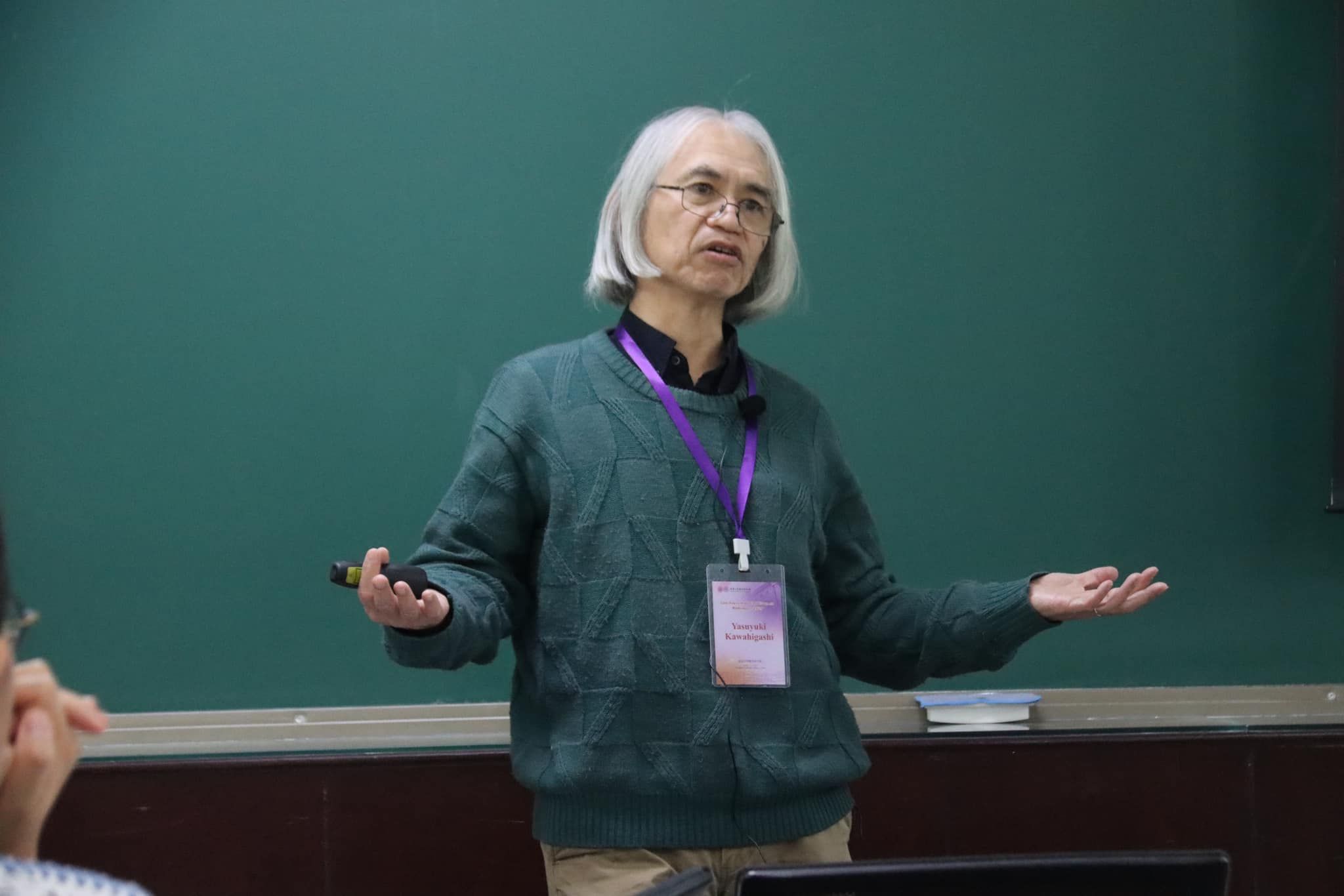
Yasuyuki Kawahigashi is a Professor at the Department of Mathematical Sciences, The University of Tokyo, where he leads research in operator algebras and mathematical physics. His office is located in Room 323 of the Mathematical Sciences Building on the Komaba campus. He serves as an editor for multiple prestigious mathematics journals including Communications in Mathematical Physics, International Journal of Mathematics, and Journal of Mathematical Physics. His research focuses on operator algebras, particularly subfactor theory and its connections to conformal field theory, topological phases of matter, quantum groups, and vertex operator algebras. He investigates 2-dimensional conformal field theory from an operator algebraic viewpoint, examining representation theory through subfactors and connections to quantum invariants in low-dimensional topology. Kawahigashi's publications demonstrate extensive work in operator algebras, conformal field theory, and topological quantum field theory. His recent research emphasizes connections between subfactors, tensor categories, and topological phases of matter, with applications in mathematical physics. Operator Algebra Prize (2000) Spring Prize of the Mathematical Society of Japan (2002) He has advised numerous postdoctoral fellows and organized major international programs such as the 2011-2012 RIMS Program on Operator Algebras. He leads the Operator Algebra Group at Tokyo and has secured research grants from Mitsubishi Foundation, Sumitomo Foundation, and JSPS. Kawahigashi directs research seminars and maintains active collaborations with institutions worldwide. His group regularly hosts international visitors and participates in conferences on operator algebras and mathematical physics.
Alex Kamenev is a Professor in the School of Physics and Astronomy at the University of Minnesota and serves as Director of the William I. Fine Theoretical Physics Institute. His academic career spans multiple decades with continuous research output since 1991, demonstrating sustained contributions to theoretical physics. His research focuses on theoretical condensed matter physics, with particular emphasis on disordered systems and glasses, field-theoretical treatment of many-body systems, mesoscopic systems, and out-of-equilibrium phenomena. His fingerprint analysis reveals strong expertise in Instanton Physics (100%), Fermion Physics (90%), Conductance (69%), Quantum Dot Physics (64%), and Superconductor physics (62%). Analysis of his recent publications shows a clear trend toward quantum computing applications, non-equilibrium quantum dynamics, and advanced field-theoretical approaches to many-body problems. His work bridges fundamental theoretical physics with practical applications in quantum information science, particularly in understanding quantum dissipation, localization phenomena, and quantum annealing processes. As Principal Investigator, Kamenev has led numerous significant research projects, primarily funded by the National Science Foundation. His current active projects include the REU Site: Physics and Astronomy at the University of Minnesota (2024-2027) and NSF-BSF: Many Body Physics of Quantum Computation (2024-2027), demonstrating his leadership in training the next generation of physicists and advancing quantum computing research. He actively mentors graduate students, as indicated by his statement that he is "Accepting new graduate research students." His research group contributes to the Condensed Matter Theory research area within the School of Physics and Astronomy, focusing on theoretical approaches to quantum systems.
Raman Kashyap is a Full Professor at the Department of Electrical Engineering and Department of Engineering Physics at Polytechnique Montréal . He serves as a researcher at the Centre d’optique, photonique et laser (COPL) and a member of the Advanced Research Centre in Microwaves and Space Electronics (POLY-GRAMES) . His work spans multiple domains in photonics and laser technology. B.Sc. (King's College), Ph.D. (Essex) Research Interests : Professor Kashyap's research focuses on optical fibers , laser cooling , Bragg gratings , optoelectronics , nonlinear optics , and periodically poled crystals . His work explores stimulated Brillouin scattering , optical sensors , and material modification via lasers , contributing to advancements in quantum photonics and microwave engineering . Recent Research Trends : His latest publications emphasize Anti-Stokes fluorescence cooling in silica and oxide glasses, elastic optical network optimization , and femtosecond laser writing for photonic devices. These works bridge material science , quantum computing , and telecommunications , showcasing innovative applications in temperature sensing , optical delay systems , and 3D integrated optics . Scientific Awards : 2016 - Québec Science's 10 Discoveries of the Year 2014 - Royal Society of Canada (RSC) Fellow 2013 - SPIE Fellow 2012 - Killam Fellowship (Canada Council for the Arts) 2011 - Engineering Institute of Canada (EIC) Fellow 2010 - Institute of Physics Fellow 2004 - Optical Society of America (OSA) Fellow Academic Supervision : Professor Kashyap has supervised 36 students , including 24 Ph.D. candidates and 12 Master’s students . His supervised projects cover spherical Bragg resonators , laser-induced cooling , optical frequency domain reflectometry , and femtosecond laser writing . Labs & Collaborations : He leads research at the Fabulas laboratory and collaborates with the POLY-GRAMES center. His work involves partnerships with institutions like INRS and Québec Science , influencing quantum computing and optical fiber communication technologies.
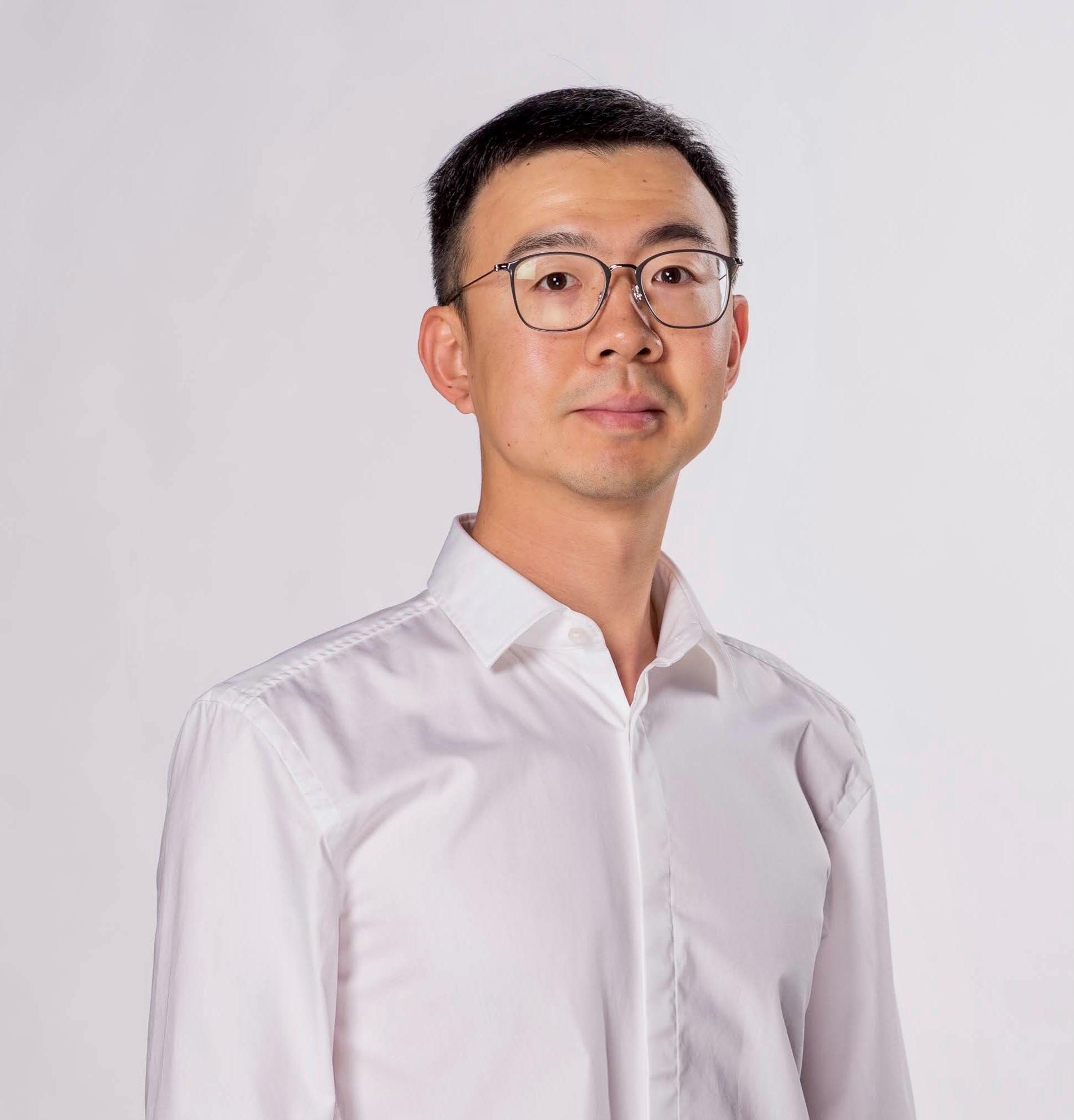
Dr. Yu Zhang is a Lecturer of Data Science at the School of Business, UNSW Canberra. His academic career focuses on text mining, knowledge and information management, social computing, and bibliometric analysis, with interdisciplinary applications in areas such as sustainable logistics, supply chain management, and net-zero energy solutions. Fields of Interest: Text Mining, Information Management, Social Computing, Bibliometric Analysis, Machine Learning for Information Systems, Heterogeneous Network Analysis, Data Mining for Asset Management, Sustainable Logistics, Supply Chain Management, Net-zero Energy in Green Buildings, and Transportation. Grants: Served as CI in projects like "Online health monitoring in Li-ion batteries via trustworthy AI" (ACT Government, $1.22M) and "Delivering net-zero energy buildings" (TRaCE Lab to Market, $1.05M). Awards: Best Paper Award (Runner-up) at ADMA 2024 and Excellent Paper Award at ICEBE 2024. Teaching: Coordinated courses in Data Analytics, Workforce Planning Research, Business Capstone, and Logistics Intelligence with Big Data Analysis. Supervision: Guided research on topics like federated learning for healthcare fraud detection, blockchain-based carbon offset management, and tier-based supply chain visibility. His publications span materials science and photovoltaic technologies, with a focus on thin-film solar cells and defect passivation methods. For collaboration or supervision inquiries, contact him at m.yuzhang@unsw.edu.au .