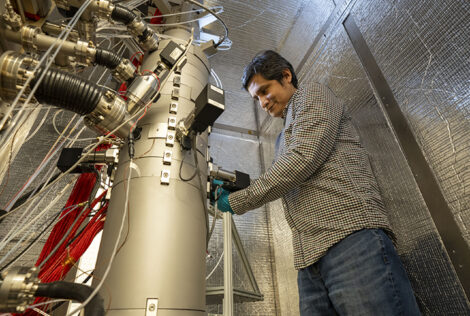
Nikita KavokineView profile
Assistant Professor
Nikita Kavokine serves as Tenure Track Assistant Professor at École Polytechnique Fédérale de Lausanne (EPFL) within the School of Basic Sciences . His dual appointments span the Institute of Chemical Sciences and Engineering (ISIC) and the School of Chemical Sciences and Engineering (SCGC) , where he leads the Quantum Plumbing Lab (LNQ) and contributes to graduate teaching. Based at Building CH A2 398 in Lausanne, he maintains active research and instructional roles across EPFL's chemistry and chemical engineering programs. His research pioneers quantum nanofluidics and nanoscale transport phenomena , focusing on electron-ion coupling mechanisms in confined geometries. Key investigations include quantum friction in water-carbon interfaces, hydroelectric energy conversion through nanochannels, and plasmon-hydron resonances in two-dimensional materials. His work bridges condensed matter physics, electrochemistry, and fluid dynamics to develop fundamental principles for next-generation nanofluidic devices and quantum sensors. Analysis of his 15 most recent publications (2023-2025) reveals three dominant research thrusts: quantum-enhanced energy conversion (evident in hydroelectric drag and electron cooling studies), non-classical ion transport (including ionic Coulomb blockade and interaction confinement), and emergent quantum hydrodynamics (momentum tunneling, collective modes). These publications consistently integrate advanced numerical methods with nanoscale experimental systems, establishing new paradigms for solid-liquid quantum interactions. Kavokine currently supervises three PhD students: Gispert Peter , Lu Hao , and Rigaux Killian David . His teaching portfolio includes graduate courses in Statistical Mechanics for Chemistry and Nanofluidics , emphasizing theoretical frameworks for many-particle systems and nanoscale fluid dynamics. Research funding supports his laboratory's exploration of quantum effects in nanofluidic channels, though specific grant details are not provided in source materials. The Quantum Plumbing Lab (LNQ) operates at the forefront of nanoscale quantum transport research, utilizing advanced nanofabrication and characterization techniques to probe electron-ion coupling phenomena. The lab's interdisciplinary team combines expertise in quantum physics, electrochemistry, and fluid dynamics to investigate fundamental limits of energy conversion and transport at atomic scales, with particular focus on graphene-based systems and angstrom-scale confinement.