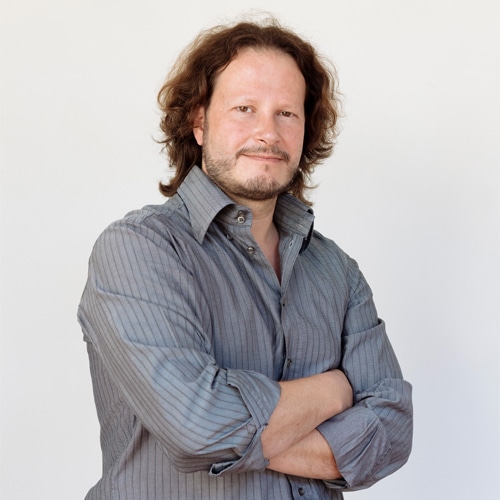
Professor Ulrik Lund Andersen heads the quantum information group at DTU Physics, Technical University of Denmark. His research develops quantum technologies including quantum computation, secure communication, and quantum-enhanced measurement systems. His group generates entangled optical states and investigates diamond-photon interactions for quantum nonlinearities. Key research areas: Quantum computing architectures Continuous-variable quantum information Quantum key distribution Quantum-enhanced sensing Solid-state quantum systems Recent work advances error correction, quantum state engineering, and quantum sensing algorithms. Publications demonstrate consistent focus on practical quantum technology implementation. Awards include multiple Sapere Aude research grants and the Eliteforsk Award from the Danish Ministry of Science.
Diego Garlaschelli is Professor of Theoretical Physics at the IMT School for Advanced Studies in Lucca, Italy, and at the Lorentz Institute for Theoretical Physics, University of Leiden, the Netherlands. He leads the NETWORKS research unit at IMT and the Econophysics and Network Theory group at Leiden. He is also an external faculty member at the Complexity Science Hub in Vienna and an associate member of the Enrico Fermi Research Center in Rome. His affiliations reflect a strong international and interdisciplinary research profile in network science and statistical physics. He holds a master's degree in theoretical physics from the University of Rome III (2001) and a PhD in Physics from the University of Siena (2005). His postdoctoral experience includes positions at the Australian National University, the University of Siena, the University of Oxford, and the Sant’Anna School of Advanced Studies in Pisa. Garlaschelli’s research spans network theory, statistical physics, econophysics, financial complexity, ecological networks, and social dynamics. He applies maximum entropy models, information theory, and random graph frameworks to understand complex real-world systems. His teaching includes courses in Network Theory, Econophysics, and Complex Systems at both PhD and MSc levels. The 15 most recent publications highlight a consistent focus on network reconstruction, ensemble inequivalence, renormalization, and applications to financial and socio-economic systems. Key themes include statistical inference in networks, resilience, and multi-scale modeling, with publications in top journals such as Nature Reviews Physics , Physics Reports , Science , and Physical Review Letters . His scientific awards include the Best Paper Award at the 6th International Workshop on Self-Organizing Systems (2012) and the Jan Kijne Prize (2013) as supervisor. He has secured multiple grants from NWO, the European Union, and the Royal Society, and has supervised over 40 students at PhD, master’s, and bachelor’s levels. He also mentors postdocs and visiting scientists. Garlaschelli leads and organizes major international workshops and schools in network science and complex systems. He serves on scientific committees and is an active referee for journals like Nature and Physical Review Letters , as well as funding agencies including the ERC and NWO.
Mikkel N. Schmidt is an Associate Professor in the Department of Applied Mathematics and Computer Science at the Technical University of Denmark (DTU). His research focuses on statistical modeling, Bayesian methods, and their applications in science and industry. He has held visiting roles at Columbia University (2007) and Cambridge University (2008-2009). His work integrates probabilistic modeling with computational inference to address complex problems in diverse fields such as molecular discovery, optical communication, and brain connectivity analysis. Education highlights include visiting scholar and postdoctoral experiences at top-tier institutions. Research interests span statistical methodology development, machine learning applications, and interdisciplinary problem-solving. Current projects involve Bayesian neural networks for molecular discovery and federated learning optimization. Advising efforts include supervising multiple PhD students in areas like molecular discovery and denoising diffusion models. Notable collaborations involve work on materials science, quantum communication, and medical signal processing. His contributions bridge theoretical advancements with practical industrial applications, emphasizing interdisciplinary innovation.
Rasmus Pagh is a Professor at the Department of Computer Science, University of Copenhagen, specializing in algorithms and complexity. His career includes a 2002 PhD from Aarhus University under Peter Bro Miltersen and a tenure at IT University of Copenhagen until 2020. He leads theoretical research with practical applications in big data, databases, and modern computer architecture parallelism. His research interests span algorithms, data structures, and privacy-preserving computing. Recent work includes the ERC-funded project on Scalable Similarity Search and contributions to the BARC center for basic algorithms research. He has collaborated with Google Research (2019-2020) and focuses on theoretical foundations with real-world impact. Key research trends in his 2023-2024 publications include privacy-preserving data analysis probabilistic data structures distributed secure computation noise-robust coding hashing efficiency continual privacy mechanisms Scientific recognition includes 2024 ACM Fellowship ERC grant leadership multiple top-tier conference publications
Nicola Dragoni is a Professor in Cybersecurity Engineering at the Department of Applied Mathematics and Computer Science, Technical University of Denmark (DTU). As Deputy Director and Head of Section, he leads research initiatives focused on securing emerging technologies. Key Research Areas : Internet of Things (IoT) security, machine learning for intrusion detection, cyber-deception techniques, fog computing, malware analysis, blockchain applications, and wireless sensor network security. Supervision : Actively supervising multiple PhD students in projects related to cyber-deception, moving target defense, and bio-inspired security mechanisms. Recent Publications : Contributions to IoT honeypots, drone identification via RF signals, passkey adoption challenges, and cyber range taxonomies.
Juan C. Vasquez is a Professor at Aalborg University's Faculty of Engineering and Science, Department of Energy Technology, and Co-Director of the Center for Research on Microgrids (CROM). He holds a PhD in Automatic Control from the Technical University of Catalonia and has held academic positions at Aalborg University since 2011. His research focuses on microgrid control, renewable energy integration, power electronics, and smart grids. He has supervised numerous PhD and master’s students and leads projects funded by EU and national grants. Education: BS in Electronics Engineering (Autonomous University of Manizales, Colombia, 2004); PhD in Automatic Control (Technical University of Catalonia, Spain, 2009). Research interests include operation and control strategies for AC/DC microgrids, maritime microgrids, energy management systems, and IoT integration in smart grids. He has authored 648+ publications, including highly cited works, and received awards like the Young Investigator Award (2019) and Clarivate’s Highly Cited Researcher status since 2017. Key projects: EU-DREAM (Digital Services for Energy Transition), NEST (National Research Infrastructure), and ActRes (Resilience in Energy Systems). Collaborations include Virginia Tech and Ritsumeikan University.
Shashi Raj Pandey serves as Assistant Professor in the Department of Electronic Systems at Aalborg University's Technical Faculty of IT and Design, Denmark. His research is anchored in the Connectivity section and Connectivity Classique-Center for Classical Communication in the Quantum Era, with office location at Fredrik Bajers Vej 7C, C1-111, 9220 Aalborg Øst. His core research spans Network Economics, Game Theory, and Wireless Networks, with specialization in Decentralized Machine Learning and Semantic/Goal-oriented Communications. Current work integrates Digital Twin technologies with 6G systems for industrial automation and earth observation, emphasizing resource-efficient protocols for Internet of Things and edge intelligence applications. Recent publications (2024-2025) reveal a clear trajectory toward AI-6G convergence, featuring semantic communications for satellite imaging, game-theoretic network resource allocation, and digital twin implementations for autonomous systems. Key themes include communication efficiency in distributed learning and physical-digital world integration. Notable recognitions include: Best PhD Thesis Nominee (2021) Excellent Paper at Korea Software Congress, KIISE 2021 Student Best Paper Award at APNOMS 2019 Best Paper at Korea Software Congress, KIISE, 2018 Brain Korea 21st Century Plus Fellowship Academic service includes external PhD examination for EU SNS projects and peer review for premier conferences (AAAI, ICLR, ICML). His lab work within the Connectivity Classique-Center explores classical communication frameworks applicable to quantum-era networks, with focus on semantic information theory and decentralized network architectures.
Carsten Baum is an Associate Professor at the Department of Applied Mathematics and Computer Science, Technical University of Denmark, working within the Cybersecurity Engineering Center for Quantum Technologies. His research focuses on cryptography, particularly post-quantum security, secure multi-party computation, and quantum-resistant protocols. Primary Affiliation: Technical University of Denmark (DTU) Academic Rank: Associate Professor Research Centers: Cybersecurity Engineering Center for Quantum Technologies Research Interests: Carsten Baum specializes in cryptographic protocols, including zero-knowledge proofs, multi-signatures, and oblivious computation. His work addresses quantum computing threats to classical cryptography and develops resilient post-quantum solutions. Key areas include: Secure multi-party computation (MPC) Post-quantum key agreement Quantum computing's impact on cryptographic security Privacy-preserving technologies Hash function security analysis (e.g., SHA-3) Time-based cryptographic primitives Advising and Projects: As a main or co-supervisor, Baum mentors multiple PhD candidates in post-quantum cryptography and secure protocols. His projects include proactive post-quantum cryptography, quantum key agreement, and long-term security frameworks, reflecting collaborations with institutions across Europe and Asia. Recent Activities: Baum actively organizes and participates in Nordic cryptography workshops, including NordiCrypt Spring 2024 and 2023, fostering academic exchange in cryptographic research.
Karsten Rottwitt is a Professor and Group Leader at the Department of Electrical and Photonics Engineering, Technical University of Denmark. He leads the Fiber Optics, Devices and Non-linear Effects research group and is affiliated with the Centre of Excellence for Silicon Photonics for Optical Communications. His work contributes to UN Sustainable Development Goals related to sustainable innovation in technology. Research Focus: Fiber optics, nonlinear effects, quantum photonics, and silicon-based photonic platforms. Key Projects: Includes quantum communication systems, mode-division multiplexing, and advanced fiber sensor technologies. Research Interests: Rottwitt’s expertise spans intermodal four-wave mixing, single-photon manipulation, and integrated photonics. His recent work emphasizes applications in quantum communication, high-dimensional entanglement, and novel materials like silicon carbide for photonic devices. Articles Trends: Recent publications focus on efficient frequency conversion using intermodal Bragg scattering, quantum state preservation in fibers, and sensor technologies leveraging few-mode fibers. These studies address challenges in nonlinear optics and quantum information processing. Advising: Supervises PhD students in projects such as Silicon Carbide Quantum Photonics and Effects of Higher-Order Modes on Optical Amplifiers. Grants: Active and completed projects include funding for quantum communication systems and photonic device development. Labs/Teams: Part of the leading research group at DTU, collaborating on integrated silicon carbide photonics and advanced fiber technologies.
Luisa Siniscalchi is an Assistant Professor (tenure track) in the Department of Applied Mathematics and Computer Science at the Technical University of Denmark (DTU), affiliated with the Cybersecurity Engineering Center and the Center for Quantum Technologies. Her research lies at the intersection of cryptography, cybersecurity, and theoretical computer science. Her research interests focus on secure multiparty computation (MPC) , zero-knowledge proofs , non-malleable and deniable protocols , post-quantum cryptography , and cryptographic primitives . She investigates foundational aspects of secure computation under minimal assumptions, aiming to achieve optimal round complexity and strong security guarantees in both synchronous and asynchronous settings. The recent publications highlight a consistent trend in designing efficient, secure, and practical cryptographic protocols, particularly in MPC and deniable authentication. Her work often appears in top-tier venues such as EUROCRYPT, CRYPTO, and TCC, demonstrating strong theoretical rigor and innovation. Key themes include black-box constructions, post-quantum security, and privacy-preserving mechanisms. Scientific Awards: No awards listed in the provided text. Luisa Siniscalchi is actively supervising PhD students in cutting-edge projects related to proactive post-quantum cryptography, long-term security of protocols, and dynamic graph algorithms. She collaborates with principal investigators such as Claudio Orlandi, Ivan Damgård, and Carsten Baum, indicating integration into major research initiatives at DTU. While specific grants are not detailed, her involvement in multi-year PhD projects suggests active grant funding. Labs and Research Groups: Cybersecurity Engineering Center, DTU Center for Quantum Technologies, DTU Active research in cryptographic protocols and algorithms
Peter Lodahl is a Professor in quantum physics and technology at the Niels Bohr Institute, University of Copenhagen, and serves as Director of the Hybrid Quantum Networks Hy-Q Center of Excellence. He leads the Quantum Photonics Group and holds the position of Deputy Section Leader of Quantum Optics at the institute. Lodahl has established himself as a leading researcher in quantum optics and quantum information processing with solid-state systems. His research focuses on developing fundamentally new quantum hardware for quantum-information science, specifically deterministic single-photon sources, spin-photon interfaces, and photonic quantum gates. His work has pioneered the demonstration that light emission can be fully controlled through intricate photonic nanostructures, enabling deterministic quantum interfaces between light and matter. His research spans quantum simulators, quantum repeaters, and quantum key distribution, all contributing to the development of a quantum internet. Lodahl's publication record shows a strong focus on quantum networks, photonic quantum technologies, and quantum information processing. His recent work demonstrates significant advances in deterministic photon sources, quantum entanglement generation, waveguide quantum electrodynamics, and practical implementations of quantum technologies. His research has shifted from fundamental demonstrations toward practical quantum applications and hardware development. EliteForsk Price (2016) ERC Advanced Grant (2015) ERC Consolidator Grant (2010) Young Researcher's Award by the Danish Research Council (2005) Lodahl has supervised 25 MSc students, 23 PhD students, and 17 postdocs since 2005. He has attracted over 200 MDKK in research funding from sources including ERC, Danish Research Council, VILLUM Foundation, Innovation Fund DK, and A.P.Møller Foundation. As Director of the Hy-Q Center of Excellence and Scientific Director for the Center of Quantum Innovation, he oversees significant research infrastructure and initiatives in quantum technology. He leads the Quantum Photonics Group at the Niels Bohr Institute and was PI for the Quantech infrastructure proposal accepted on the Danish Roadmap for Research infrastructure with a total budget of 40 MDKK. His group collaborates internationally and has developed numerous technologies including 5 patents in photonic quantum technology and a co-founded quantum-tech start-up company.
Dr. Daniel Malz is an Assistant Professor at the Department of Mathematical Sciences, University of Copenhagen. His research focuses on quantum many-body systems, quantum optics, and quantum computing, with affiliations to research groups QA, QMATH, and QfL. His work bridges theoretical physics and mathematical modeling, addressing topics like superradiance, entanglement dynamics, and quantum state preparation. Key research interests include quantum information theory, non-Markovian dynamics, and the development of efficient quantum simulation techniques. His recent publications explore advanced topics such as photonic cluster states, tensor network simulations, and cross-platform quantum network verification. Much of his work addresses foundational questions in quantum mechanics while maintaining practical relevance for quantum technologies. His contributions span both theoretical derivations and numerical methods, with a focus on bridging classical and quantum many-body dynamics.
Michael Galili is an Associate Professor in the Department of Electrical and Photonics Engineering at the Technical University of Denmark (DTU). He is affiliated with the High-Speed Optical Communications Centre of Excellence for Silicon Photonics. His research focuses on high-speed optical communication systems, including nanotechnology-based components like optical filters and ultra-fast lasers for data signal processing. He explores novel solutions to handle data rates exceeding 320 Gbit/s using photonics, addressing challenges in signal processing and system design beyond traditional electronic limits. Galili leads the Nano-COM project developing nanotechnology-driven optical communication components. His work integrates advanced photonics with fiber optics, emphasizing optical signal processing, nonlinear effects, and quantum communication systems. He has supervised multiple PhD students in areas such as quantum communication multiplexing, frequency conversion, and mode division multiplexing. His recent publications span topics including all-optical switching via Fano resonance, parametric spectral shaping, and long-haul unrepeated transmission systems. He has received awards such as the Jorcks forskningspris (2021) and AEG Elektronprisen (2023). His lab, part of DTU’s Fotonik research group, collaborates internationally on projects like photonic lanterns and silicon carbide-based Kerr combs for ultra-high-speed data transmission.
Hou Man Chin is a Visiting Professor at the Technical University of Denmark (DTU), affiliated with the Department of Electrical and Photonics Engineering and the Department of Physics. His research spans Quantum Physics and Information Technology, focusing on Machine Learning in Photonic Systems. He explores applications in quantum key distribution, optical communication systems, and quantum cryptography, with a particular emphasis on securing network infrastructure through advanced quantum protocols. Key areas of research include squeezed light generation and recovery, digital signal processing for quantum communication, and overcoming technical challenges like phase noise and signal degradation in long-distance systems. His work addresses practical implementation of quantum technologies, such as composable security frameworks and real-world deployment of quantum encryption methods. Hou Man Chin collaborates with experts in quantum technologies, including Ulrik Lund Andersen and Darko Zibar, on projects related to quantum information processing and machine learning integration. His research group (qTReX) develops semi-autonomous quantum key distribution systems and investigates vulnerabilities in modulation leakage and carrier recovery mechanisms.
You Zhou is an Associate Professor at the Niels Bohr Institute , University of Copenhagen, leading the Experimental Subatomic Physics group. With a focus on Quark-Gluon Plasma (QGP) studies via the ALICE collaboration at CERN since 2010, his work leverages anisotropic particle expansion to probe QGP properties, including shear viscosity and thermalization. Principal Investigator of Villum Young Investigator project (2019–2024) on creating the "smallest droplet of early universe" Over 450 publications in experimental nuclear/particle physics Organized major international conferences including Initial Stages 2023 and Quark Matter workshops His research bridges high-energy nuclear physics , particle correlations , and collective flow , supported by grants from the Carlsberg Foundation , DFF-Sapere Aude , and Villum Foundation . He supervises students from bachelor projects to PhDs, including award-winning theses from Katarina Gajdosova and Vojtech Pacik . Key awards include the Villum Young Investigator (2019) and Carlsberg Postdoctoral Fellowship (2016). Recent lectures span the Nordic Winter School and Peking University . His work on femtoscopy, hypernuclei, and photon production has advanced understanding of early universe conditions and matter formation.