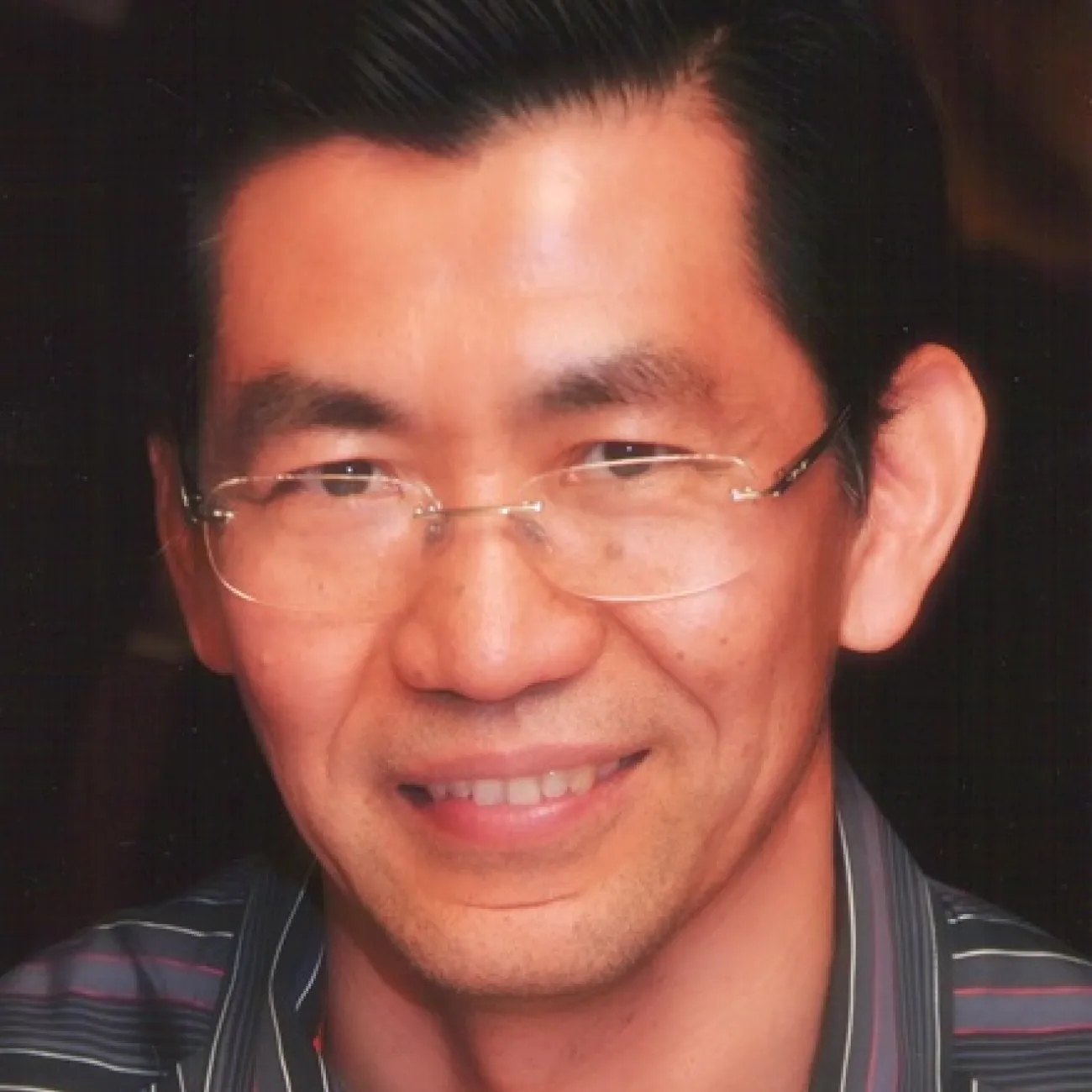
Professor Sheng Chen at the University of Southampton holds a prestigious academic rank in the Electronics and Computer Science department. His research interests span wireless communication systems, machine learning for signal processing, underwater robotics, and digital twin technology. IEEE Fellow Royal Academy of Engineering Fellow Chartered Engineer Research Focus: Professor Chen specializes in advanced wireless communication systems including MIMO technologies, channel estimation techniques, and next-generation 6G protocols. His work extends to industrial cybersecurity applications and underwater stereo matching algorithms. Recent Contributions: His latest publications demonstrate expertise in memristor-based signal processing circuits, label distribution learning using renormalization group theory, and innovative interference mitigation strategies in dynamic TDD systems. Current research projects: Optimising control system integrity (Royal Academy of Engineering), NEWCOM (European Union)
Tan Tuy Nguyen serves as an Assistant Professor in the School of Informatics, Computing, and Cyber Systems at Northern Arizona University, where his research bridges theoretical cryptography with practical hardware and software implementations. His work focuses on developing secure, high-performance computing systems for real-world applications across multiple domains. Dr. Nguyen's research program centers on five interconnected pillars: Post-Quantum Cryptography : Advancing lattice-based schemes like CRYSTALS-Dilithium and Kyber to counter quantum computing threats Hardware Acceleration : Optimizing cryptographic operations through GPU architectures and specialized hardware designs Homomorphic Encryption Systems : Enabling computation on encrypted data through CKKS scheme optimizations Medical Security Applications : Integrating cryptography with deep learning for privacy-preserving diagnostic systems Audio Processing Security : Combining neural networks with encryption for secure audio transmission and storage Analysis of his 2024-2025 publications reveals a strategic shift toward deployable cryptographic solutions, with 80% of recent work addressing performance bottlenecks in post-quantum algorithms. His research demonstrates particular innovation in GPU-accelerated cryptography (40% of recent output) and cross-domain applications to healthcare and audio processing (30% combined), establishing him as a key contributor to practical secure computing systems.
Murilo da Silva Baptista is a Reader at the Institute for Complex Systems and Mathematical Biology , within the School of Natural and Computing Sciences at the University of Aberdeen . He has been with the university since 2009, initially as a Senior Lecturer and promoted to Reader in 2014. He is actively accepting PhD students in Physics, Mathematics, and Engineering, and his research is internationally recognized in the fields of complex systems and chaos theory. His research focuses on understanding the relationship between function—such as information processing, collective behavior, and synchronization—and structure in large networked complex systems. He applies analytical methods, data science, nonlinear time series analysis, and machine learning to model systems in neuroscience, smart engineering, and Earth sustainability. He is a leading scientist in chaos-based communication, demonstrating how chaotic signals can enable smart and secure wireless and underwater communication systems. His work includes theoretical developments in phase definition in chaotic oscillators, chaos-based cryptography using Poincaré return times, and the discovery of phenomena like Collective Almost Synchronization, which enhances machine learning for EEG signal prediction. His recent publications (2023–2025) span a wide range of applications, including chaotic image and 3D model encryption, UAV surveillance using chaotic paths, causal feature selection in health systems, modeling neurological disorders, and socio-environmental analysis in Brazil. These works reflect a strong trend toward applying nonlinear dynamics and network science to real-world engineering, biomedical, and societal challenges. Scientific Contributions and Recognition: Proved a conjecture on the analytical calculation of Poincaré first return times using unstable periodic orbits. Contributed foundational work to chaos-based cryptography. Proposed a formula linking mutual information to Lyapunov exponents, supporting the Infomax theory of brain evolution. Discovered the phenomenon of Collective Almost Synchronization in complex networks. Demonstrated that causality is a space-time phenomenon, not purely temporal. Advising and Research Support: He is currently supervising PhD students in Physics, Maths, and Engineering, indicating active mentorship. His research is supported by analytical developments and data-driven modeling. He leads work on optimal wireless chaos communication, synapse modeling, brain network changes post-surgery, and socio-economic causality in Brazil. His collaborations span institutions in the USA, Brazil, Germany, and Portugal. Labs and Research Groups: He is affiliated with the Institute for Complex Systems and Mathematical Biology at Aberdeen, a hub for interdisciplinary research in nonlinear dynamics, network theory, and their applications across physical, biological, and social systems.
Chris Papadopoulos is a Professor in the Department of Electrical & Computer Engineering at the University of Victoria. He holds a BASc from the University of Toronto, a MASc from the University of Toronto, and a PhD from Brown University, with professional engineering (PEng) certification. His research focuses on nanomaterials, nanoelectronics, and nanofabrication, particularly exploring carbon nanostructures, self-assembly, and electronic/optical device applications. He leads the Nanoscale Research Laboratory, which develops nanoscale materials and devices for sensors, neuromorphic systems, and nanoelectronic networks. Key research areas include nanoscale self-assembly, electronic transport in nanomaterials, and the integration of nanomaterials into functional devices. His lab employs advanced tools such as nanofabrication, nanoscale imaging, and computational modeling. Recent work includes studies on zinc oxide-based optoelectronic devices, graphene-molecular junctions, and molecular-scale hardware encryption using nanoelectronic networks. Papadopoulos is affiliated with the University of Victoria’s Faculty of Engineering and collaborates with industry and academic partners on nanotechnology advancements. His contributions span both foundational and applied research, addressing challenges in nanoscale assembly and device integration.
Christoph C Adami is a Professor at Michigan State University (MSU), holding joint appointments in the Department of Microbiology, Genetics, & Immunology, the Department of Physics & Astronomy, the Ecology, Evolution & Behavior Program, and the BioMolecular Science Gateway within the College of Natural Sciences. He is also affiliated with the Adami Lab, which focuses on computational biology, digital evolution, and information theory. His research integrates evolutionary biology, quantum mechanics, and artificial life, with notable contributions including the Avida platform for studying digital evolution and pioneering work on applying information theory to evolutionary processes. His education includes a BS in physics and mathematics, a Diplom in theoretical physics from the University of Bonn, and MA/PhD in physics from SUNY Stony Brook. He has held roles such as Principal Scientist at the Jet Propulsion Laboratory (NASA) and authored the textbook *Introduction to Artificial Life* (1998). Adami’s research interests span Darwinian evolution at molecular to cognitive levels, quantum information theory, and the origins of life. His work on digital life explores evolutionary dynamics using computational models, while his quantum studies address foundational questions in physics. He has developed influential frameworks like Markov Brains for studying cognitive evolution and neural network dynamics. His 150+ publications (e.g., 2023’s *Evolution of Biological Information*) reflect expertise in evolutionary systems, artificial intelligence, and interdisciplinary applications. Awards include NASA’s Exceptional Achievement Medal (2011 AAAS Fellow, 2017 APS Fellow, and 2019 ISAL Lifetime Achievement Award). Adami advises students in computational biology and AI, leading interdisciplinary teams in the Adami Lab. Key projects include ealib software for evolutionary algorithms, studies on integrated information in animats, and collaborations on quantum measurement theory. His work bridges theoretical insights with experimental validation, advancing our understanding of life’s complexity and information processing across scales.
Univ.-Prof. Wolfgang Dür is a Professor and Head of the Department at the Institute of Theoretical Physics, University of Innsbruck. His research focuses on quantum communication, quantum networks, and quantum education. He leads the Quantum Communication and Quantum Networks research group, developing noise-resilient quantum protocols, scalable quantum repeaters, and quantum sensor networks. He has pioneered educational approaches integrating quantum information theory into school curricula, including games like 'Entangle Me!' and 'Encrypt Me!' to teach quantum principles. Collaborations include the RECC Physics West consortium to enhance teacher training and competency-based learning in secondary schools. Key projects include optimizing quantum resource states for networks, analyzing quantum metrology under noise, and exploring macroscopic quantum states' fragility. He has advised numerous students on topics ranging from quantum cryptography to quantum entanglement pedagogy. His work bridges foundational quantum theory with practical applications, emphasizing scalable architectures and educational innovation.
Elizabeth Quaglia is an Associate Professor (Reader) in the Department of Information Security at Royal Holloway, University of London. Her research focuses on advancing cryptographic protocols and addressing cybersecurity challenges in digital activism and education. She has organized major events such as the London Crypto Day 2024 and served as an editor for the Journal of Information Security and Applications . Education & Background: No explicit educational details provided in the text. Inferred expertise from her roles and publications. Research Interests: Elizabeth's work emphasizes secure protocols, privacy-preserving technologies, and bridging cybersecurity with societal needs. She explores practical applications like timed-release encryption and certificateless systems while advocating for cybersecurity education tailored to activists and vulnerable populations. Grants & Projects: Lead investigator on projects such as Cybersecurity for Changemakers (2022–2023), Learning Together: Cybersecurity for Toddlers (2021), and the Leverhulme Magna Carta Doctoral Studentship (2018–2021). Partnered with institutions like the National Cyber Security Centre and the Arts & Humanities Research Council. Labs & Teams: Collaborated on interdisciplinary projects like StoryFutures (2018–2021), focusing on immersive technologies and cybersecurity implications.
Mustak Erhan Yalcin is a Professor at Istanbul Technical University within the Department of Electronics and Communication Engineering. His research spans hardware security, chaos theory, and signal processing, with a focus on FPGA-based systems, GPS spoofing detection, and image encryption. Key research areas: FPGA, neural networks, hyperchaotic systems, TRNG, GPS security. Recent publications (2023-2024) address encryption designs, spoofing detection, and radiation-tolerant hardware. Active in project leadership, including FPGA-based communication blocks and GPS security systems. Recipient of the 2016 Graduation Design and Project Awards in Electronics-Communication-Biomedical. Contact: yalcinmust@itu.edu.tr
Andrea Coladangelo is an Assistant Professor at the Allen School of Computer Science & Engineering, University of Washington. He co-leads the Quantum group and is affiliated with the Theory and Crypto groups. He coordinates the NSF-funded Quantum@UW REU program and teaches courses in quantum computation and quantum learning theory. PhD in Computer Science from Caltech (advisor: Thomas Vidick) Postdoctoral researcher at UC Berkeley and the Simons Institute (advisor: Umesh Vazirani) BA in Mathematics from University of Oxford Master in Mathematics from University of Cambridge His research focuses on the intersection of quantum computation and cryptography , particularly quantum pseudorandomness, device certification, and quantum learning theory. His work explores foundational questions about entanglement, non-local games, and quantum cryptographic protocols. Recent publications examine quantum money, zero-knowledge arguments, and separations between finite/infinite-dimensional quantum correlations. Coladangelo's 15 most recent papers address topics like quantum cryptographic foundations , entanglement verification , and pseudorandom state construction . Key venues include Eurocrypt, STOC, CRYPTO, and QIP. His work often bridges theoretical quantum information with practical implementations on cloud-based quantum devices via platforms like qBraid . Google Research Scholar Award (2025) CSE Undergraduate Teaching Award (University of Washington, 2023) Best Student Paper (QIP 2019) He advises PhD student Er-Cheng Tang and has taught courses like CSE 434: Intro to Quantum Computation and CSE 599C: Quantum Learning Theory . Coladangelo also delivered a lecture series at the 22nd Bellairs Crypto Workshop (2024) on "Random and pseudorandom quantum states."
Maurizio Rebaudengo is a Full Professor at the Department of Control and Computer Science (DAUIN) of the Polytechnic University of Turin. He is a member of the PIC4SeR Interdepartmental Center for Service Robotics and holds expertise in embedded systems, fault tolerance, and sensor network applications. Research Interests: Embedded systems, fault tolerance, precision agriculture, RFID technology, wireless sensor networks, and system dependability Scientific Awards: Ramamoorthy Best Paper Award (1997) Leadership Roles: Program Chair for the 4th International EURASIP Workshop on RFID, Committee Member for Public Administration Agreements (2020-2024) Projects: Scientific Director for HONEY (Hybrid ONline tEchnologY for particle therapy), FDM (Food Digital Monitoring), IDEM (Internet of Data for Environmental Monitoring), and OPLON (Healthy Longevity Opportunities). Teaching: Course lecturer for Electronic Calculators, Computer Science, Systems Programming, and Cybersecurity at both undergraduate and postgraduate levels. His work spans IoT applications in agriculture and healthcare, focusing on low-cost sensor networks , RFID-based traceability , and cyber-physical system resilience . Recent publications emphasize particulate matter monitoring and secure communication protocols in wireless environments.
Huijia (Rachel) Lin is a Professor at the Paul G. Allen School of Computer Science & Engineering at the University of Washington , holding the Paul G. Allen Development Professorship. Her expertise lies in cryptography and its intersections with theoretical computer science and security. She actively contributes to foundational research in program obfuscation, functional encryption, and lattice-based cryptography. Research Focus: Cryptography, secure multiparty computation, non-malleability, concurrent security, functional encryption, attribute-based encryption, program obfuscation, lattice-based cryptography. Academic Leadership: Co-chair of TCC 2025, member of the TCC Steering Committee (2018–present), and associate editor for JACM. Awards & Recognition: NSF CAREER Award, Hellman Fellowship, Cisco Research Award, JPMorgan Faculty Award, Microsoft Research PhD Fellowship, and multiple best paper awards. Her work spans theoretical cryptography, with applications to post-quantum cryptography and secure computation. She has advised numerous PhD students, including those now at institutions like Boston University, MIT, CMU, and Stanford.
Daniele Micciancio is a Professor in the Computer Science & Engineering Department at the University of California, San Diego, where he has been faculty since 1999. He is a member of both the Cryptography and Security group and the Theory of Computation group within the Jacobs School of Engineering. His academic journey began with a PhD in computer science from the Massachusetts Institute of Technology in 1998. PhD in Computer Science, Massachusetts Institute of Technology (1998) Micciancio's research focuses on the intersection of theoretical computer science and cryptography, with particular emphasis on lattice-based cryptographic systems. His work spans lattice algorithms, complexity of lattice problems, symbolic analysis of cryptographic protocols, and various cryptographic primitives including zero-knowledge proofs. His research has significantly advanced the field of post-quantum cryptography, particularly in developing cryptographic systems based on the hardness of lattice problems that could withstand attacks from quantum computers. His recent publications demonstrate a continued focus on homomorphic encryption, lattice-based cryptography, and secure computation protocols. The trend shows increasing practical applications of his theoretical work, with publications addressing real-world implementation challenges in privacy-preserving computation, medical data analysis, and genomic research. Matchey Award (FOCS 1998) Sprowls Award (MIT EECS, 1999) CAREER Award (NSF, 2001) Hellman Fellowship (2001) Sloan Fellowship (2003) 20-years Test of Time Awards (FOCS 2022, FOCS 2024) Fellow of the IACR (1999) Professor Micciancio has advised numerous graduate students who have gone on to successful careers in academia and industry, including prominent researchers in lattice-based cryptography. His professional activities include serving on editorial boards for prestigious journals including SIAM Journal on Computing, Journal of Cryptology, and Information and Computation. He has also been heavily involved in conference organization, serving as program chair for TCC 2010, CRYPTO 2019, and CRYPTO 2020, and as general chair for TCC 2014. As a member of both the Cryptography and Security group and the Theory of Computation group at UCSD, Micciancio contributes to a vibrant research environment focused on foundational aspects of computer security and theoretical computer science. His work continues to influence both theoretical developments and practical implementations of cryptographic systems, particularly as the field prepares for the post-quantum era.
Bartolomeo Montrucchio is a Full Professor of Information Processing Systems (ING-INF/05) at the Department of Control and Computer Engineering (DAUIN) of the Polytechnic University of Turin. He is a member of the Interdepartmental Center Photonext - PoliTo Interdepartmental Center on Applied Photonics and serves as deputy director at the Interuniversity Center of Regional Interest for the Training of Secondary School Teachers (CIFIS) since July 2012. Additionally, he has held an adjunct professor position at the University of Illinois at Chicago during July 2008. Professor Montrucchio's research spans several cutting-edge areas with a primary focus on quantum computing, computer vision, and sensor networks. His work encompasses image processing, scientific visualization, parallel and distributed systems, and wireless sensor networks. He actively contributes to European research initiatives including the EQUO (European QUantum ecOsystems) project as Scientific Responsible. His research bridges theoretical computer science with practical applications across multiple industries. His publication record shows a strong trajectory toward quantum technologies, with numerous recent publications focusing on quantum machine learning, quantum algorithms for financial applications, and quantum applications in cybersecurity. His work demonstrates increasing emphasis on practical implementations of quantum computing in real-world scenarios, particularly in industrial settings and telecommunications. Best student paper award at BIOSIGNAL2002, conferred by EURASIP, Italy (2002) Associate Editor of IEEE TRANSACTIONS ON VEHICULAR TECHNOLOGY (2019-present) Professor Montrucchio actively supervises numerous PhD students working on quantum computing applications across various domains including finance, cybersecurity, traffic optimization, and industrial use cases. His teaching portfolio includes courses on Quantum Computing, Parallel and Distributed Computing, and Image Processing and Computer Vision across multiple degree programs including Computer Engineering, Biomedical Engineering, and Quantum Engineering. He leads multiple research projects funded by both competitive calls and commercial contracts, with a significant focus on quantum technologies since 2019. His patent portfolio includes several inventions related to tire manufacturing processes and visual rehabilitation for telemedicine.
Tomás Fernández Pena is a Full Professor at the University of Santiago de Compostela (USC) and Senior Researcher at the Research Center in Intelligent Technologies (CiTIUS) . With a career spanning over three decades, he has held academic positions since 1990 and contributed extensively to High Performance Computing (HPC), Big Data, and emerging quantum computing fields. Ph.D. in Physics from USC (1994) Senior Member of IEEE Associate Editor for IEEE Transactions on Computers and IEEE Access Research Contributions : His work focuses on parallel systems architecture, cloud computing middleware, and quantum simulation optimization. He has pioneered methods for NUMA systems, LiDAR data processing, and Big Data applications in bioinformatics/cheminformatics. His recent articles show increasing emphasis on quantum computing frameworks and distributed quantum processing. Scientific Recognition : Holds four Spanish Ministry of Education six-year research excellence periods (sexenios de investigación) and has served as Principal Investigator in 3 public projects and co-investigator in 31 EU/Xunta de Galicia funded initiatives. Supervised 7 Ph.D. theses and published 43+ international journal papers. International Collaborations : Maintains academic connections through funded research stays at Loughborough University, University of Tennessee, and University of Illinois Urbana-Champaign. Active in IEEE and participates in global conferences like Euro-Par and CHEP.
Constandinos Mavromoustakis is a Professor at the Department of Computer Science, University of Nicosia (School of Sciences and Engineering). He leads the Mobile Systems Lab (MOSys Lab) and holds leadership roles in IEEE, including Vice-Chair of the Cyprus Section and Chair of the Computer Society Chapter. He actively contributes to IEEE Communications Society committees and standardization groups like IEEE-SA SCC42 WG2040. Education includes: Dipl.Eng in Electronic and Computer Engineering from Technical University of Crete MSc in Telecommunications from University College London PhD from Aristotle University of Thessaloniki His research integrates Mobile Systems, IoT, and Wireless Communications, with emphasis on: 5G/6G network security using AI-driven strategies Resource optimization in cloud-edge ecosystems UAV-assisted networks for critical infrastructure Healthcare applications via IoMT and data analytics Recent publications (2024-2025) demonstrate strong focus on securing next-gen networks (O-RAN, 6G), optimizing edge computing for VR/IoT, and advancing smart healthcare/cities. Dominant themes include Deep Reinforcement Learning, quantum-inspired optimization, and latency minimization techniques. He participates in EU-funded initiatives including FP7, H2020, Eureka, and national projects. Industrial collaborations include consultancy for Intel Corporation. He directs the MOSys Lab, which researches mobile systems, IoT interoperability, and network security, with projects spanning UAV communications, medical IoT, and sustainable computing.