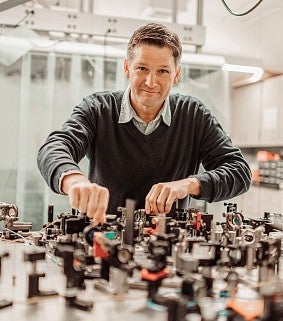
Brian J. Smith is a Professor in the Department of Physics at the University of Oregon. His research focuses on quantum optics, quantum information science and technology, optical physics, and nonlinear optics. He serves as Director of the Optical Molecular & Quantum Science research group, which develops advanced quantum-optical tools for probing fundamental quantum physics and enabling quantum-enhanced applications. Smith's recent work emphasizes harnessing the temporal-spectral mode structure of light to construct larger quantum systems. His team has made strides in quantum-enhanced sensing and networking, leveraging non-classical states of light for applications like microarcsecond astronomy and attosecond-synchronized photonic entanglement networks. He was elected Fellow of Optica in 2023, recognizing his contributions to quantum optics. His research group includes graduate students Sarah Ashby, Matthew Brown, Clark Embleton, Amy Soudachanh, and Jack Lichtman. He has contributed to the NSF National Quantum Virtual Laboratory through the ASPEN-Net pilot project, which explores precision synchronization in quantum networks. Fellow of Optica (formerly Optical Society of America), 2023
Zihe Gao serves as a tenure-track Assistant Professor in the Department of Electrical and Computer Engineering at Auburn University's College of Engineering since August 2023, following postdoctoral research at the University of Pennsylvania and industry experience at Meta (Facebook Reality Labs). His academic foundation includes: PhD in Electrical and Computer Engineering, University of Illinois Urbana-Champaign (2018) MS in Physics, University of Illinois Urbana-Champaign (2012) BS in Physics, Nanjing University (2011) Dr. Gao's research integrates optics, microelectronics, and physics to develop programmable photonic systems. His work focuses on controlling collective behaviors in multi-element photonic systems for scalable integrated chips, with applications spanning dynamically steerable laser sources and reconfigurable quantum optical platforms . Key methodologies include non-Hermitian physics, topological photonics, and spin-orbit coupling engineering. Analysis of his 2023-2025 publications reveals dominant trends in non-Hermitian photonic switching , high-dimensional quantum state manipulation , and topological semiconductor laser arrays . His team pioneers lithography-free reconfigurable photonics and spin-orbit microlasers for quantum key distribution, demonstrating strong industry-academia translation from prior Meta work on AR/VR structured-light systems. His scholarly trajectory shows continuous progression from VCSEL array fundamentals (PhD under Prof. Kent Choquette) to quantum-topological photonics (postdoc with Prof. Liang Feng), now establishing independent research at Auburn with emphasis on integrated quantum-classical hybrid systems.
Laxmidhar Behera is a Professor in the Department of Electrical Engineering at the Indian Institute of Technology Kanpur, specializing in Intelligent Systems and Control. With over two decades of academic experience at IIT Kanpur and international research experience at institutions including Fraunhofer Institute of Autonomous Intelligent Systems in Germany, ETH Zurich, and University of Ulster, he has established himself as a leading researcher in cognitive robotics and intelligent control systems. Dr. Behera's research spans multiple cutting-edge domains including Cognitive Robotics, Nano-robotics, Vision based Control, Soft Computing, Information Retrieval in music and language, Semantic Information Processing, Physics of Complex Systems, Cyber Physical Systems, Formation Control of UAVs, Brain-Computer Interface (BCI), and Sanskrit Computational Linguistics. His interdisciplinary approach bridges traditional control theory with modern computational intelligence techniques, creating innovative solutions for complex real-world problems. His extensive publication record in top-tier journals like IEEE Transactions demonstrates his leadership in areas such as brain-computer interfaces, visual servoing, multi-robot systems, and music information retrieval. Notably, his work on quantum neural networks for EEG filtering and multisatellite formation control has received significant attention in the research community. UKIERI Standard Research Award 2008 Best Paper at International Conf. on Intelligent Sensors and Information Processing (ICISIP-2004) Best Paper at WoSco,02, Int. Conf. High-Performance Computing (HiPC, 2002) AICTE career award for young teacher (1997) Senior Member IEEE Multiple IEEE top accessed articles (2009-2010) As an Associate Editor for Autosoft Journal and Technical Committee Member for Intelligent Control at IEEE Control System Society, Dr. Behera actively contributes to the academic community. His laboratory in the Western Lab - 212A of the Department of Electrical Engineering serves as a hub for research in intelligent systems, where he mentors students and collaborates with researchers worldwide on cutting-edge projects in robotics, control systems, and computational intelligence.
Dr. Carrie Weidner is a Senior Lecturer at the University of Bristol, affiliated with both the School of Physics and the School of Electrical, Electronic and Mechanical Engineering. Her research spans quantum control, atom interferometry, and quantum technology education, with a focus on robust control techniques in optical lattices and spin networks. Principal Investigator for Quantum Positioning, Navigation, and Timing Hub (2024-2029) Lead on EPSRC-funded project EP/Y004728/1 for trapped ultracold atom interferometry (2023-2025) Her recent work includes energy landscape shaping for quantum systems, deterministic generation of squeezed states, and innovative educational tools like the Quantum Composer. Publications analyze robustness metrics, control algorithms, and quantum-classical system comparisons. Collaborations span international institutions in quantum physics and engineering domains. She contributes to quantum outreach through gamification and interactive platforms, targeting improved education and community inclusivity. Current research trends emphasize precision measurement, error mitigation, and AI integration in quantum control systems.
Christian Roos is an Associate Professor at the Department of Experimental Physics , University of Innsbruck, Austria. His research focuses on quantum simulation, trapped ion systems, and quantum information processing. University: University of Innsbruck Department: Experimental Physics Rank: Associate Professor Roos's work explores quantum entanglement , many-body physics , and quantum metrology using trapped ions. His recent studies address dynamical phase transitions, thermalization with noncommuting charges, and large-scale entanglement. Key trends in his publications (2023–2025) include advancements in quantum simulation platforms, correlation spectroscopy , and multiqubit-enhanced sensing . Awards and student advising details are not explicitly mentioned in the provided data.
Philipp Schindler serves as an Assistant Professor in the Department of Experimental Physics at the University of Innsbruck, Austria. His research is centered on experimental quantum computing using trapped ion systems, with a focus on advancing quantum error correction and scalable quantum processor architectures. Dr. Schindler's primary research interests include quantum error correction, fault-tolerant quantum computing, quantum simulation, and the development of trapped ion quantum hardware. His work bridges theoretical concepts with experimental implementations, contributing to the realization of practical quantum computers through innovations in ion trap design, qudit-based processing, and verification protocols. Key methodologies involve precision control of molecular ions and multiqubit operations within cryogenic environments. Analysis of his recent publications (2022-2025) reveals a consistent emphasis on experimental demonstrations of quantum error correction, novel ion trap architectures, and the use of qudits for enhanced quantum processing. Key themes include fault-tolerant operations, two-dimensional connectivity for scalability, and verification protocols for quantum computations. His research shows increasing focus on molecular ion systems and cross-verification techniques for quantum hardware validation. No scientific awards were mentioned in the provided information. Details regarding his students and research grants are not available in the given text. Dr. Schindler operates within the quantum computing research group at the Department of Experimental Physics, utilizing specialized facilities including cryogenic setups and microfabricated ion traps at Technikerstraße 25 in Innsbruck.
Professor Tomohiro Kita is a distinguished faculty member at Tohoku University's School of Advanced Science and Engineering, specializing in silicon photonics and semiconductor laser technology. With a Doctor of Engineering in Materials from Japan Advanced Institute of Science and Technology Hokuriku, he has established himself as a leading researcher in integrated photonics and optical communication systems. His research interests span semiconductor engineering, optical engineering, photon science, silicon photonics, nonlinear optical effects, and semiconductor lasers. Professor Kita's work focuses on developing innovative photonic integrated circuits including wavelength tunable laser diodes, optical phased arrays, and high-speed optical switches. His research group has pioneered techniques for passive optical beam scanning, ultrafast thermo-optic switching, and hybrid integration of quantum dot technology with silicon photonics. Analysis of his recent publications reveals a strong emphasis on practical applications of silicon photonics for optical communications, lidar systems, and optical neural networks. His work demonstrates consistent innovation in overcoming key challenges such as thermal crosstalk in integrated devices, spectral linewidth narrowing, and expanding wavelength tuning ranges. Notably, his group has achieved record-breaking performance metrics including a 145 nm wavelength tuning range and sub-microsecond switching times. Best Paper Award 2023 for Silicon Based High Resolution Passive Optical Phased Array Consisting of Multi-Mode Waveguides Ishida Minoru Memorial Foundation Research Encouragement Award 2014 The 23rd Japan Society of Applied Physics Presentation Encouragement Award 2007 Professor Kita actively mentors students including Yamato Misugi, Kissho Iwanaga, and Yuga Tomimura, who frequently appear as first authors on his publications. He serves on multiple program committees including the IEEE International Semiconductor Laser Conference and Microoptics Conference. His research has attracted significant media attention, with coverage in Laser Focus World, Photonics Spectra, and major Japanese business publications. His laboratory focuses on developing practical photonic integrated circuits for next-generation optical communication systems and sensing applications, with strong industry collaboration particularly with Japan's National Institute of Information and Communications Technology.
Dr. Stephanie Lansing is a Professor in the Department of Environmental Science & Technology at the University of Maryland's College of Agriculture and Natural Resources. She directs the Bioenergy and Biotechnology Lab, focusing on renewable energy systems, waste treatment, and the Food-Energy-Water Nexus. Her work spans ecological engineering, antimicrobial resistance mitigation, and sustainable bioplastic production from organic waste. College of Agriculture and Natural Resources Environmental Science & Technology Bioenergy and Biotechnology Lab Her research integrates anaerobic digestion , microbial fuel cells , and nutrient recovery to address global sustainability challenges. Recent projects examine bioplastic formation from food waste and AMR dynamics in manure systems , with fieldwork in the US, Africa, and Latin America. She co-developed the NourishNet platform combining real-time surplus food distribution ( FoodLoops ) with spoilage detection ( Quantum Nose ). Active grants exceed $6 million, including two major DOE awards for biofuel and bioplastic production from food waste. Her lab collaborates with institutions like Virginia Tech, Idaho National Laboratory, and international partners. Current team members include PhD candidates Maureen Nabulime and Adanyro Atilago, MS student Rafian Aziz, and undergrad researchers exploring waste-to-energy systems.
Massi Pontil is a part-time Professor of Computational Statistics & Machine Learning in the Department of Computer Science at University College London (UCL). He joined UCL as a lecturer in 2003 and was promoted to Professor in 2010. Since 2016, his primary appointment has been at the Istituto Italiano di Tecnologia (IIT), where he leads the CSML research group. His work bridges theoretical machine learning with practical applications in physical sciences. His research interests span a wide range of topics in machine learning theory and algorithms: Machine Learning Theory and Statistical Learning Algorithmic Fairness and Ethical AI Kernel Methods and Reproducing Kernel Hilbert Spaces Transfer Learning, Multitask Learning, and Meta-Learning Operator Learning and Dynamical Systems Sparsity Regularization and Optimization Pontil's recent work focuses on the intersection of machine learning with numerical simulations of physical systems, particularly in molecular dynamics and climate science. His publications demonstrate a strong emphasis on theoretical foundations while addressing practical challenges in high-dimensional systems, symmetry-aware learning, and uncertainty quantification. Among his notable honors are: Best Paper Runner Up Award from ICML 2013 EPSRC Advanced Research Fellowship (2006-2011) Edoardo R. Caianiello Award for the Best Italian PhD Thesis on Connectionism (2002) Professor Pontil has served on program committees for major machine learning conferences (COLT, ICML, NeurIPS) and on editorial boards of prestigious journals including Machine Learning Journal, Statistics and Computing, and JMLR. He teaches Advanced Topics in Machine Learning at UCL, with a focus on convex optimization and statistical learning theory.
Takashi Tanii is a Professor at Waseda University's School of Fundamental Science and Engineering within the Faculty of Science and Engineering. He holds a Doctor of Engineering degree from Waseda University and maintains an active research program as evidenced by his homepage at http://www.tanii.nano.waseda.ac.jp. His research spans multiple interdisciplinary fields at the intersection of physics, engineering, and biology. Professor Tanii's primary research interests focus on Nanobioscience , with specific expertise in Nano-electronics and Nano-biotechnology . His work demonstrates a strong integration of quantum physics principles with biological applications, particularly in the areas of quantum sensing using diamond nitrogen-vacancy centers and neural network analysis. His research also extends to cell adhesion studies, TiO 2 photocatalysis, and single ion implantation techniques for quantum device fabrication. An analysis of his 15 most recent publications reveals a consistent trend toward quantum technologies and biophysical applications . His work on diamond nitrogen-vacancy centers for quantum sensing, particularly for nuclear spin detection, represents cutting-edge research in quantum information processing. Simultaneously, his investigations into neuronal networks and cell adhesion mechanisms demonstrate a strong commitment to understanding biological systems at the nanoscale. The interdisciplinary nature of his research bridges physics, engineering, and life sciences, with potential applications in quantum computing, neural engineering, and biomedical diagnostics. Professor Tanii is an active member of several professional societies including the Japanese Neural Network Society, Architectural Institute of Japan, Japan Society of Applied Physics, and Japan Surface Science Society, reflecting the breadth of his research interests. His work has resulted in 114 publications with 1,627 citations and an h-index of 23, indicating significant impact in his fields of study. While specific grant information is not detailed in the provided text, his consistent publication record across multiple high-impact journals suggests sustained research funding. His laboratory appears to operate at the intersection of quantum physics and biophysics, with research teams likely comprising physicists, engineers, and biologists working collaboratively. The integration of techniques from quantum sensing, microfabrication, and cellular neuroscience suggests a highly interdisciplinary research environment focused on pushing the boundaries of nanoscale measurement and manipulation technologies.
Elham Baladi is an Assistant Professor in the Department of Electrical Engineering at Polytechnique Montréal, where she conducts cutting-edge research in electromagnetics, antenna design, and microwave technologies. Her work focuses on metasurfaces, reconfigurable intelligent surfaces, and RF/microwave sensors with applications spanning satellite communications, medical diagnostics, and next-generation wireless systems. Dr. Baladi received her B.Sc. in Electrical Engineering with a focus on Communication Systems from the Iran University of Science and Technology in Tehran, Iran (2013), followed by a Ph.D. in Electrical Engineering specializing in Electromagnetics and Microwaves from the University of Alberta, Edmonton, Canada (2019). Prior to joining Polytechnique Montréal, she completed postdoctoral research at the University of Toronto's Reconfigurable Antenna Laboratory (2019-2021) and worked as an Antenna/Filter Design Engineer at Syntronic Research and Development Canada (2021-2022). Her research program explores metamaterials and metasurfaces for quantum applications, reconfigurable intelligent surfaces for communication systems, smart antennas for MIMO and satellite communications, and innovative RF/microwave sensors. Dr. Baladi's work bridges theoretical electromagnetics with practical engineering solutions, addressing challenges in wireless communications, sensing, and imaging technologies. She has published extensively in top-tier journals including IEEE Transactions on Antennas and Propagation, IEEE Transactions on Microwave Theory and Techniques, and Scientific Reports. Analysis of Dr. Baladi's recent publications reveals a strategic focus on metasurface applications across multiple domains, with increasing integration of AI techniques in electromagnetics. Her work spans antenna design for satellite communications, microwave sensors for material characterization, and innovative polarization control techniques. A notable trend is the practical implementation of theoretical concepts for real-world communication and sensing applications, with growing emphasis on healthcare applications like tumor detection. Dr. Baladi serves as a reviewer for multiple IEEE and OSA journals and is affiliated with the Advanced Research Centre in Microwaves and Space Electronics (POLY-GRAMES) and Astrolith. Her laboratory work focuses on experimental validation of theoretical concepts in metasurfaces and antenna design, with applications ranging from satellite communications to medical diagnostics. Her teaching portfolio includes Advanced Electromagnetics, Antennas and Propagation, and RF Filter Design.
Bruno Chaudret is a Research Professor at INSA-Toulouse, France, and a member of the French Academy of Sciences since 2005. He serves as Director of the Laboratoire de Physique et Chimie des Nano-Objets (UMR 5215) since 2011 and has held leadership roles in CNRS and IFPEN. PhD, Imperial College London (1977) Doctorat d'État, Université Paul Sabatier Toulouse (1979) His research bridges organometallic chemistry and nanomaterials , focusing on: Magnetic nanostructures Catalysis via C-H bond activation Dihydrogen complexes Self-assembly of nanoparticles into superlattices Gas sensor materials His scientific work spans nanoparticle synthesis , magnetic properties , and catalytic applications , with significant contributions to controlled nanoparticle shapes and assemblies. Notable scientific awards include: Coordination Chemistry Award, French Chemical Society (1982) CNRS Silver Medal (1997) Geoffrey Wilkinson Prize, Royal Society of Chemistry (2008) Grand Prix Pierre Süe, SCF (2010) He has supervised 36 PhD students and 26 Post-Doc fellows , while contributing to 16 patents and 370+ refereed publications . His work extends to industrial applications through licencing.
Horacio Dante Espinosa is the James N. and Nancy J. Farley Professor in Manufacturing and Entrepreneurship at Northwestern University's McCormick School of Engineering, holding the rank of Professor in Mechanical Engineering. He also directs the Theoretical and Applied Mechanics Program and the Micro and Nano Mechanics Lab. His research spans bioinspired materials, single-cell analysis, and multiscale experimentation, with a focus on nanoelectronics and energy harvesting. Espinosa earned his Ph.D. in Applied Mechanics from Brown University and has held academic roles at Purdue University and Harvard University. He leads interdisciplinary teams exploring metamaterials, cell engineering, and advanced fabrication techniques. His honors include the Prager Medal (2019) and multiple fellowships. Espinosa's lab combines experimental and computational methods, with capabilities in nanomechanical testing and biological assay development. Education: Ph.D. in Applied Mechanics (Brown University, 1992), M.Sc. in Structural Engineering (Polytechnic of Milan, 1987), Civil Engineering (Northeastern National University, Argentina, 1981) Key Roles: Director of iCET (2015–2018), Faculty Director of NUFAB (2013–2015), Visiting Professorships at Stanford and Harvard Labs: Micro and Nano Mechanics Lab focuses on biomaterials, metamaterials, and single-cell manipulation with advanced microscopy and electroporation systems Grants/Awards: NSF-CAREER Award, ONR Young Investigator Award, and leadership roles in professional societies His research bridges mechanics, materials science, and biology, with applications in healthcare technologies and advanced materials. Current projects include phononic crystal studies, Kirigami engineering, and high-throughput electroporation platforms for cell analysis.
Jan Stake is a Professor of Terahertz Electronics and head of the Terahertz and Millimeter-Wave Laboratory at Chalmers University of Technology. He holds a MSc (1994) and PhD (1999) in electrical engineering and microwave electronics from Chalmers. His research focuses on terahertz technology for space missions, climate science, and industrial applications. Key projects include developing THz components for the Jupiter Icy Moons Explorer (Juice) and MetOp satellites, and creating sensors for pharmaceutical manufacturing. He has authored 388+ publications, served as Editor-in-Chief of IEEE Transactions on Terahertz Science and Technology , and is an IRMMW-THz board member. Current work emphasizes integrated THz components for space science and wireless communication. Awards include visiting research fellowships at the UK’s National Physical Laboratory (2023). Teaching includes semiconductor physics and microwave engineering, with a weekly journal club for PhD students. Research Interests: Terahertz fundamental science and applications Space instrumentation (e.g., SWI instrument for Juice mission) Climate monitoring via atmospheric THz measurements Graphene-based THz detectors and amplifiers THz radar systems for industrial process monitoring Recent Work Trends: Recent articles (2023–2025) emphasize high-precision quantum-cascade lasers , antenna alignment optimization , industrial THz sensing systems , and space-borne receiver reliability . Key themes include improving THz component integration, enhancing spectral resolution for molecular analysis, and advancing THz applications in manufacturing and environmental science. Awards & Roles: Editor-in-Chief, IEEE Transactions on Terahertz Science and Technology (2016–2018) Chair, IEEE THz Best Paper Award Committee (2019–2021) Elected IRMMW-THz Board Member (2017–2024) Visiting Research Fellow, UK National Physical Laboratory (2023) Grants & Collaborations: Active in EU and industry partnerships for space instrumentation (e.g., Juice mission) and pharmaceutical sensing. Lab develops THz components with companies in aerospace and medical sectors. Labs/Teams: Leads the Terahertz and Millimeter-Wave Laboratory, collaborating with National Physical Laboratory (UK) and ESA on space instrument development.
Roles & Affiliations: Professor and President's Chair Professor in Computer Science and Engineering at Nanyang Technological University (NTU), Singapore. Member of the IEEE and IET, with roles in editorial boards of major journals like IEEE Transactions on Network Science and Engineering and IEEE Communications Surveys & Tutorials. Current positions: Editor-in-Chief of IEEE Transactions on Network Science and Engineering, Area Editor in multiple journals including IEEE Communications Surveys and Tutorials. Education: Ph.D. (2008) and M.Sc. (2005) in Electrical and Computer Engineering from the University of Manitoba, Canada. B.Eng. (1999) in Computer Engineering from King Mongkut's Institute of Technology Ladkrabang, Thailand. Research Interests: Focuses on mobile generative AI, edge general intelligence, quantum networking, incentive mechanisms, and wireless communication systems. Explores applications in 6G, IoT, UAV networks, and secure communication. Recent Articles & Trends: 15 most recent articles highlight advancements in generative AI for wireless networks, quantum computing integration, secure communication protocols, and AI-driven network optimization. Key themes include semantic communication frameworks, RIS-aided systems, and federated learning in edge networks. Awards: Over 20+ prestigious awards including IEEE Fellow (2017), IET Fellow (2022), Stuart Meyer Memorial Award (2024), and multiple best paper awards at top conferences like IEEE WCNC and IEEE ICC. Advising & Grants: Advisor to numerous students (not listed explicitly). Active in funding initiatives for AI in wireless systems, quantum networks, and low-altitude economy networking. Leads projects on GenAI for networking and 6G innovations. Labs & Teams: Research focuses on CCDS labs at NTU, collaborating on projects like GenAI for ISAC, mobile edge computing, and secure federated learning systems.