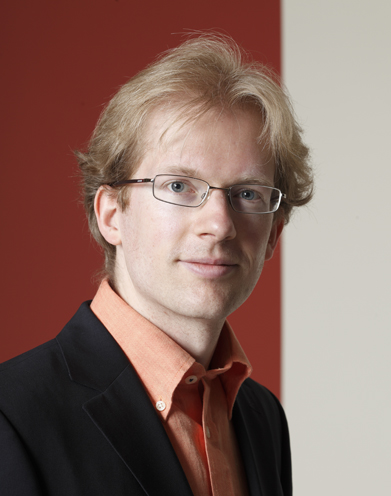
Harvey B. Meyer is a Professor of Theoretical Physics at Johannes Gutenberg University Mainz since 2014. Previously, he held positions including Junior Professor at Mainz (2010), Fellow at CERN's Theoretical Physics Division (2009), Research Scientist at MIT (2008), and postdoctoral roles at MIT (2006-2008) and DESY (2004-2006). He earned his D.Phil. in Theoretical Physics from the University of Oxford (2001-2004) and a Diplome de Physique from the University of Lausanne (1996-2001). His research focuses on lattice field theory, QCD phase diagrams, thermal field theory, and hadron structure. He leads the NEPhEuQCD collaboration and has received the ERC Consolidator Grant (2018) for the SIMDAMA project. Meyer teaches courses in theoretical physics and mathematical methods at Mainz, including 'Theoretische Physik 4' and 'Mathematische Rechenmethoden'. His work integrates advanced computational techniques to address fundamental questions in particle and nuclear physics. Key achievements include pioneering studies on the muon's anomalous magnetic moment, hadronic light-by-light scattering, and quark-gluon plasma dynamics. Collaborations include MIT, CERN, and institutions globally through lattice QCD projects. His lab and team contributions are central to the PRISMA+ Cluster of Excellence at Mainz.
Prof. Dr. Michael Klasen is a leading theoretical physicist at the Institute of Theoretical Physics at the University of Münster, where he heads his eponymous research group. His work bridges nuclear and particle physics, with significant contributions to quantum chromodynamics and physics beyond the Standard Model. His research focuses on Particle Physics , Quantum Chromodynamics , and Physics beyond the Standard Model , with particular emphasis on understanding the quark-gluon structure of atomic nuclei and dark matter phenomena. His innovative approach connects microscopic quark-gluon dynamics with nuclear binding phenomena, creating a crucial bridge between nuclear and particle physics. Prof. Klasen's recent work analyzing nucleon binding at the quark-gluon level was recognized as a "Breakthrough of the Year 2024" by Physics World. His research group's publication in Physical Review Letters demonstrated how quarks and gluons behave differently in nucleon pairs than in free nucleons, fundamentally advancing our understanding of nuclear binding. Breakthrough of the Year 2024 from Physics World Leadership of Research Training Group 2149 "Strong and weak interactions - from hadrons to dark matter" Supervision of award-winning doctoral research including the Infineon Dissertation Prize 2025 Prof. Klasen has successfully mentored numerous PhD students, with 20 of his group's graduates continuing their academic careers at prestigious institutions including CERN and Stanford University. His research has been supported by major funding bodies including the German Research Foundation (DFG), the Helmholtz Alliance for Astroparticle Physics, and BMBF collaborative research programs. The Klasen working group maintains active collaborations with international research networks including CTEQ, DM@NLO, and RESUMMINO.
Antonio Vairo is a full Professor at the Department of Physics, TUM School of Natural Sciences, Technical University of Munich, where he holds the Chair of Theoretical Physics - Applied Quantum Field Theory (T39) at the James-Franck-Str. 1/I campus in Garching bei München. His research focuses on the theoretical foundations of quantum chromodynamics with emphasis on heavy quark systems and non-perturbative phenomena. Professor Vairo's primary research interests include Quantum Chromodynamics (QCD), Heavy Quark Physics, Lattice Gauge Theory, Effective Field Theories, and Exotic Hadron Spectroscopy. His work bridges computational approaches with analytical frameworks to investigate quarkonium dynamics in extreme environments like the quark-gluon plasma, while developing novel applications of Born-Oppenheimer effective theory to multi-quark systems. Recent investigations extend into dark matter bound state formation in the early universe, demonstrating interdisciplinary reach across particle physics and cosmology. Analysis of his 2024-2025 publications reveals three dominant research thrusts: (1) quarkonium suppression mechanisms in heavy-ion collisions using open quantum systems approaches, (2) high-precision lattice QCD computations of static forces and chromoelectric correlators, and (3) systematic development of effective field theories for exotic hadrons and dark matter pairs. His work on pNRQCD (potential non-relativistic QCD) provides critical connections between lattice results and experimental observables in heavy-ion physics. Professor Vairo maintains active research leadership through collaborations with international groups including the Belle II experiment, as evidenced by his contributions to 'The Belle II Physics Book'. His methodological innovations in applying quantum trajectory methods to quarkonium evolution and developing FeynOnium computational tools for effective field theories demonstrate significant technical contributions to the field. Current research directions emphasize next-to-leading order corrections in heavy quark dynamics and Debye mass effects in dark matter bound state formation.
Olaf Kaczmarek is a researcher at the Faculty of Physics , Bielefeld University , specializing in Lattice Quantum Chromodynamics (QCD) and Strongly Interacting Matter . He leads projects related to QCD thermodynamics , quark-gluon plasma , and heavy quark transport . Principal Investigator in TRR 211/2 Subproject A06: Hadronic Excitations and Spectral Functions in the Medium (2025) Co-PI in TRR 211/2 Subproject Z02: Software Development Center (2025) Contributor to GPUHEP2014 and LATTICE2024 symposia Research Focus: Thermal QCD phase transitions, heavy quark diffusion , transport coefficients , lattice simulations , and quarkonium spectroscopy . His work bridges theoretical physics and high-performance computing , particularly in Multigpu Systems for QCD calculations. Recent Publications explore topics like the chiral crossover , spatial string tension , and thermal photon production , with keywords spanning Quantum Chromodynamics , Lattice Gauge Theory , and High Temperature Physics . Teaching: Offers courses in Lattice Field Theory , GPU Computing , and Gradient Flow for graduate students. Contributes to collaborative seminars in the CRC-TR211: Strong-interaction matter under extreme conditions .
Prof. Dr. Matthias Steinhauser is a faculty member at the Karlsruhe Institute of Technology (KIT), affiliated with the Institute for Theoretical Particle Physics (TTP) since October 2004. His research focuses on precision calculations in particle physics, particularly in Higgs boson production, rare B meson decays, non-relativistic QCD, and multi-loop corrections. Research Interests: Higgs boson production at the LHC Rare B meson decays as probes for physics beyond the Standard Model Non-relativistic QCD and QED Massive and massless form factors Automation of multi-loop calculations Prof. Steinhauser’s recent publications (2025–2024) emphasize next-to-leading and next-to-next-to-leading order QCD corrections for Higgs boson production, B meson mixing, and decay rates. His work includes advanced computational techniques and high-order quantum corrections. Contact Information: Room: 11/11 Phone: +49 (0)721 608 - 47149 Email: Matthias.Steinhauser@kit.edu Office hours: Tuesday 13:30–14:30 and by request
Robert S. Laramee is a Professor at the University of Nottingham (previously at Swansea University), specializing in visualization research. His work focuses on data visualization, scientific visualization, and computational fluid dynamics. He has authored over 170 publications in top journals like IEEE Transactions on Visualization and Computer Graphics, Computer Graphics Forum, and IEEE Computer Graphics and Applications. Research Interests: His research spans information visualization, flow visualization, visual literacy, and educational aspects of visualization. He emphasizes practical applications in fields like healthcare, digital humanities, and computational science. Recent Trends: Recent work includes studies on treemap literacy, educational frameworks for visualization, and interactive systems for clinical data. He has also contributed to visualization resources and surveys, aiming to bridge academic and industry needs. Grants & Collaborations: Collaborations include projects on visualization for smart cities, protein-lipid interactions, and quantum chromodynamics data analysis. No specific grant details are provided in the text. Labs & Teams: Affiliated with visualization research groups at Nottingham and Swansea, though specific lab names are not mentioned.
Rhenish Friedrich Wilhelm University of BonnGermany
Lena Funcke is an Assistant Professor of Theoretical Physics at Bonn University. Her research focuses on quantum computing, lattice field theory, and machine learning applications in physics. She explores topics such as topological phases, gauge theories, and quantum simulations. Her work bridges high-energy physics and computational methods, with a particular emphasis on overcoming noise challenges in quantum algorithms and leveraging machine learning for optimization tasks. Funcke’s research projects include C01 and C03, focusing on Hamiltonian lattice formulations and quantum computing methods for gauge theories. She investigates hybrid approaches combining Monte Carlo simulations with quantum computing to study quantum electrodynamics and topological systems. Her contributions highlight the interplay between theoretical physics and cutting-edge computational tools. Her publications span quantum algorithms for particle physics experiments, error mitigation strategies, and the application of normalizing flows to complex systems like the Hubbard model. She actively contributes to advancing the theoretical foundations of quantum computing and its practical implementation in solving fundamental physics problems.
Prof. Dr. Johanna Stachel is Chair of the Institute for Experimental Physics at Heidelberg University, where she leads research in high-energy nuclear physics. She maintains active affiliations with CERN's ALICE collaboration and serves on multiple international scientific committees including the American Physical Society Council. Her academic background includes a Doctorate in Physics from Mainz University (1982) under Prof. N. Kaffrell and earlier studies in Chemistry and Physics at Mainz University and ETH Zürich (1972-1978). Stachel's research focuses on Quantum Chromodynamics (QCD) and Quark-Gluon Plasma characterization through heavy-ion collisions. Her work examines particle production mechanisms , strangeness dynamics , and collective phenomena in proton-proton and nucleus-nucleus collisions. Key methodologies include femtoscopic correlation studies, heavy-flavor decay analysis, and multiplicity-dependent measurements to probe QCD phase transitions. Recent publications reveal strong emphasis on multiplicity-dependent phenomena across collision systems, with significant contributions to charm hadronization , vector meson production , and jet modification studies using ALICE data. Her team pioneers techniques for accessing hadronic interactions through correlation measurements. Stern-Gerlach-Medal of the German Physical Society (2019) Lise Meitner Prize of the European Physical Society (2014) Order of Merit of the Federal Republic of Germany (1999) Member of German National Academy of Science (2015) Presidential Young Investigator Award (1988) Stachel has directed major research initiatives including the ALICE Transition Radiation Detector project and served as spokesperson for the CERES experiment at CERN. Her leadership extends to institutional roles as former Dean of Heidelberg's Physics Department and President of the German Physical Society (2012-2014). She leads experimental teams within the Collaborative Research Center projects A02 ('From QCD transport to particle yields') and formerly C05 ('Probing the QCD phase structure with heavy quarks'), coordinating international efforts in heavy-ion collision analysis at the LHC.
Aleksas Mazeliauskas is a theoretical physicist and Assistant Professor at Heidelberg University's Institute for Theoretical Physics. Since 2022, he has led an Emmy Noether Research Group funded by the German Research Foundation (DFG), and as of 2024, serves as a project leader at the Collaborative Research Center ISOQUANT. His research focuses on many-body phenomena in high-energy hadron collisions and ultracold quantum gases. Emmy Noether Research Group Leader (2022-present) Project Leader, CRC ISOQUANT (2024-present) Senior Research Fellow, CERN (2019-2022) Postdoctoral Researcher, Heidelberg University (2017-2019) Mazeliauskas specializes in understanding emergent collective phenomena in systems of varying sizes and energy scales, with particular interest in thermalization and hydrodynamic behavior in isolated quantum systems. His work bridges theoretical physics with experimental observations from facilities like CERN's Large Hadron Collider. By analyzing heavy-ion collisions, he investigates how quark-gluon plasma forms and thermalizes, connecting these processes to broader phenomena across physics disciplines. His publication record demonstrates consistent contributions to understanding non-equilibrium dynamics in quantum systems, with recent work focusing on QCD phase transitions, hydrodynamic attractors, and energy loss mechanisms in nuclear collisions. His research group actively contributes to advancing our understanding of fundamental particle interactions under extreme conditions. 2022-2026: Emmy Noether Programme grant from DFG 2021: FCT junior researcher position (declined) 2019: Nuclear Physics A Young Scientist Award 2017: Max Dresden Prize for outstanding theoretical thesis 2016: APS FGSA Travel Award for Excellence in Graduate Research 2013: David Fox award for outstanding Teaching Assistant Mazeliauskas actively mentors students and postdoctoral researchers while securing competitive funding for his research program. His group develops computational tools like KøMPøST and FastReso for analyzing pre-equilibrium dynamics in heavy-ion collisions. He maintains strong international collaborations, particularly with CERN and Stony Brook University. Beyond research, Mazeliauskas is committed to outreach, co-organizing Girls' Day events at Heidelberg and leading physics sections at Lithuania's National Student Academy. His laboratory work focuses on computational modeling of quark and gluon kinetic theory, with applications to both high-energy nuclear collisions and ultracold quantum gases. The group's current projects include thermalization dynamics in heavy-ion collisions (Project A01) and origins of collectivity in few-body systems (Project ABC).
Professor Adi Armoni holds a Personal Chair in Physics at Swansea University's School of Biosciences, Geography and Physics. His research focuses on theoretical physics, particularly the interplay between gauge field theories and string theory, with recent work on three-dimensional Quantum Chromodynamics (QCD) and its realization via brane configurations or holography. He has contributed to understanding dualities in quantum field theories, vacuum structures, and holographic QCD. Armoni has been recognized with awards such as the PPARC Advanced Fellowship and Senior Fellow Award. His publications span over two decades, exploring topics like S-duality in Chern-Simons theories, domain walls in QCD3, and Seiberg duality in non-supersymmetric models. He advises PhD students on projects such as 'Domain walls in the large-N limit of QCD3' and 'Dualities in 3d Field Theories and String Theory'. His research also involves collaborations on holography, string theory models, and lattice simulations. Professor Armoni's work bridges theoretical frameworks to explore fundamental questions in particle physics and quantum field theory.
Karol Kovařík is a Senior Lecturer at the Institute of Theoretical Physics of the University of Münster , Germany. He supervises bachelor and master theses in theoretical particle physics and is actively involved in research projects focusing on dark matter phenomenology and proton structure studies. Research Interests: His work centers on higher-order quantum chromodynamics (QCD) corrections in supersymmetric extensions of the Standard Model, particularly for dark matter detection and relic density predictions. He also investigates nuclear parton distribution functions (nPDFs) within the CTEQ collaboration, essential for understanding proton structure in nuclear collisions at facilities like the LHC. Publications: His research includes seminal contributions to SUSY-QCD corrections for dark matter annihilation processes and precision studies of nuclear PDFs. These works bridge theoretical calculations with experimental constraints from collider experiments. Collaborations: As a member of the CTEQ collaboration, he integrates theoretical and experimental efforts to refine proton/nuclear structure models used in high-energy physics predictions.
Rhenish Friedrich Wilhelm University of BonnGermany
Prof. Dr. Matthias Schott is a faculty member at the University of Bonn, affiliated with the Physikalisches Institut under the Faculty of Mathematics and Natural Sciences. His research focuses on particle physics, quantum chromodynamics (QCD), and precision measurements at the Large Hadron Collider (LHC). He leads a group investigating axion-like particles, high-frequency gravitational waves, and non-perturbative effects in proton-proton and heavy-ion collisions. Research interests include probing the Standard Model’s theoretical gaps through precision measurements of W boson mass, strong coupling constants, and electroweak interactions. His group also develops detectors for collider neutrino physics and gravitational wave searches. Selected publications highlight contributions to ATLAS Collaboration experiments and light-by-light scattering evidence. Labs/Teams: Active in the Transdisciplinary Research Area (TRA) - Matter at the University of Bonn, collaborating on cutting-edge particle physics and detector technology.
Jochen Heitger is an Adjunct Professor at the University of Münster, Department of Physics, where he has been a permanent academic member since 2000. He was promoted to Privatdozent in 2005 and became an außerplanmäßiger Professor in 2018. His research is centered on theoretical particle physics, particularly lattice quantum chromodynamics (QCD), with a focus on precision computations of Standard Model parameters, heavy quark systems (charm and beauty), B- and D-meson decays, and non-perturbative renormalization. His research interests include: Lattice Quantum Chromodynamics (QCD) Heavy Quark Physics (charm, beauty) Monte Carlo Simulations Heavy Quark Effective Theory (HQET) Non-perturbative Renormalization and O(a) Improvement Precision Computation of Quark Masses and Decay Constants Flavor Physics and Hadron Structure The analysis of his recent publications reveals a consistent focus on advancing lattice QCD methodologies for precision calculations in heavy quark physics. His work emphasizes non-perturbative renormalization, O(a) improvement, and the determination of fundamental parameters such as quark masses and meson decay constants using state-of-the-art lattice simulations with dynamical fermions. His contributions span both theoretical development and phenomenological applications, particularly in B- and D-meson physics. Scientific awards and honors: Member of the Scientific Council of the John von Neumann Institute for Computing (NIC), 2020 He has held significant research fellowships, including a DFG Research Fellowship (2013–2016) and a DESY Theory Fellowship (1997–2000). His collaborative work involves extensive participation in the CLS (Coordinated Lattice Simulations) consortium and contributions to major lattice field theory conferences. He has not publicly listed any advisees or students. His research is conducted within the theoretical particle physics group at the University of Münster, focusing on high-precision lattice simulations.
Prof. Michal Czakon is a full-time University Professor at the Institute for Theoretical Particle Physics and Cosmology, RWTH Aachen University. His research group focuses on high-energy theoretical physics, particularly top-quark interactions, QCD corrections, and Higgs boson production mechanisms at particle colliders. Top-quark physics Factorization and resummation techniques Parton showers with quantum effects Subtraction schemes for real radiation Automation of higher-order calculations His recent publications analyze renormalization effects, interference contributions, and precision observables in collider experiments. The group develops tools like Top++ and HELAC-NLO for cross-section evaluations. Scientific Awards: Sofja-Kovalevskaja Award (2004) Heisenberg Professorship (2009) Current advisees include PhD candidates and Master's students such as Manal Alsairafi, Marco Bigazzi, and Felix Eschment. The group also collaborates on software projects for high-energy physics simulations.
Prof. Hartmut Wittig is a Full Professor at the Institute of Nuclear Physics, Johannes Gutenberg University Mainz since 2005. He leads the Cluster of Excellence PRISMA+ (Precision Physics, Fundamental Interactions and Structure of Matter). His research focuses on Lattice QCD, hadron structure, and precision calculations of the muon's anomalous magnetic moment. Wittig holds a PhD from the University of Hamburg (1992) and habilitation in theoretical physics (1998). He has held positions at the University of Southampton (1992–1995), DESY-Zeuthen (1995–1996), and the University of Oxford (1996–2000 as PPARC Advanced Fellow). His research interests include lattice QCD applications to hadron spectroscopy, muon g−2, and precision electroweak observables. Notable achievements include pioneering work on the hadronic vacuum polarization contribution to the muon’s magnetic moment and advancing machine learning techniques in lattice calculations. He has advised over 20 PhD students, many focusing on lattice QCD and precision physics. Awards include CERN Scientific Associate (1999/2000) and a teaching award from Mainz University (2013). Wittig’s lab contributes to global initiatives like the FLAG (Flavour Lattice Averaging Group) and collaborates on projects such as the Muon g−2 experiment. His work bridges theoretical calculations with experimental precision demands in particle physics.