Michael Dine is a Professor at the University of California, Santa Cruz, specializing in theoretical particle physics. His research focuses on quantum chromodynamics (QCD), heavy quark interactions, and non-perturbative methods in gauge theories. Education: Ph.D. in Physics, Yale University, 1978 Advisor: Thomas Appelquist Dissertation: Interactions of Heavy Quarks in Quantum Chromodynamics Research Interests: Static potentials in QCD derived via Wilson loop integrals and Feynman-Kac formulas Spin-dependent interactions in quark-antiquark systems Perturbative and non-perturbative approaches to QCD Coulomb-gauge quantization and Ward identities Awards: None explicitly listed. Advising & Grants: No advisees or grant details provided. His doctoral work highlights contributions to understanding quark dynamics, particularly in static potentials and infrared divergences. Labs/Teams: No specific labs or collaborative teams mentioned in the text.
Professor Viqar Husain is affiliated with the University of New Brunswick, specializing in theoretical physics and quantum gravity. His work focuses on canonical quantization methods applied to general relativity, including studies of spacetime singularities, gravitational entropy, and loop quantum gravity formalisms. Education: Ph.D. 1989, Yale University (Advisor: Lee Smolin) Research explores foundational questions in quantum gravity using ADM and Ashtekar formulations, with particular attention to Gowdy cosmology models and Weyl curvature's role in entropy. His dissertation developed solutions to Hamiltonian constraints using loop-based methods and analyzed quantum gravitational effects on spacetime structure. No academic awards or grants are explicitly mentioned. No student advisees listed in available records.
Daniel Bates is a Senior Research Associate at the University of Cambridge's Department of Computer Science and Technology. His research focuses on Computer Architecture and Machine Learning, emphasizing co-optimization of hardware and software. Key projects include the Loki manycore processor (with 128 cores fabricated in 2018) and the Muntjac RISC-V multicore processor, designed for simplicity and extensibility. Bates explores energy-efficient machine learning optimizations like dynamic gating and network architecture search. He teaches courses including Part IA Algorithms, Part IB Computer Architecture, and Part II Advanced Computer Architecture. His supervision style prioritizes student feedback and clarity, offering tailored support and prompt communication. Bates has contributed to over a dozen peer-reviewed publications since 2013, addressing topics from neural network security to embedded system optimization. His work bridges theoretical research and practical hardware implementation, with a focus on open-source contributions like the Muntjac processor. He actively collaborates with industry through the University's research initiatives, emphasizing real-world applications of computer architecture advancements.
Dr. Peter Davies-Peck is an Assistant Professor in the Department of Computer Science at Durham University. His research focuses on distributed algorithms, graph theory, and parallel computing. He has held roles on programme committees for major conferences like PODC and ICDCS, and has been an invited speaker at workshops associated with DISC. His research interests include Graph Algorithms, Distributed Algorithms, Randomised Algorithms, and Communications Networks. Notable work involves applying the Lovász Local Lemma to distributed computing challenges and developing efficient message-passing protocols in noisy environments. Recent contributions include advancements in parallel derandomization for graph coloring, optimal message-passing in radio networks, and distributed mean estimation techniques. His work bridges theoretical algorithm design with practical distributed system challenges, emphasizing scalability and resilience. Esteem indicators include Programme Committee membership for PODC 2023, ALGOSENSORS 2022, and ICDCS 2021. His publications span top venues like STOC, SODA, and the Journal of the ACM, reflecting impactful contributions to theoretical computer science and distributed systems.
Dr. Venkata S.S. Gandikota is an Assistant Professor in the Department of Electrical Engineering and Computer Science at Syracuse University. He is an Affiliate Faculty at the EnCORE Institute for Emerging CORE Methods in Data Science and an IEEE Senior Member. His research focuses on algorithmic principles for data recovery under noise, leveraging coding theory and structured redundancy to design efficient machine learning and distributed computing algorithms. Key areas include sparse recovery, error-correcting codes, and lattice-based methods. Education Ph.D. Computer Science, Purdue University MS Computer Science, Purdue University MSc Mathematics & B.E. Computer Science, Birla Institute of Technology and Science, Goa, India Research interests span Foundations of Machine Learning, Algorithms for Big Data, Coding Theory, Information Theory, and Lattice Algorithms. His work integrates combinatorial coding principles with modern machine learning challenges, emphasizing robustness against noise and computational efficiency. Recent trends in his publications include advancements in compressed sensing, distributed clustering, and quantum hypothesis testing. Awards: CUSE Seed Grant, SOURCE RA Grant, IEEE Senior Member designation Grants: Supported by CUSE and SOURCE RA grants for research in algorithmic data recovery and distributed systems Labs/Teams: Active contributor to the EnCORE Institute, focusing on emerging data science methodologies
Yoon Kim is an Assistant Professor at MIT, affiliated with the departments of Computer Science (CS), Electrical Engineering (EE), and the AI+D initiative within the School of Engineering. His research focuses on artificial intelligence, machine learning, natural language processing, and speech processing, with notable work on vision-language models and large language models (LLMs). He was named an AI2050 Early Career Fellow in 2024. His recent studies address critical issues like LLMs' failure to handle negation in high-stakes contexts and the ethical implications of retrieval-augmented systems in medical communication. Kim’s work bridges theoretical advancements and practical applications, including optimizing transformer architectures, improving model robustness, and exploring semantic representations across languages and modalities. His publications often emphasize hardware-efficient training and inference techniques, reflecting his interest in scalable AI systems. Collaborative projects with interdisciplinary teams highlight his commitment to advancing both technical and societal aspects of AI.
Jürgen Teich is a Professor at the University of Erlangen-Nuremberg, Department of Computer Science. His research focuses on computer architecture, embedded systems, and hardware-software co-design, with particular emphasis on energy-efficient and sustainable computing. He leads projects involving FPGA-based accelerators, neural networks on microcontrollers, and real-time systems optimization. His work spans topics such as approximation computing, MPSoCs (Multiprocessor Systems-on-Chip), and IoT device architectures. Key contributions include methodologies for optimizing resource allocation in heterogeneous systems and developing energy-harvesting solutions for embedded systems. Teich has authored numerous publications in top-tier conferences and journals, including DATE, FPL, and ACM Transactions. His research often collaborates with industry partners, emphasizing practical applications and open-source hardware.
Anneliese Spaeth is a Professor of Mathematics and Vice President for Technology at Huntingdon College. She holds a Ph.D. in Mathematics from Vanderbilt University (2013), with expertise in Banach Spaces and Basis Theory. Her administrative leadership includes strategic technology initiatives such as implementing Canvas LMS, Campus Café SIS, and expanding campus WiFi. She served as Department Chair (2014-2019) and pioneered the Applied Mathematics major. Her research focuses on Inquiry-Based Learning (IBL), RUME, Basis Theory, Harmonic Analysis, and Quantization Algorithms. She contributes to the Journal of Inquiry Based Learning in Mathematics editorial board and actively publishes in mathematics education and pure/applied mathematics. Notable achievements include NSF Fellowship recognition and multiple honor society memberships. Her professional service includes roles with AACTM, AMS, and MAA. Technical interests encompass Python programming and educational technology innovations.
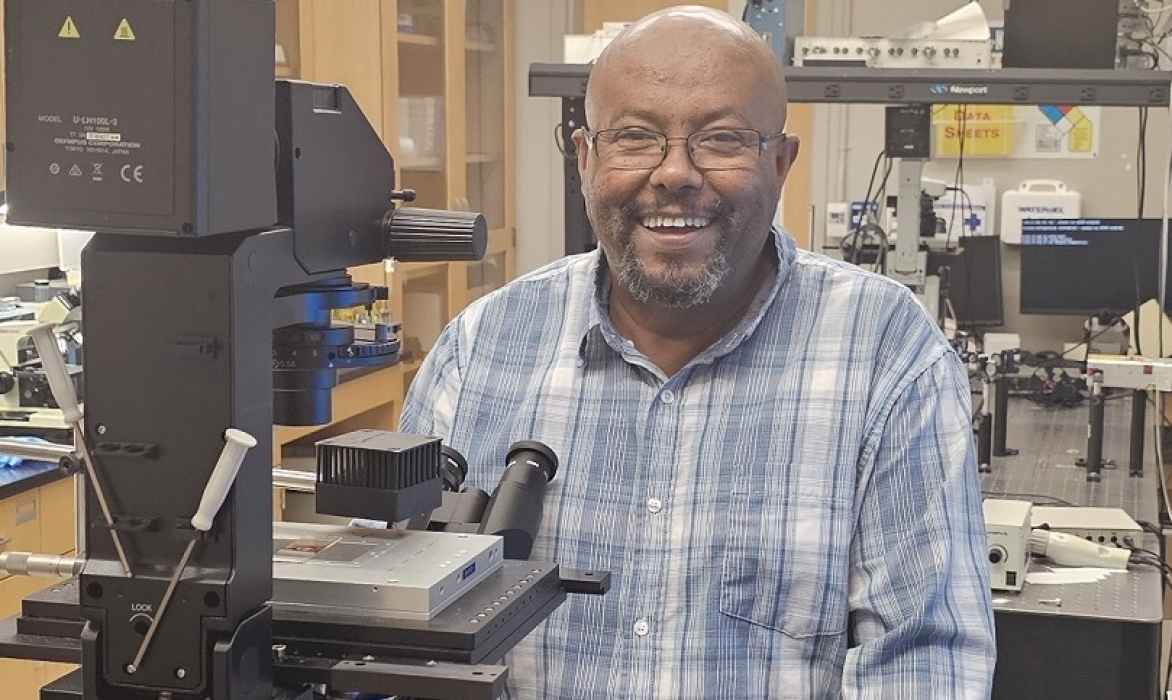
Dr. Daniel Bekele Erenso is a Professor in the Department of Physics and Astronomy at Middle Tennessee State University (MTSU), part of the College of Basic and Applied Sciences. He holds a PhD from the University of Arkansas (2003), an MS from the University of Arkansas (2002) and Addis Ababa University (1997), and a BS from Addis Ababa University (1990). His research focuses on Quantum Information , including quantum teleportation and entangled photon pairs; Experimental Biophysics , such as erythrocyte mechanics and gene therapy efficacy measurement using optical tweezers; and Synthetic Photonics Crystals for novel optical/electrical properties. He also explores Computational Biophysics involving membrane peptide simulations. Recent work emphasizes optical tweezers for erythrocyte deformation studies, quantum teleportation fidelity via entangled photons, and parametric down-conversion optimization. His presentations span topics like shear stress effects on blood cells, squeezed vacuum interactions in quantum dots, and photonic crystal design. Awards: CBAS Distinguished Research Award (2016), Fulbright Award (2016), Excellence in Teaching Award (2011) Grants: MTSU Foundation Creative Projects Award (2008), Sigma Xi Research Awards Dr. Erenso teaches courses ranging from introductory physics to advanced theoretical physics, including mathematical methods, classical mechanics, quantum mechanics, and general relativity. He has advised numerous undergraduate and graduate researchers through MTSU’s Scholars Week and national conferences.
Viridiane Fay is a researcher in the Institute of Modern Languages and Romance Studies at the University of Würzburg , specializing in French language practice and applied computational methods. During lecture periods, she holds office hours every Tuesday from 1 p.m. to 2 p.m., with appointments available during semester breaks. Role: French Editor, Language Practice Location: Am Hubland, 97074 Würzburg Contact: viridiane.fay@uni-wuerzburg.de Her research spans two distinct domains: French language pedagogy and computer vision/AI . While her institutional affiliation focuses on Romance Studies, her publication record reveals expertise in: Medical and underwater image processing Transformer-based architectures Federated learning and network optimization Watermarking and security algorithms Multi-modal AI applications Neuroscience signal analysis Recent work includes lightweight segmentation models (e.g., ContextFormer), drone/aerial imagery detection frameworks (CH-YOLO-Lite), and privacy-preserving AI systems (Find). Despite limited biographical details in the scrape, her 30+ publications since 2017 suggest significant technical contributions.
Luca Spolaor is an Assistant Professor at the University of California, San Diego . His research focuses on geometric measure theory, free boundary problems, and the regularity theory of minimal surfaces and varifolds. He works on topics including modulo p minimization, epiperimetric inequalities, and the structure of singular sets in geometric variational problems. Spolaor's work integrates advanced techniques from geometric analysis, partial differential equations, and calculus of variations. He has contributed to understanding the fine properties of solutions to free boundary problems, particularly in two-dimensional settings, and has developed novel methods for analyzing singularities in minimal surfaces and semicalibrated currents. His recent research includes studies on the regularity of area-minimizing hypersurfaces modulo p, logarithmic epiperimetric inequalities for obstacle problems, and the uniqueness of tangent cones in geometric free-boundary problems. He collaborates with leading mathematicians such as Camillo De Lellis, Max Engelstein, and Bozhidar Velichkov. Spolaor actively participates in academic events, organizing conferences on geometric measure theory and calculus of variations. His work is published in top journals like Inventiones mathematicae , Communications on Pure and Applied Mathematics , and Calculus of Variations and PDEs .
David Tewodrose is a Junior Professor in the Department of Mathematics and Data Science at the Vrije Universiteit Brussel (Belgium). His research focuses on geometric analysis, particularly metric measure spaces arising as Gromov-Hausdorff limits of Riemannian manifolds. His work involves studying Ricci curvature bounds, Sobolev inequalities, and spectral embeddings with applications in data analysis. Key research areas include geometric flows, stability of manifolds under curvature conditions, and functional inequalities in non-smooth settings. His recent publications explore topics such as Kato bounds on Ricci curvature, asymptotic Laplacian operators, and heat kernel behavior in metric measure spaces. He organizes academic events, such as the 2025 Workshop on Geometric Flows and Quantization of Kähler Metrics. Contact: David.Tewodrose@vub.be | Office: G.6.15.
Mircea Petrache is an Assistant Professor at the Department of Mathematics, Pontifical Catholic University of Chile. His research focuses on geometric deep learning, compositional learning, optimal transport, calculus of variations, and geometric measure theory, with applications to large point configurations and mathematical analysis. He holds a PhD in Mathematics from ETH Zürich (2013) and an MSc from Scuola Normale Superiore (2008). Education: PhD in Mathematics, ETH Zürich, 2013 MSc in Mathematics, Scuola Normale Superiore, 2008 Research Interests: Petrache explores the interplay between geometric principles and machine learning, particularly in equivariant networks and compositional systems. His work on optimal transport and calculus of variations addresses energy minimization and crystallization problems in materials science. Recent projects include symmetry-based structured matrices and topological pseudodistances for data analysis. Grants: Fondecyt Regular Grant (2021–2025) on rigidity and uniformity in large point configurations. Events & Organization: Co-organized workshops such as 'Theoretical and Mathematical Aspects of Deep Learning' (2022) and 'Calculus of Variations: A New Generation' (2024). Active in conferences including NeurIPS, ICIAM, and AIM workshops on discrete geometry.
Fernando de Juan Sanz is an Ikerbasque Research Professor at the Donostia International Physics Center (DIPC) in Spain. His work focuses on topological matter , quantum condensed matter physics , and correlated electron systems , with particular attention to two-dimensional materials and nonlinear optical phenomena. He holds a Ph.D. from Universidad Autónoma de Madrid and has held prestigious fellowships including a Marie Curie Fellowship at Oxford University and a Junior Research Fellowship at Somerville College. His research group investigates topological phases, symmetry-driven phenomena, and electronic correlations using theoretical and computational approaches. Key contributions include studies on chiral semimetals (e.g., CoSi), photogalvanic effects, and multipole theories in crystals. He has advised multiple graduate students, including Óscar Pozo (PhD, now at CFM), Irián Sánchez Ramírez (PhD candidate), and Daniel Muñoz Segovia (FPU Fellow). Awards : Spanish Royal Physical Society 'Investigador novel en física teórica', Marie Curie Fellowship Previous Affiliations : University of California Berkeley, Indiana University, Oxford University Current projects explore twisted heterostructures, anisotropic phase transitions, and topological quantization in novel materials. His work bridges theoretical insights with experimental collaborations, as seen in studies with the Wu Lab (U. Penn) on CoSi's photogalvanic effects.
Hong Ye Tan is currently a Hedrick Assistant Adjunct Professor in Computational and Applied Mathematics at the University of California, Los Angeles (UCLA), hosted by Professor Stanley Osher. Previously, he completed his PhD at the University of Cambridge's Department of Applied Mathematics and Theoretical Physics as a member of the Cambridge Image Analysis group and the Cantab Capital Institute for the Mathematics of Information, supervised by Professors Carola-Bibiane Schönlieb, Subhadip Mukherjee, and Junqi Tang with funding from GSK.ai. His educational trajectory is exceptional: admitted to the University of Hong Kong at age 11 in 2015 (youngest in recent history) and to Cambridge at age 13 for doctoral studies. He passed his PhD thesis with no corrections, focusing on provably convergent algorithms leveraging geometric structures in data. Tan's research centers on machine learning theory, specifically investigating why learning succeeds through interactions between problem structure, data distributions, optimizers, and network architectures. His work bridges differential geometry (manifold hypothesis, intrinsic complexity), optimization (convex learning-to-optimize, Plug-and-Play inverse problems), and sampling theory (noise-free MCMC methods). He develops theoretically grounded algorithms with practical applications in imaging and unsupervised learning, emphasizing provable convergence guarantees derived from classical mathematics. Analysis of his 13 recent publications reveals a cohesive research program connecting optimal transport theory, manifold learning, and regularization techniques. His work demonstrates how geometric insights enable efficient solutions for high-dimensional problems, particularly in image analysis where dimensionality effects transform from curse to blessing. Key themes include Wasserstein proximal methods, dataset distillation via quantization, and accelerating mirror descent through equivariance. His scientific recognition includes: Masason Foundation Fellowship GSK.ai PhD Fellowship Tan has secured research funding through the GSK.ai PhD studentship and operates within Professor Stanley Osher's group at UCLA. He maintains active collaborations from his Cambridge tenure, particularly with the Cambridge Image Analysis group. Notably, he handles 100% of coding and 98% of writing for first-author publications, actively encouraging code reuse by the community. His work continues to explore foundational questions in learning theory while developing practical tools for inverse problems and imaging science.