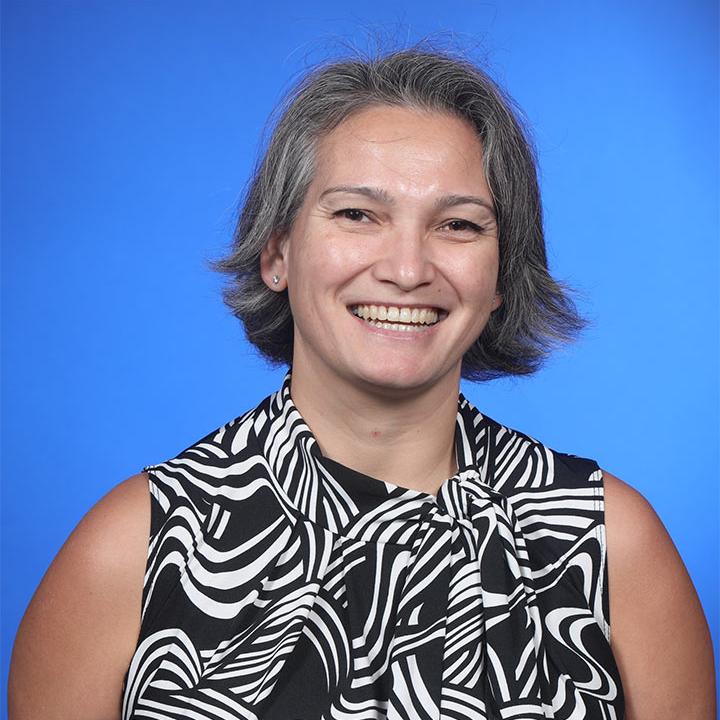
Julia Nomee is a Clinical Assistant Professor at the Seidenberg School of Computer Science and Information Systems at Pace University, specializing in Information Technology. She has been teaching courses related to computing fundamentals, web development, and socially responsible technology applications since at least 2003. Education: MS in Information Systems (2003) from Pace University, BS in Business Administration (1999) from the University of Connecticut Contact: jnomee@pace.edu | Office: 15 Beekman Street, NYC | Office Hours: Mon, Wed 12:00pm-1:30pm Her teaching focuses on foundational computing skills for non-technical audiences, with courses like: CIS 101 variants covering computing fundamentals and social responsibility CIS 102: Topics in intergenerational computing and web design for non-profits CIT 201: Introduction to programming using Python TS 105: Computers for human empowerment
Michael F. Herbst is a tenure-track Assistant Professor at the Swiss Federal Institute of Technology Lausanne (EPFL) with joint appointments in Mathematics and Materials Science. He leads the Mathematics for Materials Modelling (MatMat) research group, focusing on algorithm development for quantum-chemical simulations of solids and error control in computational modeling. His work bridges mathematics, solid-state physics, and computer science through interdisciplinary research. His research interests include: Density-functional theory (DFT) and Kohn-Sham equations Error propagation in materials property predictions High-throughput screening algorithms Julia programming for scientific computing Tensor networks and reduced basis modeling Self-consistent field convergence methods Recent publications highlight his contributions to: Efficient response property calculations in DFT Rotationally equivariant machine learning operators GPU-accelerated electronic structure methods Polarizable continuum solvation models Robust black-box quantum chemistry algorithms Open-source software development Teaching activities span mathematics, computer science, and chemistry curricula, including interdisciplinary workshops on electronic structure numerics and Julia programming for materials science. He has mentored PhD students Bruno Ploumhans and Niklas Frederik Schmitz.
Serguei Maliar is an Associate Professor of Economics at Santa Clara University's Leavey School of Business. He joined in 2013 and is affiliated with the Department of Economics, serving as an associate editor of the Journal of Economic Dynamics and Control . His research focuses on computational economics, macroeconomic theory, numerical methods, and policy analysis. He advises the Canadian Central Bank on optimal monetary policy models and holds a NSF grant (2016-2019). Education: B.S. in Physics and Applied Mathematics (Moscow Institute of Physics and Technology), M.A. in Economics (Central European University), Ph.D. in Applied Mathematics (Zaporozhye State University), and Ph.D. in Economics (University of Pompeu Fabra). Research Interests: His work bridges macroeconomic theory with computational techniques, emphasizing applications like deep learning for policy modeling, capital-skill dynamics, and nonlinear economic systems. Recent projects include analyzing cross-border economic spillovers and evaluating software tools (e.g., Python vs. Julia) for economic computing. Publications: Over 30 peer-reviewed articles in top journals such as Econometrica and Quantitative Economics , focusing on numerical methods, policy modeling, and economic inequality. His work often combines theoretical rigor with practical computational frameworks. Grants & Awards: NSF grant (2016-2019), contributions to the Handbook of Computational Economics , and collaborations with institutions like the Bank of Canada and Stanford University's Hoover Institution. Labs/Teams: Engaged with interdisciplinary teams in computational economics and policy analysis.
Professor Mingsheng Ying (University of Technology Sydney) is a Distinguished Professor specializing in quantum programming , quantum verification , and the foundations of artificial intelligence . He leads the Centre for Quantum Software and Information and co-founded the Quantum Lab . His work bridges quantum computation with formal methods and reasoning under uncertainty. Education : Mathematics, Fuzhou Teachers College (1981) Research Interests His research spans: Quantum programming languages and verification techniques Model checking quantum systems and cryptographic protocols Quantum machine learning robustness Entanglement theory and distributed quantum computation Recent Publications Key contributions include: Quantum error correction verification frameworks Quantum register machine architecture Hamiltonian simulation parallelization Symbolic execution for quantum debugging Robustness tools like VeriQR Awards & Editorial Roles NSF China Distinguished Young Scholar Award (1997) China National Science Award (2008) Co-Editor-in-Chief, ACM Transactions on Quantum Computing Vice President, International Fuzzy Systems Association (2005) Leadership & Grants He oversees 14 active grants (2010–2029) from: Australian Research Council (ARC Discovery Projects) National Natural Science Foundation of China Sydney Quantum Academy Baidu Contract Research His grants fund research in quantum program verification, entanglement classification, and distributed quantum protocols.
Alan Edelman is a Professor of Applied Mathematics at the Massachusetts Institute of Technology (MIT) and a Principal Investigator at the MIT Computer Science and Artificial Intelligence Laboratory (CSAIL). He leads the MIT Julia Lab and serves as chief scientist at Julia Computing. Edelman received his BS and MS from Yale University and PhD from MIT in 1989 under Lloyd N. Trefethen. His research spans high-performance computing, numerical computation, linear algebra, random matrix theory, and scientific machine learning. Edelman is particularly known for his work on the geometry of algorithms with orthogonality constraints, the generalized singular value decomposition, and applications of Lie algebra to matrix factorizations. His computational thinking class has gained worldwide recognition for its unique integration of computer science, mathematics, science, and engineering. Edelman has received numerous prestigious awards including the Chauvenet Prize (1998), IEEE Computer Society Charles Babbage Award (2015), IEEE Sidney Fernbach Award (2019), and the James H. Wilkinson Prize for Numerical Software. He is a fellow of ACM, SIAM, AMS, and IEEE. ACM Fellow (2020) for contributions to algorithms and languages for numerical and scientific computing IEEE Fellow (2017) for contributions to the development of technical-computing languages AMS Fellow (2015) for contributions to random matrix theory, numerical linear algebra, high-performance algorithms, and applications SIAM Fellow (2011) for contributions in bringing together mathematics and industry Edelman founded Interactive Supercomputing in 2004 (later acquired by Microsoft) and co-created the Julia programming language with Jeff Bezanson, Stefan Karpinski, and Viral Shah. The language solved the long-standing two-language problem in computing, being as easy as Python and as fast as C. Julia is widely used at institutions including MIT, Stanford, BlackRock, US Federal Reserve, and NASA. His 2023 Amazon Research Award focused on Scientific Machine Learning with Application to Probabilistic Climate Forecasting and Sustainability. As leader of the MIT Julia Lab, Edelman supervises work on scientific machine learning and compiler methodologies. His research group has developed widely adopted tools used across academia and industry for solving large-scale scientific problems in fields ranging from finance to pharmaceuticals.
Gauthier Vermandel is a full-time researcher at École Polytechnique's Department of Applied Mathematics (CMAP) and holds a tenured Associate Professor position at Université Paris-Dauphine-PSL. He is affiliated with the Institut Polytechnique de Paris and serves as a research fellow for the Stress-test Chair at Polytechnique. Vermandel is also a consultant for the Banque de France on climate change models through the DECAMS directorate and serves as President of DSGE-net, a non-profit organization supporting the Dynare project. His research interests focus on quantitative macroeconomics, climate change economics, and the development of economic modeling tools. Vermandel specializes in integrating climate considerations into macroeconomic frameworks, particularly through Dynamic Stochastic General Equilibrium (DSGE) models. His work explores social learning expectations, business cycle theory, and the economic impacts of carbon taxation policies. He has made significant contributions to the Dynare platform, extending its capabilities for climate economics and social learning applications. Vermandel's recent publications demonstrate a strong focus on the intersection of climate policy and financial markets, with particular attention to how carbon taxation affects economic stability. His research combines theoretical economic modeling with practical applications for policy makers, especially in the context of the European Union's green transition initiatives. EFA Prize in Responsible Finance (2021) Banque de France Young Researcher Prize in Green Finance (2023) Vermandel serves as program director of the Environmental Macro research group at the Institute for Macroeconomic and International Policies (i-MIP), hosted by PSE and CEPREMAP. He is a member of the Dynare Team working on implementing Dynare into Python/Julia environments and participates in the organization committee of the Quantitative Sustainable Finance (QSEF) seminar at CMAP–CREST. His former role as scientific advisor at France Stratégie (the French Prime Minister's research unit) provided him with direct policy experience that informs his academic work. Vermandel maintains active research laboratories through his leadership roles in DSGE-net and the Stress-test Chair, where his team develops advanced modeling techniques for assessing climate-related financial risks. His work bridges academic research with practical policy applications, particularly in the context of the European Central Bank's climate stress testing initiatives.
Arie Beresteanu is an Associate Professor and Associate Chair in the Department of Economics at the University of Pittsburgh. Previously, he was an Assistant Professor at Duke University. He holds a Ph.D. from Northwestern University and an undergraduate degree from the Hebrew University of Jerusalem (summa cum laude). His research focuses on micro-econometrics, partial identification in structural models, and applications to industrial organization and environmental economics. Notable contributions include work on observable consequences of incompleteness in economic behavior and methodologies for convex moment predictions. Education includes: Ph.D. in Economics, Northwestern University Bachelor's Degree, Hebrew University of Jerusalem (summa cum laude) Research interests emphasize econometric methods for identification and partial identification, nonparametric estimation, and discrete choice modeling. His work bridges theoretical econometrics with applied problems in industrial organization, environmental policy, and cost analysis in telecommunications. Recent advancements include contributions to Minkowski summation inverse operations and quantile regression with interval data. Teaching spans Ph.D. and undergraduate courses in econometrics and industrial organization. He developed a new data course for economics undergraduates. His coding projects include interactive econometric tools in Fortran, Julia, Python, and JavaScript, such as an OLS visualization app and a simulated annealing Sudoku solver. Athletic pursuits include running with notable personal records in 5K (19:58), Half Marathon (1:34:08), and Marathon (3:18:45). He maintains an extensive resource page on running strategies and training programs.
Prof. James Kermode is a Professor of Materials Modelling at the University of Warwick's School of Engineering, serving as Head of Research (Deputy Head of School). He leads the EPSRC Centre for Doctoral Training in Modelling of Heterogeneous Systems (HetSys) and the Warwick Centre for Predictive Modelling (WCPM). His research focuses on multiscale materials modelling, machine learning, and uncertainty quantification in atomistic simulations. Education: PhD in Theoretical Chemistry and Materials Modelling from the Cavendish Laboratory, University of Cambridge (2004-2007), with postdoctoral roles at King's College London and the University of Cambridge. Research Interests: Development of algorithms and software for multiscale modelling, particularly machine learning interatomic potentials, fracture mechanics, and parameter-free modelling of chemomechanical failure processes. Notable projects include QM-accurate dislocation simulations and the creation of data-driven silicon potentials. Grants and Leadership: Director of HetSys CDT since 2023, member of UKCP Consortium (2023-2026), and PI for multiple EPSRC grants. Supervised projects on radiation damage databases (ENTENTE) and hydrogen diffusion in alloys. Labs/Teams: Directs Warwick Centre for Predictive Modelling and contributes to software projects like libAtoms/QUIP and matscipy.
Louis Carillo is a PhD student at CERMICS, École des Ponts ParisTech, under the supervision of Tony Lelièvre, Urbain Vaes, and Gabriel Stoltz. His research focuses on metastability in statistical physics, particularly the Narrow Escape Problem , involving Brownian motion in bounded domains with small holes. Research Interests His work spans Statistical physics and mathematical modeling Numerical analysis of metastability phenomena Applications of computational methods to physics Machine learning (Hopfield networks) and quantum physics Publications & Conferences Louis has published two papers on arXiv, including Eigenvector Dreaming (2024) and Hard-disk computer simulations (2022). He has presented at workshops such as the Uncertainty Quantification in Molecular Simulation (2024) and the Synergies Between Mathematics, Data Science, and Molecular Simulations (2024). Teaching & Education Louis teaches advanced programming and physics at École des Ponts, covering topics like Python, Julia, and renewable energy physics. He holds a Master in Physics of Complex Systems (2024) and a Bachelor in Fundamental Physics (2021) from École Normale Supérieure, Paris-Saclay, and completed preparatory classes at Lycée Michel Montaigne, Bordeaux (2018–2020).
Gaétan Facchinetti is a FNRS postdoctoral researcher (Chargé de recherches FNRS) at the Theoretical Physics Department of the Faculty of Science, Free University of Brussels. His research focuses on dark matter phenomenology, exploring connections between particle physics models and cosmological/astrophysical observations. His academic background includes: Ph.D. in Theoretical Physics (2018-2021) from Laboratoire Univers et Particules de Montpellier and Université de Montpellier, France. Thesis: 'Analytical study of particle dark matter structuring on small scales and impact on dark matter searches.' Master's degree in Theoretical Physics (2017-2018) from Ecole Normale Supérieure de Paris, Ecole Normale Supérieure de Cachan, and Université Pierre et Marie Curie, France. Master's degree in Applied Mathematics (2015-2017) from Université Paris-Saclay, Ecole Normale Supérieure de Cachan, and Université Versailles Saint-Quentin-en-Yvelines, France. Bachelor's degree in Physics (2014-2015) from Ecole Normale Supérieure de Cachan and Université Pierre et Marie Curie, France. Dr. Facchinetti specializes in dark matter phenomenology, particularly examining how particle dark matter scenarios manifest in cosmological and astrophysical observations. His work focuses on using the 21cm line and cosmic microwave background as probes for exotic physics and dark matter models, including particles and primordial black holes. He has developed expertise in dark matter structuring properties and their observational consequences. Much of his research involves developing computational codes in C/C++, Python, and Julia to model complex physical phenomena. His publication record demonstrates a strong progression from fundamental theoretical work on dark matter structuring to increasingly sophisticated observational constraints. His recent work shows an expansion into 21cm cosmology as a complementary probe alongside traditional gamma-ray searches, indicating a maturing research program that addresses dark matter from multiple observational angles. Dr. Facchinetti has been actively involved in teaching throughout his career: Tutorials of general physics for 1st year bachelor students at Université de Montpellier (2018) Lectures of optics for 2nd year bachelor students at Université de Montpellier (2019) Tutorials of electromagnetism for 2nd year bachelor students at Université libre de Bruxelles (2021) Tutorials of quantum field theory for 1st year master students at Université libre de Bruxelles (2022-2024) Lecture on dark matter theory at BND graduate school (2024) As an FNRS postdoctoral researcher, Dr. Facchinetti holds competitive funding from the Belgian National Fund for Scientific Research. He has organized seminars at ULB (2022-2024) and previously served on the laboratory administrative board at Laboratoire Univers et Particules de Montpellier (2019-2020). His technical expertise includes programming in C/C++, Python, Julia, Fortran90, CUDA, OpenMPI, OpenMP, Mathematica, and Matlab.
Rafael Bailo is an Assistant Professor of Mathematics at the Eindhoven University of Technology , affiliated with the Centre for Analysis, Scientific Computing and Applications . His primary research focuses on the numerical analysis of kinetic equations and partial differential equations (PDEs), with additional interests in collective dynamics, self-organization, and agent-based modeling. He teaches courses such as Advanced Calculus I and Continuous Optimization . Department: Mathematics and Computer Science His research explores computational methods for complex systems, including uncertainty quantification in kinetic models, pedestrian dynamics with congestion effects, and consensus-based particle methods. Recent work emphasizes the development of numerical schemes for fractional diffusion, plasma physics simulations, and aggregation-diffusion equations. He collaborates internationally on topics like particle-in-cell methods and software tools for interacting particle systems (e.g., the CBX package). Key trends in his publications include advancing finite-volume schemes for nonlinear PDEs, analyzing structural properties of kinetic equations, and bridging theoretical analysis with computational implementation. His work often addresses challenges in preserving physical properties (e.g., positivity, energy dissipation) in numerical solutions. Bailo advises students on topics related to PDEs and computational methods but specific supervisee names are not listed. His contributions span applied mathematics, computational physics, and interdisciplinary modeling, with applications in plasma dynamics, crowd movement, and materials science.
Tyler Ransom is an Associate Professor of Economics at the University of Oklahoma, affiliated with the Dodge Family College of Arts & Sciences. He is also a Research Fellow at the Institute for the Study of Labor (IZA) and a Fellow at the Global Labor Organization (GLO). He holds a PhD in Economics from Duke University (2015), specializing in dynamic models of human capital accumulation. Education: PhD in Economics, Duke University (2015) His research focuses on labor economics, education economics, urban economics, and machine learning applications. Recent work examines college admissions, educational inequality, and human capital development. He teaches econometrics, data science, and economics of education at OU, directing the Economics BA/MA Program. His articles span topics like college attrition, admissions policies, migration economics, and wage returns to education. Technical expertise includes proficiency in multiple programming languages (Matlab, Stata, R, Julia, Python) and advanced Japanese proficiency with knowledge of Korean and German. Awards: 2022 Irene Rothbaum Outstanding Assistant Professor Award (OU Dodge College) Roles: Associate Editor of Annals of Economics and Statistics and Economics of Education Review His research has influenced policy discussions, appearing in outlets like The New York Times and The Economist .
Huaiyu (Mike) Duan is an Associate Professor in the Department of Physics & Astronomy at the University of New Mexico (UNM). He holds a PhD in Physics from the University of Minnesota, Minneapolis (2004). His research focuses on neutrino physics, particle astrophysics, and computational methods applied to extreme astrophysical environments like core-collapse supernovae and neutron star mergers. He leads the Neutrino and Compact Objects (NuCO) research group, supported by the U.S. Department of Energy's Nuclear Physics program and the National Energy Research Scientific Computing Center (NERSC). Education: PhD, Physics, University of Minnesota, 2004. Research Interests: Neutrino flavor mixing and its effects in dense astrophysical systems. Computational modeling of neutrino oscillations using C++, Python, and Julia. Quantum many-body systems in supernova and neutron star merger environments. Articles Trends: Recent work emphasizes coherent flavor oscillations, collisional instabilities, and equilibration processes in dense neutrino gases, with a focus on multidimensional simulations and high-performance computing techniques. Scientific Awards: None explicitly listed. Advising & Grants: Active in mentoring graduate and undergraduate students through the NuCO group, supported by DOE grants. Collaborates on open-source tools like NuGas and FOWDR for neutrino oscillation analysis. Labs/Teams: Leads the NuCO group, which integrates particle physics, astrophysics, and computational science to study neutrino-driven phenomena in compact objects.
Julien Pascal, PhD, is a Researcher at the Central Bank of Luxembourg. He holds a PhD in Economics from Sciences Po (2020), a Master's in Economics from Sciences Po (2016), a Bachelor of Mathematics from UPMC Sorbonne Universités (2015), and a Bachelor of Social Sciences from Sciences Po (2013). His research focuses on Labor Economics, Macroeconomics, Urban Economics, and computational methods like dynamic programming and neural networks applied to economic modeling. Notable projects include analyzing heterogeneity in macroeconomic models and exploring commuting costs' impact on employment dynamics. He has taught graduate courses such as Econometrics II, Applied Statistics for Business and Economics, and Introduction to Econometrics and Statistics. His technical expertise includes Julia, R, Stata, Python, and SQL. He contributed to open-source projects like MSM.jl and SMM.jl , focusing on economic model estimation and optimization.
Christian Düben is a Research Fellow at Monash University , conducting interdisciplinary research at the intersection of economic geography , urban economics , and economic history . His work investigates the long-term evolution of urban landscapes, focusing on their determinants and contemporary economic impacts, while integrating methods from remote sensing, machine learning, and graph theory. He specializes in developing scientific software to support economic research, including R packages like conleyreg (Conley Standard Errors), spaths (shortest paths computation), and cppcontainers (C++-R integration). Previously, he contributed to the CollEc platform at the University of Hamburg and created the LearnEconometrics teaching platform at Helmut Schmidt University. Düben’s methodological expertise extends to programming in R, C++, Python, and Julia. He launched a blog in 2025 to communicate economic insights in accessible language and welcomes collaborations on data-driven research projects.