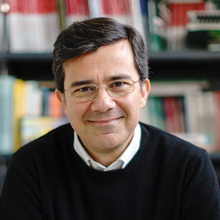
Marc Toussaint is Full Professor leading the Learning & Intelligent Systems Lab at TU Berlin's EECS Faculty. His research integrates machine learning, optimization, and AI reasoning to solve fundamental robotics problems like physical reasoning and human-robot interaction. He holds a physics diploma from University of Cologne and PhD from Ruhr-Universität Bochum. Key research themes include: Task-motion planning integration Reinforcement learning for robotics Physical simulation and control Probabilistic inference methods Recent publications focus on efficient kinodynamic planning, belief space planning under uncertainty, and neural policy learning. He develops open-source robotic tools like the 'robotic python package' used in academic courses worldwide. Toussaint collaborates with Amazon Robotics and MIT CSAIL, and has held positions at Max Planck Institute and University of Stuttgart.
Affiliations and Roles Michael Bronstein is a Professor at the Università della Svizzera italiana (USI) in the Faculty of Informatics and the Institute of Computational Science . He holds the Chair in Machine Learning and Pattern Recognition at Imperial College London and serves as Head of Graph Learning Research at Twitter . Previously, he was affiliated with the Dalle Molle Institute for Artificial Intelligence (IDSIA USI-SUPSI) as an Adjunct Professor. Education Ph.D. in Computer Science, Technion–Israel Institute of Technology (2007) Visiting appointments at Stanford University, MIT, Harvard University, and Tel Aviv University Research Interests Bronstein's work focuses on geometric deep learning , graph representation learning , and non-rigid shape analysis . He pioneered methods for extending machine learning to non-Euclidean domains like graphs and manifolds. His research combines theoretical advancements in spectral geometry with practical applications in computer vision, robotics, and medical imaging. Publications Trends His articles emphasize geometric deep learning frameworks, functional maps for shape correspondence, and spectral methods for manifold analysis. Key themes include invariant representations, partial shape matching, and applications in 3D reconstruction and graph neural networks. Awards and Honors Five ERC Grants Royal Society Wolfson Research Merit Award IEEE and IAPR Fellowships World Economic Forum Young Scientist Advising and Entrepreneurship Bronstein is a serial entrepreneur, founding companies like Novafora , Invision (acquired by Intel), and Fabula AI (acquired by Twitter). His academic advising spans PhD and Master’s students in machine learning and geometry processing. Labs and Teams Active in the Institute of Computational Science at USI and leads Twitter’s Graph Learning Research team, focusing on real-world applications of geometric deep learning.
Dr. Julian Hough is an Associate Professor of Human-Computer Interaction at Swansea University, affiliated with the School of Mathematics and Computer Science under the Faculty of Science and Engineering. His research focuses on improving human-agent interaction through Natural Language Processing (NLP) and AI, emphasizing ethical and quality outcomes in human-robot collaboration. His work spans Human-Robot Interaction (HRI), dialogue systems, and cognitive applications of speech technology. Notable projects include the FLUIDITY initiative exploring virtual reality platforms for HRI and the ARCIDUCA project annotating dialogue using conversational agents in games. He has secured significant grants, including a £587,000 EPSRC New Investigator Award for FLUIDITY and a £1.09M EPSRC grant for ARCIDUCA. Research interests include multimodal communication, disfluency analysis in dialogue, and applying LLMs to word sense disambiguation. His work often bridges computational linguistics with practical robotics and health technology, such as analyzing wearable sleep-tracker subjectivity and detecting Alzheimer’s through speech patterns. Collaborations span institutions globally, with contributions to workshops and conferences on HRI and dialogue systems. He actively supervises postgraduate research in areas like incremental intention recognition and computational law semantics.
Marco Maggini is a Full Professor in the Department of Information Engineering and Mathematics at the University of Siena, a position he has held since joining the university in 1996. His academic career spans over 25 years with foundational expertise in computer engineering and artificial intelligence, focusing on theoretical and applied machine learning research. His educational background includes: Laurea degree (cum laude) in Electronics Engineering from the University of Florence (1991) Ph.D. in Computer Engineering and Control Systems from the University of Florence (1995) Prof. Maggini's research encompasses machine learning, neural networks, kernel machines, and the integration of symbolic and sub-symbolic knowledge systems. He extends these foundations into practical applications including web mining, search engine technology, pattern recognition, natural language processing, and computer vision. This interdisciplinary approach bridges theoretical computer science with real-world implementation challenges across multiple domains. Analysis of his 15 most recent publications (2023-2025) reveals a dominant focus on multilingual NLP applications, particularly educational puzzle generation for low-resource languages (Italian, Arabic, Persian, Turkish) using LLMs. His work demonstrates consistent innovation in named entity recognition, commonsense reasoning evaluation, and cross-lingual adaptation techniques. Secondary research threads include medical imaging segmentation, molecular property prediction, and AI security vulnerabilities, reflecting his broad technical mastery across computer vision, bioinformatics, and adversarial machine learning. No specific scientific awards were mentioned in the provided documentation, though his editorial roles indicate peer recognition within the academic community. While student mentoring details are absent from the source material, his position as Full Professor and leadership of SAILab imply active graduate supervision. His extensive publication record (120+ papers) and editorial service suggest significant research grant involvement, though specific funding sources remain undocumented. He directs the Siena Artificial Intelligence Laboratory (SAILab), which serves as an interdisciplinary hub for advancing machine learning theory and applications. The lab's current projects emphasize educational technology, multilingual NLP systems, and the integration of symbolic reasoning with neural architectures, maintaining strong industry and international academic collaborations.
Dr. Raja Sooriamurthi is a Teaching Professor and Program Director of the Decision Analytics and Systems minor at the Information Systems Program of Carnegie Mellon University's Heinz College. His teaching and research focus on artificial intelligence, cognitive science, and educational pedagogy. Teaching Interests: Data science, database systems, big data, puzzle-based learning, system development lifecycle Research Interests: Case-based reasoning, knowledge management, distributed reasoning, machine learning, software development pedagogy Dr. Sooriamurthi leads curriculum innovation in information systems education, particularly through the IS2020 competency model . His work bridges AI applications with educational technologies, emphasizing authentic learning and generative AI tools for skill development. Key publication themes include: SQL instruction using AI-driven assessment Information systems curriculum design Puzzle-based learning for critical thinking Service-learning in leadership development Integration of NoSQL databases in education
Thorsten Koch is a Professor for Software and Algorithms for Discrete Optimization at Technische Universität Berlin , with multiple leadership roles including Head of the Applied Algorithmic Intelligence Methods (A²IM) , Digital Data and Information for Society, Science, and Culture (D²IS²C) , Kooperativer Bibliotheksverbund Berlin-Brandenburg (KOBV) , and Forschungs- und Kompetenzzentrum Digitalisierung Berlin (digiS) . Based at Zuse Institute Berlin and affiliated with TU Berlin's Institute for Mathematics, he focuses on integrating mathematical optimization with high-performance computing and artificial intelligence to solve complex real-world problems. Research Pillars : Mathematical optimization algorithms Quantum computing applications AI/ML integration in decision systems Energy systems optimization Scientific software development Leadership Roles : Head of Applied Algorithmic Intelligence Methods (A²IM) Head of Digital Data & Information for Society, Science, and Culture (D²IS²C) Head of Kooperativer Bibliotheksverbund Berlin-Brandenburg (KOBV) Head of Forschungs- und Kompetenzzentrum Digitalisierung Berlin (digiS) Key Collaborations : Working with IBM Quantum on quantum optimization Collaborating across institutions for energy system modeling Developing open-source optimization tools like SCIP Contributing to digital library infrastructure Recent Research Trends : Quantum optimization benchmarking Machine learning-aided optimization Multi-objective decision frameworks Energy infrastructure optimization Adaptive algorithm design CO2 network modeling Impact : Advancing hybrid optimization methods Developing open-source tools for scientific computing Building digital infrastructures for libraries and research Exploring quantum-classical algorithm synergies
Daniel Tauritz is a Professor in the Department of Computer Science and Software Engineering at Auburn University and serves as Director for National Laboratory Relationships. He holds a Ph.D. and M.S. in Computer Science from Leiden University, along with propaedeutic studies in Computer Science and Mathematics. His research focuses on AI-driven cybersecurity, automated algorithm design using hyper-heuristics, computational game theory, and evolutionary computation. Tauritz leads initiatives such as the Auburn Cyber Research Center and collaborates with institutions like Los Alamos National Laboratory on critical infrastructure protection and satellite network security. His work bridges academia and national security through projects like the Cyber Fire Puzzles competition and the Satellite Tycoon economic simulation game. His educational background includes advanced studies at Leiden University, with a strong foundation in computer science and mathematics. Research contributions span evolutionary algorithms for molecular evolution, coevolutionary defense strategies, and generative hyper-heuristics. Tauritz has secured grants including an NSF award for AI-cybersecurity education and contributed to Auburn’s partnerships with national laboratories. He is actively involved in fostering student engagement through ethical hacking clubs and experiential learning programs. Notable achievements include moderating panels on AI in cybersecurity and AI workforce development, as well as developing frameworks like Galaxy for network emulation and DCAFE for automated cyber experiments. His publications emphasize applying evolutionary computation to real-world challenges, including satellite constellation economics and adversarial network defense strategies.
António Augusto Gaspar Ribeiro serves as Professor at the Polytechnic Institute of Viseu's School of Education, where he has maintained continuous academic service since 1986, progressing from Assistant to current Professor Coordenador rank. His scholarly identity centers on Mathematics Education with specialized expertise in geometry pedagogy and educational technology integration across primary and teacher education contexts. His academic formation includes: Doctorate in Didactics of Mathematics (2005, University of Aveiro) Doctorate in Didactics (2005, University of Aveiro) Master's in Mathematics Teaching Methodology (1995, University of Lisbon) Licenciatura in Mathematics Teaching/Nature Sciences (1987, Polytechnic Institute of Viseu) Ribeiro's research program demonstrates sustained innovation in mathematics education, particularly through dynamic geometry environments like Cabri-Géomètre for primary classrooms. His work bridges theoretical frameworks with practical applications, examining teacher cognition, curriculum implementation challenges, and technology-enhanced learning. Recent scholarship shows expanded focus on interdisciplinary approaches in higher education and the pedagogical potential of humor in mathematics instruction. Analysis of his 25+ publications reveals evolving thematic trajectories: early work (2002-2006) established foundations in geometry education and technology integration; mid-career research (2009-2014) addressed curriculum reform and teacher development; current output (2017-2021) emphasizes interdisciplinary collaboration, early childhood mathematics, and socio-emotional dimensions of learning. His scientific recognition includes: 1º Concurso Nacional de Software Educacional - PUZZLE (1993) 1º Concurso Nacional de Software Educacional - JornalHist (1993) Ribeiro has supervised eight master's theses in Educational Sciences, primarily focusing on geometry education, technology integration, and teacher cognition. He leads the SmartCityKidsLab initiative (2019-present) and previously coordinated the PRINT interdisciplinary project (2017-2018) with Brazilian partners. His research portfolio includes four funded projects through the Center for Research in Education, Technologies and Health. As an institutional leader, he serves on the School of Education's Scientific Council and has held multiple governance roles including Pedagogical Council Secretary (1996-1998) and Vice-President of the School Board (2000-2002). His professional engagement extends to the Association of Mathematics Teachers and international collaborations with Brazilian institutions.
Matthias Becker is a Professor at the Institute for Practical Computer Science within the Faculty of Electrical Engineering and Computer Science at Leibniz University Hannover, where he has been a core member of the Human-Computer Interaction group since 2019. He serves as Internship Coordinator for Computer Science and Computer Engineering and holds key roles in the Computer Science Examination Board and Selection Committee, actively shaping academic governance and student development. His academic journey began with PhD studies at the University of Bremen (1996-2000) supported by a DFG grant, followed by a postdoctoral permanent position at Leibniz University Hannover (2000-2019), an Associated Assistant Professor role at École des Mines de Nantes (2000), and a Habilitation in Computer Science in 2013. This foundation enabled his transition to a full professorship in 2019. Becker's research spans Human-Computer Interaction, Simulation and Modeling, and Bio-inspired Computing, with applications in agriculture, renewable energy, and manufacturing. His work integrates distributed systems, optimization algorithms, and wireless sensor networks to solve complex real-world problems, such as greenhouse monitoring, wind farm logistics, and tire noise reduction. Recent publications reveal a strategic focus on practical validation of simulation models and cross-domain applications of nature-inspired algorithms. His 15 most recent publications (2018-2024) demonstrate consistent innovation in applying simulation techniques to offshore wind farm installation, agricultural pest management, and sports science. These works emphasize real-world validation, collaborative problem-solving, and the development of domain-specific optimization frameworks that bridge theoretical algorithms and industrial implementation. As Internship Coordinator, Becker facilitates critical industry-academia connections for students, while his examination board responsibilities ensure rigorous academic standards. His leadership in the Human-Computer Interaction group drives research on interactive systems for agriculture, energy, and health, with particular emphasis on user-centered design in complex operational environments like wind farm logistics and greenhouse automation.
Laura Bofferding is a Professor of Mathematics Education in the Department of Curriculum and Instruction at Purdue University's College of Education. Her career spans over a decade of progressive academic appointments, including Assistant Professor (2011-2017), Associate Professor (2017-2024), and current Professor (2024-present). She maintains active research and teaching roles focused on early mathematics cognition. Her educational background includes: Ph.D. in Curriculum Studies and Teacher Education from Stanford University (2011) M.A. in Learning, Design, and Technology in Education from Stanford University (2007) B.S. in Elementary Education from University of Wisconsin, River Falls (2002) Bofferding's research centers on cognitive development in early mathematics, particularly children's understanding of negative numbers, spatial reasoning through tangram puzzles, and the application of contrasting cases in instruction. Her work bridges theoretical cognitive science with practical classroom applications, emphasizing game-based learning and emergent bilingual education. Recent projects explore AI-generated word problems and programming debugging in elementary contexts, demonstrating her commitment to innovative pedagogical approaches. Her publication trends reveal sustained focus on integer conceptualization (2014-2023), expanding into spatial reasoning (2022-2023) and AI integration (2024). Key thematic clusters include measurement misconceptions, tangram-based shape transformation, and debugging strategies in computational thinking. Notable awards include: Purdue Faculty Engagement Scholar (2021) Purdue Faculty Scholar (2019) AMTE STaR Fellow (2012) Bofferding secures significant grant funding including an NSF CAREER award ($680,504) for integer understanding research and a Purdue Launch the Future Grant ($25,000) investigating AI-generated word problems. Her advising focuses on mathematics education doctoral students through courses like EDCI 62000 (Developing as a Mathematics Researcher), with grant collaborations spanning computational thinking (NSF ITEST) and emergent bilingual education (Purdue Small Research Grant).
Marcello Pelillo is a **Full Professor** at the Department of Environmental Sciences, Computer Science and Statistics at Ca' Foscari University of Venice. His research focuses on machine learning, pattern recognition, computer vision, and adversarial machine learning. He has contributed significantly to graph-based methods, clustering algorithms, and security in machine learning systems. Pelillo is affiliated with the European Center for Living Technology (ECLT) and the Research Institute for Complexity Communications . His work spans theoretical advancements in graph theory and practical applications in cultural heritage digitization, climate science (e.g., ice core analysis), and AI security. Recent projects include entropy-guided graph clustering, backdoor poisoning defenses, and benchmark datasets for puzzle-solving tasks. Publications emphasize interdisciplinary applications, such as AI-assisted historical document digitization and energy-latency attacks in networks. He has supervised multiple collaborative projects involving institutions like the Research Institute for Complexity and the European Interuniversity Research Center.
Tian Han is an Assistant Professor at the Department of Computer Science within the Charles V. Schaefer, Jr. School of Engineering and Science at Stevens Institute of Technology. His research focuses on artificial intelligence (AI) and machine learning, particularly in developing statistical learning methods for probabilistic models and building explainable, controllable AI systems. He holds a PhD in Statistics from UCLA (2019) and a degree in Computer Science from HKUST (2013). His research interests span unsupervised/semi-supervised learning, probabilistic generative modeling, explainable AI, and computer vision. Notable contributions include work on latent space energy-based models, hierarchical feature learning, and robust representation techniques. Han has served as an Area Chair/Senior Program Committee member at conferences like CVPR, NeurIPS, and AAAI. Education: PhD in Statistics, UCLA (2019) MSc/BS in Computer Science, HKUST (2013) His publications emphasize advancements in energy-based models, latent space hierarchies, and generative AI. Recent work includes enforcing sparsity in latent representations for robust AI systems (WACV 2024), molecule design via latent space modeling (UAI 2023), and context-aware health prediction (AAAI 2022). He received the NSF CAREER Award (2024) for his research. Han teaches courses on machine learning fundamentals, deep learning, and computing foundations at Stevens.
Dr. Niklas Schrape is a Researcher at Leuphana University of Lüneburg, specializing in digital media and interactive technologies. His work bridges game studies, simulation design, and media rhetoric, with a focus on how digital environments shape human experience. Research Focus: Schrape investigates gamification strategies, the epistemology of simulation, and rhetorical frameworks in digital media. His projects examine: Affective technologies and emotional self-regulation Validation mechanisms in simulation games Cultural histories of computational media Achievements: Awarded the Friedrich-Ebert-Stiftung Graduate Scholarship (2008) for his contributions to media research. Leads projects on emergent psychotechnologies and epistemic game design under the DFG-funded MECS initiative.
Patrik Voštinár is an Assistant Professor at the Department of Computer Science , Faculty of Natural Sciences , Matej Bel University . Holding a PhD in Applied Computer Science from the same university (2014-2017), he teaches courses in Programming , Discrete Mathematics , Web Technologies , and Android Programming . As department head and study advisor, he actively shapes academic programs and student experiences. Matej Bel University (2017-present) Department of Computer Science Faculty of Natural Sciences His research focuses on computer science education and educational technology , with particular emphasis on: VR/AR applications in teaching Game-based learning environments Microcontroller programming pedagogy Mobile application development education Physical computing tools for K-12 Adaptive learning interfaces His work with MakeCode , micro:bit , and EEG-controlled games demonstrates innovative approaches to programming education. He has received multiple eLearning competition awards for educational courseware development. Heart on the palm (Project of the year 2019) 2nd price in eLearning competition (2023) for Discrete Mathematics course Price of České společnosti pro systémovou integraci (2023) for Web Technologies 1st price in eLearning competition (2023) for Geometry Didactics Voštinár actively contributes to academic communities through: Membership in DIDINFO conference program (since 2017) Editorial Board member of Elementary Mathematics Education Journal Organizing workshops for primary/secondary students Popularizing informatics through extracurricular programs
Adele Goldberg is the Moses Taylor Pyne Professor of Psychology and Associate Chair at Princeton University. She leads the Psychology of Language Lab, where she conducts research on the usage-based constructionist approach to language, emphasizing emergent generalizations based on construction functions, input statistics, and domain-general cognitive processes. Dr. Goldberg's research spans construction grammar, language acquisition, metaphor processing, autism and language, neurolinguistics, and computational linguistics. Her groundbreaking work demonstrates that humans learn language through general cognitive processes rather than language-specific knowledge. She has shown that knowledge of language consists of form-function correspondences (constructions) and that conventional metaphors are more emotionally engaging than literal paraphrases, as evidenced by increased amygdala activation in fMRI studies. Her research on autism has revealed challenges faced by autistic individuals in language learning, particularly regarding flexible extension of word meanings and processing complex word meanings. She has extensively studied statistical preemption in language learning - how speakers learn to constrain generalizations based on the frequency of competing alternatives. Her work with Boyd demonstrated that younger children are less likely to generalize abstract constructions compared to older learners when exposed to the same input. Moses Taylor Pyne Professor of Psychology, Princeton University Associate Chair, Department of Psychology Director, Psychology of Language Lab Dr. Goldberg has mentored numerous students including Abby Fergus and collaborates extensively with researchers like Sammy Floyd, Arielle Belluck, and Karina Tachihara. Her recent work explores parallels between usage-based constructionist approaches and large language models, examining how both human and artificial systems learn from statistical patterns in language input.