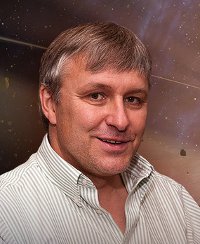
Prasanta Gorai is a Research Fellow at the Rosseland Center for Solar Physics , part of the University of Oslo . His work focuses on star formation and astrochemical modeling , particularly through observations using ALMA , SMA , and other radio telescopes. B.Sc (2012) , University of Burdwan M.Sc (2014) , University of Calcutta Ph.D (2020) , University of Calcutta His research explores the interstellar medium , carbon-chain chemistry , and astrochemical reaction networks , with projects involving ALMA-ATOMS and ALMA-QUARKS surveys. Recent publications examine dense molecular gas tracers , ethanolamine ice stability , and shock-induced star formation . Key collaborations include the Nordic Radio and Millimeter Astronomy Network (NoRMA) and the project ESGC: Tracing the impact of Evolved Stars on Galactic Chemical Enrichment . Awards include the CICO Postdoctoral Fellowship (2020-2023) and a postdoctoral position at the Institute of Theoretical Astrophysics (2024).
Giovanni Peres is a Professor at the Department of Physics and Chemistry, University of Palermo (UNIPA). His office is located at the University Observatory (Room No. 15, Piazza Parlamento 1), with office hours on Mondays and Tuesdays from 3:30 PM to 5:30 PM. His research spans astrophysics, focusing on supernova remnants, exoplanetary atmospheres, star formation, and stellar activity. His recent publications highlight trends in supernova remnant dynamics , exoplanet detection , and machine learning applications to astrophysical data. A recurring emphasis is on radiation transport , plasma interactions , and X-ray observations .
Karl Stapelfeldt is a Senior Research Scientist in the Astrophysics and Space Sciences Section at NASA's Jet Propulsion Laboratory (JPL), managed by the California Institute of Technology. He concurrently serves as Chief Scientist for the NASA Exoplanet Exploration Program since 2016, directing strategic development of exoplanet characterization missions. His 30-year career at JPL includes progressive leadership roles from Postdoctoral Fellow to Principal Scientist. His academic credentials include: PhD in Astrophysics with minor in Planetary Sciences, Caltech (1991) B.S.E. in Mechanical & Aerospace Engineering and Engineering Physics, Princeton University (1984) Dr. Stapelfeldt's research centers on observational studies of protoplanetary and debris disks as windows into planetary system formation. He pioneers coronagraphic techniques for direct exoplanet imaging and combines multiwavelength data (optical to mm-wave) with advanced modeling of circumstellar environments. His work bridges theoretical astrophysics and space mission design, with emphasis on instrumentation for future telescopes like HabEx and LUVOIR. Analysis of his 15 most recent publications reveals consistent focus on disk morphology and exoplanet detection. Early work characterized debris systems around stars like Fomalhaut using Hubble and Spitzer, while recent studies leverage ALMA for millimeter-wave disk imaging. His 2021 review established frameworks for next-generation exoplanet missions, demonstrating evolution from observational analysis to mission leadership. Key recognitions include: AAAS Newcomb Cleveland Award (2009) for optical imaging of exoplanets Muhlmann Award from Astronomical Society of the Pacific (2010) for Spitzer contributions As Chief Scientist, Dr. Stapelfeldt manages NASA's exoplanet technology portfolio, including grants for coronagraph development and starlight suppression. His mentorship occurs through JPL-Caltech collaborations, where he guides postdocs in mission studies and data analysis. Current projects emphasize technology maturation for direct imaging of Earth-like exoplanets. He leads the NASA Exoplanet Exploration Program team and contributes to international initiatives like the LBTI Exozodi Key Science Team. This collaborative environment integrates astrophysicists, optical engineers, and mission planners to advance instrumentation for characterizing exoplanetary systems.
Professor Peter Schilke is a distinguished astrophysicist at the University of Cologne's Institute of Physics I, where he has been faculty since March 2009. He serves as chair of the Bachelor of Science Examination Board and leads an active research group focused on high-mass star formation and astrochemistry. His work involves advanced observational techniques across multiple wavelengths and sophisticated modeling approaches. PhD from University of Bonn (1992) Research Fellow at Caltech (1992-1995) Postdoc at I. Physikalisches Institut (1995-1997) Scientist at Max-Planck-Institut for Radioastronomy (1997-2009) Professor Schilke's research focuses on the formation processes of high-mass stars, astrochemistry, and the evolution of molecular clouds. His work particularly emphasizes the modeling of observational data to understand physical and chemical processes in star-forming regions. He investigates how material is transported from large-scale molecular clouds to dense cores, how feedback mechanisms from newly-born stars affect this process, and how chemistry evolves from the diffuse interstellar medium to dense star-forming regions. His group has expanded studies to include clusters surrounding high-mass stars and extragalactic star formation in the Large Magellanic Cloud. Analysis of his recent publications reveals a strong focus on large-scale observational programs, particularly the ALMAGAL survey using ALMA to study high-mass protocluster formation across the Galaxy. His work combines observations from multiple facilities including ALMA, APEX, IRAM instruments, SOFIA, and SMA. The research spans both observational and computational approaches, with significant emphasis on developing software tools for data analysis and modeling. Albertus-Magnus teaching award in physics (2020) Professor Schilke actively mentors PhD students, with current advisees including Akash Gupta, Han-Tsung Lee, and Eleonore Rodrigues da Costa, among others. He has successfully supervised recent PhD graduates including Fanyi Meng, Mahya Sadaghiani, and Andreas Schwörer. His research is supported by multiple significant grants, including leadership of Project C3 in the SFB 956, involvement in projects A4 and A6, and participation in the ALMAGAL large program. He previously served as co-I of Herschel/HIFI and was involved in the HEXOS and CHESS key programs. His research group develops and maintains several important astronomical software packages including STATCONT for continuum level determination, MAGIX for model optimization, and XCLASS for spectral line analysis. The group actively participates in major observational campaigns using ALMA, planning for CCAT-prime, and analyzing data from previous missions like Herschel. They maintain strong collaborations with international partners through projects like the SFB 956 and various ALMA committees.
Thomas Robitaille is a Research Fellow at the Max Planck Institute for Astronomy (MPIA) in Heidelberg, Germany, where he leads the independent Max Planck Research Group focused on Star formation throughout the Milk-Way Galaxy within the Department of Planet and Star Formation. His research centers on astrophysical processes of star and planet formation across galactic environments, with emphasis on observational and theoretical modeling of molecular cloud dynamics, protostellar evolution, and planetary system genesis. Key methodologies include multi-wavelength observational analysis and computational simulations of interstellar medium physics. Dr. Robitaille directs the research group Star formation throughout the Milk-Way Galaxy , which operates as an autonomous unit within MPIA's Department of Planet and Star Formation, pursuing high-impact investigations into Milky Way star formation chronologies and spatial distributions.
Andras Zsom is a Researcher in the Department of Planet and Star Formation at the Max Planck Institute for Astronomy (MPIA) in Heidelberg, Germany. His work focuses on the physical and chemical processes governing the birth of stars and planetary systems within interstellar clouds. Research interests center on planet formation through dust coagulation and protoplanetary disk dynamics, and star formation mechanisms including molecular cloud collapse and protostellar evolution. His investigations utilize observational data from facilities like ALMA and theoretical modeling to understand how planetary systems emerge from circumstellar material. MPIA provides access to cutting-edge instrumentation and international collaborations through partnerships with ESO and space agencies. While specific advising details are unavailable, the institute hosts numerous PhD candidates in astrophysics through the International Max Planck Research School for Astronomy and Cosmic Physics.
Eric Stempels is a Researcher at Uppsala University's Department of Physics and Astronomy, specifically within the Astronomy and Space Physics section. His work focuses on astronomical instrumentation development and stellar astrophysics research, with significant contributions to major international projects including the Extremely Large Telescope (ELT) and its ANDES spectrograph, as well as the CRIRES+ instrument at the Very Large Telescope. Stempels' research interests center around high-resolution spectroscopy, stellar magnetic fields, T Tauri stars, and exoplanet characterization. His work bridges theoretical astrophysics with practical instrument development, particularly in creating advanced spectroscopic capabilities for ground-based observatories. He has made substantial contributions to understanding stellar accretion processes, stellar magnetic field topology, and the atmospheric properties of exoplanets through his instrumentation work and observational studies. His recent publications reveal a strong focus on next-generation astronomical instrumentation, particularly the ANDES spectrograph for the ELT, which represents the cutting edge of high-resolution spectroscopy capabilities. This work spans both the technical aspects of instrument design and the scientific applications for exoplanet research and stellar astrophysics. Stempels has maintained a long-standing collaboration with international research teams across European observatories and has contributed significantly to the development of astronomical databases like VALD (Vienna Atomic Line Database) and VAMDC (Virtual Atomic and Molecular Data Centre), which support spectroscopic analysis across the astronomical community.