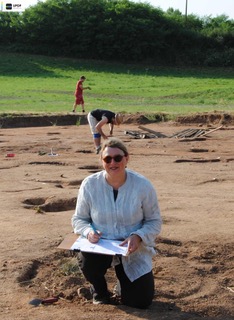
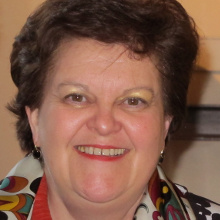
Elif BAŞTÜRK is an Associate Professor at Kırşehir Ahi Evran University's Faculty of Arts and Sciences, Department of Archaeology, specializing in Settlement Archaeology, Hittite studies, and Early Bronze Age ceramics. With a PhD from Ege University (2014), she has led excavations at Tanır Yassıhöyük since 2022 and participated in major projects across Anatolia. Education: PhD in Protohistory and Near Eastern Archaeology, Ege University (2014) MA in Protohistory and Near Eastern Archaeology, Ege University (2006) BA in Archaeology, Ege University (2003) Research Focus: Her work examines archaeological transitions in Anatolia and the Near East, particularly ceramic traditions, settlement patterns, and Assyrian influence during the Bronze and Iron Ages. She employs statistical and technological methods to analyze material culture. Projects: Notable projects include the Tanır Yassıhöyük excavations (2021–present), Assyrian trade influence studies in Afşin-Elbistan plain, and documentation of Early Bronze Age ceramics in Siirt Başur Höyük. She has also led regional surveys threatened by the Ilısu Dam. Publications: Recent outputs include 2025 studies on Iron Age ceramics and Assyrian mill technology, alongside excavation reports from 2016–2024. Her work bridges field archaeology with material analysis, contributing to understanding cultural dynamics in ancient Anatolia.
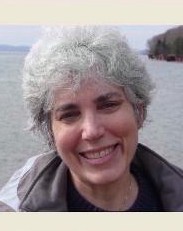
Wiebke Kirleis is Professor for Environmental Archaeology and Archaeobotany at the Institute for Pre- and Protohistory, Faculty of Arts and Humanities, Christian-Albrechts-Universität zu Kiel (CAU). She has held this position since May 2014 and was previously a junior professor at the same university from 2008 to 2014. She is actively involved in major interdisciplinary research projects, including the Cluster of Excellence ROOTS and the Collaborative Research Centre 1266 'Scales of Transformation', where she serves as co-speaker and technical platform speaker. PhD in Natural Sciences, University of Göttingen (2002) Diploma in Biology, University of Göttingen (1998) Studies in Botany, Anthropology, and Environmental History, University of Göttingen (1990–1998) Wiebke Kirleis' research centers on the interaction between humans and plants during the late Pleistocene and Holocene, with a focus on plant economy, domestication, agricultural development, and landscape transformation. Her work explores how wild and cultivated plants were used for nutrition, ritual, and technical purposes, and how agricultural innovations such as ploughing and manuring impacted Central European landscapes. She has a strong geographical focus on Northern and Central Germany, Southeastern Europe, the Near and Middle East, and Southeast and East Asia, particularly Indonesia. Her methodological expertise includes archaeobotany (analysis of charred and waterlogged plant remains), palynology (pollen and spore analysis from sediment cores), and anthracology (study of charcoal remains). Her recent research includes studies on broomcorn millet diffusion, early farming in Scandinavia and Russia, and plant use in Bronze Age settlements across Europe and Turkey. She leads and collaborates on numerous interdisciplinary projects, emphasizing the integration of botanical data into broader archaeological narratives. Her publications reflect a consistent trend in environmental archaeology, focusing on plant domestication, agricultural transitions, and human-induced landscape change. Keywords across her recent work include archaeobotany, palynology, Neolithic and Bronze Age subsistence, and environmental reconstruction. Her research spans subfields such as food security, cultural transmission of plant use, early monumentality, and socio-economic aspects of prehistoric agriculture. Board member, Cluster of Excellence ROOTS Co-speaker, CRC 1266 'Scales of Transformation' Speaker, ROOTS Technical Platform Board member, Johanna-Mestorf-Akademie Chair, Scientific Advisory Board, Dithmarschen Stone Age Park (since 2023) Full member, German Archaeological Institute (DAI) Elected member, Commission for Archaeology of Non-European Cultures (KAAK) Wiebke Kirleis has supervised numerous research projects funded by the DFG and other agencies, including the Graduate School 'Human Development in Landscapes'. She has advised students and collaborated internationally with institutions in Italy, Norway, Indonesia, and Australia. Her leadership roles in academic self-administration include serving on planning, budget, and equality committees at CAU Kiel. She is committed to science communication, having launched the digital exhibition 'Alles bleibt anders' and produced educational films on archaeobotany. She is also involved in mentoring female postdocs through the via:mento program. She leads the archaeobotanical component in the 'Superfood' module of the SFB 1266 digital exhibition and is actively involved in the ROOTS Cluster’s Subcluster 'Dietary ROOTS'. Her lab and research team operate within the Institute for Pre- and Protohistory, contributing to the university’s strong focus on interdisciplinary landscape archaeology.
Jens Kamlah serves as Professor of Biblical Archaeology and Director of the Institute of Biblical Archaeology at the University of Tübingen's Faculty of Protestant Theology. Appointed full Professor in 2018 and Pro-Dean since 2025, he concurrently chairs the German Palestine Association (DPV) since 2012 and leads the German-Lebanese Tell el-Burak excavation project since 2001. His academic journey began with studies in Protestant Theology, Ancient Oriental Studies, Egyptology, and Pre-Protohistory at Mainz and Tübingen (1983-1990). He earned his doctorate from Tübingen in 1999 with research on the Zeraqon Survey and completed his habilitation at Kiel University in 2005 on Phoenician and Israelite temple cults. Kamlah's research synthesizes archaeological evidence with biblical exegesis to reconstruct Levantine religious and social history. His work prioritizes Phoenician archaeology, temple studies, and the interplay between material culture and textual sources in ancient Israel. He examines how agricultural practices, trade networks, and urban development shaped religious institutions across the Iron Age Levant. His publication record (2006-2016) reveals consistent focus on Phoenician temple architecture, Middle Bronze Age chronology, and cross-cultural exchange. Key themes include Tell el-Burak's stratigraphy, Sidon's regional economy, and comparative analyses of Levantine sanctuaries. His approach integrates radiocarbon dating, surface survey methodology, and iconographic studies to address historiographical gaps. Kamlah directs multiple major research initiatives including SFB 1070 'ResourceCultures' (agriculture and exchange networks), the DFG Phoenician trade network, and the Encyclopedia of Material Culture of the Biblical World. His institutional leadership extends to the German Archaeologists' Association board (2006-2016) and Tübingen's Equal Opportunities Committee since 2019. As Director of the Institute since 2010, he oversees excavations at Tell el-Burak and coordinates international collaborations through the Institute for Cultures of the Ancient Orient (IANES). His team integrates German, Lebanese, and international scholars in multidisciplinary studies of Phoenician harbor cities and Bronze Age settlement patterns.
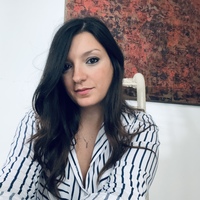
Jessica Keil is a Research Assistant and doctoral candidate at the Institute of Archaeology, University of Innsbruck. Her academic career spans multiple institutions across Germany and Austria, with a strong focus on prehistoric archaeology, particularly the Bronze Age of Central Europe. Education: Doctoral studies in Philosophy, dissertation area 'Archaeologies' (2017-present) at Leopold-Franzens-University Innsbruck Master's degree in 'Prehistoric Archaeology' with minors in 'Ancient History' and 'Near Eastern Archaeology' (2014-2016) from Philipps University of Marburg Bachelor's degree in Archaeological Sciences with minor in Ancient History (2010-2013) from Philipps University of Marburg Abitur (2010) from Ernst-Moritz-Arndt-Gymnasium Herzberg am Harz Keil's research centers on landscape, settlement, social and economic archaeology of the Neolithic and Metal Ages of Central Europe, with special emphasis on the inner-Alpine Bronze Age. Her work examines settlement patterns, copper production and distribution networks, and the socio-economic organization of Bronze Age communities in the Alpine region. She has conducted extensive fieldwork across Germany and Austria, particularly focusing on Tyrolean Bronze Age sites. Her scholarly output demonstrates consistent focus on Bronze Age settlements in North Tyrol, with particular attention to the Buchberg near Wiesing site. Her publications reveal a methodological approach combining traditional archaeological excavation with economic and quantitative analysis. Recent work shows increasing interest in adaptability and resilience of Metal Age societies, reflecting broader theoretical trends in archaeological research. Scientific Awards: ÖAW-DOC scholarship (2019-2022) Dr. Otto Seibert Paper Award for published version of the master's thesis (2018) Doctoral scholarship from University of Innsbruck's Young Researchers Program (2017-2018) Keil has been actively involved in significant research projects including the ÖAW-DOC project 'Settlement and copper supply in the Bronze Age of North Tyrol' and the TWF project 'The Buchberg near Wiesing (North Tyrol) in the Bronze Age.' She has participated in numerous academic conferences, presenting research on Bronze Age sites in North Tyrol, copper smelting, and slag-tempered pottery. Her collaborative work extends across European institutions, demonstrating strong international research connections. Her research activities include field excavations, prospections, and professional internships at multiple sites in Germany and Austria, including Altenburg-Niedenstein, Birgitz-Hohe Birga, Hollenstedt, Hungen, Milseburg, Neu-Anspach, Osterode am Harz, Schwiegershausen, Wetzlar-Dalheim, Wetzlar-Kalsmunt, and Wiesing-Buchberg.
Maria Dolors Molas Font is an Associate Professor of Ancient History at the University of Barcelona and a researcher at the ADHUC-Research Center of Theory, Gender and Sexuality . She co-founded and coordinates the Tàcita Muta research group on women and gender in antiquity since 1998. Her work bridges Mediterranean protohistory and gender studies in antiquity. University of Barcelona (since 1998) ADHUC Research Center (since 2016) Her research spans various subfields, including: Archaeology of Childhood Feminist Archaeology Gender Dynamics in Antiquity Iberian World Studies Classical Reception of Women Violence in Ancient Societies Article themes reveal expertise in: Homeric and Euripidean textual analysis Roman Republican settlement archaeology Slavery and power structures in antiquity Transgressive practices in classical myth Perinatal archaeology in Iberian contexts Gendered interpretations of oratory
Sophie Krausz is a Professor of European Protohistory at the University of Paris 1 Panthéon Sorbonne, School of Art History and Archaeology of the Sorbonne, specializing in Iron Age archaeology and Gallic societies. Previously, she served as a Lecturer at Bordeaux Montaigne University (2005–2021) and Director of Éditions Ausonius (2018–2021). Her academic journey includes a PhD (1992) and Habilitation (2014) from Paris 1-Panthéon Sorbonne. Her research focuses on fortifications, state emergence, and political systems in prehistoric and protohistoric Europe, with fieldwork spanning 91 excavations since 1986. Notable projects include Châteaumeillant, Vix, and Mont Beuvray. She leads the CNRS International Research Network NEMESIS, studying European Iron Age societies. Key contributions include over 70 published books and 121 invited lectures. Awards include the Chevalier de l'Ordre des Arts et des Lettres (2014) and Chevalier de l'Ordre national du Mérite (2017). She oversees archaeological sites, integrates paleoenvironmental studies, and collaborates on interdisciplinary projects like the GENETIX genetic study of Iron Age populations.
Dr Davide Salaris is a Marie Skłodowska-Curie European Fellow at the McDonald Institute for Archaeological Research, University of Cambridge (Department of Archaeology), funded by UKRI for 2024-2026. His work integrates material culture studies with computational, GIS and remote-sensing approaches to investigate long-term settlement dynamics, landscape management and cultural heritage in the Ancient Near East. Research Interests Salaris focuses on the archaeology of south-western and north-western Iran, especially the regions historically known as Elymais and Media Atropatene. Using GIS-based spatial analysis, remote sensing and geoarchaeological field techniques, he explores: Settlement patterns from the Bronze Age to the Sasanian period Fortified landscapes and territorial control Religious architecture and rock-reliefs of the Parthian era Cultural interactions between Iranian, Hellenistic and Mesopotamian worlds His recent projects include reassessments of Masjed-e Soleyman, Salmas Plain, Van Plain and Qara Żīāʾ-al-Dīn Plain, always foregrounding interdisciplinary digital methods. Scientific Awards Marie Skłodowska-Curie European Fellowship (2024-2026), funded by UKRI Grants & Advising As an MSCA Fellow, Salaris currently leads a UKRI-funded project examining landscape and power in pre-Islamic Iran. No doctoral or master’s students are explicitly mentioned in the provided materials. Laboratories & Teams He is formally affiliated with the McDonald Institute for Archaeological Research at Cambridge, whose state-of-the-art laboratories (GIS & Remote Sensing Laboratory, Geoarchaeology Laboratory, etc.) support his computational and environmental analyses.
Prof. Dr. Johannes Müller holds the Chair for Prehistoric Archaeology and directs the Institute of Pre- and Protohistory at Christian-Albrechts-Universität zu Kiel since 2004. His academic journey includes studies at Freiburg and Edinburgh, a habilitation at FU Berlin, and leadership roles in Bamberg. His research focuses on social archaeology, settlement patterns, and human-environment interactions in European prehistory, particularly the Neolithic and Bronze Age. Müller leads major projects like the DFG Collaborative Research Center 'Scales of Transformation' and the 'Human Development in Landscapes' Graduate School. His fieldwork spans Germany, Poland, Bosnia-Herzegovina, and Ukraine, with excavations at sites like Okoliste and Bruszczewo. He coordinates international initiatives like the Priority Program 'Early Monumentality and Social Differentiation.' Müller is a leading figure in computational archaeology, advancing predictive mapping and geophysical survey techniques. His work bridges archaeology with environmental and demographic sciences, emphasizing interdisciplinary collaboration. Education: PhD and habilitation in Prehistoric Archaeology (Freiburg and Berlin) DAI travel grant and academic roles at Freiburg, Cologne, and Bamberg Research Interests: Müller’s research integrates social archaeology with landscape and environmental studies to explore societal complexity and inequality. Key themes include: Neolithic monumental architecture (e.g., megalithic tombs, fortified settlements) Trypillia mega-sites and their socio-environmental dynamics Climate change impacts on prehistoric societies Computational methods for predictive mapping Collaborations: German Archaeological Institute (DAI) International teams in Poland, Bosnia-Herzegovina, and Ukraine Partnerships with institutions like Poznan University and the State Museum of Sarajevo Labs/Teams: He oversees the Institute’s fieldwork and laboratory facilities, including geophysical surveys and environmental analysis. His team employs cutting-edge techniques like geomagnetic imaging and isotopic dating to reconstruct ancient landscapes.
Lionel Pernet is a Lecturer in European Protohistory, specializing in the Iron Age and Roman periods, material culture, and funerary archaeology. He holds a doctoral degree from the Universities of Lausanne and Paris I Panthéon Sorbonne. Since 2015, he has served as Director of the Lausanne Cantonal Museum of Archaeology and History (MCAH), following roles at the National Museum of Zurich and the Montpellier Lattara Museum. His research explores acculturation processes, museum collections history, and anthropological perspectives on material culture. Dr. Pernet teaches Protohistoric courses (Iron Age) and supervises Bachelor and Master students. He is a member of several scientific societies, including the Swiss Archaeological Society and the French Association for the Study of the Iron Age. His 2014 Knight of Arts and Letters award recognizes his contributions to cultural heritage. Key research areas include Gallic auxiliaries, Roman necropoles, and Celtic monetary systems. He has curated exhibitions such as 'Les Celtes et la monnaie' and authored/co-authored over 60 publications, including works on Lattara, Giubiasco necropolis, and acculturation studies. His work bridges archaeology with contemporary art, as seen in exhibitions like 'Cosmos' celebrating the MCAH's bicentenary. Education: PhD in Archaeology (Lausanne & Paris I Panthéon Sorbonne) Affiliations: University of Lausanne, MCAH, Swiss Archaeological Society Awards: Chevalier des Arts et des Lettres (2014)
Marta Arzarello is an Associate Professor in Prehistory and Protohistory at the Department of Humanistic Studies, University of Ferrara (Italy). She serves as Deputy Director of the Department of Humanistic Studies and Coordinator of the Doctorate in Human Sciences and the International Master in Quaternary and Prehistory, both funded by Erasmus Mundus. She has coordinated numerous international projects (FP7, Erasmus Mundus, CNR-CNRST) and acted as EC expert since 2011. Director of over 60 Master’s and 21 PhD theses Director of excavations at Pirro Nord and Ciota Ciara Focus on Middle/Lower Palaeolithic technology, first European peopling, island colonization, and Sahara cultures Her recent publications (2025–2024) span archaeology , anthropology , and lithic technology , addressing topics such as: Neurocranial morphology of Palaeolithic remains Lithic analysis of Lower Palaeolithic sites Diet and subsistence strategies in Palaeolithic Italy Use-wear analysis for tool functionality Early human presence in Western Europe She received the Prix Prince Rainier III de Monaco (2018) for research at Pirro Nord. Her work integrates field campaigns, experimental archaeology, and museum curation to reconstruct human behavior and environmental interactions.
Giovanna Gambacurta is an Associate Professor at Ca' Foscari University of Venice, based in the Department of Humanities. She specializes in Pre-Roman Italian Civilization and Etruscology, focusing on archaeology, protohistory, and cultural interactions in ancient Veneto and the Po Delta region. Her research emphasizes funerary rituals, urbanization processes, and the application of digital technologies in archaeological studies. Key research areas include the study of Etrusco-Italic necropolises, Celticization processes, and the analysis of archaeological stratification. She has led projects such as the Visual Storytelling in the Early Iron Age and contributed to excavations like the Necropolis of_via Tiepolo/San Massimo in Padua. Her work bridges archaeology with social anthropology, exploring how material culture reflects social evolution and cultural dynamics. Gambacurta has authored over 267 publications, including monographs like I Celti e il Veneto and edited volumes such as As a Precious Gift . She serves on editorial boards for journals like Archeologia veneta and has reviewed international research projects. Her grants include the H2020-funded PROCON project on textile production in the Mediterranean. Her research extends to cultural heritage preservation, including the VALUE initiative in Ariano nel Polesine and the digitization of pre-Roman necropolises. She advises students on topics ranging from funerary archaeology to the iconography of situla art, contributing to both academic and public understanding of ancient Venetic culture.
Friederike Seyfried serves as an Honorary Professor at the Institute of Egyptology within the Department of History and Cultural Studies at Freie Universität Berlin since 2011. She has been the Director of the Egyptian Museum and Papyrus Collection at the State Museums of Berlin - Prussian Cultural Heritage Foundation since August 16, 2009. Her educational background includes: Earned her doctorate from Heidelberg University in 1991 with a dissertation on "The Theban Necropolis: On the Change of Tomb Concept from the 18th to the 20th Dynasty" (summa cum laude) Completed her Magistra Artium (M.A.) at Heidelberg University in 1986 with thesis "The Stelae of the New Kingdom in the Architectural Concept of Theban Private Tombs" (very good) Studied Egyptology, Prehistory and Protohistory, and Comparative Literature at Heidelberg and Vienna Universities (1980-1986) Friederike Seyfried's research focuses primarily on the archaeology of Ancient Egypt, with special emphasis on the New Kingdom period. Her work extensively covers the Amarna Period, tomb architecture and decoration of the New Kingdom, and innovative approaches to museum education, particularly for people with disabilities. Her scholarly contributions demonstrate a deep engagement with both archaeological fieldwork and museum curation, bridging academic research with public accessibility. She has led numerous excavations and research projects throughout her career, contributing significantly to our understanding of ancient Egyptian funerary practices and cultural history. Her publications reveal a consistent focus on Theban necropolis studies, Amarna period research, and museum curation. The trend shows her evolving from detailed archaeological studies of specific tombs and artifacts toward broader cultural interpretations and museum-based educational approaches, particularly evident in her later works focusing on accessibility for people with disabilities. Her notable awards and recognitions include: Alumna of the German Academic Scholarship Foundation Corresponding Member of the German Archaeological Institute Recipient of a Doctoral Scholarship from the German Academic Scholarship Foundation (1987-1991) Seyfried has led several significant third-party funded projects including "The Rock Tombs of Qubbet el-Hawa North" (DFG, 2017-2028), "Scientific Processing of Ludwig Borchardt's Amarna Excavations (1911-1914)" (2012-2014), and "Otto Rubensohn in Egypt - Forgotten Excavations" (2012-2014). Her work combines rigorous academic research with practical museum applications, demonstrating her commitment to making Egyptology accessible to broader audiences. As Director of the Egyptian Museum and Papyrus Collection in Berlin, she oversees one of the world's most significant collections of ancient Egyptian artifacts, including the famous bust of Nefertiti. Her leadership has focused on modernizing the museum's approach to both research and public engagement, with particular attention to making the collection accessible to visitors with disabilities.
Prof. Barbara Horejs holds dual roles as Deputy Executive Director of the Austrian Archaeological Institute (ÖAI) and Scientific Director of the Department of Prehistory & WANA-Archaeology at the Austrian Academy of Sciences (ÖAW). She leads research initiatives such as the 'Prehistoric Anatolia' and 'Madra River Delta' projects, focusing on Neolithic to Bronze Age archaeology across Southeast Europe and West Asia. Her work integrates fieldwork in Turkey, Greece, Iran, UAE, and the Balkans with cutting-edge scientific methods. Education: Studied Prehistory/Protohistory and Classical Archaeology at Universities of Vienna, Athens, and Berlin. Awarded summa cum laude from Freie Universität Berlin (2005). Holds honorary professorships at Universities of Tübingen (2015) and Vienna (2022). Served as Director of OREA (2013-2020) and Board Chair of ÖAW (2019-2021). Research Interests: Neolithisation processes, geoarchaeological surveys, material culture analysis, and interdisciplinary studies on ancient technologies. Excavates sites like Çukuriçi Höyük (Turkey), Svinjarička Čuka (Serbia), and Madra Delta (Turkey). Specializes in tracing long-distance networks through archaeological and genetic analyses. Publications highlight innovations in chert procurement, Bronze Age metallurgy, and gold trade networks. Recent work explores seasonal practices, early agricultural economies, and cross-regional connectivity in the 3rd millennium BC. Her ERC-funded projects bridge European and Anatolian archaeological datasets. Awards: FWF START Prize (2010), ERC Starting Grant (2011) Memberships: German Archaeological Institute (full member since 2020), Austrian Academy of Sciences (corresponding member since 2015) Advises international teams on field methodologies and heritage preservation, including the Puzzle in 4D digital reconstruction project at Tell el-Dabʿa (Egypt). Coordinates the Pusta Reka River investigations and the NEOSOL sediment analysis initiative.
Wendy R. Eisner is an Associate Professor in the Department of Geography at the University of Cincinnati, with affiliate appointments in the Environmental Studies Program and Department of Women's, Gender, and Sexuality Studies. She has held academic positions at multiple institutions including The Ohio State University, University of Alaska Anchorage, and University of Utrecht. Dr. Eisner serves as Editor of Polar Geography and as Graduate Program Director for the Department of Geography at the University of Cincinnati. Dr. Eisner earned her Doctor of Science in Geography from the University of Utrecht (1999), Doctorandus in Pre and Protohistory from the University of Amsterdam (1984), Kandidaats (M.A.) in Cultural Anthropology from the University of Leiden (1984), and Bachelor of Arts in Anthropology from Barnard College, Columbia University (1975). Her research focuses on Arctic system science, specifically examining paleoecology and paleoclimatology through the lens of both scientific and Indigenous knowledge systems. Dr. Eisner's work integrates traditional Iñupiat knowledge with Western scientific approaches to understand landscape evolution, climate change impacts, and human-environment interactions in the Arctic. Her research spans multiple disciplines including environmental science, geography, anthropology, and gender studies, with particular attention to how indigenous communities perceive and respond to environmental change. Dr. Eisner's recent publication portfolio demonstrates a strong emphasis on integrating Indigenous Knowledge with climate and geomorphic studies in Arctic Alaska, particularly through GIS applications and community-based research approaches. Her work increasingly focuses on documenting environmental, cultural, and social changes as observed by Iñupiat elders over their lifetimes, creating valuable cross-generational knowledge records. Best of Show, Baraga County Fair, Baraga Michigan Adult Embroidery blue ribbon (2010) Dr. Eisner has secured numerous significant research grants, primarily from the National Science Foundation, totaling over $2.5 million as Principal Investigator or Co-PI. Her major projects include "Connecting Indigenous Knowledge to Landscape Process Research" (NSF-BCS-0548846, $249,000), "Advanced End-to-End Cyberinfrastructure Installation" for the Barrow Global Climate Change Research Facility (ARC-0641623, $822,340), and "Changes in Lake Dynamics on the Arctic Coastal Plain" (ARC-0713813, $378,618). She has also served on the U.S. Civilian Research and Development Foundation panel for Geosciences. Dr. Eisner leads research teams focused on the Arctic Coastal Plain of Alaska, working collaboratively with Alaskan Native elders and communities. Her projects often involve interdisciplinary teams of geographers, environmental scientists, anthropologists, and indigenous knowledge holders to document landscape changes and develop integrated knowledge systems for understanding Arctic environmental dynamics.
Erica Platania is a Research Fellow in Prehistory and Protohistory at the University of Catania, Department of Humanities (DISUM). She specializes in zooarchaeology, focusing on animal resource exploitation, cultural landscapes, and pastoralism in Sicilian and Cretan prehistoric contexts. Her work integrates archaeological and textual data with digital methodologies. PhD in Cultural Heritage Studies (University of Catania, 2019) Master's in Archaeology (University of Catania-Warsaw) Bachelor's in Cultural Heritage Sciences (University of Catania) Her research centers on prehistoric architectural documentation, faunal remains analysis, and experimental archaeology, particularly in Minoan Crete and Bronze Age Sicily. Recent projects include CHANGES (EU-funded) and PIA.CE.RI. research groups. Key publication trends include zooarchaeology of Bronze Age communal spaces, bone processing techniques, and digital heritage management systems. She actively participates in international conferences like ScapeCon and the International Congress of Cretan Studies. 2023-present: Research Fellow, CHANGES - Spoke 6 (EU PNRR funding) 2024-present: Lecturer in Prehistory and Protohistory, DISUM 2024-present: Lecturer in Aegean Civilizations, DISUM Scientific awards include the Region of Sicily PO FSE 2014-2020 scholarship and a University of Catania Ateneo scholarship for international study at Warsaw University. She contributes to the editorial board of Creta Antica and collaborates with research teams in Italy, Belgium, and Poland.