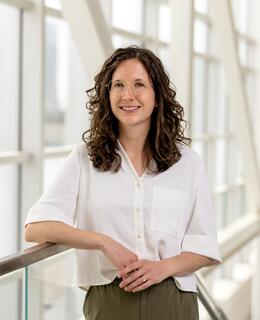
Emily Rogers-BradleyView profile
Assistant Professor
Dr. Emily Rogers-Bradley serves as an Assistant Professor at the University of Calgary's Schulich School of Engineering with dual appointments in the Department of Mechanical and Manufacturing Engineering and Department of Biomedical Engineering. She is also a Full Member of the McCaig Institute for Bone and Joint Health and a Child Health & Wellness Researcher at the Alberta Children's Hospital Research Institute. As director of the Adaptive Bionics Lab, Dr. Rogers-Bradley leads innovative research at the intersection of precision machine design, biomechanics, and robotics for medical applications. Her educational foundation includes: PhD in Mechanical Engineering from Massachusetts Institute of Technology (2023) SM in Mechanical Engineering from Massachusetts Institute of Technology (2019) SB in Biomedical Engineering from Harvard University (2015) Dr. Rogers-Bradley's research program focuses on three interconnected domains: Prosthesis Innovation: Developing robotic prosthetic devices with variable-stiffness mechanisms that adapt to walking speeds and terrains for people with lower limb amputations, significantly improving biomechanical outcomes Exoskeleton Development: Creating wearable orthotic devices that correct gait abnormalities and enhance performance for specialized activities including rock climbing and downhill walking Biomechanical Analysis: Conducting detailed studies of human gait to optimize device functionality and assess real-world impact on users Her publication trajectory reveals a strategic focus on adaptive wearable robotics, with recent work emphasizing variable-stiffness prostheses that improve walking biomechanics across speeds. Her research spans fundamental biomechanics to practical rehabilitation applications, with notable contributions to EMG-controlled prosthetics and specialized devices for extreme activities. She has also pioneered pediatric applications through wearable technologies for developmentally delayed infants. Dr. Rogers-Bradley's scholarly excellence is recognized through multiple prestigious awards: Best Paper Award Finalist, IEEE/ASME Transactions on Mechatronics (2025) Evolve to Innovate - Best Roadmap and Financial Plans, Hunter Hub for Entrepreneurial Thinking (2025) Early Career Research Excellence and Undergraduate Teaching Excellence, Schulich Excellence Awards (2024) National Science Foundation Graduate Research Fellowship (2017) As an academic leader, Dr. Rogers-Bradley serves as Associate Editor for IEEE Transactions on Neural Systems and Rehabilitation Engineering and the IEEE RAS/EMBS International Conference on Biomedical Robotics. She teaches Biomedical Engineering Foundations (BMEN 600) and Machine Component Design (ENME 493), while her research is supported through university strategic initiatives in Child Health and Wellness (2020-2025) and One Health (2020-2025). The Adaptive Bionics Lab, located in MEB223, operates as a multidisciplinary hub where mechanical engineers, computer scientists, and clinicians collaborate to develop next-generation assistive technologies. The lab's work integrates advanced materials, control systems, and biomechanical analysis to create devices that adapt to real-world environments, with ongoing projects spanning from adult mobility restoration to pediatric developmental support.